


Jesuit Higher Education Leaders Meet at Scranton


 The University of Scranton from Oct. 8-10 hosted 30-plus academic leaders from more than 20 Jesuit institutions at the 2026 Association of Jesuit Colleges and Universities College of Arts and Sciences Deans’ Network Meeting. The gathering included discussions, presentations and opportunities for networking and the exchange of ideas centered on issues affecting arts and science education. Pictured, front row, from left: Jeff Paris (University of San Francisco), Leonard Kahn (Loyola New Orleans), Erin Winterrowd (Regis University), Carolyn Barry (University of Scranton), Donna LaVoie (Saint Louis University), Laurie Russell (Saint Louis University), Jocelyn Boryczka (University of Detroit Mercy), Catherine Campbell (John Carroll University), Jeanne Darby (LeMoyne College), Daniel Press (Santa Clara University), Richard Fox (Loyola Marymount University). Middle row: Travis Newton (LeMoyne College), Michael Goldman (University of San Francisco), Heather Hathaway (Marquette University), Joseph Desciak (Boston College), Colby Lemieux (Fairfield University), Richard Greenwald (Fairfield University), Robert Hume (Fordham University), Jason Smith (Fairfield University), Frank Golom (Loyola University Maryland), Bahram Roughani (Loyola University Maryland), María Bullón-Fernández (Seattle University), Jack Lendvay (University of San Francisco). Top row: Jeffrey Dueck (St. Peter’s University), Rebecca Murray (Creighton University), Dan Marenda (University of Scranton), Aleksandra Snowden (Marquette University), Holly Ann Harris (Creighton University), Joshua Russell (Canisius University), James Carter (St. Joseph’s University), Greg Grobis (University of Detroit Mercy), Brian Gareau (Boston College), Theresa DiDonato (Loyola University Maryland), Kathleen Schneider (Santa Clara University).
The College of Arts and Sciences at The University of Scranton, led by Carolyn Barry, Ph.D., welcomed academic leaders from across the nation as it hosted the three-day 2026 Association of Jesuit Colleges and Universities College of Arts and Sciences Deans’ Network Meeting.
From Thursday, Oct. 8 through Saturday, Oct. 10, 35 deans, associate deans and other academic leaders, representing 21 Jesuit institutions, participated in their annual network gathering.
Sessions explored career readiness and the future of liberal arts, faculty issues, artificial intelligence, student retention, fiscal challenges and advancement, as well as the Jesuit mission and how it may guide decisions affecting students, faculty and institutions.
Rev. Joseph McShane, S.J. H’04, a former president of The University of Scranton and Fordham University and current Superior for the Scranton Jesuit Community, spoke to the delegation on Thursday evening.
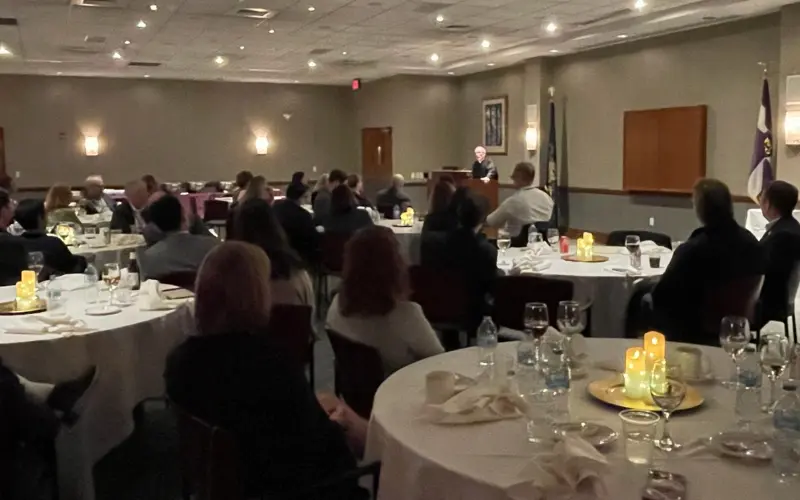
Father McShane spoke about Jesuit institutions’ commitment to “bothered excellence,” as he termed it, a calling to pursue world-embracing spirituality and living “For the Greater Glory of God” even as it challenges students to live lives filled with “a taxing but energizing restlessness.”
“This restlessness ensures that our education is anything but dull, complacent or smug. Rather, it was, by design, always on edge, always on the lookout for new challenges, always on the verge of discovery,” he said. “But how can this be? Easy. Exhausting but easy, at least in formulation. You see, Jesuit education believes so strongly in the transcendent power of a well-framed question that it places questions at the center of its pedagogy, the pedagogy of ‘bothered excellence.’ In our schools, our students are exposed to this without even knowing it. In our schools, our students experience the pedagogy of ‘bothered excellence’ as something of an intellectual chain reaction: wonder gives rise to curiosity, curiosity gives rise to questioning, questioning gives rise to exploration, exploration leads to discovery, which once again sparks curiosity that leads to even more questioning.
“And so, the chain reaction of discovery begins again and again and again. This, my friends, is the magic at the heart of a Jesuit educational experience and of the Jesuit approach to life.”
Scranton administrators participated throughout the program, including Dr. Barry, dean of the College of Arts and Sciences, who moderated sessions on advancement, extramural funding and Jesuit mission. Daniel Marenda, Ph.D., associate dean of the College of Arts and Sciences, moderated a session on data-informed decision-making, and WeiDong Zhu, Ph.D., provost and senior vice president for academic affairs, participated in a discussion on professional discernment.