


Guest Speaker Shares Framework to Moving Beyond Disagreements


 The University of Scranton's Schemel Forum and the Slattery Center for the Ignatian Humanities recently hosted a Collaborative Program with guest presenter Peace Ike. Ike's presentation, "The 3 Degrees of Why: Moving Beyond Positions to the Stories That Shape Us," provided attendees with a framework designed to help them move beyond surface disagreement and welcome in a deeper understanding of one's beliefs. From left: Sarah Kenehan, Ph.D., executive director of the Slattery Center; Ike; and George Aulisio, Ph.D., dean and professor of the Weinberg Memorial Library and director of the Schemel Forum.
By Cassidy Lowman ’27, Student Correspondent
In an era of deep political and social division, Peace Ike challenged University of Scranton community members to replace judgment with curiosity during her interactive workshop. The key, she said, is exploring the personal values and experiences that shape one another’s beliefs.
Ike, a cultural and conflict strategist, embraces the difficulty that comes from polarizing conversations and encouraged members of the University community to do the same at her presentation. “The 3 Degrees of Why: Moving Beyond Positions to the Stories that Shape Us,” a Collaborative Program between the Schemel Forum and the Slattery Center for the Ignatian Humanities, was held in the Rose Room of Brennan Hall on Oct. 20.
Ike’s “3 Degrees of Why” — Surface Why, Values Why and Story Why — build upon one another in the framework designed to help participants evolve past surface disagreements and welcome in a deeper understanding of one another’s beliefs. By examining how beliefs are shaped by values, experiences and personal stories, individuals can better understand the people behind those beliefs.
The Surface Why is the initial explanation offered to defend a belief. It is often generalized and impersonal and is where arguments stall. An interactive exercise started with the example of apples being better than oranges; that’s the Surface Why. The Values Why dives deeper into the principles and values that guide one’s beliefs. For instance, apples may taste better and may be a more commonly used ingredient.
Ike said that the conversations that happen after the Surface Why are what make society flourish.
“It is the building block of human dignity,” Ike said of getting past the Surface Why. “It is acknowledging that I can learn something from you, and you can learn something from me, and that we don’t have all the answers. When we stop asking questions, we stop learning."
Finally, the Story Why is where humanization takes form in a personal story that shaped one’s beliefs. For example, apple pie is a favored tradition in one’s household and this deepened their appreciation for the fruit.
Listening to the experiences behind viewpoints different from our own helps create a culture where difficult conversations can be approached with curiosity and grace, Ike said. The framework is meant to teach us that we have much more in common with one another than we realize.
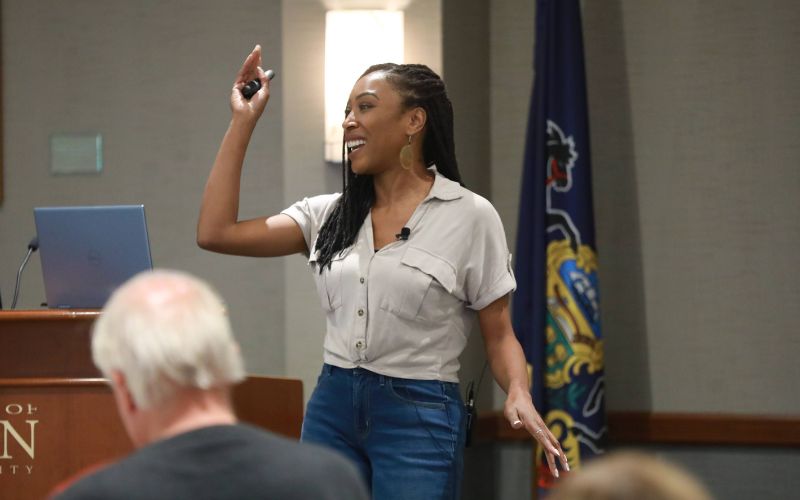
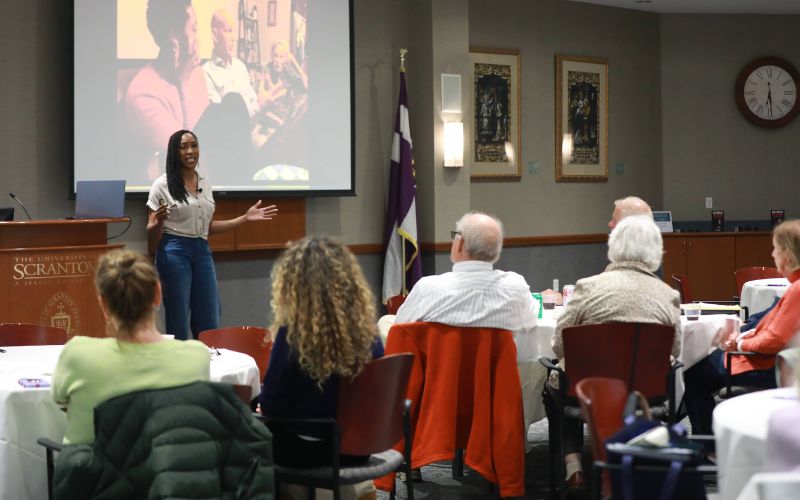
The personalization aspect of the exercise allowed participants to move beyond the position and to the person who holds it. This, she said, is particularly important at colleges where students’ worldviews are being shaped in new surroundings with people from different backgrounds.
“I believe that collegiate culture right now is not valuing critical thinking in the ways that it should,” Ike said in an interview after the event. “I value helping people learn how to think, not telling them what to think. That’s why the framework is so important for me, because it cuts straight to the chase.”
As the workshop concluded, Ike left the participants with two questions to think about: Where might I be forming a judgment without understanding what shaped someone’s view? And before I respond to a problem that activates me, what story might be shaping my reaction and how is that influencing me?
In such a polarized climate, it can be a challenge for young people to know how to navigate the world they enter. For University students, Ike advised them to remain people of integrity.
“In everything you do, make sure that your values remain intact. Be true to what those values are so that you can live an integrous life,” Ike said.
Cassidy Lowman '27, Dauphin, is a communications major with a political science minor at Scranton.