

Global Insights 'Taiwan' Set for March 12


 Chih-Yi (Arena) on the beach of Sanxiantai in Taitung County, east coast Taiwan.
"People are there for their belief but also bond deeper connections and human touch with strangers who also live in this land." - Chih-Yi (Arena)
Global Insights visits the lush Pacific island, Taiwan! Chih-Yi (Arena), visiting instructor from the 'Visiting Mandarin Chinese Teacher Program' sponsored by the Taiwanese Ministry of Education, will present the next spring Global Insights event on Thursday, March 12, beginning at 11:30 a.m. in the Rose Room, Brennan Hall 509.
All students, staff, and faculty are invited to the free lunch-and-learn program. Cultural cuisine will be provided. Registration is required.
Global Insights interviewed Arena about her upcoming presentation.
Where did you study to prepare to teach? Which courses are you teaching at Scranton?
I studied at National Taiwan Normal University and majored in Teaching Chinese as a Second Language. I teach Elementary Chinese, Intermediate Chinese and Politics in Chinese (an independent study course) this semester.
What is an interesting, lesser-known fact you will speak more about in your presentation?
Taiwanese people are so good at puns. Since the same pronunciation can have five maximum tones, each tone can have many different characters with all different meanings. This wordplay includes tones, pronunciation and characters in Mandarin, as well as combining Taiwanese, English and Japanese. We not only apply this skill in daily conversation, but also in naming a restaurant or store. For example, there's a gym called '益(yì)身(shēn) GYM', which sounds similar to '益生菌(yì shēng jùn)', probiotic in Mandarin, and it has a healthy connotation as a gym.
 What are some favorite activities in Taiwan?
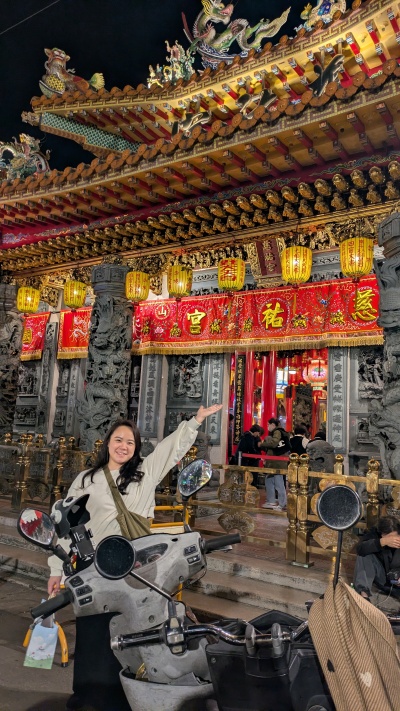
I would like to share our folk religion and rituals. ... We use sticks to pray to multiple gods in a temple. Each god is in charge of different matters, like romance, giving birth, safety, for fishermen, for police, for test-takers, etc.
Every March in the Lunar Calendar (around April or the end of March), people are crazy about the Mazu Pilgrimage. There are two main pilgrimages in central Taiwan; the route is around 250 miles long. … Since sometimes the route and time to start and end in a day are uncertain, food and accommodations are what people have to consider before starting this trip, but during the pilgrimage, you can see Taiwanese hospitality and generosity. Residents on/around the route supply free food/beverages, and volunteers offer free rides when they see anyone who needs to take a rest. People are there for their belief, but also bond deeper connections and human touch with strangers who also live in this land.
(Photo: Songshan Ciyou Temple in Taipei City shown above)
What do you miss/enjoy most about being in Taiwan?
Super convenient public transportation in Taipei, especially the metro. Stations are with AC, super clean and bright, since you are not allowed to eat and drink, even water, in stations and cars. People follow lines on the ground to line up and wait to get into cars.
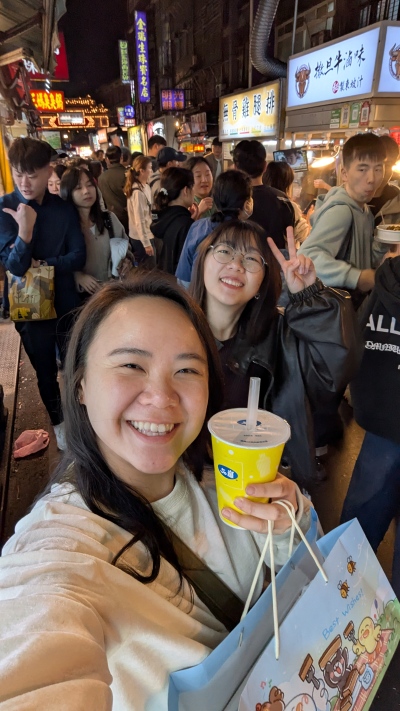
I really enjoy all kinds of cheap street food in Taiwan, such as $2 boba tea, $2 braised pork rice, $6 beef noodles, $3 dumplings, $9 Din Tai Feng soup dumplings and $1 deep-fried sweet potato balls in night markets. Yum yum yum.
(Photo: Raohe Street Night Market in Taipei City shown below)
 Where is your favorite place to visit?
I love the east coast very much. We call the counties on the east side the pure land in Taiwan, which have much lower population density. The coastline and mountains face the Pacific Ocean. You can travel between mountains and beaches by buses or trains, visiting a deep gorge and a blue and spectacular ocean. They are the best places for urban people who want to relax, have a slow-paced trip and get closer to Mother Nature.
Briefly describe the people and culture. What values or traditions help to shape both?
Taiwan is an immigrant society and has a complicated history. We not only have "Han" people who moved from Mainland China around the 16th century, but also we own the Dutch and Spanish colonized heritages in language and architecture left in the 17th century, and all the infrastructures built during the Japanese colonial time in the early 20th century. However, we still preserve our aboriginal people's cultures and languages, even though they were banned and endangered when the foreign authority, Chiang Kai-shek, came to Taiwan in 1949.
The chaos of the authority changes has shaped Taiwanese people to be resilient and hardworking. No matter how complex it is for Taiwanese people to find our own identities, starting from the older generations who desired to escape poverty and the damages left by the war, and over the decades, Taiwan has been established as a technology island and is known for its semiconductor manufacturing technique.
Register for Taiwan.
Global Insights is hosted by the Office of Global Education, the Cultural Centers, Residence Life and the Office of Institutional Compliance and Title IX. For more information, please contact international@scranton.edu or 570-941-4841.