


2026
September
August
View August Listing Page
Forty incoming first-year students at The University of Scranton will begin their college experience with a week of service, reflection and community engagement through the University’s F.I.R.S.T. (First Years Involved in Reflective Service Together) program.
Now in its 24th year, F.I.R.S.T. brings first-year students to campus approximately one week before the start of classes to participate in volunteer service with nonprofit and community organizations throughout the Scranton area. The students are guided by a team of upper class student leaders and staff members from the University’s Center for Service and Social Justice.
The 2026 F.I.R.S.T. program will take place Monday, Aug. 24, through Friday, Aug. 28, with students volunteering at a variety of organizations and community sites, including the Gino J. Merli Veterans Center, St. Joseph’s Center, NeighborWorks, the Harry and Jeanette Weinberg Northeast Regional Food Bank and CHOP Out Hunger. The program will also cohost a community day on Tuesday, Aug. 25, in conjunction with Friends of the Poor/Catherine McAuley Center: Partnership for the Common Good at Novembrino Park in West Scranton.
The program is coordinated by the Center for Service and Social Justice, which provides students with opportunities to engage with community partners, develop leadership skills and connect service experiences with the University's Jesuit mission.
For more information, please email avianna.carilli@scranton.edu or call 570-941-7429.
Service Before the Semester: F.I.R.S.T. Program Set for 24th Year
Camia Rosella Capalongo ’27, an accounting major from Scranton, has been named a 2026 Scholar by the Public Company Accounting Oversight Board, earning a $15,000 scholarship through the organization’s nationally competitive program.
Capalongo is one of 677 college students in the U.S. to receive the scholarship, which recognizes students pursuing accounting studies and supports their development as future professionals in the field.
Capalongo, who graduated from West Scranton High School, is a dean's list student and a member of both the Frank P. Corcione Business Honors Program and the Robert L. McKeage Business Leadership Honors Program. She is actively involved in the Kania School of Management Student Advisory Board, the Beta Alpha Psi and Omega Beta Sigma Honor Societies, Kania Women in Business, the Italian Society and the Commuter Student Association. She interned this past spring with Kronick, Kalada, Berdy and Co. in Kingston.
"I am truly grateful to receive the PCAOB Scholarship," Capalongo said. "This financial support will have a meaningful impact on my education and inspires me to continue working hard as I pursue a career in accounting."
Capalongo is the seventh University of Scranton student to receive the scholarship since 2017, bringing the total amount awarded to Scranton students through the program to $85,000.
The Scholars Program was launched in 2017 by the PCAOB, which is a nonprofit corporation established by Congress. It is charged with overseeing the audits of public companies to protect investors and further public interest and trust in audit reports.
“As a career choice, accounting offers students an opportunity to enter an innovative, technology-driven field that helps protect investors and build trust in our capital markets,” PCAOB chair Demetrios (Jim) Logothetis said in a press release. “We congratulate this year’s PCAOB Scholars, who have shown already that they have what it takes to become leaders in the profession and gatekeepers in financial reporting.”
U.S. News and World Report’s 2026 Best Colleges report ranked The University of Scranton No. 8 in the Regional Universities (North) category with a national ranking of No. 40 in Best Undergraduate Programs in Accounting.
Senior Accounting Student Named PCAOB Scholar
The University of Scranton’s Schemel Forum will offer an eclectic lineup of programs this fall, spanning topics including culture, health care, history, media, politics and beyond. The events are sponsored by Munley Law.
The first of the Schemel Forum’s two evening courses this fall explores television series M*A*S*H as a lens through which to examine American culture, war and storytelling. Charlie Cino, English and theatre instructor at The University of Scranton, will lead the course. The second evening course examines Karl Marx’s “Das Kapital,” one of the most debated and influential works of economic and political thought. Andrew LaZella, Ph.D., professor of philosophy at The University of Scranton, will lead the course. The M*A*S*H course will be held from 6 to 8 p.m. on Thursdays, beginning Sept. 10 and concluding Oct. 15, in Room 305 of the Weinberg Memorial Library. The Karl Marx course will be held from 6 to 7:15 p.m. on Mondays, beginning Oct. 19 and concluding Nov. 23, also in Room 305 of the library.
The first of four World Affairs Luncheon Seminars will feature Rev. James Martin, S.J. H’17, a New York Times best-selling author and frequent media commentator seen and heard throughout the world. Father Martin’s lecture will be held from 11:30 a.m. to 1 p.m. Friday, Sept. 18, inside the McIlhenny Ballroom on the fourth floor of the DeNaples Center. Terence Keel, Ph.D., an award-winning professor at UCLA, will discuss death records and accountability in cases involving police violence from 11:30 a.m. to 1 p.m. on Wednesday, Oct. 7. Dr. Keel’s presentation will be held inside the Rose Room on the fifth floor of Brennan Hall. Victor Goines, jazz chair at the New Orleans Center for Creative Arts, will explore the various forces that have shaped the evolution of jazz from 11:30 a.m. to 1 p.m. Friday, Nov. 6, at the Rose Room in Brennan Hall. Steven J. Scheinman, M.D., dean emeritus of the Geisinger College of Health Sciences, will present on the “social determinants of health” from 11:30 a.m. to 1 p.m. Monday, Nov. 16, at the Rose Room in Brennan Hall.
The Schemel Forum will cosponsor two collaborative programs, beginning with Peace Ike’s presentation and discussion on “The 3 Degrees of Why: Moving Beyond Positions to the Stories That Shape Us.” Ike is a culture strategist, dialogue facilitator and speaker who works across secular and faith-based spaces to build bridges and foster cultural transformation. Ike’s presentation, offered in conjunction with the University’s Slattery Center for the Ignatian Humanities, will be held at 6 p.m. Tuesday, Oct. 20, in the Rose Room of Brennan Hall. Beginning at 6 p.m. Thursday, Nov. 12, in the Pearn Auditorium on the second floor of Brennan Hall, the documentary, The Librarians, will be screened. A panel discussion will follow featuring Susan Campbell Bartoletti, an award-winning author; Kate Cummings, assistant professor and research and instruction librarian for business and AI at the University’s Weinberg Memorial Library; and Michele Legate, district consultant for the Northeast Library District, based out of the Scranton Public Library. The screening and panel are presented in partnership with the Friends of the Weinberg Memorial Library.
The Schemel Forum’s annual University for a Day program will return from 8:30 a.m. to 12:30 p.m. Saturday, Sept. 19, in the Moskovitz Theater of the DeNaples Center. Participants will attend three lectures presented by University faculty members on topics ranging from theology and mindfulness to college football analytics. Presenters include Will Cohen, Ph.D., professor of theology; Katherine J. Stefanelli, Ph.D., assistant professor of counseling and human services; and David A. Mahalak, D.Eng., assistant professor of operations and analytics.
Registration fees vary by program and membership level. The collaborative programs are offered free of charge. World Affairs Luncheon Seminars are priced at $30 per person. University for a Day is $35 per person; however, the first 100 high school students to register may attend free of charge. Membership options and package rates are also available.
For complete program details, registration information and membership rates, please visit the Schemel Forum website, email schemelforum@scranton.edu or call 570-941-4740.
-
Two courses
- M*A*S*H: Television, War and American Culture with Charlie Cino, English and theatre instructor at The University of Scranton (Thursdays Sept. 10, 17, 24, Oct. 1, 8, 15 at 6 p.m.)
- Karl Marx’s Das Kapital with Andrew LaZella, Ph.D., professor of philosophy at The University of Scranton (Mondays Oct. 19, 26, Nov. 2, 9, 16, 23 at 6 p.m.)
-
Four World Affairs Luncheon Seminars
- James Martin, S.J. H’17, “Work in Progress: Confessions of a Busboy, Dishwasher, Caddy, Usher, Factory Worker, Bank Teller, Corporate Tool and Priest (Friday, Sept. 18 at 11:30 a.m.)
- Terence Keel, Ph.D., “The Coroner’s Silence: Death Records and the Hidden Victims of Police Violence” (Wednesday, Oct. 7 at 11:30 a.m.)
- Victor Goines, “Jazz: From the Streets and Clubs to the Schools and Concert Halls” (Friday, Nov. 6 at 11:30 a.m.)
- Steven J. Scheinman, M.D., “Why Do We Have the Worst Health Care Outcomes? A Consideration of the Social Determinants of Health” (Monday, Nov. 16 at 11:30 a.m.)
-
Two collaborative programs
- “The 3 Degrees of Why: Moving Beyond Positions to the Stories That Shape Us” with Peace Ike (Tuesday, Oct. 20 at 6 p.m.)
- “The Freedom to Read: A Screening and Panel Discussion of The Librarians” with Susan Campbell Bartoletti, Kate Cummings and Michele Legate (Thursday, Nov. 12 at 6 p.m.)
-
One session of University for a Day (Saturday, Sept. 19 from 8:30 a.m. to 12:30 p.m.)
- “The ‘New Right’ and the Old Liberalism of John Courtney Murray, S.J.” with Will Cohen, Ph.D., professor of theology at The University of Scranton
- “Stress, Mindfulness and Resilience: Small Changes, Big Results!” with Katherine J. Stefanelli, Ph.D., assistant professor of counseling and human services at The University of Scranton
- “Evaluating Alternative College Football Playoff Structures: A Multicriteria Framework for Balancing Stakeholder Objectives” with David A. Mahalak, D.Eng., assistant professor of operations and analytics at The University of Scranton
Fall Schemel Forum Programs to Feature Nationally Recognized Presenters
Performance Music at The University of Scranton is excited to announce to the public its fall concert season public performance lineup.
The concerts are open to the public and free of charge. Seating is on a first-come, first-seated basis. Shows begin at 7:30 p.m., unless otherwise noted (e.g. Noel Night), and take place in the Houlihan-McLean Center at Mulberry Street and Jefferson Avenue, downtown Scranton.
For further information on the concerts or Performance Music at The University of Scranton, call 570-941-7624, email music@scranton.edu or visit scranton.edu/music. For more info on guest artists, please visit their artist websites (links can be found on the events page at scranton.edu/music).
Friday, Sept. 18, 7:30 p.m.
IN RECITAL: BAROQUE OR BUST!
Aisslinn Nosky, violin, and Caroline Nicolas, cello
Saturday, Sept. 26, 7:30 p.m.
FAMILY WEEKEND CONCERT: SWINGIN’ THE CLASSICS
The Anderson Twins Sextet with an appearance by The University of Scranton Concert Choir
Wednesday, Oct. 7, 7:30 p.m.
GENERAL RECITAL
University of Scranton Performance Music student musicians in solo, duo, trio and small ensemble performances
Friday, Oct. 30, 7:30 p.m.
IN RECITAL: SAINTS & SPIRITUALS
Marcus Printup, trumpet, and Riza Printup, harp
Saturday, Nov. 7, 7:30 p.m.
IN CONCERT: The University of Scranton Jazz Band with guest artist Victor Goines, woodwinds
(Visit scranton.edu/schemelforum for info on Mr. Goines’ luncheon lecture on Friday, Nov. 6.)
Saturday, Nov. 14, 7:30 p.m.
IN CONCERT: The University of Scranton String Orchestra
Saturday, Nov. 21, 7:30 p.m.
IN CONCERT: The University of Scranton Symphonic Band
Saturday, Dec. 5, 8 p.m. (prelude from 7:05, doors open at 7)
59th ANNUAL NOEL NIGHT
The University of Scranton Singers, String Orchestra and Chamber Ensembles with special guest Dr. Wycliffe A. Gordon H'06
Friday, Dec. 11, 7:30 p.m.
EMPTY STOCKING BENEFIT CONCERT: HOLIDAYS AROUND THE WORLD featuring Llewellyn Sánchez-Werner, piano
(Admission “charge” is one new unwrapped toy or piece of child’s clothing, or a cash donation. All proceeds will directly benefit local families in need.)
IF YOU GO
What: Free concerts at The University of Scranton
When: September through December 2026
Where: The University of Scranton Houlihan-McLean Center (Mulberry Street and Jefferson Avenue, downtown Scranton)
Admission: Free
Fall Concert Season Schedule Announced
The National Association of Scientific Materials Managers (NAOSMM) recently awarded one of its highest honors to a University of Scranton laboratory supervisor.
Deborah Wardach, laboratory supervisor in the University’s Department of Biology, received the 2026 Lamar Houston Service Award at the 53rd annual NAOSMM Conference and Trade Show in Wichita, Kansas.
The award, named for the organization’s founder, recognizes exceptional dedication, leadership, volunteerism and long-term commitment that contributes to the NAOSMM’s success and growth.
Wardach has been an NAOSMM member since 2008. She contributed extensively on the awards, finance, hospitality and technology committees and spent six years on the organization’s board. She served as treasurer beginning in 2019 before continuing in the organization’s newly established past treasurer role.
Throughout her varied service, Wardach has strengthened the NAOSMM’s financial operations while also playing a key role in documenting institutional knowledge and creating a framework for continuity at the leadership level.
“Beyond her official roles, Deborah has always been willing to answer questions, provide guidance and support others,” said the citation accompanying the award. “Deborah’s leadership and dedication have left NAOSMM stronger than she found, and we are grateful for her many years of service.”
Wardach was hired at The University of Scranton in 2022. In her role, she supports teaching and research activities in the Biology Department while advancing the scientific materials management profession.
The NAOSMM was founded in 1974 and includes more than 500 members involved in teaching, researching and practicing in the scientific industry.
Scranton Biology Lab Supervisor Receives National Service Honor
A four-week class in the summer provided University of Scranton students with hands-on learning and connection — with a side of culinary practice.
Students in the University’s Distance Education Master of Science in Speech-Language Pathology program participated in “Recipe for Connection,” a cooking program that paired graduate students with adults with intellectual and developmental disabilities. Together, they prepared recipes while practicing communication, social interaction and problem-solving skills in the natural and supportive environment at Coffee Inclusive in Pittston.
“Rather than focusing solely on therapy activities, ‘Recipe for Connection’ creates genuine opportunities for conversation, collaboration and meaningful human connection,” said Tara Carito, the program’s clinical education coordinator. “It is an experience that benefits both our students and the participants they serve.”
Students in the two-year graduate program participated this summer in their in-person clinical experiences through partnerships with Coffee Inclusive, as well as the Scranton School for the Deaf and Hard of Hearing Children and the Waverly Community House. These placements allowed students to apply their developing knowledge to real-world settings.
$content.getChild('content').textValueWhile cooking may seem like a straight-forward activity, it naturally brings together many of the communication skills needed in speech-language pathologists.
“As a meaningful takeaway from the experience, every participant received a recipe book featuring all of the recipes they created together, allowing them to continue enjoying the meals and memories long after the program concluded,” Professor Carito said.
The graduate students will continue their clinical training in the upcoming academic year through supervised placements in schools in the fall, followed by adult-based clinical placements in the spring.
For additional coverage, please read WVIA’s article about “Recipe for Success.”
$content.getChild('content').textValueSLP Students Follow ‘Recipe for Connection’ at Pittston Coffee Shop (PHOTOS)
Bree Health’s Virtual Concierge Services: Services save you time by providing research and recommendations for a wide range of everyday needs. Whether you’re planning a trip, looking for family care resources, or relocating, Bree's expert support helps simplify the process.
Summer Mental Health - Staying Balanced All Season: It's easy to rush from one activity to the next. Take a few moments each day to slow down, appreciate the season, and focus on what matters most instead of trying to do everything. Not every memorable summer moment has to be a big vacation. Reading on the porch, enjoying a sunset, spending time with loved ones, or taking a quiet evening walk can have a lasting impact on your well-being.
Expert Legal Consultations:
Legal concerns can arise at any time, and Bree Health provides confidential legal consultations and resources to help you navigate important matters at no cost. Get expert advice from licensed attorneys on a wide range of personal and financial legal issues. Speak with an attorney about wills, marriage and divorce, personal injury, small claims, landlord/tenant disputes, immigration, motor vehicle issues, and more. Available to employees: One free consultation per Issue, per year: receive professional legal guidance tailored to your situation.
Get more tips for summer or learn about Bree Health and other benefits available to employees at this link.
ICYMI: Learn About the Employee Benefits Available at Bree Health
Royal News will have a reduced publishing schedule over the summer.
After the June 3 issue, the University's Royal News e-newsletter is published on the first Wednesdays of July and August; the website will continue to be updated with the latest news. Weekly issues will resume on Wednesday, Aug. 26, and continue throughout the fall semester.
We welcome announcement submissions from faculty, staff, students and clubs at any time, so please send them along. Find the instructions at this link: Royal News FAQ.
Thanks, and have a great summer!
Royal News To Continue Summer Schedule
Alumni are invited to return to campus on Saturday, Nov. 14, for Living the Mission: A Day of Faith and Connection, a special opportunity to reflect, reconnect and explore the enduring impact of a Jesuit education.
From 10 a.m. to 4 p.m., participants will gather for a day centered on faith, conversation and community. Through discussions with current students and fellow alumni, attendees will explore how Jesuit values continue to shape lives of service, leadership and purpose.
The event offers alumni an opportunity to strengthen their connection to The University of Scranton community while reflecting on the mission that continues to inspire Royals long after graduation.
Registration will open in late September.
Save the Date: Living the Mission: A Day of Faith and Connection
The University’s Department of Communication and Media will present the inaugural Hall of Fame award to John A. Walsh ’66, Susan Swain ’76, Mike Bonner ’95, Kate Groark Shields ’97 and Nicole Young ’01 on Saturday, Sept. 19, on campus. The award was established to recognize the achievements of alumni, to bring alumni and students together, and to provide funding for the Department’s equipment and student career development needs. All alumni, parents, friends, students, faculty and staff are welcome to attend.
A student-focused panel will kick off the event, followed by an induction ceremony. Registration, details and sponsorship information will be available soon. For more information on the Communication and Media Hall of Fame, contact Department Chairperson Stacy Smulowitz at stacy.smulowitz@scranton.edu.
The deadline for submissions for the 2027 Communication and Media Hall of Fame awards is March 30, 2027. Nominations for the 2027 event will open on Sept. 19.
The University of Scranton Communication and Media Department Hall of Fame honors distinguished alumni, living or deceased, who have made extraordinary and lasting contributions at the highest levels of public service, industry, the military or academia for at least 20 years. Eligible nominees do not need to be retired professionals. All graduates of the University, no matter their degree at the time of their graduation, are eligible for nomination.
Hall of Fame Criteria
To be considered a Hall of Fame candidate, an individual’s nomination should clearly demonstrate the following:
- Superior service and achievement in the nominee’s respective field(s); nominations should highlight merits of accomplishment and may also highlight previous awards and honors
- Significant impact of professional contributions at the organizational, local, regional, national or international levels
- Outstanding leadership, character, values and ethical conduct
- Jesuit model of being men and women for and with others
Fields for Consideration
Any area of the communication arts will be considered for this honor. Examples include communications planning, social media, media relations, marketing, public relations, advertising, journalism, business communication, broadcasting, video and audio production and graphic arts.
What to Include in a Nomination Packet
All packets should include the following:
- A two-page narrative of the nominee’s accomplishments and qualifications for receiving the award
- The candidate’s resume
- A list of any awards received
Also, packets may include letters of support, endorsement or recommendation.
Need Additional Information?
Questions can be directed to Stacy Smulowitz, Ph.D., Associate Professor and Chair, Department of Communication and Media, at stacy.smulowitz@scranton.edu.
University To Honor Alumni at Inaugural Hall of Fame Event Sept. 19
The University of Scranton will present the President’s Medal to Robert S. ’68 and Marilyn A. Weiss at the President’s Medal Gala Thursday, Oct. 1, at Pier Sixty, Manhattan’s largest waterfront event venue. Watch a short video message featuring Rev. Joseph G. Marina, S.J., University president, announcing the University’s intent to honor Bob and Marilyn here.
The event is the premier annual fundraiser for the University, and proceeds from the dinner benefit the Presidential Scholarship Endowment Fund, which awards four-year, full-tuition scholarships to incoming first-year students with outstanding high school records and notable community involvement. The University presents the President’s Medal to individuals who have achieved excellence in their fields and who have demonstrated extraordinary compassion for others. All alumni, parents and friends of the University are welcome and encouraged to register here for this year’s event.
Scranton has held a special place in the hearts of Bob and Marilyn ever since they met at a “U Dance” at the Gunster Memorial Student Center in 1966. Their 2015 gift of $1.25 million resulted in the creation of the Robert and Marilyn Weiss Pediatric Low Vision Research and Training Suite, and their 2016 gift of $1 million established Robert and Marilyn Weiss Field as a first-class home for Scranton’s soccer, lacrosse and field hockey teams. In 2024, their gift of $10.5 million, the largest single donation in the history of the University, blossomed into the four-story, 90,000 square-foot Robert S. and Marilyn A. Weiss Hall. The building houses the University’s Department of Criminal Justice, Cybersecurity and Sociology, the Department of Psychology, Student Health Services, the Center for Health, Education and Wellness, the Small Business Development Center, the University of Success, and the state-of-the-art IDEA Center, which features woodworking, 3D printing, laser engraving, sewing and audio recording capabilities.
A native of Lake Ariel, Bob became the first person in his family to attend college when he began studying accounting through the University’s ROTC program. As a U.S. Army Captain, he was awarded two Bronze Stars and the Army Commendation Medal for his service in Vietnam. He became a certified public accountant and began working as an assistant corporate controller in 1977 at Cooper Laboratories Inc., which would eventually become The Cooper Companies, Inc., a multinational manufacturer and marketer of specialty healthcare products with annual revenues exceeding $4 billion.
Bob rose through the ranks at Cooper during a remarkable 41-year career, serving as corporate controller, treasurer, chief financial officer, chief operating officer, president of Coopervision, and, ultimately, president and CEO. During Bob’s time at the company, Cooper had a number of industry-defining breakthroughs, including the development of intraocular lenses and Lasik surgery, two advancements that have helped millions see more clearly. Under Bob’s leadership, the company sought to address the approximately 50% of children and young adults aged 5-22 who are suffering from progressive myopia, a condition that often leads to eye diseases such as cataracts, glaucoma, retinal detachment and macular degeneration later in life, by developing MiSight, a soft contact lens that was ultimately approved by the FDA in 2019 for myopia management in children aged 8-12. Bob was named the “Most Admired CEO of 2012” by the San Francisco Business Times, and he was recognized with the Albert Nelson Marquis Lifetime Achievement Award for 2017-2018. After retiring in 2018, he became the chair of Cooper’s board of directors through January of 2026, and he remains on its board today.
Bob was honored by the University with the Frank J. O’Hara Distinguished Alumni Award in 2008. As a University trustee, he became informally known as “the pizza guru” due to his unabashed love of and enthusiasm for the pizza of Northeastern Pennsylvania. He also sponsors the Pediatric Refractive Error Training Center, an eyecare clinic in Hanoi, Vietnam, that trains optometrists to fight the growing pandemic of myopia.
A native of South Scranton, Marilyn studied at the University through the Scranton State General Hospital School of Nursing. She served as the head nurse at the Edward S. Harkness Eye Institute at Columbia Presbyterian Medical Center in New York and as a pediatric nurse at Bayside Pediatrics in Pleasanton, California.
Bob and Marilyn are frequent sponsors of local charitable causes in the San Francisco East Bay area, including Goodness Village, which provides tiny homes and supportive services to the Tri-Valley’s formerly unhoused neighbors, Valley Humane Society, and the Bay Area Military Classic & The Joey Graves Memorial Golf Tournament, which supports Gold Star Families.
The couple are the proud parents of three children, Chris, Kim and Doug, and they are blessed with two grandchildren, Kylie and Jayden. They reside in Pleasanton, California.
An Ambitious Goal
At last year’s gala, Rev. Joseph G. Marina, S.J., University president, announced an ambitious University-wide effort to permanently endow the Presidential Scholarship Endowment Fund by raising an additional $7 million through the 2025 and 2026 President’s Medal Galas, which would bring its lifetime total up to $30 million.
“In 2002, The University of Scranton embarked upon a marathon endeavor when it held its first award dinner in support of the Presidential Scholarship Endowment Fund,” said Father Marina in a video announcing the initiative. “We are only $7 million away from securing the future of The Presidential Scholarship Endowment Fund and ensuring that our Presidential Scholars will continue to thrive at the University forever.
“Help us write the ending this 25-year marathon deserves.”
Visit this link to support Presidential Scholarships at The University of Scranton.
For more information on the President’s Medal Gala, contact Associate Vice President of Development Eric Eckenrode at eric.eckenrode@scranton.edu or Executive Director, Annual Giving & Campus Partnerships Brad Troy ’02 at bradley.troy@scranton.edu.
Register Today for the President's Medal Gala Oct. 1
The University of Scranton will host its fifth annual Alumni-Student Golf Outing on Saturday, Sept. 26, at Pine Hills Country Club in Taylor.
The outing will feature a 1:30 p.m. shotgun start in a scramble format, followed by a buffet dinner. The event provides alumni and students with an opportunity to connect, enjoy a day on the course and strengthen the Royal network.
Registration will open in late August. Be sure to save the date, and stay tuned for additional details.
Save the Date for the 5th Annual Alumni-Student Golf Outing
What's new with you? To submit a Class Note, visit the Class Notes Submission Page.
Lawrence J. Spegar ’84, Jessup, continues to be a leading sports influencer in the United States. He recently attended his 29th consecutive Super Bowl (Super Bowl LX) and his 26th consecutive College Football National Championship Game. Attorney Spegar was an entertainment writer for The Aquinas while at The University of Scranton and served as a three-year officer of the Pre-Law Society.
Members of the Centennial Class of 1988 celebrated their 60th birthdays during a stay at a beautiful villa in Tuscany. The group included Anne Dubon Murphy ’88, Mary Haumacher ’88, Christine Lawless Clayton ’88, Jeannie Martin Petrucci ’88, Kathy Waszak Rossi ’88 and Kelly McDonnell Mulroy ’88.
Daniel W. Munley ’90, Waverly, of Munley Law, has been selected to the 2026 “Lawdragon 500 Leading Consumer Lawyers” list.
Ailish M. Farragher ’95, Dublin, Ireland, a Redington Scholar, recently co-authored the peer-reviewed publication, Effectiveness and Safety of Pharmacist Prescribing: A Systematic Review, published in BMJ Open (2026).
Jason Pierce ’14, Bala Cynwyd, was named No. 109 in Pennsylvania on the 2026 Forbes "Best-in-State Wealth Advisors" list (Philadelphia Area – High Net Worth category). A partner at Bala Cynwyd-based Nottingham, Walsh, Goodman, Pierce & Associates at Merrill, Pierce joined the firm in 2014 and holds the CFA® and CFP® certifications. He specializes in wealth management for affluent individuals and families, with expertise in investment analysis and estate planning. Pierce lives in Berwyn, where, outside of work, he coaches high school and grade school basketball in the Main Line communities and is active with the Chestnut Hill Community Association.
MARRIAGES
Patrick Nancoz ’21 to Gina Garatino Nancoz ’21, DPT ’24
Sean McTiernan ’20, G’21 to Amanda Pecora McTiernan ’20, G’21
DEATHS
John Abda, M.D. ’59, Clarks Summit
Francis J. Houston ’59, Pittston
William P. Kuehner ’63, Whippany, New Jersey
James J. Barrett ’67, Washington Crossing
Chester J. Banull ’72, Scranton
Michaeline A. Kmush G’74, Dallas
Jeffrey D. Freid, M.D. ’75, Lower Gwynedd
Paul C. Asman ’77, Throop
Daniel C. Cummings ’90, Falls Church, Virginia
Virgilio Sebastianelli ’90, Scranton
Laurel Ann Carroll ’91, Fort Worth, Texas
G. Michael Frazier ’95, Olyphant
Patricia Gribbin McGeehan G’95, Scranton
Alumni Class Notes, August 2026
With baseball season officially underway, it’s the perfect time to make plans to join fellow Royals at the ballpark.
We’re excited to invite you to a series of University of Scranton Alumni Baseball Outings planned over the coming months. These events are a great way to connect with alumni, enjoy America’s pastime and represent the Royal community in cities across the country.
Here’s what we have lined up:
Thursday, August 27: Houston Astros vs. New York Yankees at Yankee Stadium
Tuesday, September 1: Seattle Mariners vs. Boston Red Sox at Fenway Park
Wednesday, September 16: Baltimore Orioles vs. New York Mets at Citi Field
Thursday, September 24: Milwaukee Brewers vs. Philadelphia Phillies at Citizens Bank Park
We hope to see you soon at a ballpark near you!
Catch a Game With Fellow Royals This Baseball Season
July
View July Listing Page
The Staff Senate would like to thank all staff members who took the time to recognize and share their colleagues' accomplishments, sense of community, and dedication to excellence. The Meg Cullen Brown Magis Award would not exist without our caring community!
THE MEG CULLEN-BROWN MAGIS AWARD WINNER for July 2026 is:
John Witko – Trades
We would like to take this opportunity to congratulate and celebrate the good work that John does on a daily basis. We hope you will join us in personally congratulating John and all our nominees. John will receive a complimentary food donation at our fabulous University food service outlets and a reserved parking space in the DeNaples Parking Pavilion. Each winner is also invited to the Staff Senate Recognition event in May 2027 to receive a certificate of appreciation.
We congratulate John and all the wonderful nominees for being recognized as “Magis” employees!
July 2026 Nominees
Nominations open for August Meg Cullen-Brown Magis Award.
Have you witnessed a University staff member, Aramark or Follett employee offer a simple act of kindness? Go above and beyond for others? Perhaps they embody our Jesuit mission or simply possess an incredible attitude. If so, please recommend this individual for this prestigious award.
Although only University staff members, Aramark, or Follett employees win the award, nominations may be made by any University of Scranton employee.
Nominate here.
Meg Cullen-Brown Magis Award for July
The dawn of the 2026-27 academic year is just weeks away.
It's not too late, though, to celebrate the year that was, particularly as it relates to The University of Scranton's graduates of distinction in the University's prestigious honors and leadership programs.
Nearly 100 members of the Class of 2026 graduated from one of Scranton's programs of excellence.
Special Jesuit Liberal Arts Honors Program
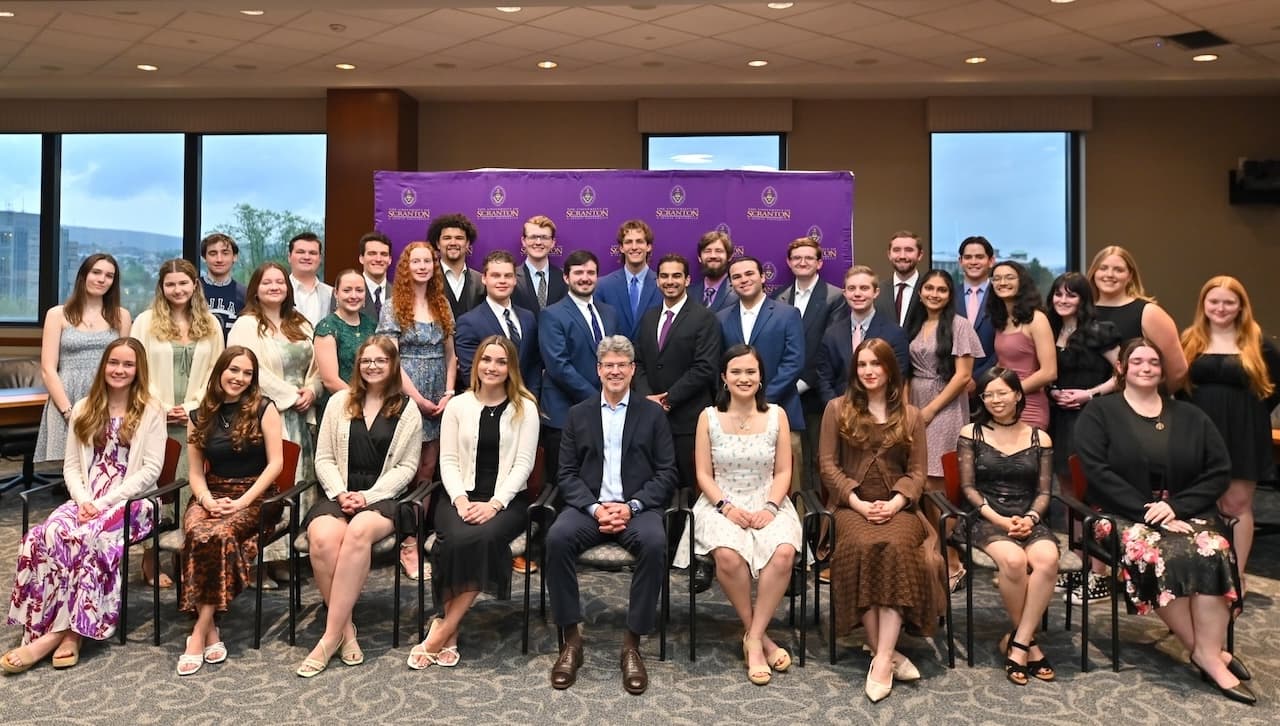
The Special Jesuit Liberal Arts Honors Program (SJLA) brings together students with an interdisciplinary curriculum rooted in the Jesuit tradition of intellectual excellence, critical inquiry, leadership and service.
This year, SJLA graduated 34 members.
Read the full list by following this link.
University Honors Program
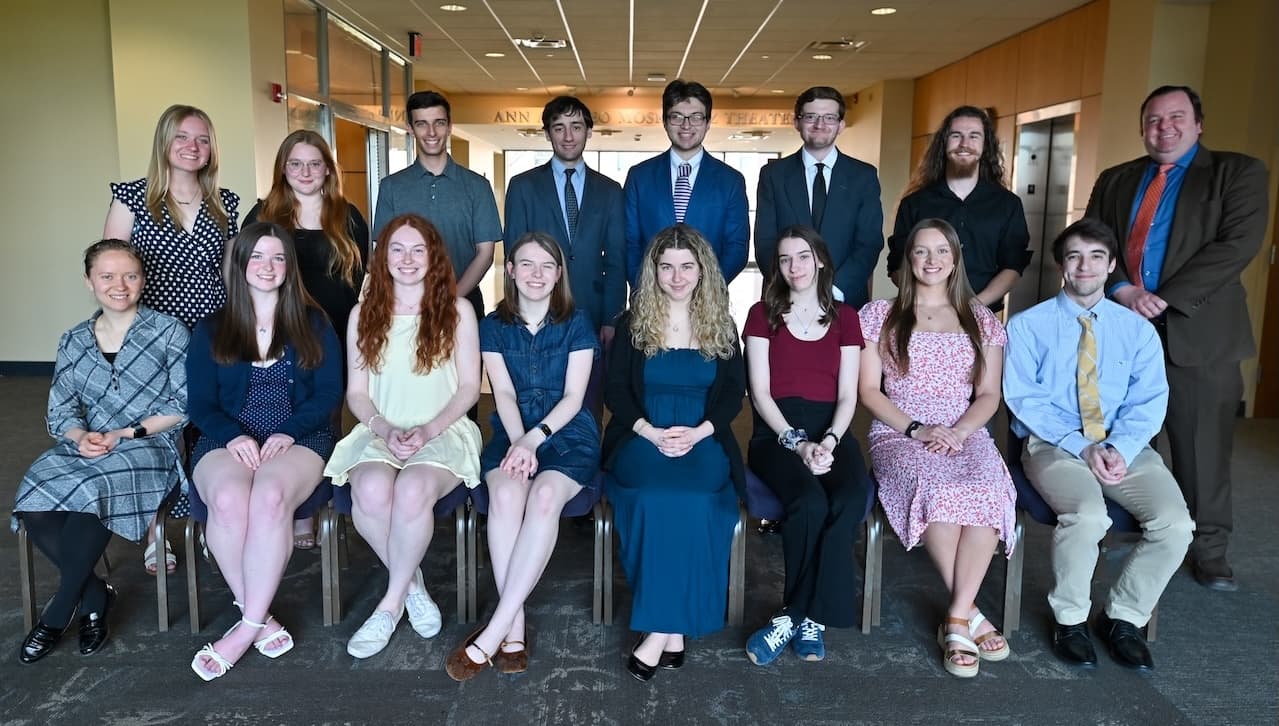
The University Honors Program challenges students through rigorous independent scholarship, close faculty mentorship and advanced inquiry that culminates in significant original research or creative work.
This year, the program graduated 31 members.
Read the full list by following this link.
Robert L. McKeage Business Leadership Honors Program
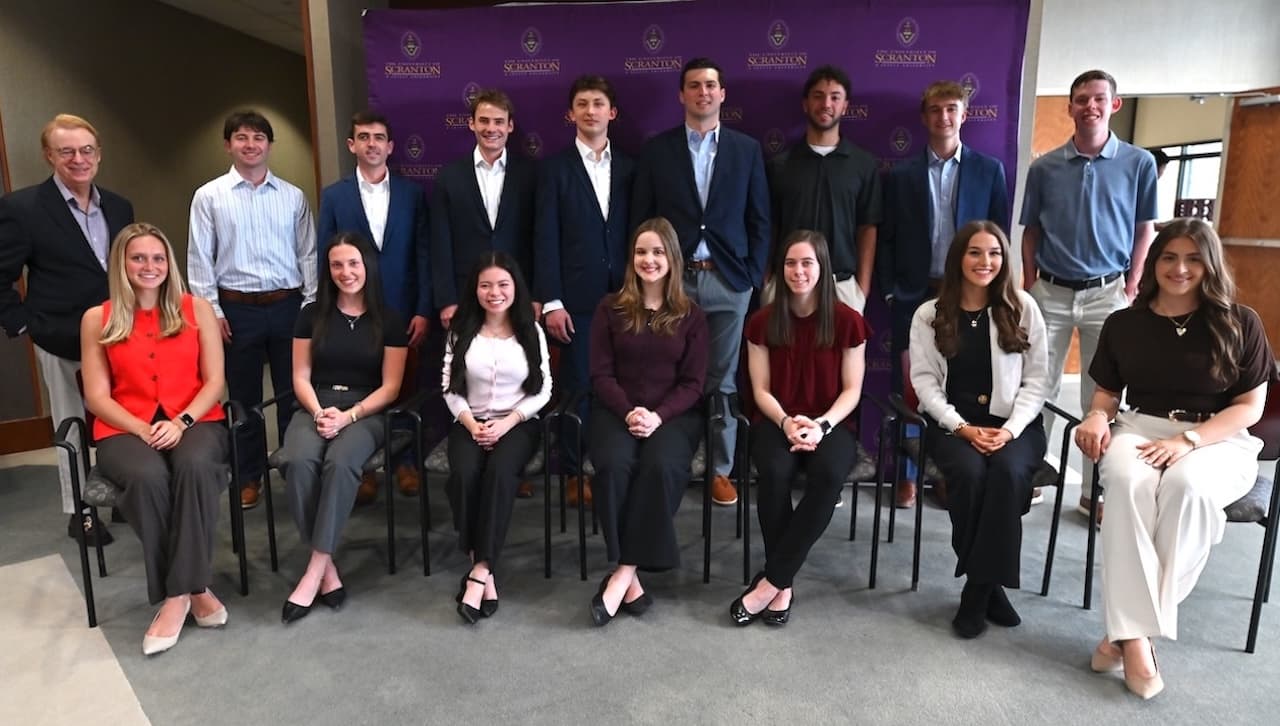
The Robert L. McKeage Business Leadership Honors Program provides transformative leadership and service experiences designed to prepare students for exceptional professional success.
This year, the program graduated 19 members.
Read the full list by following this link.
Magis Honors Program in STEM
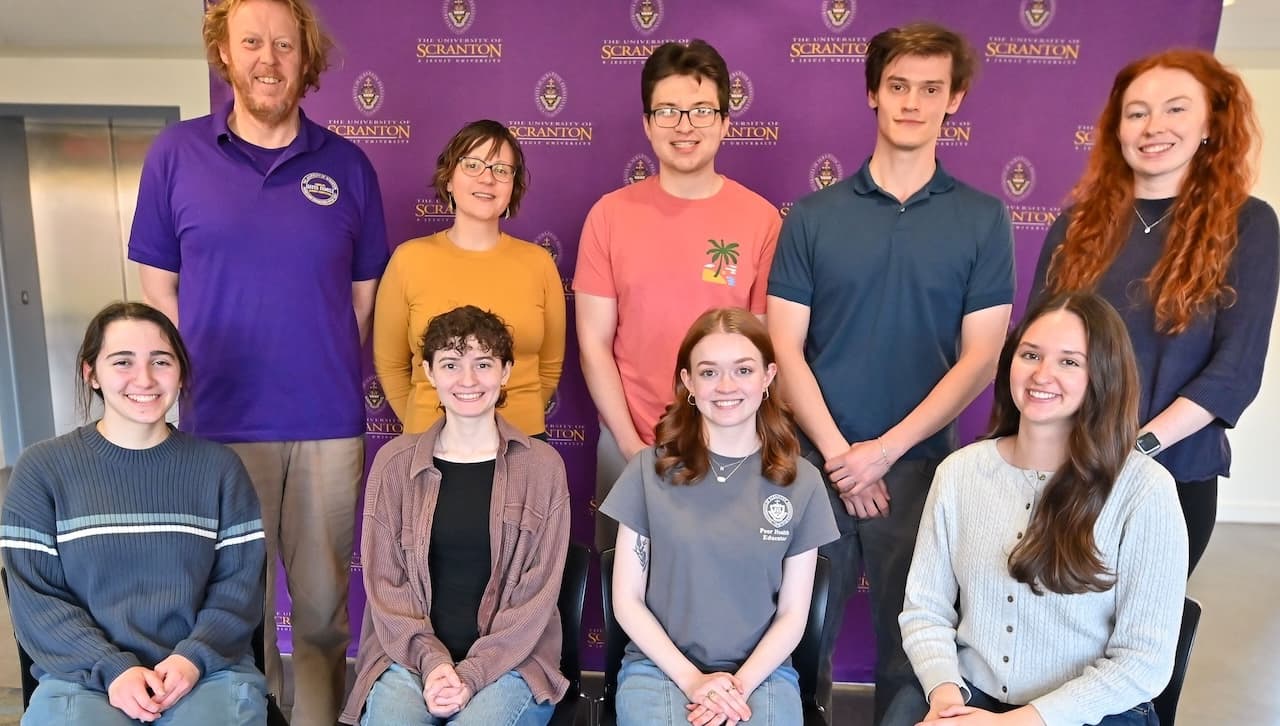
The Magis Honors Program in STEM's interdisciplinary research experience fosters scholarly achievement and leadership in the sciences, technology, engineering and mathematics.
This year, the program graduated seven members.
Read the full list by following this link.
Frank P. Corcione Business Honors Program
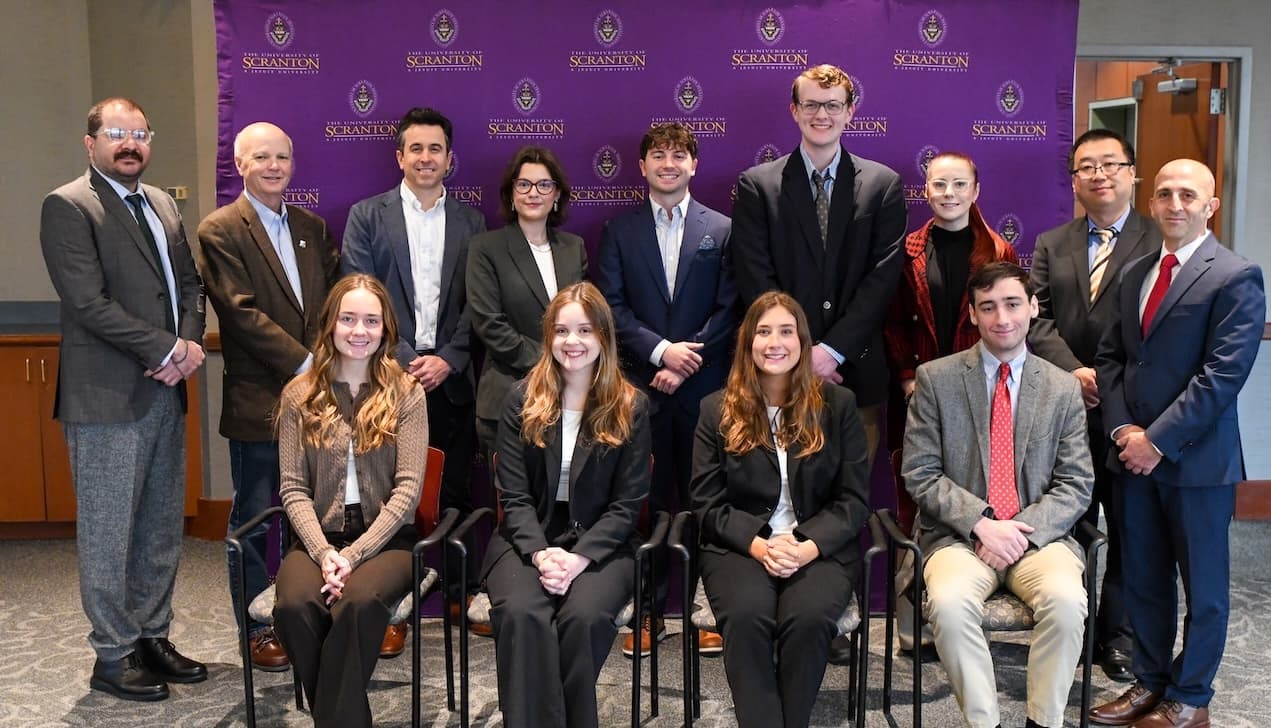
The Frank P. Corcione Business Honors Program provides high-achieving business students with a four-year experience that combines original research, professional development and leadership formation.
This year, the program graduated six members.
Read the full list by following this link.
Additionally, 60 students were inducted into Alpha Sigma Nu, the national honor society for students in Jesuit colleges and universities. Juniors, senior and graduate students who have distinguished themselves in loyalty, scholarship and service are eligible for membership into the oldest honor society at Scranton.
Read the full list of inductees at this link.
Also, earlier this summer, the University announced the 65 members of its undergraduate Class of 2026 who were presented with awards honoring their academic excellence, leadership and service.
Read the full list of Class Night award winners at this link.
In addition to the regular Wednesday email newsletter, The University of Scranton's Royal News website is updated continuously throughout the year with new stories, features and announcements. Readers may visit at any time to find the latest news from across the University.
Campus Catch-Up: Honoring Outstanding Class of 2026 Graduates
Nearly 1,900 students were named to The University of Scranton’s Dean’s List for the 2026 spring semester. The Dean’s List recognizes students for academic excellence. A student must have a grade point average of 3.5 or better with a minimum number of credit hours during the semester to make the Dean’s List. The list includes students from the Jesuit university’s College of Arts and Sciences, Kania School of Management and the Leahy College of Health Sciences.
A list of students making the 2026 spring semester Dean’s List can be seen here.
University Announces Spring 2026 Dean’s List
The following students were added to The University of Scranton Dean’s List for the fall 2025 semester after publication of the list in February of 2026.
The Dean’s List recognizes students for academic excellence during the 2025 fall semester. A student must have a grade point average of 3.5 or better with a minimum number of credit hours to make the Dean’s List. The list includes students from the Jesuit university’s College of Arts and Sciences, the Kania School of Management and the Leahy College of Health Sciences.
Students added to the fall 2025 Dean’s List are:
Anna S. Belfiore, Howard Beach, New York;
Philip R. Danchik, Woodbine, Maryland;
Jessica L. Ely, Dimock;
Alyssa J. Ferreri, Sewell, New Jersey;
Liam P. Frey, Verona, New Jersey;
Issac Gutierrez Ortiz, Scranton;
Sophia M. Hallenbeck, South Glens Falls, New York;
Owen A. James, Haddon Heights, New Jersey
McKenna R. Kokoszka, Downingtown;
Thomas E. Marine, Cockeysville, Maryland;
Sheldon S. Myers, Downingtown;
Stephen J. Reppa, Dalton;
Shane M. Reznick, Allentown;
Kiera K. Ronan, Mamaroneck, New York;
Kathryn I. Schell, Denville, New Jersey;
Therese J. Shimkus, Scranton;
Jonathon A. Symuleski, Hop Bottom;
Kamil J. Szewczyk, Maspeth, New York;
Madison R. Waltz, Dunmore;
Douglas J. Wilhelms, Califon, New Jersey.
Students Added to Fall 2025 Dean’s List
The University of Scranton’s University of Success recently received a $2,000 donation from Waymart Inmates Nurturing Growth and Stability (WINGS).
Founded in 1996, the University of Success is a four-year, pre-college mentorship program that provides high school students with educational opportunities and support designed to help them gain entrance into a college or university. The program is a fully funded by corporate and foundation grants, ensuring there is no charge to students and their families.
WINGS, based at SCI Waymart, actively raises funds for charitable causes and local organizations including the University of Success.
SCI Waymart Program Donates to University of Success
As is the case in every professional field, clinical rehabilitation counselors come from various backgrounds.
Aaron Redis, for instance, saw the vocation as an opportunity to combine his interests in advocacy, psychology and social justice. Cassandra Dierolf’s choice to pursue the profession was informed by her personal experience navigating life with perceived limitations. And for Mia Sandy, a year of service work reinforced her decision to return to school as a graduate student.
While Redis, Dierolf, Sandy and their classmates entered the clinical rehabilitation counseling profession for different reasons, they each answered the call and will leave The University of Scranton dedicated to the same goal of helping others achieve independence and become the best version of themselves despite disabilities or chronic health conditions.
It’s only fitting that clinical rehabilitation counseling is one of the most historic, highest-achieving and federally supported programs at Scranton, which prides itself on Jesuit values such as cura personalis (care for the whole person).
“The University of Scranton brings attention to the importance of taking care of each client’s mind, body and spirit,” said Redis, a Bloomsburg native who earned a bachelor’s degree in psychology from Southern New Hampshire University and a master’s in organizational leadership from the University of Maine at Presque Isle. “Because this perspective resonates with me, I am aware that a client’s psychological state, social support network, physical health and career objectives must all be taken into account in order to provide effective counseling.”
Therein lies the unique distinction about clinical rehabilitation counselors. They go beyond helping clients work through emotional or psychological challenges and are trained to address a client’s social, physical and other barriers that may stand in the way of a full and independent life.
“The inherent focus on commitment to social inclusion, holism, autonomy and resilience are all things that we need more of in society today,” Redis said.
A five-year, nearly $1 million grant ($999,909.16, to be exact) is helping Scranton train the next generation of clinical rehabilitation counselors. Announced earlier this year in partnership with the U.S. Department of Education’s Rehabilitation Services Administration and U.S. Rep. Rob Bresnahan ’12, the grant provides funding for student scholarships and expansion of program access by adding a fully online version of the program, directed by Samantha Herrick, Ph.D., as it seeks to address workforce shortages.
$content.getChild('content').textValueThe need for highly qualified rehabilitation counselors is significant, as is their impact.
Scranton’s clinical rehabilitation counseling program recently celebrated its 60-year anniversary, a span during which its graduates have served at least 1.5 million people with disabilities. Research shows that state vocational rehabilitation professionals with a master’s in rehabilitation counseling are also more likely to help clients achieve successful outcomes more quickly and with fewer state and federal resources, as opposed to professionals who hold other degrees.
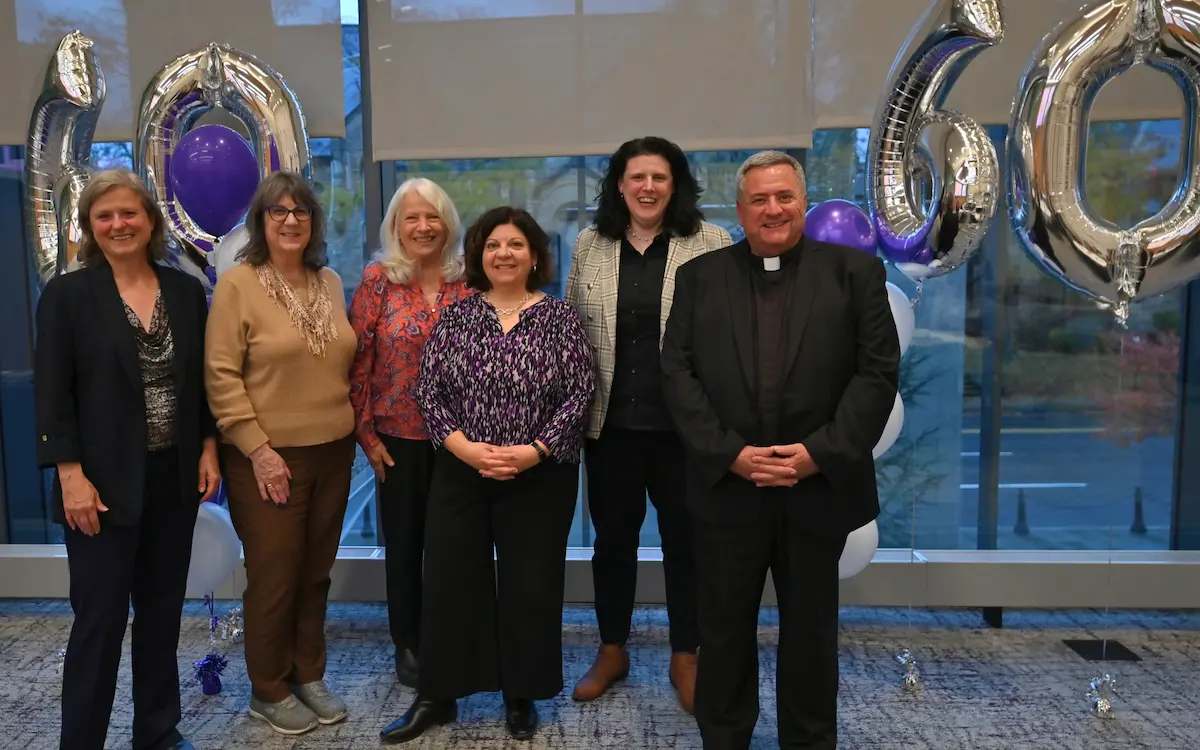 Dierolf, of Larksville, understands better than most the impact that can be made with proper resources and a supportive team.
Diagnosed with autism at three years old, Dierolf was told by professionals that she may never drive nor live independently.
“I got my driver’s license at 16 and have built an independent life while pursuing a meaningful and fulfilling career path,” she said.
While Dierolf kept her diagnosis private for many years, she has openly shared her story in hopes that it inspires others to embrace their identities. This, she believes, will help with treating clients — and it already aided her in other opportunities, such as serving as a job coach and direct support professional for adults with intellectual disabilities at PA Inclusive.
A graduate of Penn State Wilkes-Barre, Dierolf has made the most of her time at Scranton by getting involved with the Performance Music program and earning induction into Chi Delta Rho, the counseling honor society, among other things.
“Each experience has reinforced my commitment to advocacy, accessibility and empowering individuals with disabilities to reach their full potential,” Dierolf said.
Unlike Redis and Dierolf, Sandy completed her undergraduate studies at Scranton. She says she was “forever changed” while pursuing her degree in counseling and human services — and not only because of her coursework and mentors but because of a foundational experience with First-years Involved in Reflective Service Together (FIRST), a weeklong volunteer program that allows students to get involved in the community and see the impact they can make.
After graduating from Scranton in 2023, Sandy, a Scranton native, took a gap year to complete a service experience as an AmeriCorps member at Maggie’s Place in Phoenix, Arizona.
She returned to Scranton in 2024, prepared and inspired to follow another Jesuit ideal of “walking for and with others.”
“We are taught from the beginning of the program that anyone, at any time, can be diagnosed with a disability or acquire one,” Sandy said. “This career path became my passion, but like many counselors, I struggled with impostor syndrome and worrying about working with clients who may have very different life experiences compared to my own. …
“My experience at Maggie’s Place was fundamental in my choice to return to Scranton. I was surrounded by so many individuals with very different life experiences, and at the core of it all, I was relying on my rehabilitation background to support them.”
Sandy, who completed her graduate studies this past spring and was immediately hired by the Pennsylvania Bureau of Blind and Visual Services in Wilkes-Barre, shares fond recollections of the fourth floor of McGurrin Hall, where she was pushed to learn and acquire the skills and tools that she now shares with clients.
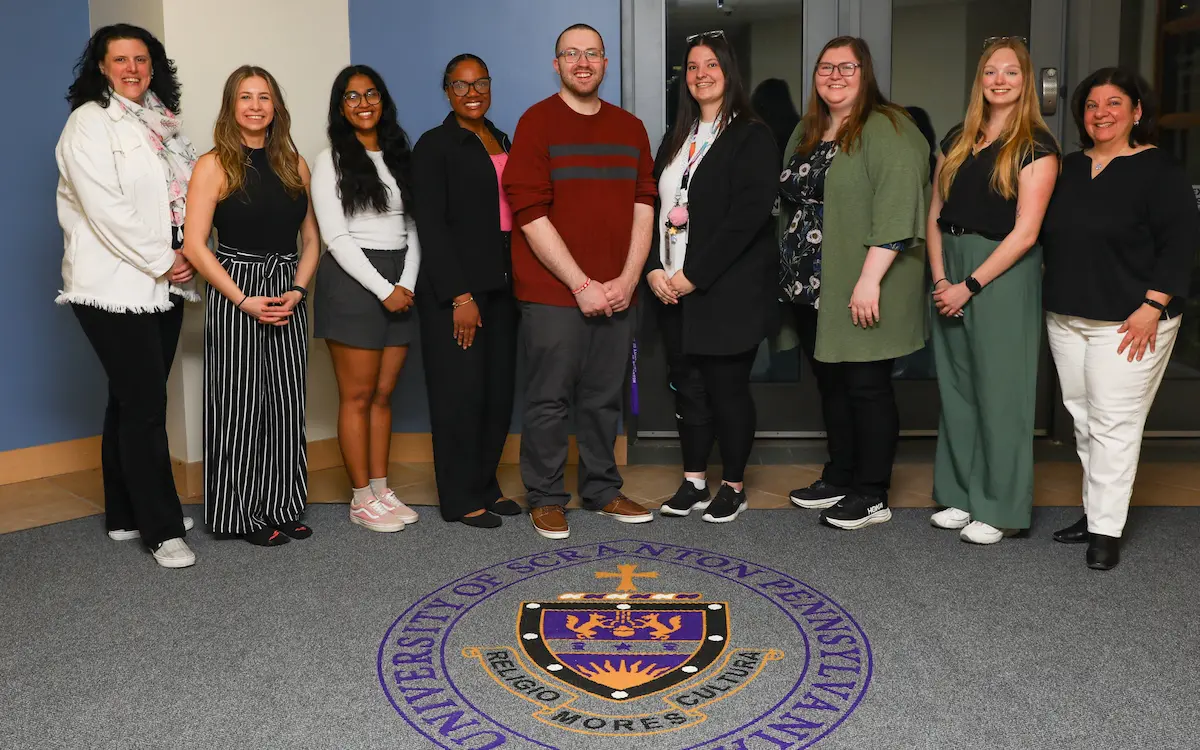 For Sandy, though, those classrooms, hallways and peers represent something even deeper, having suffered the unexpected death in November of her father. She leaned on her clinical rehabilitation counseling community to get through her toughest times, including stepping up to become the legal guardian for her two teenage siblings.
“Many people would offer guidance and share their experiences, which healed me in so many ways,” Sandy said. “It is something I will never, ever forget and something that I will always carry with me. I never felt alone, and there is nothing more important to me than making sure whoever I work with has the same experience. …
“We, as students, get a lot more from this program than just a good education. We get to understand the commitment of showing up for ourselves, our clients and most importantly each other.”
Scranton’s RSA Scholars Support Critical Needs: ‘More Than Just a Good Education’
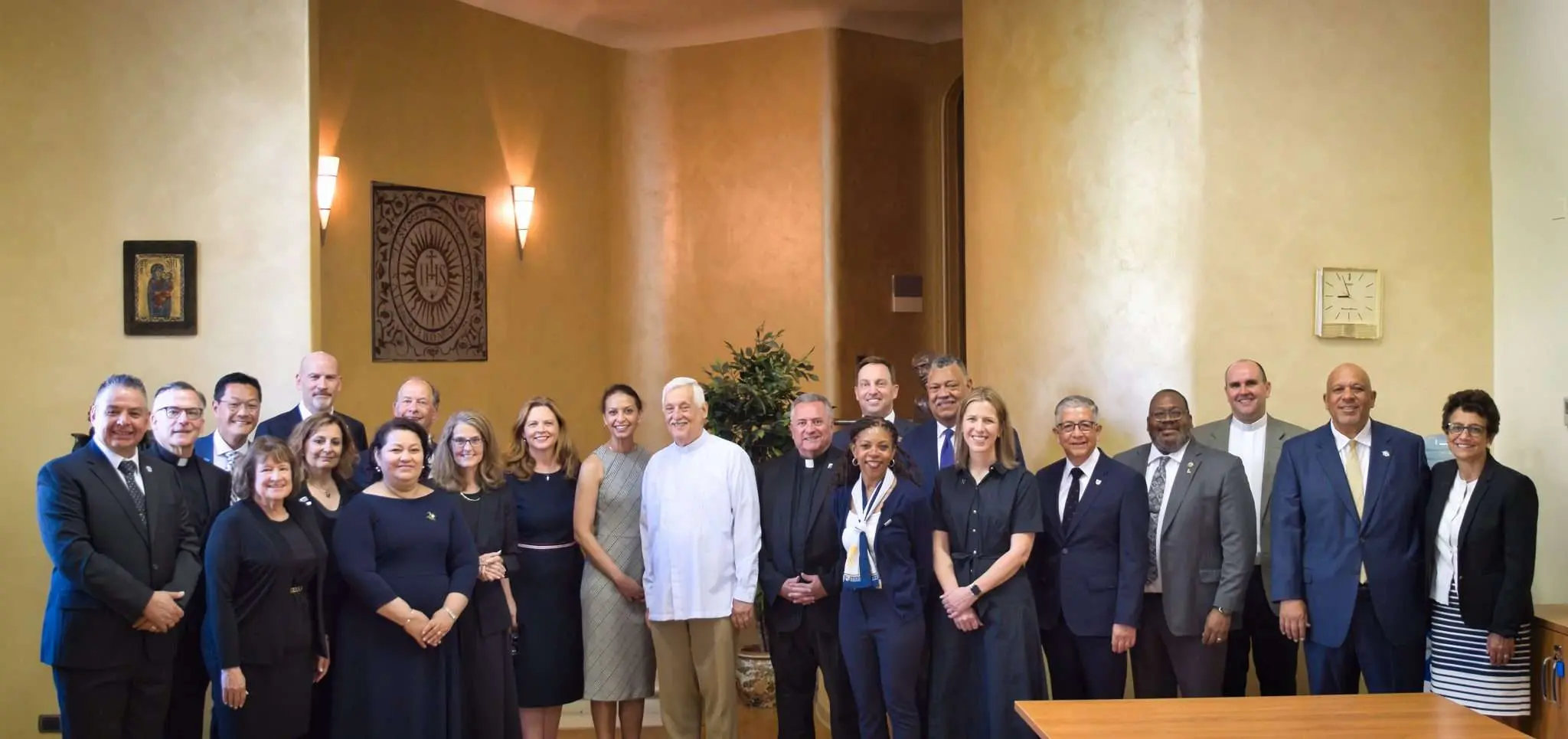
Rev. Joseph G. Marina, S.J., University of Scranton president, took part in a portion of this year's Association of Jesuit Colleges and Universities Presidents’ Pilgrimage to Rome, where he and his peers met Pope Leo XIV.
Father Marina met with the Pope on Thursday, June 25, at Consistory Hall, where Pope Leo acknowledged the challenges facing humanity and higher education.
“Often times young people are left without hope in a world that seems to lack the promise of a better future, and the natural environment continues to be degraded by those who would use the planet’s resources for their own interests instead of for the common good,” Pope Leo said. “Our world is also increasingly aware of the growing impact of artificial intelligence and the wider-ranging effects it can have on humanity.”
Pope Leo encouraged the AJCU delegation to address these challenges, using a framework provided by the Society of Jesus’ four Universal Apostolic Preferences as their guide. The full text of Pope Leo’s address is available online.
“Students normally begin their academic careers full of idealism and energy, often seeking to serve the needs of others,” Pope Leo said. “The studies that take place on your campuses, the friendships that naturally blossom there and the opportunity for all in your academic communities to encounter the thought and research of great scholars, both past and present, can bring a sense of hope and the promise of what could change for the better.”
Father Marina, who entered the Society of Jesus in 2004 and was ordained to the priesthood in 2012, described the experience as “inspiring.”
“It’s hard to describe what it feels like and how inspiring it is when you’re there not only representing yourself, but a much broader reality, namely the mission of Jesuit higher education and The University of Scranton,” Father Marina said. “I was very proud to represent this fine institution that we all know and love so well.
“And I want to bring that experience back here to Scranton. It should not be just a memory and an experience that I had but something that we can all share together.”
Father Marina’s cohort also met with Very Rev. Arturo Sosa, S.J., superior general of the Society of Jesus.
$content.getChild('content').textValueA photograph of the presidents’ meeting with Father Sosa appeared in a news article on the AJCU’s website. A gallery of online images is posted on the Vatican Media website.
Born in Chicago, Pope Leo was elected last year as the United States of America’s first leader of the Roman Catholic Church. His predecessor, Pope Francis, who served from 2013 until his death in 2025, was the first Jesuit pontiff.
Father Marina has served since 2021 as The University of Scranton’s 29th president. He previously served as an administrator at institutions of higher learning including Le Moyne College, where he was provost and vice president for academic affairs and professor of education. He is a graduate of St. John’s University, Boston College and Fordham University.
Founded in 1888, The University of Scranton offers 70 majors, more than 40 graduate programs and has been recognized in recent national rankings by U.S. News and World Report, The Wall Street Journal, Princeton Review and Forbes. The most recent First Destination Survey by the Roche Family Center for Career Development revealed success rates of 99% and 100% for Scranton's undergraduate and graduate members of the Class of 2024.
The Society of Jesus is the Catholic Church’s largest religious order of priests and brothers. The AJCU is comprised of 28 Jesuit colleges and universities spanning 17 states, the District of Columbia and Belize.
Father Marina Reflects on Meeting Pope Leo XIV (Video + Photos)
EDITOR'S NOTE: This message, written by Rev. Joseph G. Marina, S.J., president of The University of Scranton, was shared ahead of Independence Day with members of the University community.
Dear Friends,
Yes, I am old enough to remember the bicentennial celebration of the United States of America in 1976! In fact, it occurred in the same year that I graduated from elementary school. Now, as the USA approaches its 250-year anniversary, Scranton continues to show forth a resilient people and a nation still emerging.
When I moved to Scranton more than five years ago, I carved out a daily walking route that took me through the historic Scranton Iron Furnaces just beyond Fitzpatrick Field. I remember being moved by those moments of stillness, peering over the ledge into the silos and imagining the booming, back-breaking work being done by thousands of Scrantonians in the 19th century.
I learned during my early days in Scranton that, before iron rails and anthracite coal defined the local industry, there was a previous attempt to advance commerce in the Area by manufacturing wrought iron nails. I also read that the nails produced here often failed. They were brittle and broke easily. The venture to build up Northeastern PA nearly went from boom to bust but was saved when proprietors deftly ditched the nails for rails, giving way to something stronger and more enduring.
And yet, the thought of those nails lingers in my mind — an early failure at the root of a story about reinvention and strength.
We know that not all nails fail. In the saving death of Jesus, the nails held. They pierced both his hands and feet, bearing the full weight of suffering and sacrifice as the life of the world itself seemed to give way.
However, something much greater was unfolding. What appeared to be the end was actually a beginning and what seemed to be defined by death was, in fact, transformed into life eternal.
Both stories, one industrial and one sacred, reflect the passage of hardship into something brighter and enduring. Each story reflects the truth of a people and perhaps a nation: that we are formed not only by what succeeds, but by how we endure and respond in the face of challenge. We are saved by grace, not by nationalism.
As we reflect upon America’s 250th birthday through a local lens, what can we discover here in Scranton?
To begin with, our summer is already an active one. The great Big Boy train engine rolled into town a couple of weeks ago with much fanfare, drawing tens of thousands of onlookers. The city’s downtown has “World Cup fever," with fans gathering for live entertainment and festive fun. Incoming first-year students have carried their hopes and dreams onto our campus for New Student Orientation and our summer schedule of camps and conferences is just revving up.
While our coal mines and iron furnaces have been quiet and cool for decades, hard work in our city and at our University has not gone away. It has simply taken on new forms inside classrooms, laboratories, hospitals and small businesses where another kind of labor, which calls for its own endurance and skill, has emerged.
These do not feel like separate moments but signs of life instead, continuing at a place still gathering, still welcoming, still becoming. We do not see a story of uninterrupted success but instead something more honest and human. We see a place and a country shaped by what breaks and by what holds.
On behalf of my Jesuit brothers, please accept my very best wishes and promise of prayers on this great anniversary of our nation. May the very best still lie ahead of us, for our nation and for our mission.
Yours faithfully,
Joseph G. Marina, S.J.
President
Commemorating America’s 250th Anniversary
Retired and ready to serve? Opportunities await with the Ignatian Volunteer Corps of Northeastern Pennsylvania, which matches retirees and people 50 and over to serve at nonprofit partner organizations in Luzerne and Lackawanna counties.
Meet: IVC Member Marie Karam, English Language Tutor at United Neighborhood Centers of Northeast PA
Your work as Director of The University of Scranton’s Language Learning Center for 20 years makes you a natural fit for volunteer service as an IVC member teaching English Language Learners at United Neighborhood Center’s Family Education and School-Aged Tutoring program. For those with little or no experience in teaching, is training offered in advance of volunteer service?
“No experience is required! UNC tutor coordinators provide training materials and an overview of programming. They also schedule observations so that volunteers can see or participate in classes prior to being paired or given a class. Working with one individual may be a good way to start.
As a volunteer with UNC, you become part of a dynamic and caring community, dedicated to making a meaningful difference in the lives of those in need. Whether working with families, seniors, youth, or immigrants, UNC will provide all the support and assistance you need to be successful in your volunteer experience. In addition, the tutor coordinators provide access to training sites, articles and webinars so that volunteers can become more acquainted with teaching English as a Second Language (ESL), the diverse backgrounds of the students and teaching adult learners. Tutor coordinators also schedule quarterly training sessions for all volunteers.”
How many hours do you volunteer each month?
“I tutor one afternoon each week and have worked with the same Hispanic teens for the past three years. They started at age 14 as 8th graders and now are 17 and juniors in high school. Accompanying them on this journey into adulthood has been a great joy and privilege. Each class, they share what has been happening in their lives: the good, the not-so-good, and the challenges.
We also do a very interactive overview of local, national and international news with visuals, articles, fun worksheets and take-home books of interest.
With academic subjects, it is sometimes helpful to provide a quick overview in Spanish of the semester syllabus. ... Then we can proceed in English knowing that we are clear on the objectives.”
I've read that you assist students with their academic assignments and address areas of need, including the basics of ordering lunch at school. Also, you offer tutoring and social support to the entire family. Please share a moment when you realized your efforts were having a significant effect.
“My first tutoring experience with UNC resulted from my accompanying an expectant Congolese woman to her doctor appointments. After meeting her three school-age children in May and realizing they would have no English throughout the summer, I decided (not speaking Swahili) to design some fun, practical, English sessions at their home that featured the menu items they would soon be seeing in the school cafeteria, along with colorful picture binders for each with interactive activities.
The whole family enjoyed tasting a different food each week. Those family sessions were filled with fun and laughter. ...I knew they were enjoying the sessions when other neighborhood Congolese children appeared and joined us as well!"
What advice would you offer to a person considering volunteer service with Ignatian Volunteer Corps (IVC)?
I read an interesting meditation recently, “Don’t get so comfortable where you are that you miss where God wants to take you.”
Do yourself a favor and contact Teddy Michel, IVC Director, and set up a meeting to discuss the many opportunities available. Teddy is great at matching your talents and interests with something you will truly enjoy!
“Do yourself a favor and check out the numerous opportunities. Try one, or several, until you find something you truly enjoy! You cannot imagine the joy you will bring to yourself by investing some time in bringing joy to others.”
Inspired to Give Back?
Members of IVC’s service corps commit one or two days per week to work directly with organizations that address the issues of poverty and marginalization. Corps members gather monthly to reflect prayerfully on their apostolic work and discover the deeper meaning within their service.
Founded in 1995 by two Jesuit priests, Rev. Jim Conroy, S.J., and Rev. Charlie Costello, S.J., IVC matches the talents, skills and life experiences of corps members with the greatest social needs of our time. As a Jesuit-founded organization, corps members transform from ordinary volunteers to contemplatives in action. Seeking the presence of God in each person, they bring their stories back to one another in community to reflect, enrich, teach and learn.
Considering Ignatian Volunteer Corps? Learn About Their Work With United Neighborhood Centers
More than 200 employees attended an Employee Wellness Kick-Off to Summer event hosted on campus June 10 by the Center for Health Education and Wellness (CHEW.) The free event included wellness resources, raffles, lunch and conversations.
There is still time to complete the Employee Wellness Survey. Everyone who completes the survey will be entered into a raffle for additional prizes. Feedback helps CHEW continue improving wellness programs and events.
Click Here to take the survey.
The CHEW staff extends thanks to:
-
Wellness Committee members, for promoting the event, securing donations, assisting with setup and serving as Wellness Ambassadors
-
Student Health Services and the Counseling Center
-
Facilities team
-
Joe Boyd and Aramark team for providing a delicious lunch and donating raffle prizes
-
All raffle prize donors
-
Wellness vendors
-
Staff Senate for helping to sponsor this year's employee gift - mugs!
Congratulations to our raffle winners who have been contacted by phone. Anyone who has not yet claimed their prize should contact chew@scranton.edu.
CHEW: 200 Attend Employee Wellness Kick-Off to Summer
David Dzurec, Ph.D., associate provost for academic affairs and professor of history, recently achieved a 1310-plus-mile milestone: running a marathon in all 50 states. On June 20, he crossed the finish line at the Mayor’s Marathon in Anchorage, Alaska.
The feat, 30 years in the making, began in 1996 when Dr. Dzurec ran the Vermont City Marathon. Since then, he has logged 55 marathons in total with a few Jesuit connections along the way, most recently in the form of logistical guidance from interim provost and senior vice president for academic affairs Tracy Stewart.
“It was a fun coincidence that Tracy Stewart is from Anchorage and knew the course well. I was grateful to my boss for the insider scoop, which was very helpful as I prepared,” said Dr. Dzurec, who also shared his appreciation to the University community at large.
“Being a part of a community, especially the University of Scranton community, really helps make all of this possible and helped to keep me motivated. Cross Country/Track Coach Bill Burke has been a regular source of support and provided me with an opportunity to run with our teams over the last two decades.
“I am grateful to everyone who would stop me on campus and ask where I was in my states list. Members of the campus community have run with me at different times, including Dr. Jim Roberts, criminal justice, Dr. Adam Pratt, history, and Dr. Megan Heeder, theology, who will be running the Sydney Marathon in a few weeks.”
The quest for 50 states took Dr. Dzurec to some of the most storied races in the country, including the Boston Marathon, New York City Marathon, shown below, Chicago Marathon and Marine Corps Marathon in Washington, D.C. 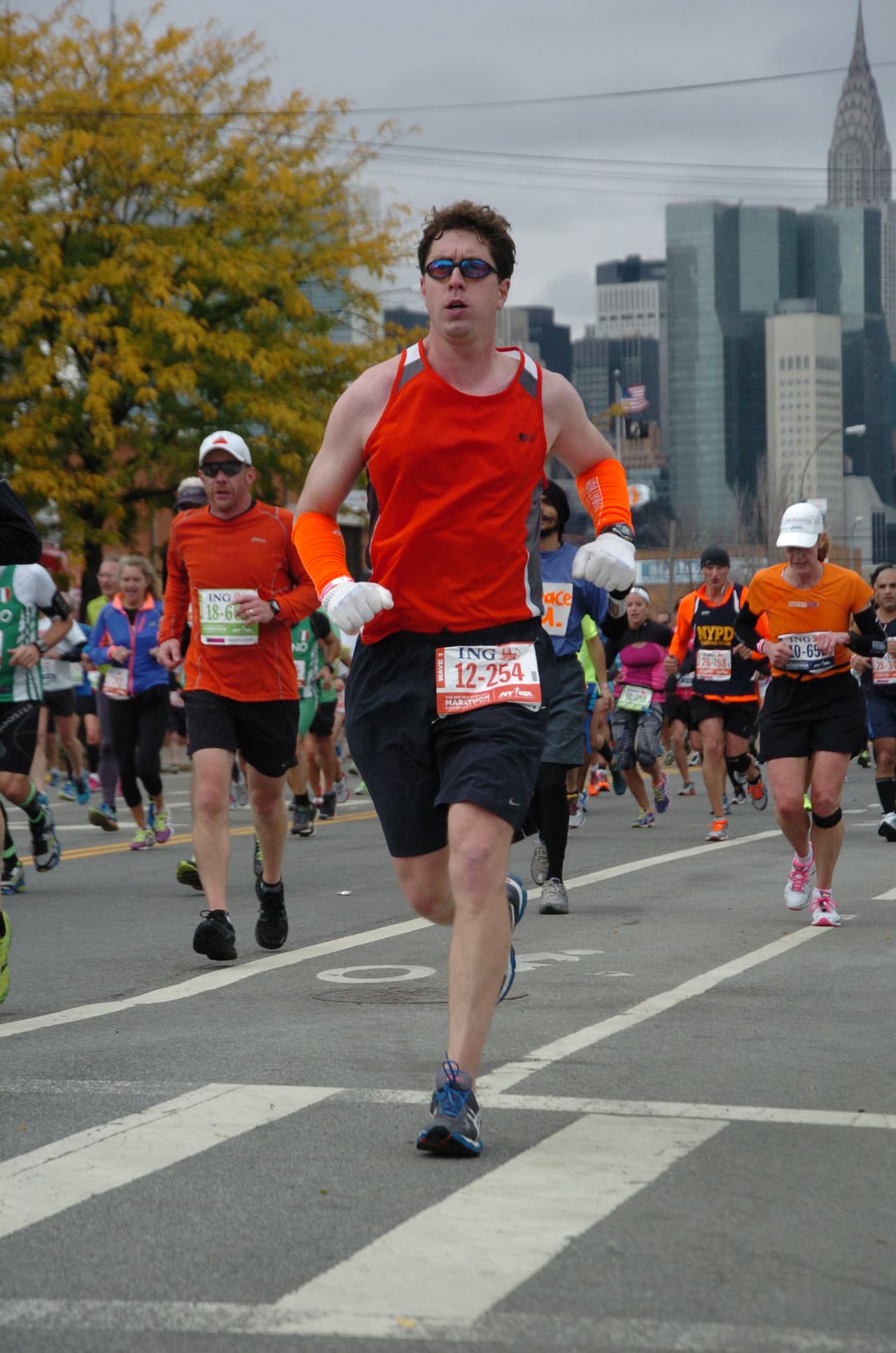
Journey Begins With Service
Dr. Dzurec's marathon journey began in 1999 while he was participating in volunteer service on the West Coast.
“My senior year at Fairfield in 1999, I went to visit a friend, and we watched the Boston Marathon from the Boston College campus at the top of Heartbreak Hill. ... That fall, while participating in AmeriCorps in Southern Oregon, I ran the California International Marathon in Sacramento, and managed to qualify for Boston. After Boston in April 2000, I decided to try to run a marathon in all 50 states.”
After three decades of distance-running dedication in North America, Dr. Dzurec said he’s considering the World Majors Marathons.
“The original six include Boston, Chicago, New York, London, Berlin and Tokyo. Since I've already run half, I'm considering the remaining three to complete the cycle. They've recently added Sydney and Cape Town, so I could add those if I'm really ambitious,” Dr. Dzurec said.
Memorable Pin Drops on the Marathon Map
Dr. Dzurec shared a few notable runs that round out his favorite list, in addition to the prestigious marathons in Boston, New York and Chicago.
A few with historical significance presented scholarly encounters for this subject matter expert.
-
Alabama. “The Birmingham Marathon was striking when I realized the phrase ‘Black Lives Matter’ had been painted down the middle of the street in a city once known as ‘Bombingham’ because of the bombing of black churches during the Civil Rights movement.”
-
Arkansas. “The Little Rock Marathon ran by Little Rock Central High School, of the 1957 Little Rock Nine.”
-
Texas. “The Dallas Marathon ran right by the Texas School Book Depository.”
-
South Dakota. “The Crazy Horse Marathon started at the Crazy Horse Memorial in the Black Hills.”
Others offered a glimpse of the country’s purple mountain majesty.
-
Maine. “The Mount Desert Island, shown below, ran through Acadia National Park, was one of the most beautiful.”
Still others presented tests of endurance.
-
Colorado. “Steamboat Springs was the highest elevation, at 8,200 feet above sea level.

Dr. David Dzurec in the Mount Desert Island Marathon in Maine, shown above.
And, perhaps two of the most memorable runs resulted in a lifelong partnership and a quintessential Alaska family experience.
-
Hawaii. “My wife and I met while running cross country at Fairfield (University.) So, on our honeymoon we went to Maui, where I ran the full marathon, shown below, and she ran the half.

-
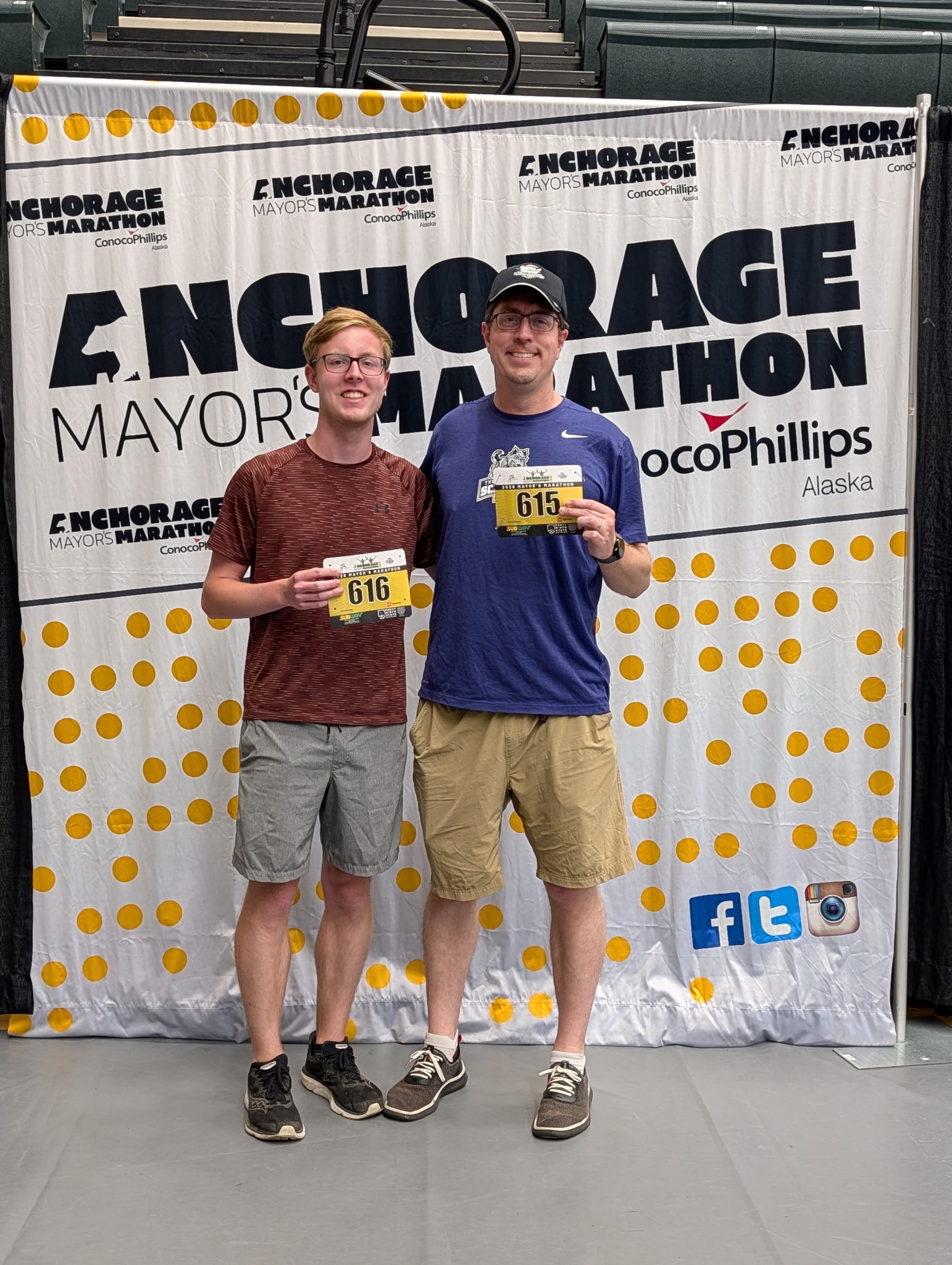
Alaska. “My wife also ran the half in Anchorage. ... My son David, shown below, who was running his first marathon, and my brother Paul both ran with me. At about mile 22, there was a moose with two calves on the edge of the course. (There were also two police officers there to ensure this was without incident.)
Associate Provost David Dzurec, Ph.D., Completes Marathon in 50 States
The University of Scranton will present the President’s Medal to Robert S. ’68 and Marilyn A. Weiss at the President’s Medal Gala Thursday, Oct. 1, at Pier Sixty, Manhattan’s largest waterfront event venue. Watch a short video message featuring Rev. Joseph G. Marina, S.J., University president, announcing the University’s intent to honor Bob and Marilyn here.
The event is the premier annual fundraiser for the University, and proceeds from the dinner benefit the Presidential Scholarship Endowment Fund, which awards four-year, full-tuition scholarships to incoming first-year students with outstanding high school records and notable community involvement. The University presents the President’s Medal to individuals who have achieved excellence in their fields and who have demonstrated extraordinary compassion for others. All alumni, parents and friends of the University are welcome and encouraged to register here for this year’s event.
Scranton has held a special place in the hearts of Bob and Marilyn ever since they met at a “U Dance” at the Gunster Memorial Student Center in 1966. Their 2015 gift of $1.25 million resulted in the creation of the Robert and Marilyn Weiss Pediatric Low Vision Research and Training Suite, and their 2016 gift of $1 million established Robert and Marilyn Weiss Field as a first-class home for Scranton’s soccer, lacrosse and field hockey teams. In 2024, their gift of $10.5 million, the largest single donation in the history of the University, blossomed into the four-story, 90,000 square-foot Robert S. and Marilyn A. Weiss Hall. The building houses the University’s Department of Criminal Justice, Cybersecurity and Sociology, the Department of Psychology, Student Health Services, the Center for Health, Education and Wellness, the Small Business Development Center, the University of Success, and the state-of-the-art IDEA Center, which features woodworking, 3D printing, laser engraving, sewing and audio recording capabilities.
A native of Lake Ariel, Bob became the first person in his family to attend college when he began studying accounting through the University’s ROTC program. As a U.S. Army Captain, he was awarded two Bronze Stars and the Army Commendation Medal for his service in Vietnam. He became a certified public accountant and began working as an assistant corporate controller in 1977 at Cooper Laboratories Inc., which would eventually become The Cooper Companies, Inc., a multinational manufacturer and marketer of specialty healthcare products with annual revenues exceeding $4 billion.
Bob rose through the ranks at Cooper during a remarkable 41-year career, serving as corporate controller, treasurer, chief financial officer, chief operating officer, president of Coopervision, and, ultimately, president and CEO. During Bob’s time at the company, Cooper had a number of industry-defining breakthroughs, including the development of intraocular lenses and Lasik surgery, two advancements that have helped millions see more clearly. Under Bob’s leadership, the company sought to address the approximately 50% of children and young adults aged 5-22 who are suffering from progressive myopia, a condition that often leads to eye diseases such as cataracts, glaucoma, retinal detachment and macular degeneration later in life, by developing MiSight, a soft contact lens that was ultimately approved by the FDA in 2019 for myopia management in children aged 8-12. Bob was named the “Most Admired CEO of 2012” by the San Francisco Business Times, and he was recognized with the Albert Nelson Marquis Lifetime Achievement Award for 2017-2018. After retiring in 2018, he became the chair of Cooper’s board of directors through January of 2026, and he remains on its board today.
Bob was honored by the University with the Frank J. O’Hara Distinguished Alumni Award in 2008. As a University trustee, he became informally known as “the pizza guru” due to his unabashed love of and enthusiasm for the pizza of Northeastern Pennsylvania. He also sponsors the Pediatric Refractive Error Training Center, an eyecare clinic in Hanoi, Vietnam, that trains optometrists to fight the growing pandemic of myopia.
A native of South Scranton, Marilyn studied at the University through the Scranton State General Hospital School of Nursing. She served as the head nurse at the Edward S. Harkness Eye Institute at Columbia Presbyterian Medical Center in New York and as a pediatric nurse at Bayside Pediatrics in Pleasanton, California.
Bob and Marilyn are frequent sponsors of local charitable causes in the San Francisco East Bay area, including Goodness Village, which provides tiny homes and supportive services to the Tri-Valley’s formerly unhoused neighbors, Valley Humane Society, and the Bay Area Military Classic & The Joey Graves Memorial Golf Tournament, which supports Gold Star Families.
The couple are the proud parents of three children, Chris, Kim and Doug, and they are blessed with two grandchildren, Kylie and Jayden. They reside in Pleasanton, California.
An Ambitious Goal
At last year’s gala, Rev. Joseph G. Marina, S.J., University president, announced an ambitious University-wide effort to permanently endow the Presidential Scholarship Endowment Fund by raising an additional $7 million through the 2025 and 2026 President’s Medal Galas, which would bring its lifetime total up to $30 million.
“In 2002, The University of Scranton embarked upon a marathon endeavor when it held its first award dinner in support of the Presidential Scholarship Endowment Fund,” said Father Marina in a video announcing the initiative. “We are only $7 million away from securing the future of The Presidential Scholarship Endowment Fund and ensuring that our Presidential Scholars will continue to thrive at the University forever.
“Help us write the ending this 25-year marathon deserves.”
Visit this link to support Presidential Scholarships at The University of Scranton.
For more information on the President’s Medal Gala, contact Associate Vice President of Development Eric Eckenrode at eric.eckenrode@scranton.edu or Executive Director, Annual Giving & Campus Partnerships Brad Troy ’02 at bradley.troy@scranton.edu.
Registration Now Open for the President’s Medal Gala Oct. 1
Thirty-one members of The University of Scranton’s class of 2026 graduated from the University Honors Program, which is one of the Jesuit university’s programs of excellence. Undergraduate students in the Honors Program pursue a rigorous education that stresses independent work through close engagement with professors and other honors students, including the preparation, presentation and defense of a research or creative project during their senior year.
The following is a list of the class of 2026 University Honors Program graduates and their faculty mentors and their research projects.
Amber H. Armitage, Stroudsburg, graduated, summa cum laude, as a neuroscience major. Armitage worked with faculty advisor Marc Seid, Ph.D., professor of biology, on a thesis project titled "Neuroprotective Effects of Pagonomyrmex badius Venom on PTZ-Induced Seizure Activity in Camponotus floridanus."
David P. Banko, Wind Gap, graduated, summa cum laude, as a biochemistry major. Banko worked with faculty advisor Michael Fennie, Ph.D., professor of chemistry, on a thesis project titled "Syntheses of 4-Azidoproline and 4-Cyanamidoproline."
Connor Patrick Brophy, Macungie, graduated, cum laude, as a biochemistry, cell, molecular biology major and member of the Magis Honors Program in STEM. Brophy worked with faculty advisor Riddhiman Medhi, Ph.D., assistant professor of chemistry, on a thesis project titled "Silver Nanoparticles & Sensing Capabilities Ysiny Machine Learning and Statistics."
Christopher G. Conboy, Yardley, graduated, magna cum laude, as a neuroscience major and member of the Special Jesuit Liberal Arts Honors Program. Conboy worked with faculty advisor Marc Seid, Ph.D., professor of biology.
Erica C. Czerwinski, Burlington, Massachusetts, graduated, summa cum laude, as a psychology and philosophy double major and member of the Special Jesuit Liberal Arts Honors Program. Czerwinski worked with faculty advisor Jill A. Warker, Ph.D., associate professor of psychology, on a thesis project titled "The Effect of Different Types of Lies on Destination Memory."
Philip R. Danchik, Woodbine, Maryland, graduated as a chemistry major. Danchik worked with faculty advisor Riddhiman Medhi, Ph.D., assistant professor of chemistry, on a thesis project titled "Removal of Methylene Blue Dye from Water by Magnetic Nio.6Co0.4Fe2O4 Nanoparticles in a Silica Matrix."
Ethan C. Distler, Royersford, graduated, cum laude, as a mechanical engineering major. Distler worked with faculty advisor Mojib Saei, Ph.D., assistant professor of physics and engineering, on a thesis project titled "Transmission Maintenance Mount."
Rebecca R. Doyle, Massapequa, New York, graduated, summa cum laude, as a neuroscience and physiology double major and member of the Special Jesuit Liberal Arts Honors Program. Doyle was the recipient of the University's four-year, full-tuition Presidential Scholarship. Doyle worked with faculty advisor Krisy Elrod, Ph.D., assistant professor of counseling and human services, on a thesis project titled "Music on the Brain - A Neurological and Philosophical Review of the Emotional Processing of Songs."
Marc K. Guillet, Lindenhurst, New York, graduated, magna cum laude, as a biology major. Guillet worked with faculty advisor Robert Smith, Ph.D., professor of biology, on a thesis project titled "Effects of Parasite Load, Body Condition."
Marilyn Keating, New Providence, New Jersey, graduated, summa cum laude, as a communication sciences and disorders major. Keating worked with faculty advisor Hope Baylow, D.A., associate professor of health and human performance, on a thesis project titled "Managing ARFID and PFD in Neurodevelopmental Disorders: A Scoping Review of Behavioral and Feeding Treatments."
Madison Jean Kuharchik, West Pittston, graduated, magna cum laude, as a forensic chemistry major. Kuharchik worked with faculty advisor John C. Deak, Ph.D., professor of chemistry, on a thesis project titled "Using Partial Molar Volume to Determine Differences in Glucose Molecular Properties."
Jenna M. LaBarca, Tuckahoe, New York, graduated, summa cum laude, as a English and criminal justice double major. LaBarca worked with faculty advisor Michael J. Jenkins, Ph.D., professor and chair of the Department of Criminal Justice, Cybersecurity and Sociology, on a thesis project titled "Comparison of the American and Italian Legal Systems through the Maxi Trials, Amanda Knox Trial and O.J. Simpson Trial."
Grace V. Lennox, Peckville, graduated, summa cum laude, as a political science and philosophy double major and member of the Special Jesuit Liberal Arts Honors Program. Lennox worked with faculty advisor Joyanna S. Hopper, Ph.D., associate professor of political science, on a thesis project titled "Local Labor Leadership & Political Approaches in Northeastern Pennsylvania."
Grace L. Lloyd, Yardley, graduated, summa cum laude, as an individualized major and member of the Magis Honors Program in STEM. Lloyd worked with faculty advisor Marc Seid, Ph.D., professor of biology, on a thesis project titled "Computational Modeling of Temperature-Dependent Prion Protein Misfolding."
Allison M. Magee, Harleysville, graduated, summa cum laude, as a mathematical sciences and economics - social sciences double major. Magee was the recipient of the University's four-year, full-tuition Presidential Scholarship. Magee worked with faculty advisor Aram R. Balagyozyan, Ph.D., associate professor of economics, finance and international business, on a thesis project titled "Hot-handed Effect and Gambler's Fallacy in Equity Markets: Evidence from Short-selling Data."
Ian T. Mahalek, Fairfax, Virginia, graduated, summa cum laude, as an environmental science major. Mahalek worked with faculty advisor Christopher Howey, Ph.D., associate professor and chair of the Biology Department, on a thesis project titled "The Effects of Prescribed Fire on Stream Habitats and Impact on Salamander Biodiversity."
Thomas Edward Marine, Cockeysville, Maryland, graduated, magna cum laude, as a biochemistry major and member of the Special Jesuit Liberal Arts Honors Program. Marine worked with faculty advisor Marc Seid, Ph.D., professor of biology, on a thesis project titled "Synthesis of Tetraarylmethanes and Diaryl Ethers."
Dylan P. Matamala, New Rochelle, New York, graduated, cum laude, as a psychology major. Matamala worked with faculty advisor Jason Shrive, J.D., faculty specialist for criminal justice, cybersecurity and sociology, on a thesis project titled "From Amateurism to Professionalism: The Legal Evolution and Future of Name, Image, and Likeness (NIL) in College Athletics."
Kylie K. Matulich, Bellmore, New York, graduated, summa cum laude, as a business administration major. Matulich worked with faculty advisor Rose Sebastianelli, Ph.D., professor of operations and analytics, on a thesis project titled "An Empirical Examination of the Bloomberg Gender Equity Index."
Nathan A. Micknick, Jermyn, graduated, magna cum laude, as a biology major. Micknick worked with faculty advisor Gary Kwiecinski, Ph.D., professor of biology, on a thesis project titled "Androgen and Estrogen Impacts on Bone Development."
Faith E. Montagnino, Morganville, New Jersey, graduated, summa cum laude, as an English major and member of the Special Jesuit Liberal Arts Honors Program. Montagnino worked with faculty advisor Billie R. Tadros, Ph.D., associate professor of English and theatre, on a thesis project titled "The Wound as Method: Pain, Language, and Feminist Knowledge in Confessional and Post-Confessional Poetry."
Michael R. Nicotera, Mountain Top, graduated, magna cum laude, as an economics and philosophy double major and member of the Special Jesuit Liberal Arts Honors Program, the Frank P. Corcione Business Honors Program and the Robert L. McKeage Business Leadership Honors Program. Nicotera worked with faculty advisor Andrew T. LaZella, Ph.D., professor of philosophy, on a thesis project titled "Marx Was a German Philosopher: Misunderstanding and Mischaracteriation of the Labor Theory of Value."
Janvi R. Patel, Scranton, graduated, magna cum laude, as an English major. Patel worked with faculty advisor Robert (Hank) Willenbrink, Ph.D., professor of English and theatre, on a thesis project titled "Autonomy: The Quest."
Kiera K. Ronan, Mamaroneck, New York, graduated as a neuroscience major.
Melissa J. Schweizer, Sparta, New Jersey, graduated, cum laude, as a nursing major.
Therese J. Shimkus, Scranton, graduated, summa cum laude, as a historyand philosophy double major.Shimkus worked with faculty advisor Patrick A. Tully, Ph.D., professor and chair of the Philosophy Department, on a thesis project titled "Natual Law and the Death Penalty."
Samantha R. Sonnie, Philadelphia, graduated, summa cum laude, as a journalism and electronic media major. Sonnie worked with faculty advisor Brian J. Snee, Ph.D., associate professor of communication and media, on a thesis project titled "Conspiracy Theories and The Media: Q'Anon Theory."
John C. Thomas, Danville, graduated, magna cum laude, as a neuroscience and philosophy double major and member of the Special Jesuit Liberal Arts Honors Program. Thomas worked with faculty advisor Marc Seid, Ph.D., professor of biology, on a thesis project titled "The Effects of CO2 on Memory in Camponotus floridanus."
Ashlyn Urbanski, Pittston, graduated, summa cum laude, as a neuroscience and mathematical sciences double major. Urbanski was the recipient of the University's four-year, full-tuition Presidential Scholarship. Urbanski worked with faculty advisor Joseph J. Klobusicky, Ph.D., professor of mathematics, on a thesis project titled "Two Problems in Computational Geometry."
Jordon B. Wagner, Falls, graduated, magna cum laude, as a biology major. Wagner worked with faculty advisor Marc Seid, Ph.D., professor of biology, on a thesis project titled "Integration of Haltere Feedback with Physical Stimuli in Dipterans."
Jared P. White, Clarks Summit, graduated, summa cum laude, as a political science and philosophy double major. White worked with faculty advisor Joyanna S. Hopper, Ph.D., associate professor of political science, on a thesis project titled "Trust in the Digital Age: Podcasts, Alternative Media, and the Reconfiguration of Institutional legitimacy."
Sean Brennan, Ph.D., professor of history, serves as the director of the University Honors Program.Class of 2026 University Honors Program Graduates
Thirty-four members of The University of Scranton’s class of 2026 graduated from its Special Jesuit Liberal Arts Honors Program (SJLA), which is one of Scranton’s programs of excellence. Students in SJLA pursue a rigorous education designed to develop enhanced writing, oral and critical-thinking skills through specially designed courses in philosophy, theology and literature.
The following is a list of the class of 2026 SJLA Honors Program graduates and their majors.
Dermot I. Alvidrez, Summit, New Jersey, graduated as a journalism and electronic media major.
Jordan L. Badman, Sunbury, graduated, summa cum laude, as a kinesiology major.
Jamison C. Bessoir, Clarks Summit, graduated, magna cum laude, as a management and philosophy double major.
Emily R. Carey, Monroe Township, New Jersey, graduated, summa cum laude, as a public policy and service and philosophy double major.
Aryan M. Chandavarkar, Westborough, Massachusetts, graduated as an electrical engineering and philosophy double major.
Christopher G. Conboy, Yardley, graduated, magna cum laude, as a neuroscience major and member of the University Honors Program
Adelle K. Confer, Canton, graduated, magna cum laude, as an English and philosophy double major.
Erica C. Czerwinski, Burlington, Massachusetts, graduated, summa cum laude, as a psychology and philosophy double major and member of the University Honors Program
Sophia C. da Costa, Ambler, graduated, cum laude, as a neuroscience and philosophy double major.
Lauren N. DeSantis, Copiague, New York, graduated, magna cum laude, as an English and philosophy double major.
Mason S. DiCesare, Feasterville Trevose, graduated as a biochemistry, cell and molecular biology major.
Joseph T. Dolan, Conshohocken, graduated, summa cum laude, as a computer science major.
Rebecca R. Doyle, Massapequa, New York, graduated, summa cum laude, as a neuroscience and physiology double major and member of the University Honors Program. Doyle is also the recipient of the University's four-year, full-tuition Presidential Scholarship.
Kevin P. Finning, Rockville Centre, New York, graduated, summa cum laude, as a history and philosophy double major.
Roseanna L. Hessler, Warrington, graduated as a neuroscience major.
Sean H. Kavanagh, White Plains, New York, graduated, summa cum laude, as a history and philosophy double major.
Grace V. Lennox, Peckville, graduated, summa cum laude, as a political science and philosophy double major and member of the University Honors Program
Thomas E. Marine, Cockeysville, Maryland, graduated, magna cum laude, as a biochemistry major and member of the University Honors Program
Sofia Mastellone, Wayne, New Jersey, graduated, summa cum laude, as a psychology major and member of the Robert L. McKeage Business Leadership Honors Program
Joseph J. Mazich, Sparta, New Jersey, graduated, summa cum laude, as a business analytics major.
Molly R. McGuinness, Stewart Manor, New York, graduated, magna cum laude, as a communication sciences and disorders major.
Olivia N. Miller, Phoenixville, graduated, summa cum laude, as an operations management major and member of the Frank P. Corcione Business Honors Program
Faith E. Montagnino, Morganville, New Jersey, graduated, summa cum laude, as an English major and member of the University Honors Program
Michael R. Nicotera, Mountain Top, graduated, magna cum laude, as an economics and philosophy double major and member of the Frank P. Corcione Business Honors Program, Robert L. McKeage Business Leadership Honors Program and the Undergraduate Honors Program
Thomas W. Noll, Scranton, graduated as a biology and philosophy double major.
Brian M. O'Connor, Sussex, New Jersey, graduated, summa cum laude, as a mechanical engineering major.
Buse Z. Onat, S Abington Twp., graduated, cum laude, as a cybercrime and homeland security, criminal justice and philosophy triple major.
Gabriella M. Palmer, Phoenixville, graduated, magna cum laude, as an English and theatre major.
Sophia G. Perrin, Milford, graduated, cum laude, as a History, philosophy and theology and religious studies triple major.
Rebecca F. Potter, Hasbrouck Heights, New Jersey, graduated, summa cum laude, as a physics and philosophy double major.
John C. Thomas, Danville, graduated, magna cum laude, as a neuroscience and philosophy double major and member of the University Honors Program
Nicholas S. Tollefsen, Rockville Ctr, New York, graduated, magna cum laude, as a finance and philosophy double major and member of the Frank P. Corcione Business Honors Program
Joseph T. Vazquez, Nutley, New Jersey, graduated, summa cum laude, as a psychology and philosophy double major.
Molly E. White, Scranton, graduated, summa cum laude, as a communication major.
Daniel Haggerty, Ph.D., professor and chair of the Philosophy Department, serves as the director of the Special Jesuit Liberal Arts Honors Program.
Special Jesuit Liberal Arts Honors Program Graduates
The University recently launched “Royals Remember 9/11,” a new initiative that will mark the 25th anniversary of the Sept. 11, 2001, attacks.
As part of the project, the University will reintroduce “Making Meaning of 9/11,” a first-year seminar taught by Teresa Grettano, Ph. D., associate professor in the Department of English and Theatre, to assist current students’ efforts to understand the multi-faceted legacy of 9/11.
“Most of today’s students were born after 2001 and know 9/11 only as history,” Dr. Grettano said. “Through both academic programming and broader campus initiatives, we hope to help students understand not only the events of that day, but also the profound ways they shaped our nation, our communities and our lives.”
Plans for the project include taking students to the National September 11 Memorial Museum in New York and hosting the FealGood Foundation, an organization that assists emergency personnel and educates elected officials and private entities on the issues faced by first responders, on campus.
Given the focus of the project, Alumni Society Advisory Board Chair Christopher Neumann, Esq. ’87, P ’24, ’27 is hopeful that the Scranton alumni community will support the initiative.
“This is a meaningful opportunity for our alumni community to help preserve the memory of 9/11 while supporting student learning and reflection,” he said. “As someone who was deeply affected by 9/11, remembering that day, and the service opportunities that now arise from it, are extremely important to me.”
Support “Royals Remember 9/11” here.University Launches ‘Royals Remember 9/11’ Initiative
Seven members of The University of Scranton’s class of 2026 graduated from its Magis Honors Program in STEM. The program, which is one of the Jesuit school’s five honors programs. combines the development of STEM knowledge and research techniques with programming to further the students’ understanding of the impact science has on society.
The Magis Honors Program in STEM offers talented students a more intense, interdisciplinary experience of research in science, technology, engineering and mathematics (STEM). Courses taken over four years at Scranton combine a series of seminars on STEM and society with humanities courses. With guidance by faculty mentors, the students in the program develop, present and defend a thesis based on their individual research projects. In addition, the program requires participation in annual community service projects as well as professional development programs.
The following members of Scranton’s class of 2026 graduated as members of the Magis Honors Program in STEM.
Connor P. Brophy, Macungie, graduated, cum laude, as a Biochemistry, Cell and Molecular Biology major and as a member of the University Honors Program. Brophy worked with faculty mentor Riddiman Medhi, Ph.D., assistant professor of chemistry, on a thesis project entitled "Silver nanoparticles (AgNPs) and their ability to detect things in the environment."
Alyssa M. Cosklo, Fell Township, graduated, summa cum laude, as a Biology major. Cosklo worked with faculty mentor Amelia Randich, Ph.D., associate professor of biology, on a thesis project entitled "Characterizing the growth and morphology/reproductive method of the marine Caulobacteria Henriciella pelagia." Cosklo is the recipeint of the University's four-year, full-tuition Presidential Scholarship.
Grace L. Lloyd, Yardley, graduated, summa cum laude, as an individualized major and as a member of the University Honors Program. Lloyd worked with faculty mentor Marc Seid, Ph.D., professor of biologyon a thesis project entitled "Thermal dynamics of prion and protein misfolding: A compuational approach."
Alexa R. Martinez, Walden, New York, graduated, summa cum laude, as a Biochemistry, Cell and Molecular Biology major. Martinez worked with faculty mentor Michael Hague, Ph.D., assistant professor of biology, on a thesis project entitled "Effects of transmission of the parasite Wolbachia."
Sheldon S. Myers, Downingtown, graduated, summa cum laude, as a Biochemistry major. Myers worked with faculty mentor Michael Fennie, Ph.D., professor of chemistry, on a thesis project entitled “Cyano and Azido Tryptophan Probe Synthesis for Use in 2D IR Spectroscopic Protein Structure Elucidation.”
Hailey C. Patts, Harding, graduated, summa cum laude, as a Biochemistry major. Patts worked with faculty mentor Michael Fennie, Ph.D., professor of chemistry, on a thesis project entitled "Effects of the estrous cycle on Parkinson's Disease in female mice."
Daniella M. Scanlon, Goshen, New York, graduated, magna cum laude, as a Neuroscience major. Scanlon worked with faculty mentor Chris Howey, Ph.D., associate professor and chair of the Biology Department, on a thesis project entitled "Ambient light at night and how it affects the behavior of male anoles."
Declan Mulhall, Ph.D., professor of physics and engineering, and Amelia Randich, Ph.D., associate professor of biology, serve as the directors of the Magis Honors Program in STEM.
Class of 2026 Graduates of Magis Honors Program in STEM
Six members of The University of Scranton’s class of 2026 graduated from its Frank P. Corcione Business Honors Program, which is one of Scranton’s programs of excellence. Students in this program undergo four years of honors studies in the areas of economics, entrepreneurship, operations management, accounting, finance, international business, marketing and management, as well as a series of personal development extracurricular activities in the areas of service and career building.
The Business Honors Program students presented their senior projects to a panel of judges in early May. Grace Boyle received the award for best senior project, and Colin Merriman and Frederick Rollo received honorable mention awards.
The following is a list of the class of 2026 Business Honors Program graduates and their majors, as well as their faculty mentors and research project.
Karleigh A. Capobianco, Long Beach, New York, graduated, magna cum laude, as a business analytics major. Capobianco was also a member of the Robert L. McKeage Business Leadership Honors Program. Capobianco worked with faculty advisor David Mahalak, Ph.D., professor of operations and analytics, on a thesis project titled "Uncovering the Impact of Social ESG Through Firm Clustering."
Dean J. Finan, Malvern, graduated, summa cum laude, as a finance and business analytics major. Finan was also a member of the Robert L. McKeage Business Leadership Honors Program and was the recipient of the University's four-year, full-tuition Presidential Scholarship. Finan worked with faculty advisor Pedro Monteiro, Ph.D., assistant professor of finance, on a thesis project titled "Government Spending Uncertainty and the Systematic Risk of Corporate Bonds: Asymmetric Effects Across Credit Quality."
Olivia N. Miller, Phoenixville, graduated, summa cum laude, as an operations management major. Miller was also a member of the Special Jesuit Liberal Arts Honors Program. Miller worked with faculty advisor Ozgur Isil, M.B.A., Ph.D., associate professor of operations and analytics, on a thesis project titled "Overproduction by Design: How Fast Fashion Supply Chains Drive Textile Waste and the Offsets of Secondhand Market Solutions."
Michael R. Nicotera, Mountain Top, graduated, magna cum laude, as an economics and philosophy major. Nicotera was also a member of the Special Jesuit Liberal Arts Honors Program, Robert L. McKeage Business Leadership Honors Program and the Undergraduate Honors Program. Nicotera worked with faculty advisor Andrew Lazella, Ph.D., professor of philosophy, on a thesis project titled "Marx the Economist vs. Marx the Philosopher: Limitations of a Popular Reading of Marx's Writings."
Camille C. Schwabe, Harleysville, graduated, summa cum laude, as a business administration major. Schwabe worked with faculty advisor John Ruddy, D.P.S. '91, associate professor of economics, finance, and international business, on a thesis project titled "Evaluating PRISM Portfolio Performance (2020–2025)."
Nicholas S. Tollefsen, Rockville Centre, New York, graduated, magna cum laude, as a finance and philosophy major. Tollefsen was also a member of the Special Jesuit Liberal Arts Honors Program. Tollefsen worked with faculty advisor Jinghan Cai. Ph.D., associate professor of economics, finance, and international business, on a thesis project titled "Local Sentiment and Alpha: Evidence from Country‑, State‑, and County‑Level Twitter Data."
Aram Balagyozyan, Ph.D., associate professor of economics, serves as director of the University’s Frank P. Corcione Business Honors Program.
Class of 2026 Business Honors Program Graduates
Nineteen members of The University of Scranton’s class of 2026 graduated from its Robert L. McKeage Business Leadership Honors Program, which is one of Scranton’s programs of excellence. Students in this highly-selective program explore the basic theories and concepts of leadership through special seminars and courses in management, ethics, strategy and analysis, in addition to field trips to learn from top executives and projects in leadership, service and mentoring.
The following is a list of the class of 2026 Business Leadership Honors Program graduates and their majors.
Matthew J. Almonte, East Stroudsburg, graduated, magna cum laude, as a finance major. Almonte was also the recipient of the University's four-year, full-tuition Presidential Scholarship.
Luca J. Baratta, Richboro, graduated, summa cum laude, as a finance major. Baratta was also the recipient of the University's four-year, full-tuition Presidential Scholarship.
Owen P. Barlow, Chesterfield, New Jersey, graduated, magna cum laude, as a finance major.
Katie E. Brennan, Bohemia, New York, graduated, summa cum laude, as a business analytics major.
Camia R. Capalongo, Scranton, graduated as an accounting major.
Karleigh A. Capobianco, Long Beach, New York, graduated, magna cum laude, as a business analytics major. Capobianco was also a member of the University's Frank P. Corcione Business Honors Program.
Nathan F. Clarke, Malvern, graduated, summa cum laude, as an accounting major.
Philip J. Evan, Kingston, graduated, summa cum laude, as a finance and economics double major.
Dean J. Finan, Malvern, graduated, summa cum laude, as a finance and business analytics double major. Finan was also a member of the University's Frank P. Corcione Business Honors Program and the recipient of the University's four-year, full-tuition Presidential Scholarship.
Phoebe A. Glidewell, Clarks Summit, graduated, summa cum laude, as a accounting major.
Matthew Hanley, Staten Island, New York, graduated, magna cum laude, as a business administration major.
Ryan W. Hanley, Dumont, New Jersey, graduated, summa cum laude, as a accounting major.
Sofia Mastellone, Wayne, New Jersey, graduated, summa cum laude, as a psychology and finance double major. Mastellone was also a member of the University's Special Jesuit Liberal Arts Honors Program.
Denis P. McBride, Mount Laurel, New Jersey, graduated, summa cum laude, as an applied computing major.
Ava M. Milicia, Holbrook, New York, graduated, summa cum laude, as an accounting major.
Michael R. Nicotera, Mountain Top, graduated, magna cum laude, as an economics and philosophy major. Nicotera was also a member of the Special Jesuit Liberal Arts Honors Program, Frank P. Corcione Business Honors Program and the Undergraduate Honors Program.
Jakub Niemczyk, Bartonsville, graduated, magna cum laude, as a finance and economics double major.
Kaeli M. Romanowski, Lake Ariel, graduated, summa cum laude, as a finance major.
Nicole C. Tonny, Scranton, graduated, summa cum laude, as a marketing major.
Robert McKeage, Ph.D., associate professor of management, marketing and entrepreneurship, serves as director of the University’s Business Leadership Honors Program.
2026 Business Leadership Honors Program Graduates
On June 15, the University honored Rev. Bernard R. McIlhenny, S.J. H’98, dean of admissions emeritus at The University of Scranton, with the 2026 Peter A. Carlesimo Award at the Carlesimo Golf Tournament and Award Dinner.
Nearly 300 alumni, parents and friends of the University raised more than $125,000 for Scranton Athletics at the event, which was held at Canoe Brook Country Club in Summit, New Jersey.
“This is one of my favorite days of the year,” said Executive Director of Athletics Dave Martin, who acted as master of ceremonies at the event. “Thanks to the incredible support of everyone in this room, we’re thrilled that we were able to again exceed our expectations.”
Father McIlhenny, known to many as “Father Mac,” arrived in Scranton in 1958 to serve as headmaster of Scranton Preparatory School, which was owned by the University at the time. He was appointed dean of admissions at the University in 1966 and admitted more than two-thirds of Scranton’s living alumni over the next 31 years. His work expanded the University’s regional reach and paved the way for Scranton to attract students from around the nation, which helped the University become one of the top NCAA Division III schools in the country. He retired from admissions in 1997; the University dedicated the Rev. Bernard R. McIlhenny, S.J. Ballroom in The DeNaples Center in his honor, and it honored him with the President’s Medal in 2016.
While accepting the award, Father Mac reflected on his decades of friendship with the Carlesimo Family and cited the Jesuit order’s emphasis on serving others before expressing his gratitude.
“I’m honored, really, to receive this Carlesimo Award,” he said. “I’m very proud of it.”
The University also honored basketball and broadcasting legend P.J. Carlesimo, the son of the event's namesake, the late Peter A. Carlesimo, who served the University for nearly 25 years as a coach and athletic director, with an honorary degree at the event.
“The University has been a great, great place, and my parents would be so proud,” he said.
For more information, visit scranton.edu/carlesimoaward.University Honors Rev. Bernard R. McIlhenny, S.J., With Carlesimo Award
Adventure is calling! Join fellow Scranton alumni on unforgettable trips through the University's travel program with Orbridge. From exciting destinations to expertly curated experiences, your next journey is just around the corner.
View upcoming trips and book your next adventure now!
Discover the World With Scranton Alumni Travel
The University of Scranton and the Alumni Society are accepting nominations for the 2027 Frank J. O'Hara Distinguished Alumni Awards through Saturday, Aug. 1. The award is the highest honor jointly presented by the University and the Alumni Society, and it recognizes alumni who exemplify Scranton's Catholic and Jesuit mission through outstanding professional achievement, personal accomplishment and commitment to Ignatian values.
This year's awards will honor alumni from class years ending in "2" or "7." Recipients will be recognized during Reunion Weekend, June 4–6, 2027.
To submit a nomination, complete the online nomination form or email the nominee's information to alumni@scranton.edu.
2027 O'Hara Award Nominations Now Open
What's new with you? To submit a Class Note, visit the Class Notes Submission Page.
Marion Munley '83, Moosic, has been selected to the 2026 Lawdragon Hall of Fame and the Lawdragon 500 Leading Consumer Lawyers list. The Lawdragon Hall of Fame recognizes lawyers for their long and impactful careers, considering their contributions, leadership and relationships over decades. This process involves extensive tracking and evaluation beyond recent achievements. Munley, of Munley Law, has also been selected for the Top 10 Pennsylvania Super Lawyers, the Top 100 Pennsylvania Super Lawyers and the Top 50 Women Pennsylvania Super Lawyers lists in the 2026 edition of Pennsylvania Super Lawyers.
MARRIAGES
Nicole Reale '13, G’16 married Dylan Desaulniers
DEATHS
Cyrus L. Mineo, M.D. '58, Phoenixville
Donald G. Myers, Ed.D. '60, Honesdale
Thomas A. Artabane, M.D. '63, South Abington Township
Ronald Troy '65, Margate Florida
James Walsh, Esq. '69, Camp Hill
Andrew A. Kettel '75, Clarks Summit
Gregory P. Korgeski, Ph.D. '76, Saxtons River, Vermont
Mary Kilgallon Berezinsky '77, Myrtle Beach, South Carolina
Connie Shershenovich ’84, Estero, Florida
Thomas S. Zayac G'87, Endicott, New York
Neil F. MacDonald '88, Dunmore
Richard J. Burns Jr., D.O. '89, Moosic
Edward A. Gable '94, Scranton
Lisa M. Sohara G'98, Old Forge
Karyn Yorke Montano '00, Cedar Knolls, New Jersey
Sharifa Esi Mtingwa G'10, Hillsborough, North Carolina
Alumni Class Notes, July 2026
Enjoy a summer evening with fellow Royals at Pier 13 in Hoboken on Thursday, July 23, at 6:30 p.m. Your $30 registration includes two drink tickets, and you'll be entered for a chance to win a Scranton swag basket. The first 25 alumni to register will also receive a complimentary Scranton alumni T-shirt (sizes not guaranteed). Food trucks and an ATM will be available on site. A rain date is scheduled for Friday, July 24.
Scranton Returns to Pier 13
The University of Scranton’s Provost’s Faculty Enhancement Awards are some of the University’s most coveted prizes, presented with the intention of encouraging, supporting, promoting and recognizing the efforts of faculty who strive for and achieve distinction and excellence in their work.
This year, nine Provost Awards were presented Thursday, May 14, at the McIlhenny Ballroom inside the DeNaples Center.
Award recipients included:
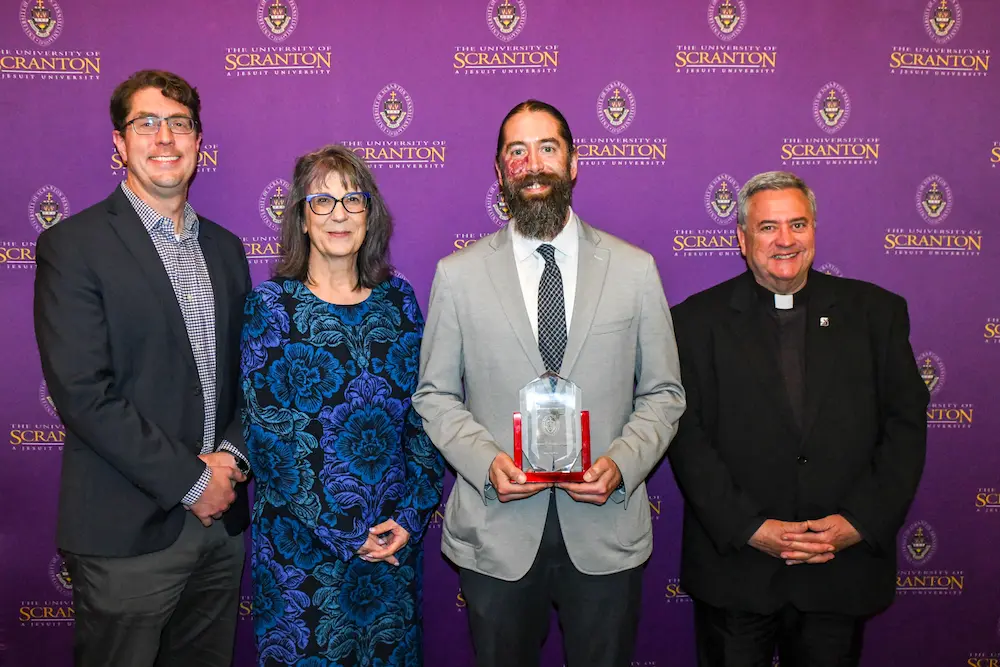
Honoring exceptional leadership in shared governance and academic planning, Andrew Venezia, Ph.D., associate professor of health and human performance, earned the Award for Academic Leadership and Institutional Stewardship. Dr. Venezia’s extensive service across more than 10 committees, including key chair roles, fosters collaboration, transparency and institutional strength while advancing faculty engagement and academic excellence throughout the University. As Faculty Senate Curriculum Committee chair alone, he convenes weekly meetings and works daily with various dean’s offices, the registrar, the provost and faculty from all three colleges.
Honoring a commitment to justice, human dignity and belonging, the Beloved Community Faculty Enhancement Award recognizes Kate Cummings, assistant professor and research and instruction librarian for the University’s Weinberg Memorial Library. Professor Cummings’ leadership in promoting intellectual freedom and equitable access to knowledge has earned widespread recognition. In 2025, she was elected as the Pennsylvania Library Association’s vice president and president-elect, a three-year commitment that will culminate in her leading the state’s library association.
Advancing care for creation and environmental justice, the Laudato Si’ Award honors Rich Larsen, professor of English and theatre. Professor Larsen has demonstrated decades of sustainable theatre practices, including innovative material reuse and eco-conscious design, long before sustainability became an institutional priority. His scenic design for a recent musical production used an estimated just $400 in new materials with the rest assembled entirely from stock and donated and reclaimed items, demonstrating how the arts can model creative stewardship of the natural world.
Recognizing excellence in outcomes-based education, the Award for Assessment and Educational Effectiveness honors the Department of Counseling and Human Services. Across their five degree programs, CHS faculty members commit themselves to helping their graduates become competent practitioners who are genuinely prepared to care for those they serve. The department assesses its students through transparent and rigorous practices and while using a continuous feedback model that drives student and programmatic success, building a culture of assessment that benefits the entire University and its people.
Honoring innovative and mission-centered collaboration, the Award for Mission-Driven Innovation and Partnerships recognizes the Department of Crime, Justice and Security. The department's Center for the Analysis and Prevention of Crime engages students with community partners to address real-world challenges while advancing justice, public safety and transformative student learning. Partner organizations include the Scranton Police Department, the Lackawanna County District Attorney’s Office and the Office of Youth and Family Services, among others. The department also runs an annual cyber camp in the summer, providing training to high school students.
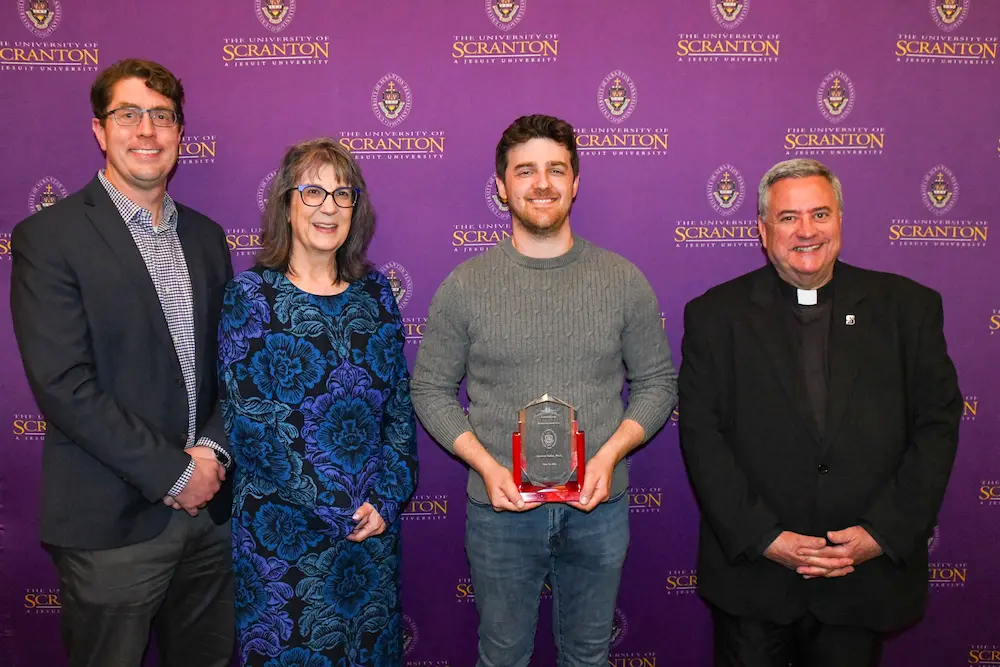
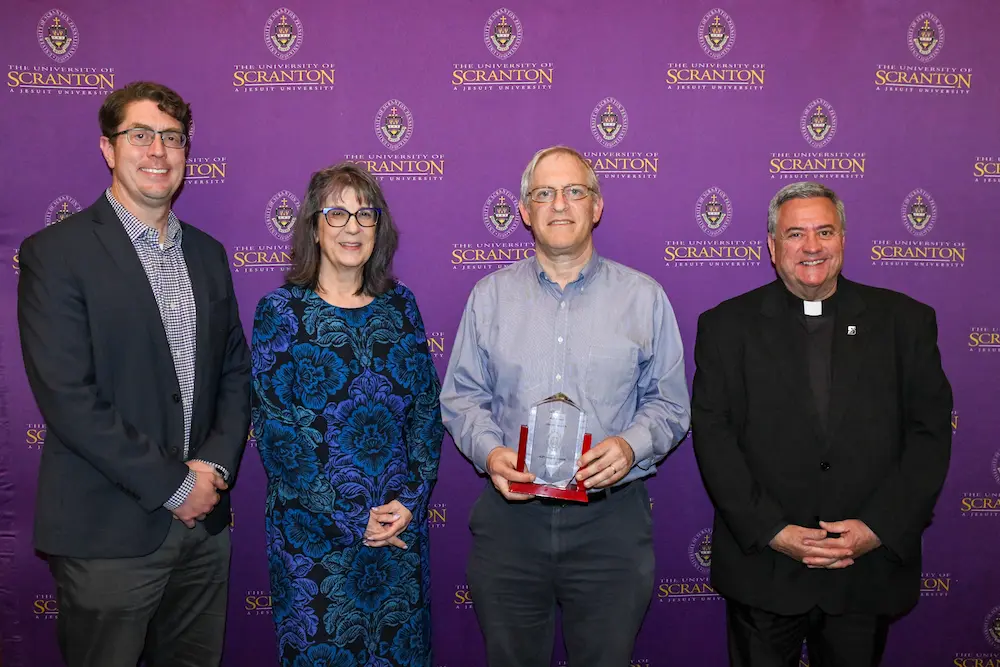
Celebrating outstanding scholarly achievement, the Award for Research and Scholarly Practice recognizes corecipients Spencer Galen, Ph.D., assistant professor of biology, and Marc Shapiro, Ph.D., professor and chair of theology and religious studies. Dr. Galen’s prolific research record includes 14 articles and a book chapter in an open-source textbook. He has also generated significant external funding and his work has been cited hundreds of times. Dr. Shapiro’s decades of leadership in Judaic Studies at Scranton has elevated the University’s international reputation and connections within worldwide Jewish communities. He is the author of nine books — with Nos. 10 and 11 in progress — and his most recent book about Rav Kook was a finalist for the prestigious Rabbi Sacks Book Prize.
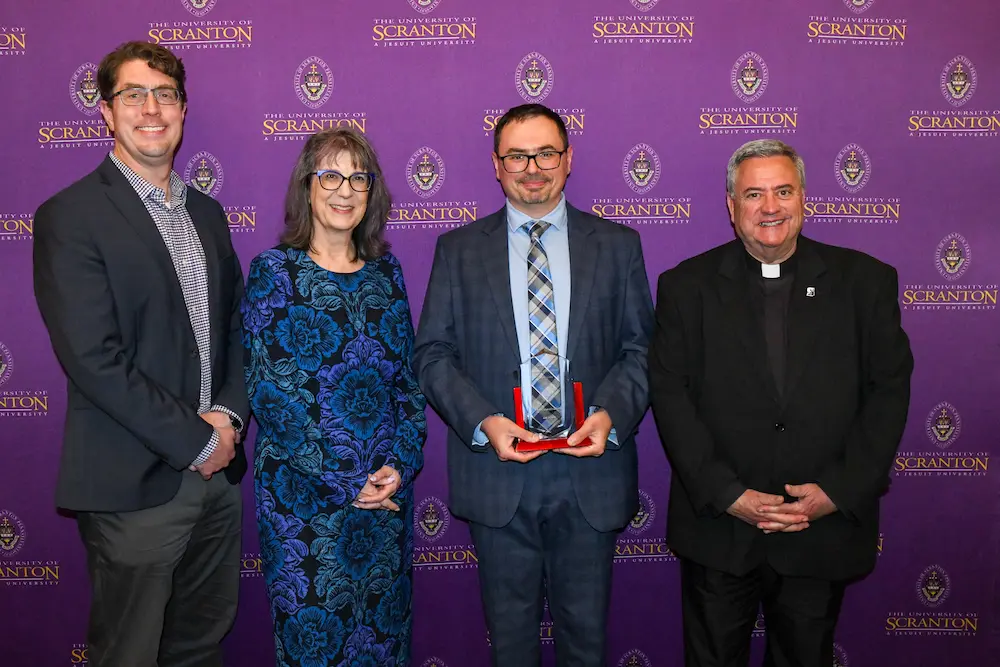
Recognizing innovative teaching excellence, the Award for Transformative Teaching and Learning honors Ovidiu Cocieru, Ph.D., associate professor of management. Dr. Cocieru’s Classroom-as-Organization (CAO) approach is a research-based model in which students live organizational life rather than simulating it. For instance, his students in MGT 430 plan and execute Scranton SoccerFest every spring. Dr. Cocieru’s instruction strengthens student engagement and awards real authority to students. He has authored six peer-reviewed publications on CAO pedagogy, establishing him as a national authority on the subject.
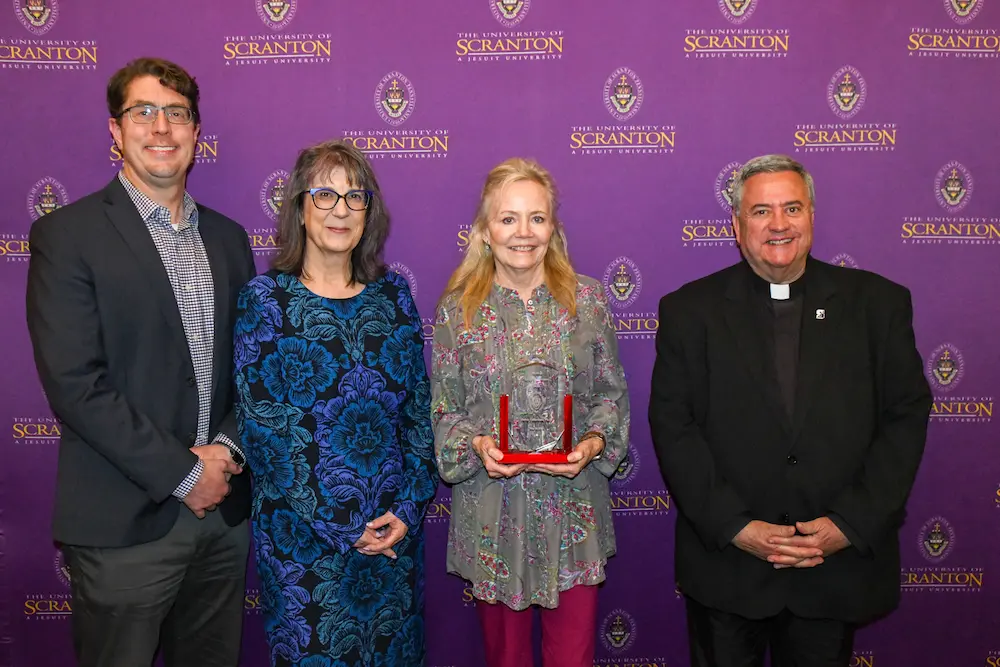
Honoring sustained excellence across teaching, scholarship and service, the Magis Award recognizes Debra Fetherman, Ph.D., professor and chair of health and human performance. Dr. Fetherman’s leadership as Community-Based Learning’s (CBL) faculty coordinator has exemplified Ignatian values and prepared students to lead lives of purpose and service. She has led faculty workshops, supported colleagues in integrating CBL into their courses and secured grant funding. She also plays a central role in the Leahy College of Health Sciences’ TAPESTRY program, which introduces first-year students to Jesuit values to guide seniors to discern how those values will shape their professional lives.
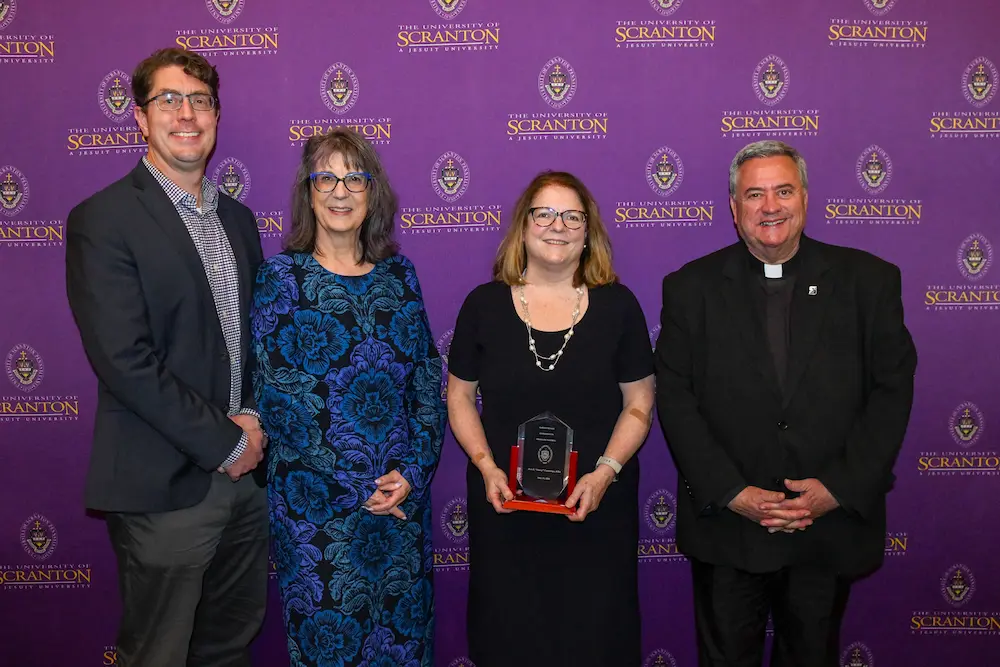
Additionally, Ann "Nancy" Cummings, management and marketing faculty specialist, received the Faculty Senate Excellence in Graduate Teaching Award. The award recognizes a faculty member's dedication to teaching graduate students in an encouraging and intellectually stimulating environment that promotes critical thinking and learning. Last year's award winner, Wesam Alramadeen, assistant professor of operations and analytics, presented the award to Professor Cummings.
The University also honored a group of distinguished faculty members who are transitioning into scholarly pursuits, personal projects or retirement, among other things. The group includes Rev. Timothy Cadigan, S.J., Jones DeRitter, Ph.D., Michael Friedman, Ph.D., Jean Harris, Ph.D., Bonnie Markowski, MFA, and Terrence Sweeney, Ph.D., of the College of Arts and Sciences; Robert Spinelli, DBA, of the Leahy College of Health Sciences; and Daniel Mahoney, Ph.D., of the Kania School of Management.
$content.getChild('content').textValueUniversity Faculty Members Honored With Provost Awards
June
View June Listing Page
The University of Scranton's New Student Orientation for the Class of 2030 concludes on Thursday, July 2, capping a two-week, four-session program that offered incoming students a first look at campus life and connections with classmates, faculty and staff.
Across the sessions, students were introduced to the academic, extracurricular and community opportunities that define the Scranton experience. A large group of orientation leaders and staff members guided the newest Royals — and their family members — through the transition to college, encouraging them to engage fully, build relationships and begin finding their place within the University community.
The incoming students were divided into four groups who each participated in a two-day orientation session. The fourth and final group began its session on Wednesday, July 1.
The University's 2026-2027 academic year begins with the first day of classes on Monday, Aug. 31.
$content.getChild('content').textValue
This Year’s Leaders Share Advice for New Student Orientation
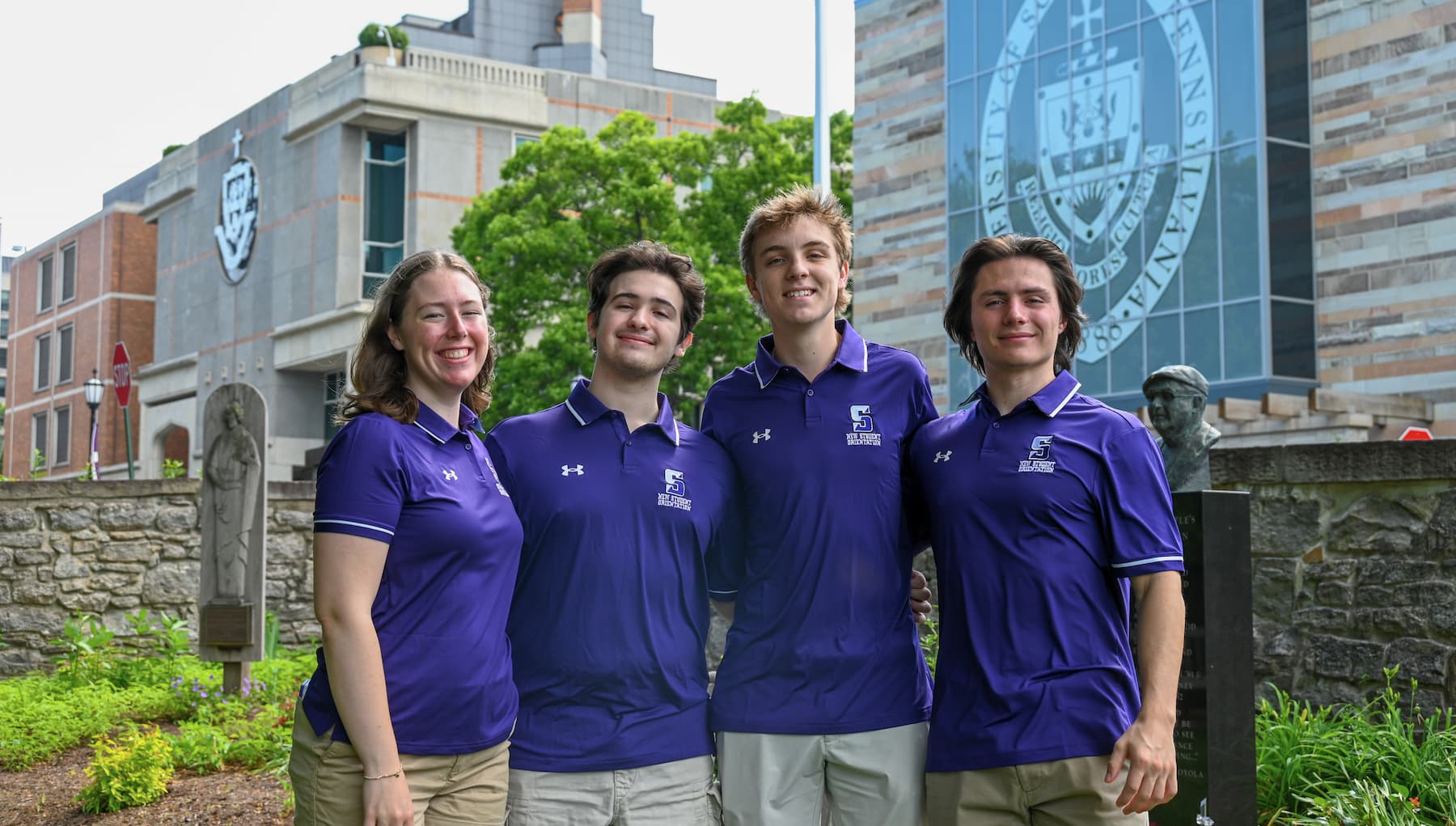
Ahead of this year's New Student Orientation, Royal News caught up with the four current undergraduate students who served as Orientation Team Leaders.
Click here to read what Mary McAlpin, Michael Mancini, Gavin Kovaleski and Michael Zipay shared with readers and incoming students.
Pope Francis Co-author Speaks at University's Judaic Studies Lecture
While the University turns its attention to the upcoming school year, we aren't too far removed from the end of the past school year.
One of the highlights late in the spring term included Rabbi Abraham Skorka, Ph.D., a globally recognized scholar, author and longtime collaborator of Pope Francis, who visited Scranton to deliver the Judaic Studies Institute Lecture.
Click here to read more about Dr. Skorka's appearance.
University to Honor Robert S. '68 and Marilyn A. Weiss at President's Medal Gala
In case you missed it, the University announced this year's President's Medal Gala will be held Thursday, Oct. 1, at Pier Sixty in New York City.
Click here for more information about the upcoming event and the President's Medal recipients, Robert S. '68 and Marilyn A. Weiss.
In addition to the regular Wednesday email newsletter, The University of Scranton's Royal News website is updated continuously throughout the year with new stories, features and announcements. Readers may visit at any time to find the latest news from across the University.
Campus Catch-Up: Welcoming the Class of 2030
The Staff Senate would like to thank all staff members who took the time to recognize and share their colleagues' accomplishments, sense of community, and dedication to excellence. The Meg Cullen Brown Magis Award would not exist without our caring community!
THE MEG CULLEN-BROWN MAGIS AWARD WINNER for June 2026 is:
Karen Dolan – Payroll
How long have you worked at the University?
I have been at The University of Scranton for 19 years.
What is your title?
My title is Payroll Specialist.
What do you like best about your job?
What I like best about my job is making people happy on payday! I also enjoy helping people and being someone they can count on when they have payroll questions.
What do you like to do for fun?
For fun, I enjoy playing Mahjong every Monday night with a group of friends, and I love spending time with my two sons, especially going to sporting events together.
We would like to take this opportunity to congratulate and celebrate the good work that Karen does on a daily basis. We hope you will join us in personally congratulating Karen and all our nominees. Karen will receive a complimentary food donation at our fabulous University food service outlets and a reserved parking space in the DeNaples Parking Pavilion. Each winner is also invited to the Staff Senate Recognition event in May 2027 to receive a certificate of appreciation.
We congratulate Karen and all the wonderful nominees for being recognized as “Magis” employees!
June 2026 Nominees
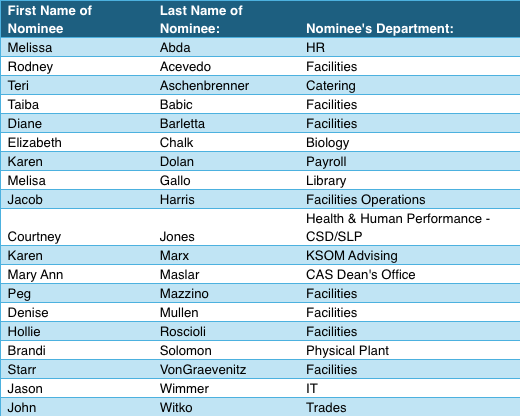
Nominations open for JULY Meg Cullen-Brown Magis Award.
Have you witnessed a University staff member, Aramark or Follett employee offer a simple act of kindness? Go above and beyond for others? Perhaps they embody our Jesuit mission or simply possess an incredible attitude. If so, please recommend this individual for this prestigious award.
Although only University staff members, Aramark, or Follett employees win the award, nominations may be made by any University of Scranton employee.
Nominate here.
Meg Cullen-Brown Magis Award for June
The state’s leading professional membership organization for accountants has and will continue to benefit in the coming years from a distinguished member of the faculty at The University of Scranton.
Ashley L. Stampone, Ph.D ’10, G’11, Ph.D ’23, assistant professor of accounting, is currently serving as a vice president on the Pennsylvania Institute of Certified Public Accountants (PICPA) Board of Directors. She previously served a one-year term as a vice president and is now in her second year of a two-year, at-large term that will extend her service through April 2027.
Dr. Stampone was formally sworn in at PICPA’s annual meeting, held May 5 at the Omni Bedford Springs Resort and Spa in Bedford County.
“Dr. Stampone's appointment to the PICPA Board of Directors reflects the respect she has earned throughout the accounting profession,” said Douglas M. Boyle, DBA ’88, accounting professor and chair at the University. “As a dedicated educator, accomplished scholar and engaged professional, she consistently demonstrates a commitment to excellence and service. Her contributions to the profession, our students and the University have been significant, and I am confident she will make a meaningful impact in helping guide the future of the PICPA.”
The PICPA Board of Directors oversees the organization’s property and affairs. It includes officers and directors who advance the organization’s mission of serving, supporting and advocating for the profession while serving as a valuable resource to its nearly 18,000 members.
Dr. Stampone, who joined in the University in 2016, is a five-time recipient of the Kania School of Management’s Teacher of the Year award, presented by KSOM students. She has received numerous state and national awards and professional honors, including PICPA’s Young Leaders Award in 2021.
Stampone, a Scranton Alumna and Professor, Re-Appointed to PICPA Board
A research team from The University of Scranton has set out to answer a few questions whose answers may benefit communication systems around the world.
NASA’s Heliophysics Citizen Science Investigations program awarded the University a $568,117 grant to discover more information about the weather in space and how those conditions affect the reliability of high-frequency communication systems used on Earth.
The three-year project, titled “Ionospheric Model Validation and Development of an Open-Source High Frequency Ray-Tracing Toolkit” is led by Kornyanat "Kukkai" Hozumi, Ph.D., research scientist at Scranton. Dr. Hozumi is serving as the principal investigator with collaborators Nathaniel Frissell, Ph.D., associate professor of physics and engineering, and Mark Fenner, Ph.D., assistant professor of computing sciences, on the interdisciplinary team. The grant was awarded in February 2026 with work slated to continue through January 2029.
The Scranton team is researching how radio waves travel through the ionosphere, a region of the upper atmosphere that enables long-distance radio communication. Disturbances caused by solar activity can disrupt these signals, affecting aviation, emergency alerts, military operations and global radio networks.
Researchers will develop a freely available, open-source software toolkit capable of modeling radio wave propagation in three dimensions. This represents a significant advancement from the earlier two-dimensional tools.
Amateur radio operators from within the influential and prolific Ham Radio Science Citizen Investigation (HamSCI) community will test tools and contribute data that will then be analyzed by the researchers.
While several aspects of the work have already been outlined, the project centers on four key goals: 1. Developing a three-dimensional, open-source, high-frequency ray-tracing toolkit; 2. Validating leading ionospheric models using data from the global HamSCI network; 3. Studying space weather’s effects on radio signals; 4. Broadening access to data through public seminars and other avenues that support researchers, students and amateur radio operators.
Earlier this year, The University of Scranton received a three-year, $600,000 grant from the Office of Naval Research regarding ionospheric research.
Scranton Researchers Awarded NASA Grant Totaling More Than a Half-Million Dollars
The University of Scranton’s Orientation Team Leaders will play a key role in welcoming members of the Class of 2030 as they arrive later this month for New Student Orientation.
Students and their families who attend one of the four sessions — June 22-23, June 25-26, June 29-30 and July 1-2 — will meet classmates, faculty and staff members and administrators covering virtually all areas of campus life. You have questions — about academics, arts, athletics, service, campus life, spiritual life, food, off-campus entertainment and everything in between — they’ll have answers.
The four Orientation Team Leaders will have answers, too, providing guidance and support, drawing on their own experience to help new students adjust.
We caught up with this year’s Orientation Team Leaders as they imparted some words of wisdom to the newest Royals.
Mary McAlpin, a theology and religious studies major on the pre-med track from Newtown: “I would encourage new students to be very open to the whole experience, to put themselves out there. This is really your first exposure to your new class and your new life at Scranton. So, take advantage of everything, get out there, talk to people, start making connections. Doing those things will only help you grow once you step on campus in the fall.”
Michael Mancini, a nursing major from Trumbull, Connecticut: “I think the most important part is having an open mind and living the experience for what it is. Take your time to get to know our beautiful campus and also the great people you’re going to be around. If you do that, you will feel more comfortable and more familiar when you get here in the fall.”
Gavin Kovaleski, a theology and philosophy double major from Dunmore: “People at orientation are more than willing to help you in every single facet to ease your college transition. Other new students and friends are also coming in with an open mind — so look to meet new people and make your next four years the best four years that you could possibly make, together.”
Michael Zipay, a mathematical sciences and philosophy major from Archbald: “Don’t be afraid to take on any opportunity that you’re given. Embrace it. There’s so much for you to do at Scranton. We’d love to see you take advantage of it.”
Students and their families are urged to visit the University’s website and check their emails for updates regarding programming.
What to Expect at New Student Orientation? This Year’s Leaders Share Advice
A group of students recently returned from Las Vegas, Nevada, where they represented The University of Scranton at this year’s Future Business Leaders of America National Leadership Conference.
Continuing the trend of Scranton FBLA members returning from state and national competitions with prizes, four Scranton students finished in the top 10 of their respective categories:
- Gary Mrozinski, a finance major from Taylor, placed third nationally in the Foundations of Finance category.
- Mallory Woodland, an advertising/public relations major from Nazareth, placed third nationally in the Foundations of Communication category.
- Kaeli Romanowski, a finance major from Lake Ariel, placed ninth nationally in the Foundations of Management category.
- Lillian Stein, a cybercrime and homeland security major from Lehighton, placed ninth nationally in the Computer Applications category.
Earlier this year, Scranton had its best showing to date at the FBLA State Leadership Conference with four state champions and five runners-up.
David Mahalak, D. Eng., assistant professor of operations and analytics, is the University’s FBLA moderator and accompanied the students, whose experience also included networking and taking in the sights of the Las Vegas Strip.
Established in 1942, FBLA is the world’s largest organization of its kind, annually helping 230,000-plus members in middle school, high school and college prepare for careers in various business fields.
Scranton FBLA Students Bring Home National Recognition
The University of Scranton hosted Rabbi Abraham Skorka, Ph.D., a globally recognized scholar, author and longtime collaborator of Pope Francis, at its recent Judaic Studies Institute Lecture.
Dr. Skorka’s lecture, titled “The Pope and the Rabbi: My Story of Friendship and Dialogue with Pope Francis,” took place Tuesday, May 12, at the Pearn Auditorium inside Brennan Hall. It was free and open to the public.
A native of Buenos Aires, Argentina, Dr. Skorka highlighted his decades-long relationship with Pope Francis, a fellow Argentine. Dr. Skorka and Pope Francis’ friendship began in the second half of the 1990s and evolved through ongoing dialogue grounded in mutual respect and intellectual exchange. They collaborated on the 2013 book “On Heaven and Earth,” which explored topics including faith, family and the role of the Church in the modern world.
The Weinberg Judaic Studies Institute was created at Scranton in 1979 through an endowment funded by the local Jewish community. The lecture is one of the program’s annual highlights. Marc B. Shapiro, Ph.D., professor and chair of theology and religious studies at The University of Scranton, serves as its chair.
$content.getChild('content').textValuePope Francis Co-author Speaks at University’s Judaic Studies Lecture (Photos + Video)
The Center for Health Education and Wellness (CHEW) Employee Wellness Program invites University of Scranton faculty and staff to a Kickoff to Summer event on Wednesday, June 10, from 11:30 a.m.-2 p.m. in the DeNaples Center Ballroom - Room 407.
Chat with colleagues, enjoy a free lunch, visit the wellness fair and receive a summer giveaway. Registration is required.
Register for the event by Monday, June 8.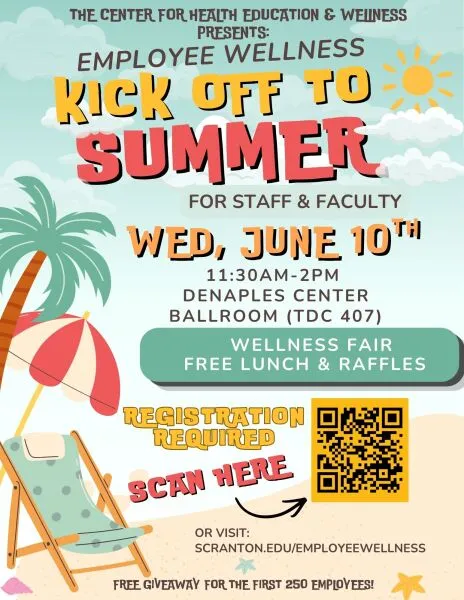
CHEW Employee Summer Wellness Fair June 10
At the Ignatian Volunteer Corps (IVC), the belief is that the life experience, wisdom and skills of older adult men and women can transform the world through justice rooted in Gospel values. The unique national non-profit organization provides people 50 and over with meaningful opportunities to serve others. IVC also provides membership in a faith-sharing community united by a desire for spiritual development in the tradition of Ignatius of Loyola.
Finding the PERFECT Volunteer MATCH
The Ignatian Volunteer Corps of Northeastern Pennsylvania (IVC NEPA) provides men and women with the opportunity to:
* assist the underserved,* increase the amount of professional skills-based human capacity at partner organizations, and
* grow deeper in their Christian faith by reflecting and praying in the Ignatian tradition.
To accomplish this mission, IVC NEPA matches retired men and women, 50 and above, to serve eight hours per week for 10 months at nonprofit partner organizations in Luzerne and Lackawanna counties.
Teddy Michel, Director of the Ignatian Volunteer Corps of NEPA, said IVC members often share feedback with him after dedicating time to the program.
Said Michel: "A comment made recently by one IVC member explains our mission best, 'You never know when you might be the answer to someone else’s prayer.' "
Presently, 29 IVC members serve 200 hours per week at the following agencies:
Lackawanna County Partner Organizations: Nativity Miguel School of Scranton; NeighborWorks NEPA; Women’s Resource Center; Friends of the Poor; Saint Francis of Assisi Soup Kitchen, Clothing Store and Client Choice Food Pantry; United Neighborhood Centers of NEPA; Meals on Wheels of NEPA; Saint Joseph’s Center; The Recovery Bank; Catholic Social Services Refugee Resettlement; Hospice of the Sacred Heart Outreach; Catherine McAuley Center and Allied Services Hospice.
Luzerne County Partner Organizations: Weinberg Regional Food Bank, Junior Achievement of NEPA, Catherine McAuley House, Dress for Success Luzerne County and St. Vincent de Paul Kitchen.
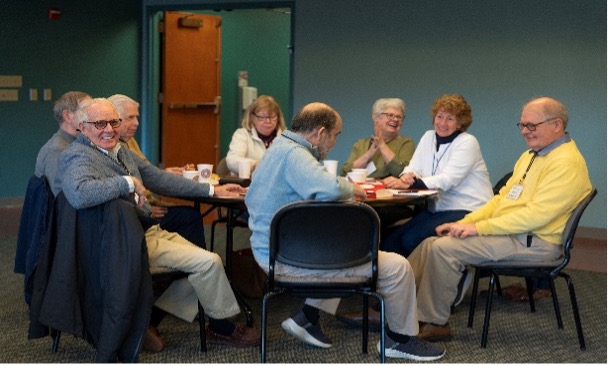
Inspired to Give back?
Members of IVC’s service corps commit one or two days per week to work directly with organizations that address the issues of poverty and marginalization. Corpsmembers gather monthly to reflect prayerfully on their apostolic work and discover the deeper meaning within their service.
Founded in 1995 by two Jesuit priests, Rev. Jim Conroy, S.J., and Rev. Charlie Costello, S.J., IVC matches the talents, skills and life experiences of corpsmembers with the greatest social needs of our time. As a Jesuit-founded organization, corpsmembers transform from ordinary volunteers to contemplatives in action. Seeking the presence of God in each person, they bring their stories back to one another in community to reflect, enrich, teach and learn.
Retired and Ready to Serve? Opportunities Await With the Ignatian Volunteer Corps of NEPA
On Commencement Weekend, the Legacy Families of the Class of 2026 gathered with Rev. Joseph G. Marina, S.J., University president, and Alumni Society Advisory Board Chair Chris Neumann, Esq. ’87, P’24, P’27, as they prepared to “go forth and set the world on fire.”
University Holds Class of 2026 Legacy Families Reception
The University of Scranton will present the President’s Medal to Robert S. ’68 and Marilyn A. Weiss at the President’s Medal Gala Thursday, Oct. 1, at Pier Sixty, Manhattan’s largest waterfront event venue. Watch a short video message featuring Rev. Joseph G. Marina, S.J., University president, announcing the University’s intent to honor Bob and Marilyn here.
The event is the premier annual fundraiser for the University, and proceeds from the dinner benefit the Presidential Scholarship Endowment Fund, which awards four-year, full-tuition scholarships to incoming first-year students with outstanding high school records and notable community involvement. The University presents the President’s Medal to individuals who have achieved excellence in their fields and who have demonstrated extraordinary compassion for others. All alumni, parents and friends of the University are welcome and encouraged to attend this year’s event.
Scranton has held a special place in the hearts of Bob and Marilyn ever since they met at a “U Dance” at the Gunster Memorial Student Center in 1966. Their 2015 gift of $1.25 million resulted in the creation of the Robert and Marilyn Weiss Pediatric Low Vision Research and Training Suite, and their 2016 gift of $1 million established Robert and Marilyn Weiss Field as a first-class home for Scranton’s soccer, lacrosse and field hockey teams. In 2024, their gift of $10.5 million, the largest single donation in the history of the University, blossomed into the four-story, 90,000 square-foot Robert S. and Marilyn A. Weiss Hall. The building houses the University’s Department of Criminal Justice, Cybersecurity and Sociology, the Department of Psychology, Student Health Services, the Center for Health, Education and Wellness, the Small Business Development Center, the University of Success, and the state-of-the-art IDEA Center, which features woodworking, 3D printing, laser engraving, sewing and audio recording capabilities.
A native of Lake Ariel, Bob became the first person in his family to attend college when he began studying accounting through the University’s ROTC program. As a U.S. Army Captain, he was awarded two Bronze Stars and the Army Commendation Medal for his service in Vietnam. He became a certified public accountant and began working as an assistant corporate controller in 1977 at Cooper Laboratories Inc., which would eventually become The Cooper Companies, Inc., a multinational manufacturer and marketer of specialty healthcare products with annual revenues exceeding $4 billion.
Over the next 41 years, Bob rose through the ranks at Cooper, serving as corporate controller, treasurer, chief financial officer, chief operating officer, president of Coopervision, and, ultimately, president and CEO. During Bob’s time at the company, Cooper had a number of industry-defining breakthroughs, including the development of intraocular lenses and Lasik surgery, two advancements that have helped millions see more clearly. Under Bob’s leadership, the company sought to address the approximately 50% of children and young adults aged 5-22 who are suffering from progressive myopia, a condition that often leads to eye diseases such as cataracts, glaucoma, retinal detachment and macular degeneration later in life, by developing MiSight, a soft contact lens that was ultimately approved by the FDA in 2019 for myopia management in children aged 8-12. Bob was named the “Most Admired CEO of 2012” by the San Francisco Business Times, and he was recognized with the Albert Nelson Marquis Lifetime Achievement Award for 2017-2018. After retiring in 2018, he became the chair of Cooper’s board of directors through January of 2026, and he remains on its board today.
Bob was honored by the University with the Frank J. O’Hara Distinguished Alumni Award in 2008. As a University trustee, he became informally known as “the pizza guru” due to his unabashed love of and enthusiasm for the pizza of Northeastern Pennsylvania. He also sponsors the Pediatric Refractive Error Training Center, an eyecare clinic in Hanoi, Vietnam, that trains optometrists to fight the growing pandemic of myopia.
A native of South Scranton, Marilyn studied at the University through the Scranton State General Hospital School of Nursing. She served as the head nurse at the Edward S. Harkness Eye Institute at Columbia Presbyterian Medical Center in New York and as a pediatric nurse at Bayside Pediatrics in Pleasanton, California.
Bob and Marilyn are frequent sponsors of local charitable causes in the San Francisco East Bay area, including Goodness Village, which provides tiny homes and supportive services to the Tri-Valley’s formerly unhoused neighbors, Valley Humane Society, and the Bay Area Military Classic & The Joey Graves Memorial Golf Tournament, which supports Gold Star Families.
The couple are the proud parents of three children, Chris, Kim and Doug, and they are blessed with two grandchildren, Kylie and Jayden. They reside in Pleasanton, California.
An Ambitious Goal
At last year’s gala, Rev. Joseph G. Marina, S.J., University president, announced an ambitious University-wide effort to permanently endow the Presidential Scholarship Endowment Fund by raising an additional $7 million through the 2025 and 2026 President’s Medal Galas, which would bring its lifetime total up to $30 million.
“In 2002, The University of Scranton embarked upon a marathon endeavor when it held its first award dinner in support of the Presidential Scholarship Endowment Fund,” said Father Marina in a video announcing the initiative. “We are only $7 million away from securing the future of The Presidential Scholarship Endowment Fund and ensuring that our Presidential Scholars will continue to thrive at the University forever.
“Help us write the ending this 25-year marathon deserves.”
Visit this link to support Presidential Scholarships at The University of Scranton.
Registration and sponsorship information will be available soon. For more information on the President’s Medal Gala, contact Associate Vice President of Development Eric Eckenrode at eric.eckenrode@scranton.edu or Executive Director, Annual Giving & Campus Partnerships Brad Troy ’02 at bradley.troy@scranton.edu.
University To Honor Robert '68 and Marilyn Weiss at President's Medal Gala Oct. 1
The University of Scranton is proud to announce that it will honor Rev. Bernard R. McIlhenny, S.J. H'98, Dean of Admissions Emeritus, with the Peter A. Carlesimo Award on Monday, June 15, at the 2026 Carlesimo Golf Tournament & Award Dinner at Canoe Brook Country Club.
We are once again partnering with the Quandel Construction Group as the title sponsor for this event. Register for this year's event here.
About "Father Mac"
Rev. Bernard R. McIlhenny, S.J. H'98 arrived in Scranton in 1958 to serve as the fourth headmaster of Scranton Preparatory School, which at the time was owned by the University. While at Prep, he oversaw the school’s relocation to its present site. Fr. McIlhenny was appointed dean of admissions at the University in 1966. Known to many as “Father Mac,” his tenure as dean of admissions spanned 31 years, during which time he is credited with admitting more than two-thirds of the University’s living alumni.
In 1966, the University was all male and mainly comprised of commuting students with a small number of residential students. The campus was just beginning to develop. A special summer program that he attended at Harvard University in 1967 introduced Father Mac to the changing dynamic and future competition of higher education admissions to a “buyer’s market.” In his approach to promoting the University beyond the academic programs to prospective students, Father Mac emphasized the University's family-like atmosphere where students could receive personal attention and make friends for life, a fact that he witnesses presently during class reunions. His impact upon the University and its Athletics program cannot be overstated. He retired from admissions in 1997 and continued to serve the University as minister of the Scranton Jesuit Community.
A native of Philadelphia, Father Mac is a graduate of St. Joseph’s Preparatory School and St. Joseph’s University. He entered the Society of Jesus at the age of 18 and celebrated his 70th anniversary as a Jesuit in 2014. He remains an avid golfer and maintains close friendships with those alumni whom he knew during their student days. In 2009, the University dedicated the Rev. Bernard R. McIlhenny, S.J. Ballroom in The DeNaples Center in honor of Father Mac’s years of service to Scranton, and the University honored him with the President's Medal in 2016. Last fall, at the age of 99, he hit a hole-in-one, the second of his golfing career, and he celebrated his 100th birthday in March.
Founded in 1901, Canoe Brook Country Club offers 36 holes of championship golf. Recognized as a 5-Star Platinum Club of the World, the club has played host to a number of significant events, including U.S. Open and British Open qualifiers and the U.S. Women's Amateur.
Named in honor of the late Peter A. Carlesimo, former University of Scranton coach and athletics director, the Carlesimo Golf Tournament & Award Dinner celebrates athletics at The University of Scranton and honors a person who has made special contributions to athletics and Catholic education. The Golf Tournament and Award Dinner serves as a fundraising event to support and enhance the student-athlete experience at Scranton.
If you have any questions or would like to learn more about the event or sponsorship opportunities, contact Eric Eckenrode at eric.eckenrode@scranton.edu.
Carlesimo Golf Tournament and Award Dinner to Honor Father McIlhenny June 15
The University will celebrate Reunion Weekend 2026 from June 5-7. Register for this year's celebration here. Online registration will close Thursday, June 4, at noon EST.
Friday, June 5
7 p.m. The Frank J. O'Hara Awards Dinner-The DeNaples Center, McIlhenny Ballroom, 4th floor
All alumni and guests are invited to join us for this complimentary signature event to start the weekend. The Frank J. O’Hara Distinguished Alumni Award, presented annually to alumni who have exhibited sustained achievement in a particular field or endeavor, is the highest award bestowed jointly by the University and The Alumni Society. This year's event will honor Christine Blazynski, Ph. D. '76, Justin Murphy '76, Dcn. James Knipper '81, Lawrence R. Lynch '81, H'22, Patricia Byrnes Clarke '86, P'17, '19, James M. Slattery '86, H'23, Elizabeth Madden '96, and Thomas J. Gibbons '96, G'99 in memoriam. Register for this year's dinner or leave a congratulatory note for an honoree here.
9 - 11 p.m. All-Class Welcome Reception
Kick off Reunion Weekend by reconnecting with classmates and friends at the All-Class Welcome Reception, featuring music, food, drinks and a festive atmosphere. Flagpole Terrace.
Saturday, June 6
9 - 10:30 a.m. Class of 1976 Breakfast and Campus Tour Weiss Hall -1st floor
10 a.m. Goat Yoga: A fun yoga session where goats will interact while you stretch, breathe and unwind. Founder's Green
10 a.m. Campus Tour: Departs from the 2nd floor of the DeNaples Center.
11 a.m. - noon Pints with Professors: Enjoy your favorite beverage(s) while sharing stories with faculty, staff and friends. The DeNaples Center, 2nd Floor
11 a.m. - noon Bands and Singers Hanging out in Houlihan with Boga
Noon - Blessing and Dedication of the Rev. J. A. Panuska, S.J. Commons, Linden and Monroe
12:30 - 3 p.m. Reunion Block Party: Enjoy live music, games. food, beer/wine/soda and more. Dionne Green
3 p.m. Campus Tour: Departs from the 2nd floor of the DeNaples Center.
6 - 10:30 p.m. Saturday Evening Celebration: The perfect opportunity to connect with your class! Enjoy cocktails and dinner together, then cap off the evening with everyone at the after-party.
Sunday, June 7
9:30 a.m. Reunion Weekend Mass in Madonna della Strada Chapel
9:30 a.m. - noon Brunch on the 3rd floor of The DeNaples Center
Reunion Weekend Returns
From Friday, May 22, through Sunday, May 24, The University of Scranton welcomed thousands of guests who arrived with the shared motive of celebrating Scranton's newest graduates.
Karen L. Pennington, Ph.D. '76, G'83, H'15, was among commencement's most active participants. Dr. Pennington, a longtime higher education administrator, was in town to celebrate her 50-year class reunion and to also serve as the principal speaker who imparted wisdom upon the 900-plus undergraduate and 450-plus graduate members of the Class of 2026.
"Some of us old-timers are back here today because there's something about this University that not only lives in your memory, but that gets in your bones and never goes away," Dr. Pennington said at the undergraduate commencement ceremony. "It's not just the cura personalis that was part of your Ignatian experience; it's the community of which you have been and will always be a part. There are faculty members whose words will come to you at the strangest times. There are lessons you learned that you won't even realize you learned until you need them. And those people sitting beside you, those classmates who were there — they're so much a part of your Scranton days and will continue to be so important to you at your best and your worst times."
In case you missed it, here are a few stories covering one of the best times of year at The University of Scranton:
Scranton Holds 2026 Undergraduate Commencement (Full Story + Photos)
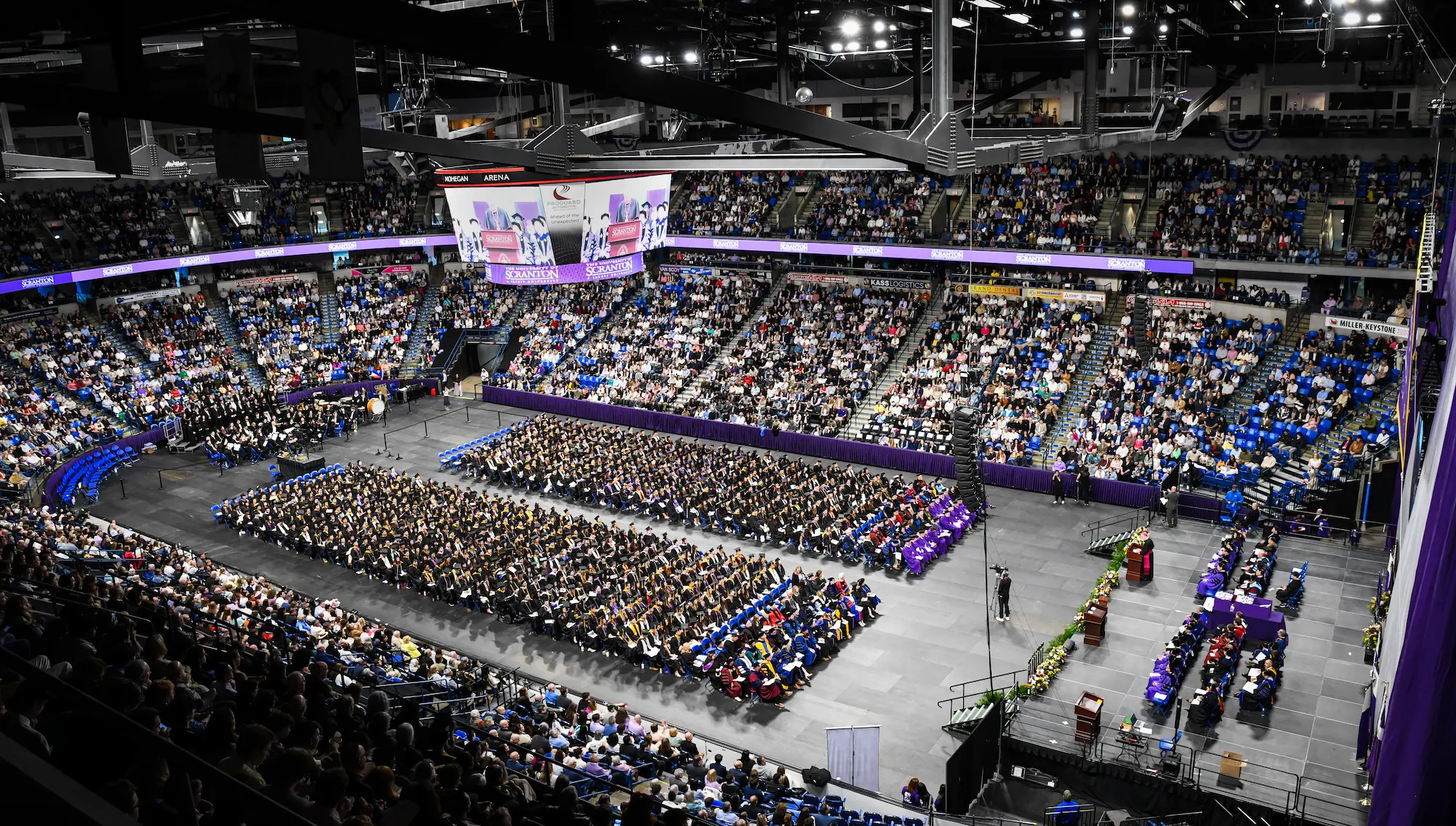
Curious about this year's most common majors? The most populous states? The distinguished individuals who received honorary degrees?
We've got you covered. Click here to read more about the undergraduate commencement ceremony. Follow this link to watch it.
Graduate Commencement Held at Mohegan Arena (Full Story + Photos)
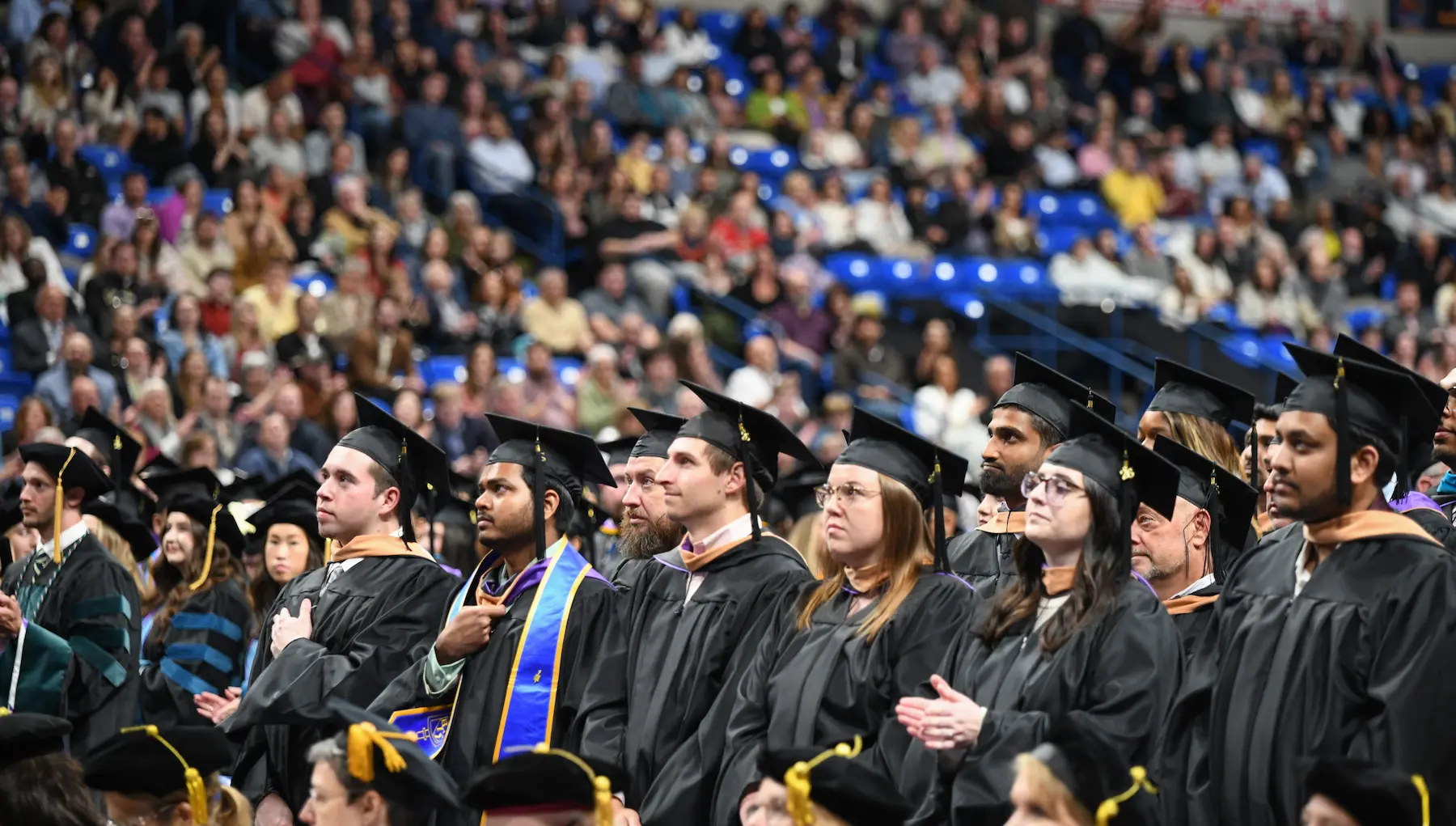
For master's and doctoral graduates at The University of Scranton, commencement offered an opportunity for class speaker Harshil Nariya G'26, of Enola, to reflect on the empathy, resilience and sense of responsibility he and his classmates developed at Scranton.
Click here to read the full story from graduate commencement. An archived video recording is available at this link.
Class of 2026 Selects Teachers of the Year
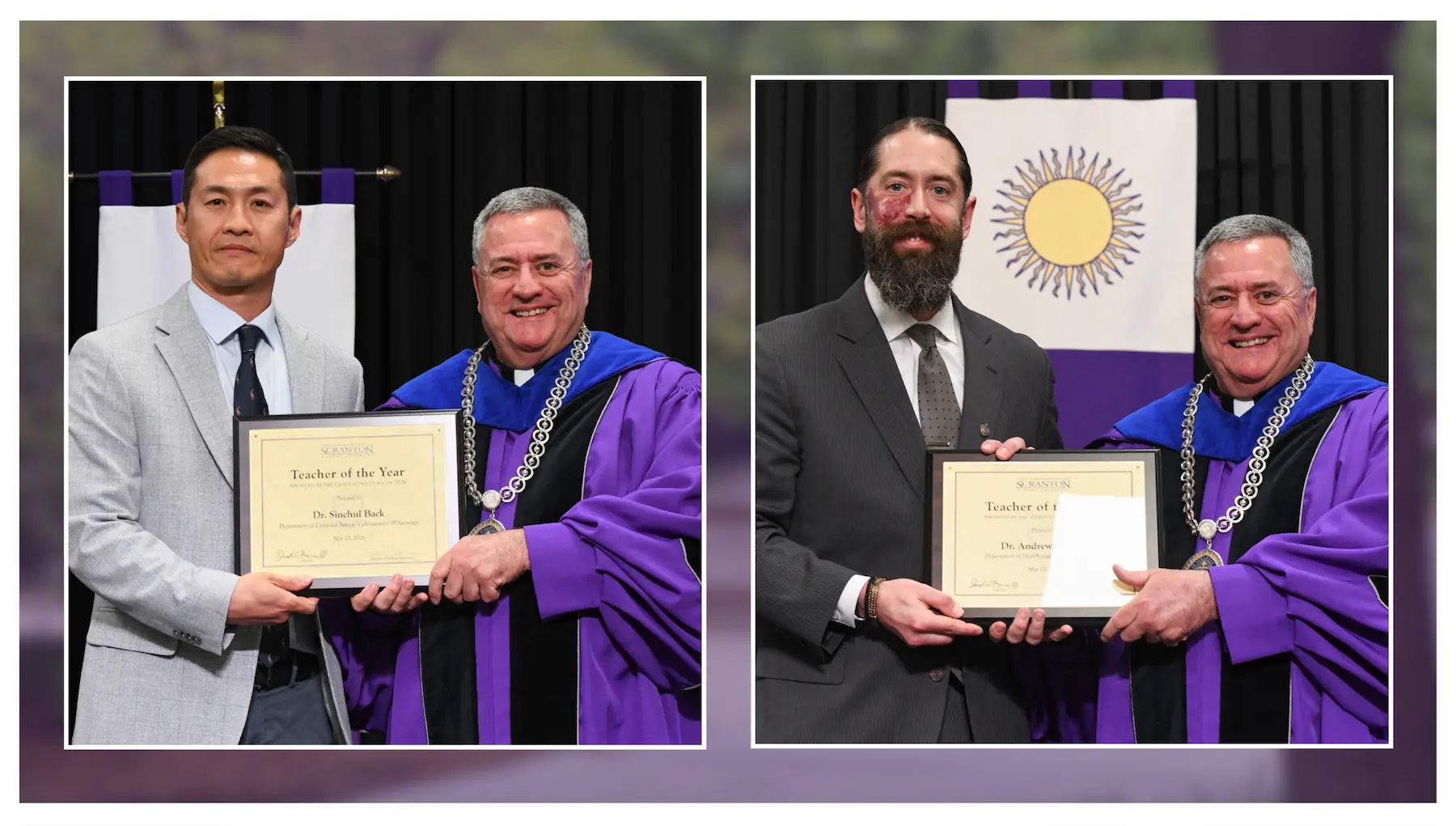 The University’s graduating senior Class of 2026 awarded this year’s Teacher of the Year to Sinchul Back, Ph.D., associate professor and director of the cybercrime and homeland security program; and Andrew Venezia, Ph.D., associate professor of health and human performance.
Click here to read more about the faculty members and their meaningful award.
Outstanding Graduates Recognized at Class Night
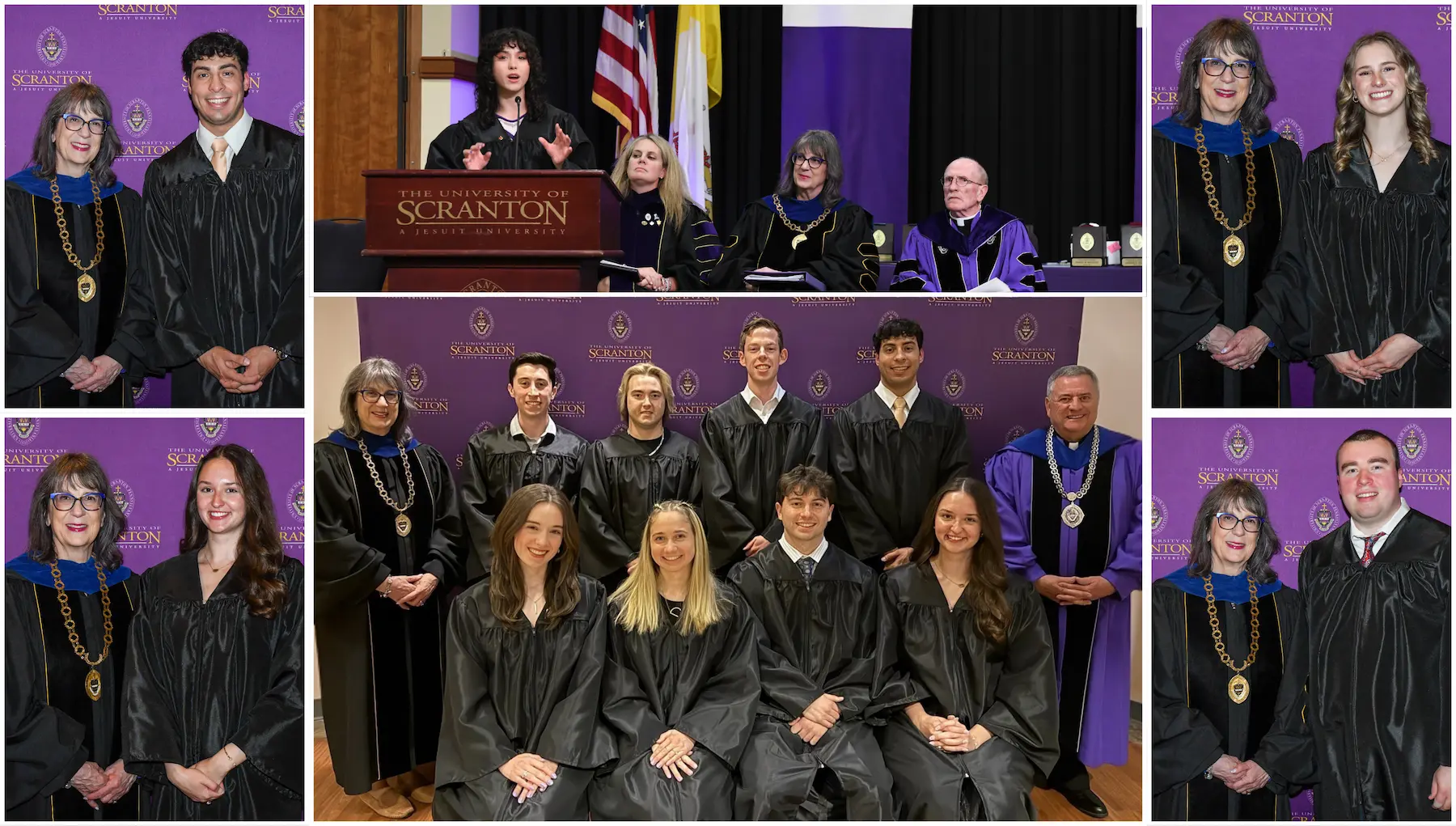
The University of Scranton honored 65 members of its undergraduate Class of 2026 for academic excellence, leadership and service at a Class Night ceremony.
Click here for a list of all the award winners and their awards.
Top Master's, Doctoral Graduates Awarded
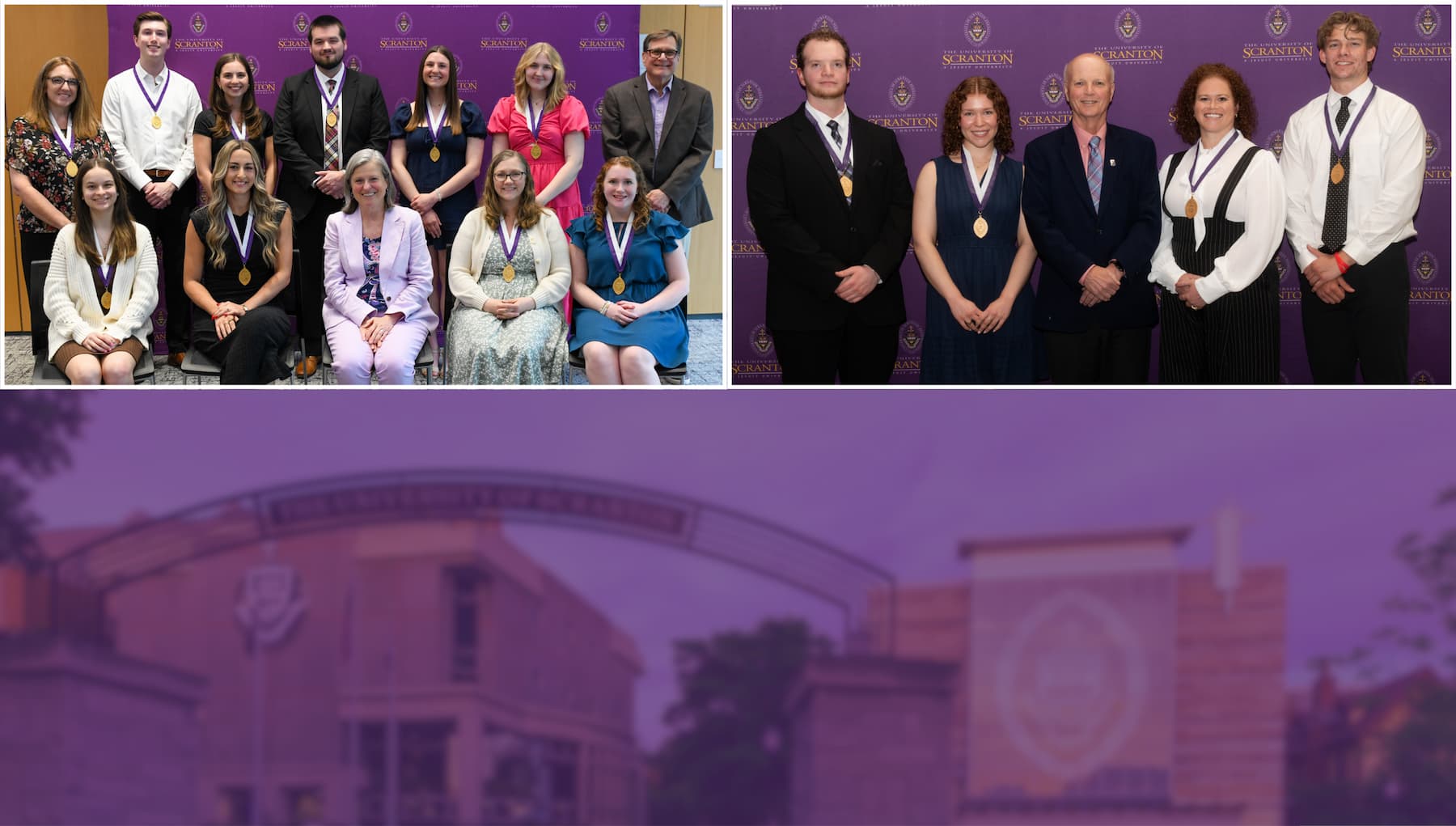
The University of Scranton recognized 34 outstanding master’s and doctoral degree graduates at its graduate commencement events.
Click here to read more about the graduate honorees.
Scranton Graduates Commissioned as Second Lieutenants
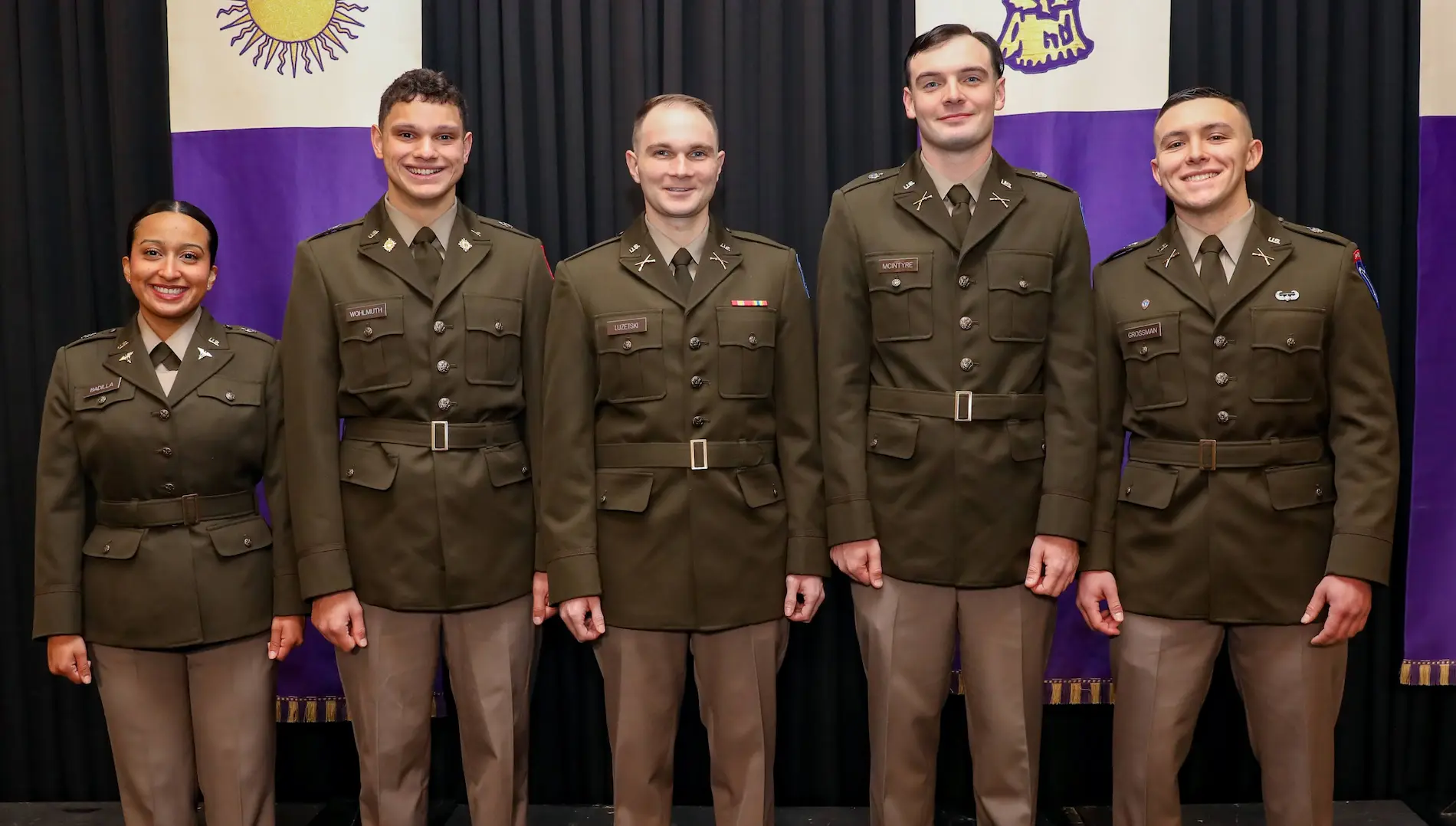
Five members of The University of Scranton's Class of 2026, along with three additional members from other regional colleges, were commissioned as second lieutenants in the U.S. Army.
Click here to read more about the Royal Warrior Battalion.
Additionally, the University was featured in a handful of news articles and videos about topics unrelated to graduation:
- WBRE visited the IDEA Center at Weiss Hall
- The Hope Horn Gallery's anthracite art was featured on WVIA
- WNEP spoke with a faculty member about bird migration
Continue reading Royal News all year round to stay up-to-date on the latest happenings at Scranton.
Campus Catch-Up: Celebrating the Class of 2026
The Scranton Brass Orchestra will perform a “pops” concert on Sunday, June 14, at 7:30 p.m. in the Houlihan-McLean Center at The University of Scranton. Admission is free. The performance is open to the public with doors opening at 6:50 p.m. Seating is on a first-come, first-seated basis.
The program for the concert features compositions, arrangements and transcriptions for brass band/brass orchestra, including pops hits, Disney favorites and music for film. The evening’s fare will include Malcolm Arnold’s "Four Scottish Dances," Turrin’s "Overture for Brass," a number of Disney favorites, the theme from "Bridge Over The River Kwai" and more.
The Scranton Brass Orchestra is under the direction of Cheryl Y. Boga and is presented by Performance Music at The University of Scranton. Co-founded by Dr. Hal Baillie and Mark Gould, the fully professional 26-member ensemble comprised of brass and percussion players/teachers from the region is entering its 14th season. The group's performances are free of charge, open to the public and have often featured nationally and internationally acclaimed guests, including many of the most respected brass players of our time. The group made its debut before hundreds of appreciative audience members in June 2011 and has since garnered acclaim from both audiences and musicians alike.
For additional information, visit scranton.edu/music or email music@scranton.edu.
Scranton Brass Orchestra Performing Sunday, June 14
Join alumni from The University of Scranton, Fordham University, Loyola Marymount University and St. Joseph's University for a Summer JAM Happy Hour on Thursday, June 25, at 230 Fifth Rooftop Bar in New York City. Reconnect with fellow alumni, make new connections and celebrate the spirit of the #JesuitEducated community. Admission is $30 and includes two drinks and appetizers. Space is limited.
Summer JAM Happy Hour in NYC
With baseball season officially underway, it’s the perfect time to make plans to join fellow Royals at the ballpark.
We’re excited to invite you to a series of University of Scranton Alumni Baseball Outings planned over the coming months. These events are a great way to connect with alumni, enjoy America’s pastime and represent the Royal community in cities across the country.
Here’s what we have lined up:
Friday, July 31: Texas Rangers vs. Houston Astros at Daikin Park
Thursday, August 27: Houston Astros vs. New York Yankees at Yankee Stadium
Tuesday, September 1: Seattle Mariners vs. Boston Red Sox at Fenway Park
Wednesday, September 16: Baltimore Orioles vs. New York Mets at Citi Field
Thursday, September 24: Milwaukee Brewers vs. Philadelphia Phillies at Citizens Bank Park
We hope to see you soon at a ballpark near you!
Step Up to the Plate With Royal Baseball Outings
Alumni, parents and friends are invited to join us for an afternoon at the Jersey Shore on Saturday, June 27, from 3–6 p.m. at the Belmar Fishing Club in Belmar, New Jersey.
Hosted by Karen Golding ’91, this gathering is a great opportunity to reconnect with fellow alumni and enjoy time by the ocean.
Royals To Gather at the Jersey Shore June 27
What's new with you? To submit a Class Note, visit the Class Notes Submission Page.
William L. Kovacs ’69, Great Falls, Virginia, published his most recent book, “Congress: An Irrelevant Institution or Guardian of the Republic,” completing his trilogy on reforming the federal government. The book warns that as Congress retreats from its constitutional responsibilities, the separation of powers erodes and executive overreach strengthens presidential power over the nation. His first book, “Reform the Kakistocracy,” received the 2021 Independent Press Award for Social/Political Change. His second book, “Devolution of Power: Rolling Back the Federal State to Preserve the Republic,” was a finalist in the 18th Annual National Indie Excellence Awards in the Government category.
Salvatore A. Luongo '86, Tampa, Florida, was named President and Chief Operating Officer at Red Rock Group Holdings. He also serves as Principal Consultant at Hamilton Grace.
Annmarie E. Andrejko '92, Hudson, was named regional president for Northeast PA and head of Corporate Banking for the region at PNC Bank.
Tina Gallagher ’95 and Cecelia Mecca ’96, G’98 are releasing the first book in their co-authored contemporary romance series, "The Brewhouse Book Society," on April 28. The two alumnae, who did not know each other while at Scranton, connected decades later through the romance writing community and developed both a friendship and a creative partnership. The series is set in a fictional small town in Pennsylvania and follows a group of women navigating love, life, and friendship through a local book club. In addition to writing, they also host masterminds for indie authors, bringing writers together to foster collaboration and community.
Talia Argondezzi ’03 has a new book coming out in August from University of Toronto Press titled "Bedtime Stories for Academics: Quibbles and Squabbles at Typical University." The book is a collection of linked short stories that takes a satirical look at higher education, highlighting both the day-to-day experiences of faculty and staff at universities and the broader social forces affecting higher education.
John R. Patro Jr., OTD, OTR/L, CPAM, FNAP '06, Aston, recently accepted the position of inaugural Associate Dean for Health Sciences at Molloy University Barbara H. Hagan School of Nursing and Health Sciences. In this role, Dr. Patro oversees a diverse portfolio of health sciences programs and is leading initiatives related to interdisciplinary education, program development, enrollment growth and global engagement. A proud graduate of The University of Scranton, Dr. Patro continues to advance his work in occupational therapy education, leadership and international collaboration. He was recently inducted as a Distinguished Fellow of the National Academies of Practice and is completing his Ph.D. in Educational Studies with a focus on adult learning and development. His dissertation explores faculty perspectives on cultivating cultural humility in entry-level health professions education. Dr. Patro remains passionate about mentoring future healthcare professionals and creating innovative opportunities.
Megan Thompson G'08, Minneapolis, Minnesota, was selected as iCivics' and the Bill of Rights Institute's Civic Star Challenge Gold Prize Winner.
MARRIAGES
Katie Leithauser '16 to Nick Cassidy
Chelsea Malota ’18 to Sarin Baldante ’21
Julie Weismiller '20 to Thomas Conlon '20
BIRTHS
Robbie and Patricia Cermignano Boushehri ’11 announce the birth of their son, Hugo Patrick, born on October 23, 2025, in London, UK
Colleen '12 and Anthony Cestaro had a baby boy, Anthony John (AJ), on January 24, 2025
Erin Knight Preno '14 and Russell Patrick Preno III '05 welcomed baby Russell Patrick Preno IV on May 19, 2026
DEATHS
John E. Swift, M.D. '58, Bonita Springs, Florida
Joseph R. Rinaggio '63, East Amherst, New York
Edward J. Lynett Jr '65, Clarks Summit
Robert C. McGrath '68, Palm Springs, California
John R. Sebastianelli, M.D. '69, Dorchester, Massachusetts
Bruce P. Ceccacci '73, Jessup
Alexander J. Marchel '76, Old Forge
William R. Cary III '80, Punta Gorda, Florida
Alexandra Lee Hughes Weckesser '10, Bayonne, New Jersey
Alumni Class Notes, June 2026
May
View May Listing Page
George Aulisio, Ph.D., dean of the Weinberg Memorial Library, is pleased to announce the winners of the 2026 Bonnie W. Oldham Library Research Prize competition.
This year’s winning projects in the three prize categories are:

Undergraduate Foundational Winner: Lucas Camacho, for the project, Building Habits that Last a Lifetime, completed in WRTG 107: Composition taught by Prof. Dawn D'Aries Zera, adjunct faculty member, English and theatre.
Undergraduate Upper-level Winner: Hannah Horn, for the project, Money Laundering through Online Gambling, completed in CJ 231: Environmental Criminology taught by Ismail Onat, Ph.D., associate professor; criminal justice, cybersecurity and sociology.
Graduate Winner: Aaron T. Redis, for the project, Seeing Trauma Differently: Evaluating the Efficacy of EMDR Across Varying Abilities and Contexts, completed in COUN 521: Physical and Psychosocial Aspects of Disability taught by Samantha Herrick, Ph.D., associate professor, counseling and human services.
Currently celebrating its 16th year, the Weinberg Memorial Library inaugurated the prize in 2011 to recognize excellence in research projects that show evidence of significant knowledge of the methods of research and the information gathering process and use of library resources, tools and services. In 2017, the prize was named for Professor Emerita Bonnie W. Oldham, who founded the prize at the University in 2011.
The Bonnie W. Oldham Library Research Prize was fully endowed in 2019 and consists of a prize of $500 awarded to winning projects in each of the three categories: Undergraduate Foundational (100-level projects), Undergraduate Upper-level (200- to 400-level projects) and Graduate. Winning projects and descriptions of the research process submitted by the student winners will be deposited into the Bonnie W. Oldham Library Research Prize Collection this summer.
The following projects were selected by the judges as Honorable Mentions:
Undergraduate Foundational Honorable Mention: Emma McMahon, for the project, Prioritizing Cognitive Behavioral Therapy Over Pharmacotherapy, completed in WRTG 107: Composition taught by Prof. D'Aries Zera.
Undergraduate Foundational Honorable Mention: Abigail Wall, for the project, Does Telehealth Improve Access to Healthcare or Compromise the Quality of it?, completed in WRTG 107: Composition taught by Prof. D'Aries Zera.
Undergraduate Upper-level Honorable Mention: Corinne R. Langowski, for the project, Predicting Developmental Outcomes in Toddlers with Early Language Delay Using the Preschool Language Scale — Fifth Edition, completed in CSD 412: Introduction to Research Methods taught by Joseph Motzko, Au.D., adjunct faculty member, health and human performance.
Undergraduate Upper-level Honorable Mention: Faith E. Montagnino, for the project, The Wound as Method: Pain, Language, and Feminist Knowledge in Confessional and Post-Confessional Poetry, completed in WRTG 489H: Honors Project II mentored by Billie Tadros, Ph.D., associate professor of English and theatre.
Prize winners were honored at an awards ceremony on Friday, May 22, in the Charles Kratz Scranton Heritage Room of the Weinberg Memorial Library.
A special thank you to the judges of this year’s competition: Kate Cummings, Colleen Farry, Corinne Flynn, Margaret Lakomy, Michael Landram, Bonnie Markowski, Bill Miller, Linda Mlodzienski, Ian O’Hara, Ashley Stampone, Ben Willis and Xinyu Zhou.

2026 Bonnie W. Oldham Library Research Prize Winners
Eighteen local high school students graduated this spring from The University of Scranton's University of Success, a four-year program designed to provide academic, social and cultural enrichment to high school students.
Continuing a tradition that spans decades, the Class of 2026 successfully completed its journey and helped the program achieve its goal of assisting first-generation, college-bound students in completing high school and gaining entrance into a college or university or confidently pursuing the next steps that best fit their personal goals.
The University of Scranton will enroll five of the 18 graduates whose intended majors include accounting, chemistry, cybercrime and homeland security, business and early childhood education and special education. Students will also matriculate to Harrisburg University, Howard University, Lehigh University, Liberty University, Loyola University, Luzerne County Community College, Marywood University, Misericordia University, Penn State and the University of Pittsburgh.
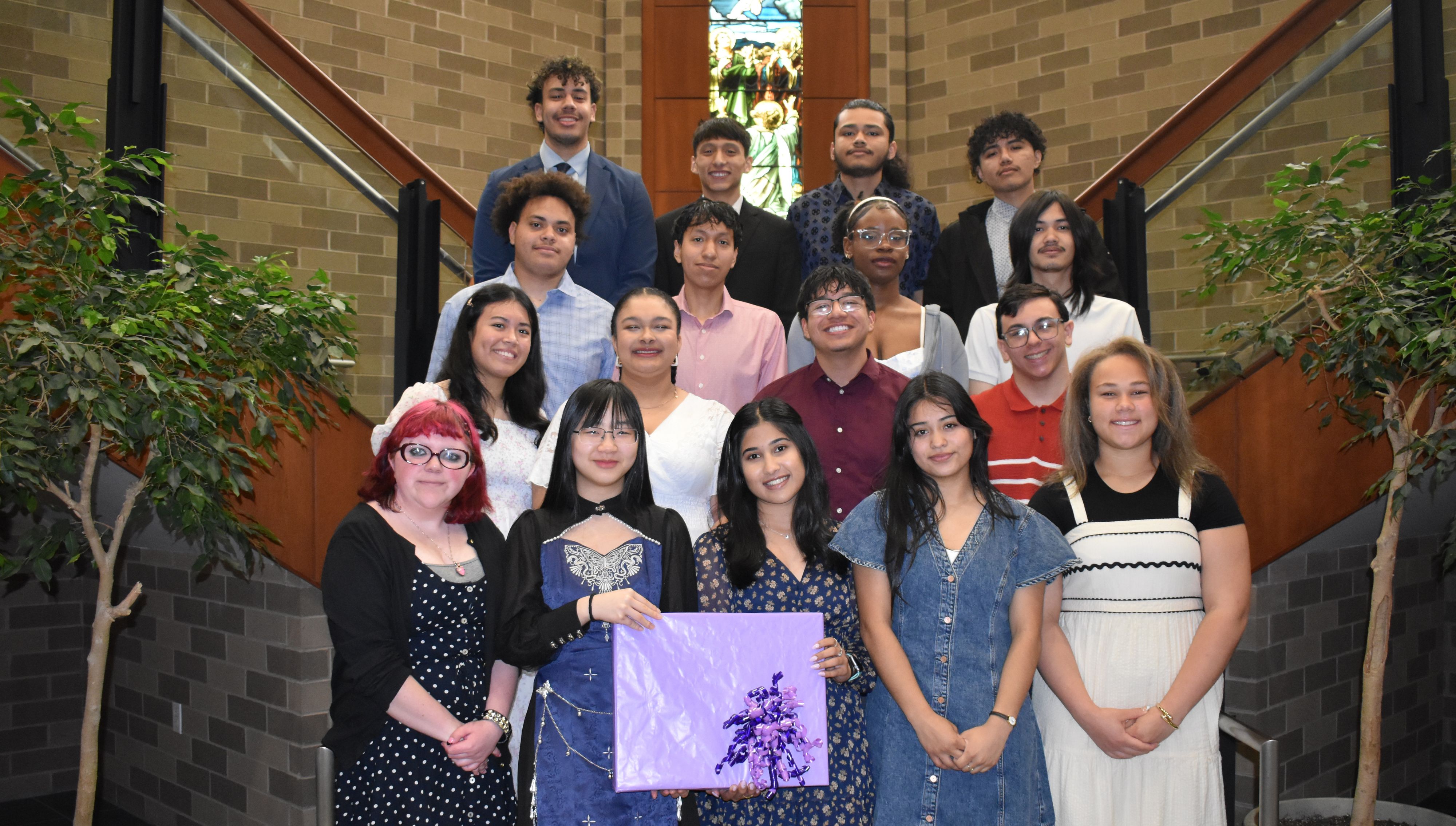
Below are this year’s University of Success graduates, listed alongside their high schools and colleges and intended majors or career paths:
Royli Jesus Ayala, West Scranton — Loyola University, Biology Pre-Med
Sophia Chen, Delaware Valley — Penn State, International Relations
Trent Coffield, Commonwealth Cyber School — Harrisburg University, Cybersecurity
Corey Condon, Dunmore — Marywood University, Communications
Luis Angel Espino, West Scranton — Misericordia University, Neuroscience Pre-Med
Vishwa Gandhi, Riverside — The University of Scranton, Accounting
Lucianna Gonzales, Abington Heights — Liberty University, Biomedical Science
Emily McDonald, Wyoming Valley West — Luzerne County Community College, Nursing
Joshua Miranda, Cyber School Scranton — Art Pursuits
Elany Nunez, West Scranton — Lehigh University, International Relations
Engel Ovalles, West Scranton — Marywood University, Architecture
Yadhira Paromo, West Scranton — The University of Scranton, Chemistry
Juan Ramos, West Scranton — The University of Scranton, Cybercrime and Homeland Security
Elias Rios, West Scranton — The University of Scranton, Business
Brandon Sanchez, West Scranton — Gap Year, Business Owner
K’lea Palukonis, Abington Heights — University of Pittsburgh, Early Childhood Education and Special Education
Nmesoma Clare Udoye, Scranton — Howard University, Public Health
Layla Weeks, Abington Heights — The University of Scranton, Early Childhood Education and Special Education
The University of Success is funded entirely by corporate and foundation grants, ensuring there is no charge to students and their families. The program was created in 1996 and graduated its first full class in 2001. Applications are accepted and new students are admitted each year. The deadline for applications for the Class of 2030 closed earlier this spring.
University of Success Celebrates 2026 High School Graduates
Members of The University of Scranton community gathered in Leahy Hall’s Kane Forum on Tuesday, Feb. 17, for the annual presentation of the Pedro Arrupe, S.J., Award as part of the monthly Jesuit Spirituality Luncheon.
This year, the University presented the Arrupe Award to M. Shawn Copeland, Ph.D., professor emerita of systematic theology in the Department of Theology at Boston College.
At the ceremony, Dr. Copeland presented a lecture called "Healing and Creating in History: The Redemptive Praxis of Christian Community,” providing members of the Scranton community an opportunity to hear her discuss her work and philosophy.
$content.getChild('content').textValueBorn in Detroit, Michigan, Dr. Copeland received her Bachelor of Arts degree in English in 1969 from Madonna College and became a Felician religious sister.
For four decades, Copeland taught courses in theology at institutions across the United States and conducted field-defining research at the intersection of the Catholic, Black and Feminist traditions. Her books include "Enfleshing Freedom: Body, Race, and Being (2010)" and "Knowing Christ Crucified: The Witness of African American Religious Experience (2018)." In addition to her work in the academy, she has also lectured at parishes across the country.
The University of Scranton established the Arrupe Award in 1995 to recognize individuals who have furthered in a significant way the Ignatian mission. It is named for the late Very Rev. Pedro Arrupe, S.J., the 28th Superior General of the Society of Jesus and sometimes referred to as its “second founder.”
$content.getChild('content').textValueProlific Theologian Receives Arrupe Award (Photos)
Philip E. Auerswald, Ph.D., professor of public policy at George Mason University, recently presented “How We Got to Now,” the keynote lecture at The University of Scranton's Spring Henry George Seminar.
Over 300 students, faculty, alumni and community members attended the lecture on Wednesday, April 15, at the McIlhenny Ballroom inside the DeNaples Center. The lecture reflected Dr. Auerswald's extensive research on technology-driven growth, innovation, entrepreneurship and economic development.
Dr. Auerswald currently serves as co-chair and executive director of the Global Entrepreneurship Research Network, an initiative of the Kauffman Foundation; is a Senior Fellow at George Mason's Mercatus Center; and is the cofounder and editor of "Innovations," a quarterly journal about entrepreneurial solutions to global challenges published by MIT Press.
A distinguished author, Dr. Auerswald's most recent book, "The Code Economy: A Forty-Thousand Year History," was released in 2017. The book discusses the ways in which code has driven human development throughout history.
$content.getChild('content').textValueDr. Auerswald received a Ph.D. in economics from the University of Washington and a Bachelor of Arts in political science from Yale University. From 2010 to 2013, he was an advisor to the Clinton Global Initiative.
Financial support for the Henry George Seminar is provided by a grant from the Progress and Poverty Institute. The lecture series is organized and presented by the Kania School of Management's Department of Economics, Finance and International Business and the XI chapter of Omicron Delta Epsilon. The series is named in honor of the 19th-century American economist and social reformer and has hosted many of the world's leading economists.
For more information about the Spring Henry George Seminar, please call 570-941-4048 or email pamela.turbessi@scranton.edu.
Renowned Economist Headlines Spring Henry George Seminar (Photos)
University of Scranton nurse anesthesia students Gina Biancarelli, Jillian Moyer, Michael Schultze and Zachary Sigirci won the Pennsylvania Association of Nurse Anesthetists College Bowl 2026. The College Bowl is an annual, fast-paced academic quiz show competition hosted by the Pennsylvania Association of Nurse Anesthetists (PANA).
The University of Scranton team brought home the trophy for a second consecutive year.
Learn more about the University's Nursing Programs.
The Pennsylvania Association of Nurse Anesthetists hosted its spring symposium April 30 - May 3 at The Hotel Hershey in Hershey.
University Nurse Anesthesia Students Win Statewide Competition
The University of Scranton recognized 34 outstanding master’s and doctoral degree graduates at its graduate commencement events the weekend of May 22-24, including at the graduate commencement ceremony at Mohegan Arena at Casey Plaza, Wilkes-Barre Township.
$content.getChild('content').textValue
The following graduate students were honored for achievement in their academic area:
Bryant L. Richards, of Webster, Massachusetts, received the Doctor of Philosophy Outstanding Student Award for Accounting;
Madison A. Borys, of West Caldwell, New Jersey, received the Doctor of Occupational Therapy Outstanding Student Award for Occupational Therapy;
Zadok I. Miller, of Glen Allen, Virginia, received the Doctor of Nursing Practice Outstanding Student Award for Nurse Anesthesia;
Madison R. Ribeiro, of Fairfield, New Jersey, received the Doctor of Physical Therapy Outstanding Student Award for Physical Therapy;
Cassidy A. Bartkowski, of Clarks Summit, received the Outstanding Student Award for Family Nurse Practitioner;
Madalyn Dolores Beretzki, of Mount Laurel, New Jersey, received the Outstanding Student Award for Occupational Therapy;
Logan H. Campbell, of Conshohocken, received the Outstanding Student Award for Business Analytics;
Bethany Earley, of Clarks Green, received the Outstanding Student Award for School Counseling;
Christopher W. Eppley, of Harleysville, received the Outstanding Student Award for Finance;
Fara C. Etienne, of Wheatley Heights, New York, received the Outstanding Student Award for Healthcare Management;
Amelia J. Farry, of South Abington Township, received the Outstanding Student Award for Cybercrime Investigation and Cybersecurity;
Cassandra K. Haw, of Scranton, received the Outstanding Student Award for Clinical Rehabilitation Counseling;
Thomas W. Hoy, of Danville, received the Outstanding Student Award for Business Administration;
Jonathan Janosky, of Greenfield Township, received the Outstanding Student Award for Software Engineering;
Paul L. Katz, of Pittsburgh, received the Outstanding Student Award for Accountancy;
Kevin M. Keil, of Egg Harbor Township, New Jersey, received the Outstanding Student Award for Business Administration;
Faith M. Kwasnik, of Fair Lawn, New Jersey, received the Outstanding Student Award for Special Education;
Nicholas A. Luzetski, of Edwardsville, received the Outstanding Student Award for Business Administration;
Kevin Ly, of Danville, received the Outstanding Student Award for Business Administration;
Anna J. Merkel, of Skillman, New Jersey, received the Outstanding Student Award for Chemistry;
Renata Monteiro, of Mount Arlington, New Jersey, received the Outstanding Student Award for Corporate Finance and Investment Specialization;
Spencer R. Owens, of Coopersburg, received the Outstanding Student Award for Health Administration;
Christian S. Rizzotti, of Macungie, received the Outstanding Student Award for Business Administration;
Allison Schuessler, of Selinsgrove, received the Outstanding Student Award for Business Administration;
Alyssa E. Sendek, of Haddon Township, New Jersey, received the Outstanding Student Award for Business Administration;
Ryan V. Sophabmixay, of Scranton, received the Outstanding Student Award for Secondary Education;
Julia R. Swistak, of Olney, Maryland, received the Outstanding Student Award for Business Administration;
Ashley M. Tirone, of Budd Lake, New Jersey, received the Outstanding Student Award for Applied Behavior Analysis;
Angeliki I. Trifonopoulos, of Jeffersonville, New York, received the Outstanding Student Award for Clinical Mental Health Counseling;
Kristen Ullmeyer, of Walden, New York, received the Outstanding Student Award for Speech-Language Pathology;
Anathae Wallace, of Levittown, received the Outstanding Student Award for Health Informatics;
Isabelle M. Wohlleber, of Hazleton, received the Outstanding Student Award for Biochemistry.
Top Master’s, Doctoral Graduates Awarded
The University of Scranton honored 65 members of its undergraduate Class of 2026 for academic excellence, leadership and service at a Class Night ceremony on Friday, May 22, at the McIlhenny Ballroom inside the DeNaples Center.
Students with the highest GPA in each of the University’s three undergraduate colleges were presented Frank J. O’Hara Awards for General Academic Excellence, a memorial to the late administrator who served the University for 53 years.
Class of 2026 O’Hara Award recipients were: Alyssa M. Cosklo, of Fell Township, Michael J. Gallo, of Whitehall, Sheila A. Miller, of Milford, New Jersey, and Matthew F. Schade, of Haddon Heights, New Jersey, for the College of Arts and Sciences; Nathan F. Clarke, of Malvern, Dean Joseph Luciano Finan, of Downingtown, and Gary C. Mrozinski, of Taylor for the Kania School of Management; and Claudia Vivian Campisciano, of Broomall, for the Leahy College of Health Sciences.
Member of the Class of 2026 Mariah Mancuso, of Dunmore, offered remarks at the ceremony.
$content.getChild('content').textValue
In addition, students were honored for outstanding academic achievement in their fields of study, leadership and service.
The students honored at Class Night and the awards received are as follows:
David P. Banko, of Wind Gap, received the Lawrence A. Mann Award;
Alessandra Bellino, of Schwenksville, received the Excellence in Mathematics Award;
Diana Lynn Bobko, of Exton, received the Excellence in Occupational Therapy Award;
Claudia Vivian Campisciano, of Broomall, received the O'Hara Award;
Emily R. Carey, of Monroe Township, New Jersey, received the Excellence in Public Policy and Service Award;
Nathan F. Clarke, of Malvern, received the O'Hara Award and the Excellence in Accounting Award;
Chloe P. Colozza, of Old Forge, received the Mary E. Quinn Award for Excellence in Secondary Education;
Rebecca M. Colwell, of Taylor, received the Jesuit Community Award for Outstanding Service (ex aequo);
Kaitlyn M. Conrad, of Wyoming, received the Excellence in Management Award;
Alyssa M. Cosklo, of Fell Township, received the O'Hara Award and the J.J. Quinn, S.J., Achievement Award for Demonstration of Excellence in English Studies and the Excellence in Biology Award;
Erica C. Czerwinski, of Burlington, Massachusetts, received the Excellence in Psychology Award;
Philip R. Danchik, of Woodbine, Maryland, received the Excellence in Chemistry Award;
Allie D. Dean, of Endicott, New York, received the Sigma Theta Tau, International Honor Society of Nursing, Award;
Philip J. Evan, of Kingston, received the Excellence in Economics Award (Kania School of Management);
Dean Joseph Luciano Finan, of Downingtown, received the O'Hara Award and the Excellence in Finance Award (ex aequo);
Kevin P. Finning, of Rockville Centre, New York, received the Prof. Frank C. Brown Award for Excellence in History;
Maeve A. Gale, of Shrewsbury, Massachusetts, received the Excellence in Health Administration Award;
Michael J. Gallo, of Whitehall, received the O'Hara Award;
Ryan W. Hanley, of Dumont, New Jersey, received the Pennsylvania Institute of Certified Public Accountants Award;
Matthew J. Jasienski, of Duryea, received the Excellence in Biochemistry, Cell and Molecular Biology Award;
Christina M. Kennedy, of Morristown, New Jersey, received the Jesuit Community Award for Outstanding Service (ex aequo);
Ashley A. Kessell, of Exeter, received the Excellence in Health Promotions Award;
Madison Jean Kuharchik, of West Pittston, received the Excellence in Forensic Chemistry Award;
Benjamin Lenert, of Havertown, received the Excellence in Cybercrime and Homeland Security Award;
Grace V. Lennox, of Peckville, received the Prof. Timothy H. Scully Award for Excellence in Political Science;
Bianca Leonard, of Hellertown, received the Excellence in Counseling and Human Services Award;
Grace L. Lloyd, of Yardley, received the J. Timothy Cannon Award for Excellence in Neuroscience;
Tanis J. MacNamee, of Windsor, New York, received the Excellence in Kinesiology Award;
Allison M. Magee, of Harleysville, received the Excellence in Economics Award (College of Arts and Sciences);
Ian T. Mahalek, of Fairfax, Virginia, received the Excellence in Environmental Science Award;
Mariah A. Mancuso, of Dunmore, received the Student Life Award (ex aequo) and spoke at the event;
Thomas Edward Marine, of Cockeysville, Maryland, received the Susquehanna Valley American Chemical Society Senior Award;
Sofia C. Mastellone, of Wayne, New Jersey, received the Lawrence Lennon Award for Outstanding Service and Achievement in Psychology;
Denis P. McBride, of Mount Laurel, New Jersey, received the Excellence in Applied Computing Award;
Ashley M. McCartney, of Macungie, received the Excellence in Early and Primary Teacher Education Award;
Deirdre Rose Meagher, of Staten Island, New York, received the Excellence in Communication Sciences and Disorders Award;
Hadley M. Michaels, of Baldwinsville, New York, received the Academic Excellence in Nursing Award;
Olivia N. Miller, of Phoenixville, received the Excellence in Operations Management Award;
Sheila A. Miller, of Milford, New Jersey, received the O'Hara Award and the Prof. Bernard J. McGurl Award for Excellence in Communication;
Faith E. Montagnino, of Morganville, New Jersey, received the Prof. Joseph B. Cullather Award for Excellence in English;
Gary C. Mrozinski, of Taylor, received the O'Hara Award and the Excellence in Finance Award (ex aequo);
Sheldon S. Myers, of Downingtown, received the Excellence in Biochemistry Award;
Thomas M. O'Hern, of West Caldwell, New Jersey, received the Excellence in Chemistry Business Award;
James W. O'Malley, of Ambler, received the Dr. A.J. Cawley Award for Excellence in Engineering;
Caroline E. O'Rourke, of Huntington, New York, received the Excellence in Physiology Award;
Evangelina M. Paisi, of East Stroudsburg, received the Excellence in International Studies Award;
Gabriella M. Palmer, of Phoenixville, received the Excellence in Theatre Award;
Alek D. Panchik, of Hershey, received the Excellence in Business Administration Award;
Quentin A. Pegan, of Upper Chichester, received the Croteau and Marx Family Award for Excellence in Mechanical Engineering;
Rebecca F. Potter, of Hasbrouck Heights, New Jersey, received the Prof. Joseph P. Harper Award for Excellence in Physics;
Jonathon Purvis, of Carbondale, received the Excellence in Computer Science Award;
Brian Readie, of Cranford, New Jersey, received the Excellence in Information Technology Award;
Kaeli Marie Romanowski, of Lake Ariel, received the Edward K. Spitzer Scholarship Award;
Vito M. Rotell, of Eynon, received the Excellence in Business Analytics Award and the Student Life Award (ex aequo);
Matthew F. Schade, of Haddon Heights, New Jersey, received the O'Hara Award;
Therese J. Shimkus, of Scranton, received the Excellence in Philosophy Award;
Sarayah F. Smith, of Dallas, received the Excellence in Criminal Justice Award;
Samantha R. Sonnie, of Philadelphia, received the J. Harold Brislin Memorial Award for Excellence in Journalism;
Nicole C. Tonny, of Scranton, received the Excellence in Marketing Award;
Ashlyn Urbanski, of Pittston, received the Excellence in Mathematical Sciences Award;
Elizabeth G. Vander Neut, of Exton, received the Alumni Loyalty and Service Award;
Maria I. Viola, of Monroe, New York, received the Excellence in Theology Award;
Stevie-Gianna V. Vitale, of Freehold, New Jersey, received the Excellence in Sociology Award;
Steven Wohlmuth, of Cromwell, Connecticut, received the Military Science Leadership Award;
Delaney M. Wozniak, of Kings Park, New York, received the Excellence in Human Resource Studies Award.
An archived recording of the ceremony can be seen at this link.
Outstanding Graduates Recognized at Class Night
It is one of the highest honors at The University of Scranton.
And, this year, it was presented to two individuals.
The University’s graduating senior Class of 2026 awarded this year’s Teacher of the Year to Sinchul Back, Ph.D., associate professor and director of the cybercrime and homeland security program; and Andrew Venezia, Ph.D., associate professor of health and human performance.
Created in 1997 by the University’s Faculty Senate, the Teacher of the Year award recognizes faculty members who exemplify excellence across multiple dimensions of teaching and student engagement. Honorees must be committed to maintaining the highest standards of academic excellence and fairness, ensuring an enlightening, rigorous and equitable learning environment for all students. Voting was conducted in April. Dr. Back and Dr. Venezia accepted their awards on Friday, May 22, at Class Night, held inside the DeNaples Center’s McIlhenny Ballroom.
$content.getChild('content').textValueDr. Back, who has worked at Scranton since 2019, is a retired Marine captain who served as an instructor in counter-terrorism tactics and counter-intelligence operations for the Republic of Korea Marine Corps. He previously served as a legislative aide for the South Korea Senate and the Massachusetts State House.
Dr. Back holds a Ph.D. in International Crime from Florida International University, a Master of Science in Criminal Justice from Bridgewater State University and a Bachelor of Science in Leadership and Political Science from Northeastern University. He teaches courses on cybercrime, cyber intelligence, mobile forensics, digital forensics investigation and introduction to homeland security.
Dr. Venezia, who has worked at Scranton since 2016, teaches in the kinesiology program and nutrition concentration and serves on the advisory committee for the neuroscience program. Among his courses is Advanced Physiology of Sport and Exercise, which he’s taught to every graduating kinesiology senior since 2016. He has also mentored several students in the University Honors Program.
Dr. Venezia earned bachelor’s and master’s degrees in exercise science from Bloomsburg University. He earned his Ph.D. in Neuroscience and Cognitive Science from the University of Maryland.
Faculty members may earn the Teacher of the Year award no more than once.
Class of 2026 Selects Teachers of the Year
Five members of The University of Scranton’s Class of 2026 capped their undergraduate careers by being commissioned as second lieutenants in the U.S. Army.
The five Scranton graduates, as well as three additional members from other regional colleges, were honored at an on-campus ceremony, held Saturday, May 23, at the McIlhenny Ballroom inside the DeNaples Center.
$content.getChild('content').textValueUniversity of Scranton ROTC
- 2nd Lt. Natalie M. Badilla, of Fairless Hills, graduated, magna cum laude, as a nursing major.
- 2nd Lt. Caleb A. Grossman, of Swoyersville, graduated, magna cum laude, as an international studies major. He was named a Distinguished Military Graduate, placing him in the top 10% of cadets in the nation. He received the George C. Marshall Military Leadership Award, as well.
- 2nd Lt. Nicholas A. Luzetski, of Edwardsville, graduated as a business administration major. He was named a Distinguished Military Graduate, placing him in the top 10% of cadets in the nation.
- 2nd Lt. David R. McIntyre, of Scranton, graduated, magna cum laude, as a criminal justice major.
- 2nd Lt. Steven Wohlmuth, of Cromwell, Connecticut, graduated, summa cum laude, as a communication and philosophy double major. He was named a Distinguished Military Graduate, placing him in the top 10% of cadets in the nation. He received The University of Scranton's Military Science Leadership Award at Class Night on May 22.
Also commissioned at the event were members of the Royal Warrior Battalion from area colleges:
- 2nd Lt. Efrain Madera, of Reeders, who graduated as a criminal justice major from East Stroudsburg University;
- 2nd Lt. Stephen Tellez, of Moscow, who graduated as a U.S. history major from East Stroudsburg University.
- 2nd Lt. Amanda Trzesniowski, of Wilkes-Barre, who graduated as a nursing major from Marywood University.
Col. Kaitlyn Perkins '03 served as the principal speaker. Rev. Joseph G. Marina, S.J., University president, and Lt. Col Jay Wenger, Ph.D., University professor of military science and leader of the Royal Warrior Battalion Army ROTC program, also participated in the ceremony.
$content.getChild('content').textValueScranton Graduates Commissioned as Second Lieutenants
The University of Scranton conferred more than 450 master’s and doctoral degrees at its graduate commencement ceremony for the Class of 2026. Graduates received their diplomas on Sunday, May 24, at Mohegan Arena at Casey Plaza in Wilkes-Barre Township. Graduates must have completed their academic requirements between August 2025 and May 2026.
Graduates spanned 22 states from throughout the U.S., including Arizona, California, Florida, Georgia and Tennessee with a large concentration from the East Coast. Pennsylvania was the most populous state among the graduates at 48%, followed by New Jersey and New York at about 15% each. International graduates hailed from Canada, India and Saudi Arabia.
Harshil Nariya ’26, a Master of Business Administration graduate from Enola, addressed his fellow graduates as the class speaker.
“Today is not just a celebration of what we have become, but it is also a reflection of who we are," Nariya said. “We came here with ambitions: to build careers, to learn, to create opportunities. And yes, we have done that. But along the way, we also developed something deeper. We developed empathy, resilience and a sense of responsibility.
“I come from a background where opportunities are not always guaranteed. From working in my family business to studying here, I have seen different sides of the world. And what I think connects them is simple: an understanding that our success is tied to those around us.”
$content.getChild('content').textValueKaren L. Pennington, Ph.D. ’76, G’83, H’15, who spoke earlier in the day at the undergraduate commencement ceremony, addressed the graduate crowd, as well.
Dr. Pennington, a former higher education administrator, was also in town to celebrate her 50-year class reunion.
“You have a chance to use this gift of education, this special status you achieved, as the launching pad to be more than you were before,” Dr. Pennington said. “Take all you have learned about managing time — past, present and future — to carry the lessons of organization, respect and kindness with you, as you commit to taking the actions necessary to achieve all of your goals.
“What does it mean to have a degree from The University of Scranton? You soon will know, because you have reached the end of this part of your Scranton journey. ... I say it's just ‘this part,’ because what it means to have a degree from The University of Scranton is more than a piece of paper to hang on your wall. It is knowing that you are part of a larger community, not just while in class but for long after."
Among the degrees awarded were Masters of Accountancy, Business Administration, Health Administration, Science and Science in Nursing; as well as Doctors of Nursing Practice, Occupational Therapy, Philosophy and Physical Therapy.
An archived recording of the ceremony is available online.
$content.getChild('content').textValueGraduate Commencement Held at Mohegan Arena (Full Story + Photos)
The University of Scranton awarded undergraduate degrees to more than 900 members of the Class of 2026. The newest Scranton alumni received their bachelor’s degrees on Sunday, May 24, at Mohegan Arena at Casey Plaza, Wilkes-Barre Township. Graduates must have completed their academic degree requirements in August and December of 2025, as well as January and May of 2026.
The most populous states in this year’s graduating class included Pennsylvania (46%), New York (27%) and New Jersey (20%). Graduates hailed from 11 other states, stretching as far west as Washington and as south as Florida and Texas. The countries of Ireland and Ukraine were represented, as well.
The most common major among the graduates was nursing (10%), while accounting, biology, business administration, criminal justice, finance, kinesiology and occupational therapy represented about 5% each. In total, the graduates covered 61 distinct majors.
Following the processional and a welcome by Tracy M. Stewart, Ph.D., interim provost and senior vice president for academic affairs, the Most Rev. Joseph C. Bambera, D.D., J.C.L., H’14, Bishop of Scranton, provided the Invocation.
Sajidul Alam ’26, a double major in political science and philosophy from Kingston, addressed his fellow graduates as the class speaker.
Alam spoke about how the University became “home” for the Class of 2026, referencing two quotes that graduates have seen and heard throughout their daily travels at Scranton.
“‘Go forth and set the world on fire.’ At first, it may have sounded like a call to do something big, something enormous. But Scranton has taught us that sometimes, it means taking what we have learned here and carrying forward those values with intention, integrity, compassion and purpose,” Alam said. “And there is another idea that defines this place, one that is etched on the side of the DeNaples Center: ‘Not where I breathe, but where I love, I live.’ For the past four years, The University of Scranton has been that place.”
$content.getChild('content').textValueFollowing Alam’s remarks, the University conferred honorary degrees to former Dominican University president Donna M. Carroll, Ed.D.; attorney and University alumnus Vincent F. Reilly, Esq. ’80; and longtime educator Jack Raslowsky.
Karen L. Pennington, Ph.D. ’76, G’83, H’15, then took the stage as the principal speaker. Dr. Pennington’s 40-plus-year career in higher education administration, prior to retiring in 2021, included 22 years as vice president for student development and campus life at Montclair State University.
In addition to serving as the principal speaker, Dr. Pennington celebrated her class reunion. She and other 1976 graduates gathered before the ceremony, reminiscing on their historic class — the University’s first undergraduate, full-time student class to include women.
$content.getChild('content').textValueRev. Joseph G. Marina, S.J., president, conferred degrees upon candidates presented by the deans of the University’s three colleges: Victoria H. Castellanos, Ph.D., Leahy College of Health Sciences; Mark Higgins, Ph.D., Kania School of Management; and Carolyn M. Barry, Ph.D., College of Arts and Sciences.
Following the awarding of diplomas, Christopher J. Neumann, Esq. ’87, president of the alumni society, addressed the graduates, as did Father Marina. Megan E. Heeder, Ph.D., assistant professor of theology, provided the benediction prior to the recessional.
Music throughout the event was provided by the University’s concert band and singers.
An archived recording of the ceremony is available online.
$content.getChild('content').textValueScranton Holds 2026 Undergraduate Commencement (Full Story + Photos)
Center for Service and Social Justice (CSSJ) annual End of the Year Drive, largest sustainability project on campus, is underway. Donations will be accepted through Sunday, May 24.
Boxes for drop-offs are available in the parking garage stairwell (Monroe Entrance); and in the DeNaples Center by the ATM, first floor by the elevator and second floor outside the CSSJ office. Donations may also be brought directly to the back door of Ciszek Hall, 1120 Mulberry Street.
View the list below to see which items will be accepted. Questions? Contact ellen.judge@scranton.edu
End-of-the-Year Drive Continues Through May 24
Royal News will have a reduced publishing schedule over the summer.
After the June 3 issue, the University's Royal News e-newsletter will be published on the first Wednesdays of July and August; the website will continue to be updated with the latest news. Weekly issues will resume on Wednesday, Aug. 19, and continue throughout the fall semester.
We welcome announcement submissions from faculty, staff, students and clubs at any time, so please send them along. Find the instructions at this link: Royal News FAQ.
Thanks, and have a great summer!
Royal News To Begin Summer Schedule
The University of Scranton from Friday, May 22, through Sunday, May 24, will celebrate its undergraduate and graduate Class of 2026.
Thousands of guests are expected for a wide range of on- and off-campus events, making this — combined with Memorial Day weekend — one of the busiest travel periods of the year in the Greater Scranton/Wilkes-Barre area.
Many of the University's colleges and programs host their own celebrations throughout the weekend, leading up to Sunday's commencement ceremonies.
More than 900 bachelor's degrees will be awarded at the undergraduate commencement ceremony. The degree recipients span 14 states, as well as Ireland and Ukraine. Additionally, 450-plus master's and doctoral degrees will be awarded at the graduate commencement ceremony.
🗓️ KEY EVENTS
FRIDAY, MAY 22
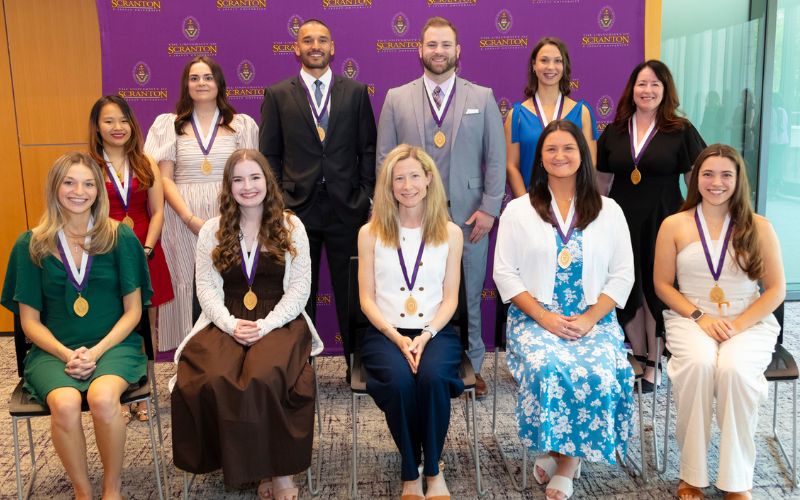
4 p.m. Leahy College of Health Sciences Outstanding Graduate Awards Ceremony at the Kane Forum of Leahy Hall.
5:30 p.m. Kania School of Management Reception at the fifth floor of Brennan Hall.
7:30 p.m. Class Night, recognizing undergraduates for academic achievement, leadership and service, at the McIlhenny Ballroom of the DeNaples Center.
SATURDAY, MAY 23
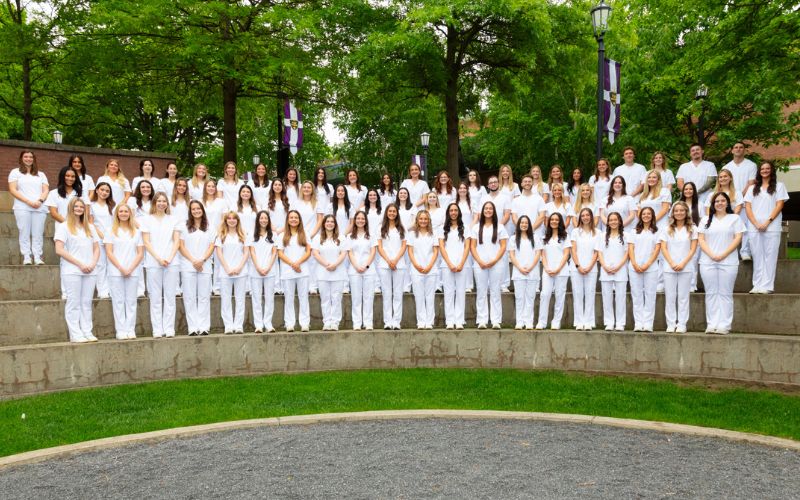
9 a.m. Pinning Ceremony for nursing graduates at the Byron Recreation Complex.
11:30 a.m. Multicultural Graduation Celebration at the Byron Recreation Complex.
1 p.m. ROTC Commissioning at the McIlhenny Ballroom of the DeNaples Center.
2:45 p.m. Class of 2026 Legacy Photo at the Loyola Science Center.
4 p.m. Baccalaureate Mass at the Byron Recreation Complex.
5:30 p.m. A Royal Toast to the Class of 2026 at the Dionne Campus Green.
SUNDAY, MAY 24
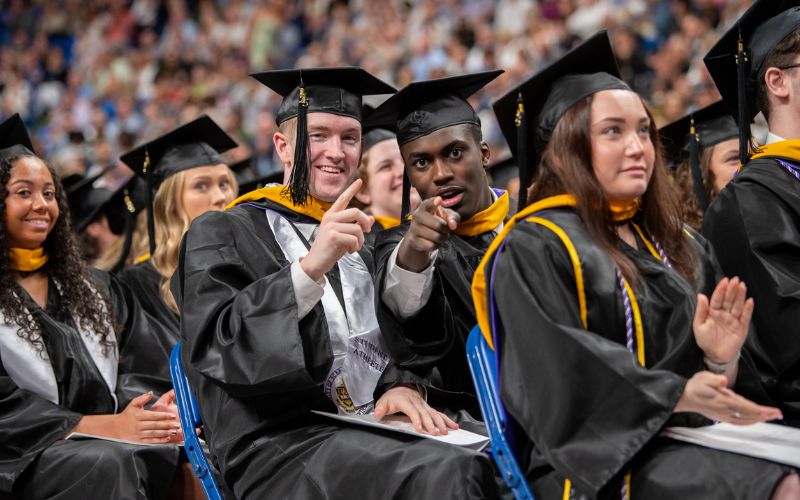
9:45 a.m. Doors open for the Undergraduate Commencement Ceremony at Mohegan Arena at Casey Plaza, Wilkes-Barre Township. Tickets are not required.
11 a.m. Undergraduate Commencement Ceremony begins.
12 p.m. Doctor of Physical Therapy Awards Ceremony at the McIlhenny Ballroom of the DeNaples Center.
3:45 p.m. Doors open for the Graduate Commencement Ceremony at Mohegan Arena at Casey Plaza, Wilkes-Barre Township. Tickets are not required.
4:30 p.m. Graduate Commencement Ceremony begins.
📍 LOCATIONS
Please refer to the University’s campus maps webpage for precise locations of school buildings.
Mohegan Arena, home of the NHL’s Pittsburgh Penguins’ top minor league affiliate, is located at 255 Highland Park Blvd., Wilkes-Barre Township, PA 18702, about 20 miles south of campus. Visit the arena’s website to review its clear bag policy and security procedures.
🎥 LIVESTREAMS
Class Night (7:30 p.m. Friday)
Pinning Ceremony (9 a.m. Saturday)
Baccalaureate Mass (4 p.m. Saturday)
Undergraduate Commencement Ceremony (11 a.m. Sunday)
Graduate Commencement Ceremony (4:30 p.m. Sunday)
ℹ️ ADDITIONAL INFORMATION
Further details, including commencement photography and programs, could be found on the University's website.
Join the fun by following @UniversityofScranton on Instagram, Facebook, TikTok and LinkedIn.
Commencement 2026: Schedule and Essential Information
Former Dominican University president Donna M. Carroll, Ed.D., University of Scranton alumnus and attorney Vincent F. Reilly, Esq. ’80, and longtime educator Jack Raslowsky will receive honorary degrees from The University of Scranton at its undergraduate commencement ceremony on Sunday, May 24.
A fourth honorary degree will be conferred to legendary college and professional basketball coach P.J. Carlesimo. His degree will be awarded at a later date.
Dr. Carroll is a lifelong leader in Catholic, Jesuit higher education who served from 1994 to 2021 as president of Dominican University in Illinois. She was the first lay president of Dominican. Using a mission-centered, student-focused approach, she guided the institution through major transformations while advancing equity, supporting students on the margins and raising the university’s national profile.
Dr. Carroll is a former member of the Board of Trustees at The University of Scranton. She has served since 2024 as president of the Association of Catholic Colleges and Universities, which serves as the collective voice of Catholic higher education in the U.S.
Reilly is a lawyer, philanthropist and alumnus whose life reflects cura personalis and service to those in need. He was the law partner of fellow Royal Kevin O’Brien, Esq. ’80, for 17 years before founding Reilly, McDevitt and Henrich, where he is the firm’s co-managing partner and has emphasized service to clients of modest means.
Reilly’s generosity extends to community service, parish life and education. Deeply connected to his alma mater, Reilly served multiple terms on The University of Scranton’s Board of Trustees, including as chair from 2022-2025. In 2015, he was awarded the University’s prestigious Frank J. O’Hara Distinguished Alumni Award.
Raslowsky is a veteran Jesuit secondary education leader whose career spans 35-plus years as a teacher, administrator and president. In 2009, he became the first lay president of Xavier High School (New York City), where he has since championed human dignity, inclusion and spiritual formation.
A strong advocate for social justice, Raslowsky has integrated Ignatian values into leadership and service in and out of the classroom, serving on numerous faith-based boards. He will retire from Xavier following the 2026-2027 academic year.
Deeply connected to Jesuit values and The University of Scranton, Carlesimo is a major supporter of Scranton athletics and the annual Carlesimo Golf Tournament and Award Dinner held in memory of his late father, Peter A. Carlesimo, a historic University coach and athletic director.
Carlesimo has coached major college programs and NBA teams and was an assistant coach for the gold medal-winning 1992 U.S. Olympic men’s “Dream Team.” He won three NBA titles as an assistant coach for the San Antonio Spurs and won 212 games as an NBA head coach. He is currently a prominent basketball broadcaster.
Douglas Brinkley, Ph.D., a New York Times best-selling author, was previously announced as this year’s undergraduate principal speaker. Due to unforeseen circumstances, Dr. Brinkley will not be able to attend commencement. Karen L. Pennington, Ph.D. ’76, G’83, H’15, will serve as the principal speaker for the undergraduate and graduate commencement ceremonies.
The University’s undergraduate commencement ceremony, including the awarding of the honorary degrees, will begin at 11 a.m. Sunday, May 24, at Mohegan Arena at Casey Plaza in Wilkes-Barre Township. Doors open at 9:45 a.m.
EDITOR'S NOTE: This article was updated on Wednesday, May 20, to reflect a change in the undergraduate commencement speaker.
Honorary Degree Recipients Announced
The University of Scranton honored its Reserve Officers’ Training Corps (ROTC) students at a special luncheon, held April 21 at The Colonnade in downtown Scranton.
Rev. Joseph G. Marina, S.J., University president, offered a blessing as the students dined with him; former U.S. Sen. Bob Casey, the University’s Leahy Distinguished Fellow in Public Service; and Lt. Col. Jay Wenger, professor of military science and leader of the Royal Warrior Battalion Army ROTC program.
ROTC is a college-based leadership and training program that prepares students to serve after graduation as officers in the U.S. military. ROTC cadets pursue their academic degrees while participating in military science courses, leadership training and physical fitness activities.
In its most recent rankings, U.S. News and World Report ranked Scranton No. 3 in the North category for “Best Colleges for Veterans,” recognizing the University’s efforts in making higher education more accessible and affordable for veterans and active-duty service members.
ROTC Students Gather With Father Marina, Former U.S. Sen. Casey
The University of Scranton’s Mathematics Department hosted the annual Math Integration Bee on Tuesday, April 29, in the DeNaples Center's McIlhenny Ballroom.
Around 90 competitors from 16 high schools throughout Northeastern Pennsylvania competed in the Bee, which ran all evening.
Elijah Serota, of Wyoming Valley West High School, won the competition with four other finalists being selected. Those finalists were Natalie Barry, Martin Chen and John Masteller, all of Central Columbia High School; and Cayden Liu, of Southern Lehigh High School.
Students partaking in the Bee competed to solve definite and indefinite integral problems, a type of calculus problem, in order to win points to advance to the next round of the competition.
The Math Integration Bee helps high school students improve their skills for Advanced Placement mathematics tests and was open to the public.
$content.getChild('content').textValueWyoming Valley West Student Wins Annual Math Integration Bee (Photos)
Democratic candidates in Pennsylvania’s 22nd Senatorial District Marty Flynn, the incumbent, and Jeffrey Lake participated in a primary debate on Thursday, May 7, at The University of Scranton.
Voters filled the Pearn Auditorium at Brennan Hall, where the debate was hosted by the University’s Center for Ethics and Excellence in Public Service (CEEPS).
The hourlong debate was moderated by Brian Snee, CEEPS director; livestreamed and broadcasted by ECTV; and covered by virtually all media in Northeastern Pennsylvania.
Among the media members in attendance were three local journalists — Donnie Collins of the Times-Tribune, Jake Higgins of the Times Leader and Borys Krawczeniuk of WVIA — who served as panelists and asked the candidates questions.
$content.getChild('content').textValueMore than 100 people attended the debate, filling most seats inside the Pearn Auditorium.
In the fall, CEEPS also organized and executed debates featuring Lackawanna County Commissioner candidates and Scranton Mayoral candidates.
The primary election is May 19.
$content.getChild('content').textValueUniversity of Scranton Hosts State Senate Debate (Photos)
The University of Scranton is accepting applications for Cohort 6 of its Nonprofit Leadership Certificate Program (NLCP), which will run from January 2027 through January 2028. The deadline to apply is June 12, 2026.
Applications can be submitted by following this link to the Nonprofit and Community Assistance Center (NCAC) website.
The NLCP, housed in the Kania School of Management, is designed to be broad-based, hands-on and practitioner-focused to help high-potential nonprofit leaders tackle the pressing leadership challenges in organizations throughout Northeastern Pennsylvania.
Since the program’s inception in 2016, 87 nonprofit professionals from 65 regional organizations have graduated from the program. Cohort 5 included 19 community leaders who completed the program. The NLCP has created a network of high-performing individuals serving at nonprofit institutions, in addition to building an informal regional network of mentors and coaches for emerging nonprofit leaders.
Douglas Boyle, DBA'88, CPA, CMA, Accounting Department chair and founder of the Nonprofit Leadership Certificate Program, noted the program fulfills a critical need in the region.
“The NLCP creates an ecosystem for new and emerging leaders to collaborate on solving an organizational challenge and strengthening their leadership skills," Dr. Boyle said. "The cohort-based approach assures that by building strong relationships, each participant gains a network of peers with specialized skills that they can gain insights from long after graduation. The program assists the organizations with succession planning, nurtures future collaborations with the nonprofit sector and most importantly yields strong and resilient leaders.”
Sessions are led in-person by Kania School of Management faculty and peer group coaches with deep expertise in nonprofit management and practical leadership tools. The program includes work towards specific organizational and personal goals, peer group work, mentorship, and academic leadership components.
For additional information, visit the Nonprofit Leadership Certificate Program webpage or contact one of the NLCP co-directors: Kurt Bauman at kbauman@nepa-alliance.org; Jesse Ergott at jesse.ergott@scranton.edu.
Nonprofit Leadership Program Now Accepting Applications for 2027 Cohort
In 1979, artist Jim Markowich shifted focus after creating a visual celebration of baseball. Today he's getting back in the game to showcase a significant body of work.
"I graduated with a BFA from the Cooper Union School of Art back in 1979," said Markowich. "Making a living as a fine artist was an iffy proposition, so I became a computer programmer and did that professionally for 45 years."
Since his retirement in 2024, the lifelong learner has been engaging in University coursework as an auditor and volunteering botanical skills at the University's Quain Memorial Conservancy Greenhouse. And this spring, in addition to studying European History and Science and the Human Environment at The University of Scranton, he can be found exhibiting a collection of paintings (78!) at the Everhart Museum.
The museum is showcasing his artistry, "Play Ball!: The Tarot de Cooperstown," now through July 19. And, at an Artist's Reception there on Friday, May 15, from 5-8 p.m., Markowich will walk visitors through the development of 78 baseball-related tarot paintings inspired by the baseball diamond and its cast of characters, including the manager, the owner, the players and the commissioner, to name a few.
Registration is not required, but is recommended.
In celebration of America’s pastime, artists Paul Kuhrman and James Markowich used the 18th-century Nicolas Conver tarot card deck, itself derived from the original Tarot de Marseille decks, as the foundation for a series of 78 paintings inspired by the baseball diamond and its cast of characters, including the manager, the owner, the players and the commissioner, to name a few.
According to the Everhart Museum exhibition description, "Tarot decks were originally created for card games, before evolving into tools used to seek guidance and insight into the future. As any baseball fan understands, speaking to and pleading with one's deities about the game is a rite of passage, even to the extent of praying for a hit by one’s favorite player or team, or a recorded out by the opposition. These artistic interpretations take a different approach: not to predict what lies ahead, but to offer a playful celebration of baseball through the imaginative lens of tarot imagery.
In conjunction with the series of paintings, reproductions of the paintings have been printed into a complete tarot card deck that can be used to play an actual baseball game, complete with hits, outs, and interactions with the gods of the diamonds — the umpires!"
Postcard courtesy Everhart Museum.
IF YOU GO:
What: "Play Ball!: The Tarot de Cooperstown," on view through July 19, 2026
When: Artist's Reception with Jim Markowich, Friday, May 15, 2026, 5 –7 p.m.
Registration is not required, but is recommended.
Where: Everhart Museum,1901 Mulberry St, Scranton, PA 18510. Contact: info@everhart-museum.org and 570-346-7186 ext. 510
University Lifelong Learner Showcases 78-Painting Collection at Everhart
The Student Education Club of The University of Scranton (SECUS), led by Co-Moderators Dr. Tata Mbugua and Dr. Jinqing Liu, joined over 20 dedicated education majors for a landmark visit to the Pennsylvania State Board of Education meeting in Harrisburg. The student delegation represented all three certification tracks: Early and Primary Education (PreK–4), Middle Level Education (4–8) and Secondary Education (7–12).
The Pennsylvania State Board of Education is comprised of 21 members, ten of whom serve as the Board’s Council of Basic Education and ten of whom serve as the Board’s Council of Higher Education. The Board has the power and duty to review and adopt regulations that govern educational policies and principles and establish standards governing the educational programs of the Commonwealth.
During the meeting, Dr. Mbugua was recognized by the Board and invited to make a public comment. A public comment at a Pennsylvania State Board of Education meeting follows specific protocol, usually requiring a two- to four-minute limit and a focus on education-related matters such as academic policy, education priorities and teacher preparation priorities. In her 90-second address, Dr. Mbugua expressed the group's gratitude to the Pennsylvania State Board of Education, with special thanks to Board Member Nathan Barrett. Dr. Mbugua noted that Barrett has been a steadfast supporter of The University of Scranton students and was instrumental in facilitating this visit.
"This opportunity allows our future educators to experience firsthand how advocacy and professional agency function at the state level," Dr. Mbugua told the board. "By witnessing these proceedings, our students are moving beyond classroom theory to see how policy is debated, shaped and implemented for the benefit of all Pennsylvania learners."
She emphasized that such experiential learning moments are vital in empowering students to envision themselves not only as future classroom teachers, but as active participants in the broader educational landscape.
Dr. Mbugua thanked the Pennsylvania Board of Education “for its leadership and for providing this platform that helps prepare the next generation of educators to advocate effectively for their students and their profession in Pennsylvania and beyond.”
The group was also addressed by Dr. Carrie Rowe, Secretary of the Pennsylvania Department of Education, who encouraged the students to continue seeking opportunities to contribute to the teaching profession. Dr. Rowe commended the delegation for their participation and extended an invitation to return for next year's Board meeting. Her current priorities span a wide range of pressing issues, including teacher recruitment and retention, student mental health, funding for 27 Pennsylvania libraries, structured literacy, workforce development, expanding dual credit enrollment taught by certified 9–12 grade teachers, amplifying student voices in Board priorities, and funding initiatives to reduce sexual violence on campuses.
Adding to the significance of the occasion, the Pennsylvania Department of Education generously provided a complimentary coach bus for the students' travel to Harrisburg. Dr. Mbugua reflected that the experience was nothing short of a once-in-a-lifetime opportunity — one that brought the future of Pennsylvania education face to face with those who shape it.
“One of the best parts of the trip was speaking with Board of Education members, learning more about education policy, advocacy, and seeing firsthand how decisions impacting schools and students are discussed,” Alexis Cox, SECUS Secretary.
The following students and faculty attended the PDE Board of Education session in Harrisburg: Nina Balchune, Sarah Batista, Julia Brophy, Alexis Cox, Kayla Cunningham, Monical Dell’Olio, Abigail Griesemer, Bridgid Guarnuccio, Makenzi Jashembowski, Bridgit Ann Lewis, Anya Kelly, Jena Lewis, Breana Metric, Bridget Mitchell, Grismeiris De Jesus, Ashley McCartney, Alahna Pidich, Emma Schultz, Emma Ryan, Riley Schmidt, Lizzy Zdziebkowski, Dr. Jinqing Liu and Dr. Tata Mbugua.
The students also had the opportunity to engage with Amy Lena, Deputy Secretary of Education, who applauded them for attending the Board session and invited them to reflect on the meeting's agenda items — among them campus hunger and food insecurity, dual enrollment, minimum of 30-minute recess in K–12 schools, and the Science, Technology, Engineering, Environmental Literacy and Sustainability (STEELS) Standards.
Dr. Liu captured the significance of the experience: "As an Assistant Professor, I am honored to co-lead alongside Dr. Mbugua in bringing our future educators to this Board meeting — where they witness firsthand how educational policy is shaped through dialogue, debate, and democratic action. This transformative experience empowers our students to see themselves not only as teachers, but as advocates and leaders in the future of education. By engaging directly in the policymaking process, they gain the confidence and inspiration to cultivate civic engagement and democratic participation in the generations they will one day teach."
SECUS President Julia Brophy echoed that sentiment: "By observing the Board's deliberations firsthand, we gained an invaluable understanding of teacher advocacy and the critical role of professional agency in shaping the education system."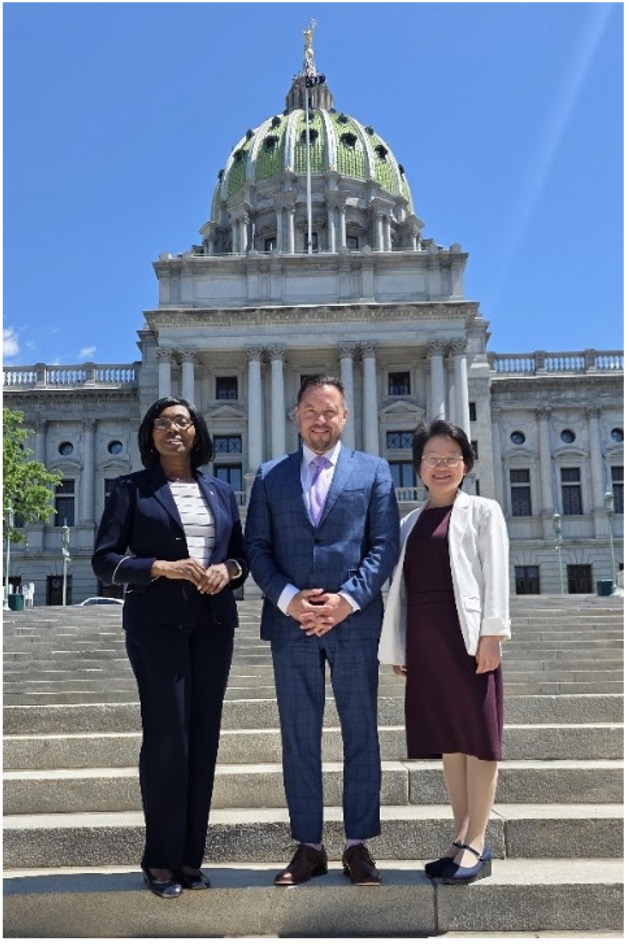
Pennsylvania State Board of Education Member Nathan Barrett guided University of Scranton students and faculty on a tour of the State Capitol and Darby Free Library. Shown are Dr. Mbugua, Barrett and Dr. Liu.
University Education Students Meet With Pennsylvania Secretary of Education
A trailblazing member of a landmark graduating class in The University of Scranton’s history, Karen L. Pennington, Ph.D. ’76, G’83, H’15, will return to deliver remarks as the keynote speaker at this year’s graduate commencement ceremony.
Dr. Pennington, who led strategic initiatives and managed complex departments through periods of growth and transition as a senior director in higher education, holds three degrees from Scranton and also worked for five years at her alma mater. Notably, her undergraduate class, the Class of 1976, was the University’s first undergraduate, full-time student class to include women.
“As one of the first women to graduate from The University of Scranton, Dr. Pennington’s role in the history of our institution cannot be understated. It is through such moments that values take root and communities learn how to grow toward greater justice and belonging,” said Rev. Joseph G. Marina, S.J., University president. “Dr. Pennington has a keen understanding of this concept, as it has informed her own leadership in higher education, marked by inclusion and a steady commitment to the well-being and dignity of students and communities alike.”
This year’s graduate commencement will begin at 4:30 p.m. Sunday, May 24, at Mohegan Arena in Wilkes-Barre Township. Doors open at 3:45 p.m. The undergraduate commencement will be held earlier in the day, beginning at 11 a.m.
After receiving a bachelor’s degree in history from Scranton, Dr. Pennington worked at Gannon University and Ohio University before returning to her alma mater in 1980. Over the next five years at Scranton, she was an associate dean of students and director of student activities whose duties included managing the production of all activities for 50 co-curricular student organizations and overseeing the functions of elected student government and class officers.
From Scranton, Dr. Pennington held positions at the State University of New York at New Paltz and State University of New York at Geneseo until landing in January 1998 at Montclair State University in New Jersey.
Dr. Pennington worked at Montclair State for 22-plus years as vice president for student development and campus life. As its chief student affairs officer, Dr. Pennington was one of seven vice presidents who, with the president, set the University’s general policy and direction. She was responsible for hiring and developing staff; supervising and coordinating 23 departments and 300-plus employees; and serving as a media spokesperson for all activities involving students. Shortly before retiring in 2021, Dr. Pennington was awarded Montclair State’s Scott Goodnight Award for Outstanding Performance as a Dean from the National Association of Student Personnel Administrators.
Dr. Pennington credits The University of Scranton as being a formative and deeply influential part of her life. In particular, she says John R. Gavigan ’42, former vice president of student affairs and namesake of the University’s Gavigan Hall, instilled in her an appreciation for the purpose of serving and helping college students.
Dr. Pennington received an honorary degree in 2015 from The University of Scranton.
University of Scranton Class of 2026 Graduate Commencement Speaker Announced
EDITOR'S NOTE (Wednesday, May 20, 2026): Due to unforeseen circumstances, Douglas Brinkley, Ph.D., will not be able to attend commencement. He will accept an honorary degree at a future date. Karen L. Pennington, Ph.D. ’76, G’83, H’15, who was previously announced as the graduate commencement speaker, will address the undergraduates, as well. Read more about Dr. Pennington at this link.
The information below reflects the original announcement at the time of publication.
Douglas Brinkley, Ph.D., a best-selling author, award-winning producer and nationally celebrated historian and scholar, will serve as the principal speaker at The University of Scranton’s 2026 undergraduate commencement ceremony. Dr. Brinkley will address Scranton’s Class of 2026 on Sunday, May 24, at Mohegan Arena in Wilkes-Barre Township.
Dr. Brinkley’s prolific career has included authoring, editing and contributing to dozens of books and hundreds of essays. He has covered topics including American foreign policy, the presidency and the environment, as well as the lives of transformative figures such as Jack Kerouac, Rosa Parks and Hunter S. Thompson.
Among Dr. Brinkley’s New York Times bestselling books are his biography of Walter Cronkite, which won Fordham University’s Ann M. Sperber Prize, and “The Great Deluge: Hurricane Katrina, New Orleans and the Mississippi Gulf Coast,” which earned the Robert F. Kennedy Human Rights Book Award. He also won a pair of Grammy Awards as a co-producer of the albums “Presidential Suite” and “Fandango at the Wall in New York.”
“We are honored to welcome Dr. Brinkley to Northeastern Pennsylvania, where he will address our graduating students at an important moment in their lives,” said Rev. Joseph G. Marina, S.J., University president. “Dr. Brinkley has demonstrated that history, when researched with care and written with authority, can inform, inspire and endure.”
Additionally, Dr. Brinkley is a leading voice in the environmental conservation and historic preservation community with service that has included board membership and advisory leadership in support of organizations at the forefront of protecting America’s natural beauty.
“Dr. Brinkley’s writing invites readers to see history not as possession, but as gift, entrusted to each generation anew,” Father Marina said. “In that spirit, he has taken his words and thoughts and put them into action, advocating for the preservation of our nation’s natural and historic treasures. He reminds us that the finest form of scholarship comes when intellect and action align in service of the common good.”
Dr. Brinkley was born in Atlanta, Georgia, before moving as a child to Perrysburg, Ohio. He pursued the study of U.S. history at Ohio State University and was awarded a fellowship to Georgetown University, where he immersed himself in the study of U.S. diplomatic history, and received master’s and doctorate degrees.
Dr. Brinkley’s early career included faculty positions at the U.S. Naval Academy, Princeton University and Hofstra University. As part of his “American Odyssey” course at Hofstra, he traveled across the country with students to historic landmarks that shaped America. The ambitious nature of his course drew national attention with write-ups in publications like The New York Times and SPIN magazine. Dr. Brinkley has since taught at the University of New Orleans and Tulane University.
He is currently the Katherine Tsanoff Brown Professor in Humanities at Rice University. He is also CNN’s presidential historian and a Vanity Fair contributor.
Dr. Brinkley will receive an honorary degree at the undergraduate commencement ceremony, which will be followed by the graduate commencement ceremony, also held at Mohegan Arena. Doors open at 9:45 a.m. Undergraduate commencement activities are set to begin at 11 a.m. and graduate activities at 4:30 p.m.
NYT Bestselling Author To Serve as Undergraduate Commencement Speaker
Hundreds of students have been inducted into national and international honor societies represented at The University of Scranton throughout the 2026 spring semester. Lists of students inducted into some of the University’s honor societies can be seen below.
Students Inducted into National Honor Societies
Brandon Terry, Ph.D., presented the Slattery Center for the Ignatian Humanities’ annual Sondra H’87 and Morey Myers H’12 Distinguished Visiting Fellowship in the Humanities and Civic Engagement Lecture on April 23.
Dr. Terry, Harvard University's John L. Loeb associate professor of the social sciences and co-director of the Institute on Policing, Incarceration and Public Safety at the Hutchins Center for African and African American Research, presented a lecture called “Shattered Dreams, Infinite Hope,” which shared a name with his recently published book.
$content.getChild('content').textValueThe 546-page book, published in October, which was selected by the New York Times as one of “100 notable books of 2025,” deals with the reality of the civil rights movement, trying to replace romanticized, idealistic visions of the movement with a more nuanced understanding.
According to the New York Times, “The civil rights movement has been enshrined in American history as an exemplary model of transformative social action. Terry, a Harvard scholar, upends the conventional wisdom, rejecting both romanticized versions of the past and pessimistic accounts of the present to offer a nuanced theory of the movement — and of social movements in general — predicated on a rigorous philosophical vision of what he calls ‘tragic hope.’”
The Myers lecture, which is housed in The University of Scranton’s Slattery Center for the Ignatian Humanities, works to advance the University’s efforts in bringing renowned scholars, artists and thinkers to campus to share their work and enrich cultural and civic activity.
Sondra Myers was a longtime director of the University’s Schemel Forum whose career has focused on strengthening democracy and civic engagement through cultural programming, public policy work and humanities scholarship. Morey Myers, a civil rights activist and accomplished jurist, is a graduate of the Yale University School of Law and Syracuse University.
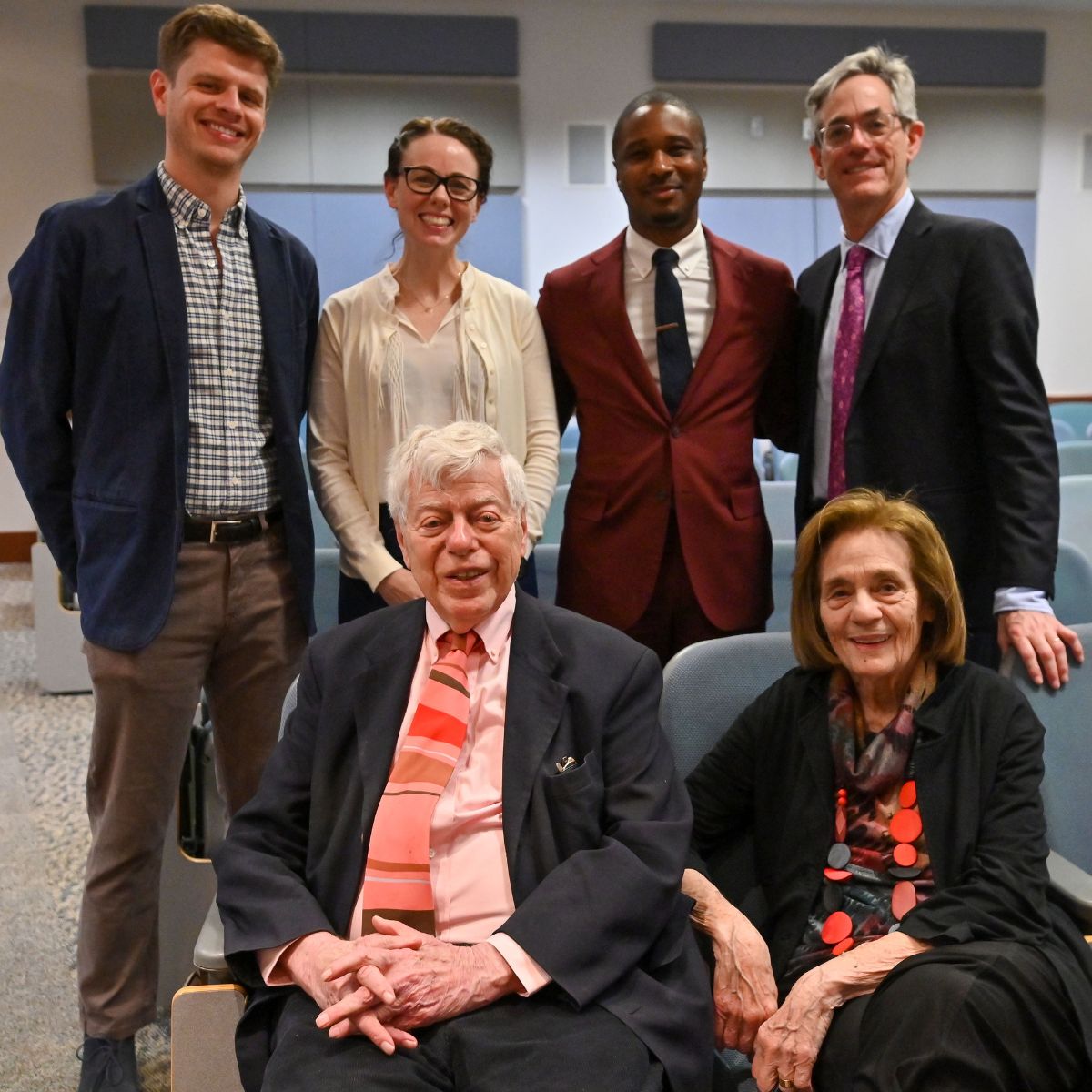
Harvard Professor, Author Discusses Civil Rights in Myers Lecture (Photos)
The University of Scranton recently hosted a massive history education event, bringing to campus hundreds of middle and high school students who used various platforms to showcase their creativity and research skills.
More than 700 middle and high school students from across Pennsylvania, competing as individuals and groups in junior and senior age levels, entered nearly 400 projects at this year’s National History Day in Pennsylvania State Contest. The students displayed and presented their submissions on Saturday, April 25, and Sunday, April 26, at facilities throughout the University’s campus.
"It was amazing to see students from all kinds of backgrounds and from all over Pennsylvania, coming to The University of Scranton to share their research in and love of history," said Sean Brennan, Ph.D., professor of history and event organizer. "This contest not only helps to cultivate historical knowledge, but also promotes a sense of civic future the students will take into adulthood."
$content.getChild('content').textValuePrizes were awarded in the following categories: Best Documentary, Best Exhibit, Best Paper, Best Performance and Best Website. The first-, second- and third-place finishers received medals, while the first- and second-place finishers advance to the National Finals, held June 14-18, at the University of Maryland.
The overall school champions were Harrisburg’s Holy Name of Jesus School, Junior Division; and Parkland High School, Senior Division.
Coinciding with the 250-year anniversary of the Declaration of Independence, entries followed the theme of Revolution, Reaction, Reform in History.
In total, 708 students competed with 386 entries. A full list of medalists and special prize winners are available online.
The University of Scranton also hosted the National History Day Pennsylvania Region 2 contest in February .
The University will host next year’s Region 2 (March 6) and State Contests (April 24-25), as well.
$content.getChild('content').textValueChampions included the following:
Junior Group Documentary
Mikhail Zachariah, Nithin Raja, Srisathwik Kanteti and Advai Shyam, of South Fayette Middle School, “Three Mile Island: Nuclear Reform in the United States”
Senior Group Documentary
Daniel Khan and Edward Cheung, of the Haverford School, “Asphalt Genesis: The Hidden Cost Under the Forced Revolution of America’s Roads”
Junior Group Exhibit
Terra Nguyen and Reese Perry, of Holy Name of Jesus School, “From Charity to Care: Catherine Hershey’s Philanthropic Revolution”
Senior Group Exhibit
Lily Sadowski, Stella Rusinko, Alexis Strine and Hansa Gogineni, of Peters Township High School, “Orval Faubus: A Revolutionary Reaction to the Reform of the Little Rock Nine”
Junior Group Performance
Isabella Sedano-Perez, Hadley Schuller, Annabelle Valentin and Penelope Whetstone, of Reynolds Middle School, “Her Side of History”
Senior Group Performance
Nyahme Joslyn, Sophia Plastaras, Eliana Kelberg-Gross, Olivia Kang and Leila Golzari-Hunt, of the Julia Reynolds Masterman School, “One Voice, One America: How Marian Anderson’s Lincoln Memorial Performance Set a Precedent for Reform”
Junior Group Website
Grace Greenwood, Adalia Mathew and Diya Thirumurugan, of South Fayette Middle School, “A Glowing Workplace With Dark Secrets: The Radium Girls’ Fight for Reform”
Senior Group Website
Hari Kasibhotla and Lucas Vicente-Mendoza, of Central Bucks High School-South, “The Meiji Restoration: Rise of an Asian Powerhouse”
Junior Individual Documentary
Ella Futrel, of Holy Name of Jesus School, “The Monumental Miles”
Senior Individual Documentary
Madelyn Yucha, of Central High School (Philadelphia), More Than a Maid: The Complex Legacy of Hattie McDaniel
Junior Individual Exhibit
Rafael Alicea, of Saint Margaret Mary School, “El Grito de Lares: Revolution, Reaction and Reform Puerto Rico’s First Fight for Freedom”
Senior Individual Exhibit
Marjorie Yaschur, of Central Bucks High School-East, “The Sweet Side of History: Unwrapping Hershey’s Great American Chocolate Bar”
Junior Individual Performance
Hajar Syamsuddin, of Springhouse Middle School, “After Genocide and Revolution: The Journey of Healing Together Through Traditional Ways”
Senior Individual Performance
Areesha Mariyam, of Parkland High School, “An Unjust Reaction to the Bolshevik Revolution: The Palmer Raids”
Junior Individual Website
Imogan Middleton, of Springhouse Middle School, “Girls to the Front: The Riot Grrrl Revolution”
Senior Individual Website
Julide Ozcan, of Parkland High School, “Ether Day: Conquering Pain, Stirring Reaction and Catalyzing Modern Medicine”
Junior Paper
Aadhya Palepua, of Mount Nittany Middle School, “Liberty, Property and Federal Authority: Constitutional Conflict in Fries’s Rebellion”
Senior Paper
Vanshika Jain, of Mount Lebanon Senior High School, “Breaking the Gilded Hierarchy: The Bully Pulpit and the Birth of the Square Deal”
History Day State Champions Crowned at Scranton (Photos)
On Saturday, May 16, Performance Music at The University of Scranton will present a recital by critically and popularly acclaimed pianist and Northeastern Pennsylvania native John Wilson. The concert begins at 7:30 p.m. in the Houlihan-McLean Center, Mulberry Street and Jefferson Avenue, downtown Scranton. Admission is free and the concert is open to the public. Seating is on a first-come, first-seated basis.
“It is always a special pleasure to extend a warm welcome home to a world-renowned musician like John, who grew up in our area,” says Performance Music Executive Director, Janelle Decker.
A native of the Mid Valley area near Scranton, Wilson serves as orchestral pianist for the San Francisco Symphony; principal keyboard for the Marin Symphony, San Diego Symphony and Oakland Symphony; and is critically and popularly acclaimed for his extraordinary artistry and commanding presence. Last season cemented his reputation as a defining voice in American solo piano, beginning with a sold-out Carnegie Hall recital. In addition to his near-constant orchestral work, he performed solo concerti with San Francisco Philharmonic, Marin Symphony and Merced Symphony. He teaches at San Francisco Conservatory. His recording of Gershwin transcriptions by Earl Wild surpassed 1 million streams in its first year. He appears on two Grammy Award‑winning recordings with San Francisco Symphony and on “GRACE: The Music of Michael Tilson Thomas.”
Wilson has performed with violinist Joshua Bell; cellist Johannes Moser; and iconic vocalists Frederica von Stade, Sasha Cooke and Michael Feinstein; played on international tours with the San Francisco Symphony under Michael Tilson Thomas and Esa-Pekka Salonen; and made guest appearances with the Chicago Symphony Orchestra. A passionate advocate for new music, he has premiered works by Michael Tilson Thomas, John Adams, Steve Reich, Timo Andres and Gabriela Lena Frank.
Wilson’s outstanding performances and artistry have garnered widespread recognition and critical acclaim both domestically and internationally, earning him First Prize at the 2019 International Respighi Prize, the 2021 American Competition and the 2023 Ernst Bacon Memorial Award — the latter honoring exemplary performances of American music. Earlier milestones include a last-minute triumph in Beethoven’s Triple Concerto at the Sun Valley Music Festival — praised as “breathtakingly assured” by Idaho Press — and a standout performance of Mozart’s K. 491 at the 50th Anniversary Midsummer Mozart Festival.
For further information on the recital, call 570-941-7624, email music@scranton.edu or visit the Performance Music website. For more info on Wilson, visit johnwilsonpiano.com.
IF YOU GO:
What: IN RECITAL: John Wilson, piano, presented by Performance Music at The University of Scranton
When: 7:30 p.m. Saturday, May 16, 2026
Where: Houlihan-McLean Center, Mulberry Street and Jefferson Avenue, downtown Scranton
Admission: Free
Performance Music To Host Pianist John Wilson on Saturday, May 16
Sixty University of Scranton students were inducted into Alpha Sigma Nu, the national honor society for students in Jesuit colleges and universities in 2026. The Scranton chapter of Alpha Sigma Nu, founded in 1943, is the oldest honor society at the University. Juniors, seniors and graduate students, including students in doctoral-level degree programs, who have distinguished themselves in scholarship, loyalty and service are eligible for membership.
The following undergraduate and graduate students earned the distinction of being inducted into Alpha Sigma Nu:
Sixty Students Inducted into National Jesuit Honor Society
Kania School of Management Operations and Analytics Department hosted the INFORMS Omega Rho 2026 International Honor Society Induction Ceremony on April 23.
Omega Rho is the official honor society of INFORMS—the Institute for Operations Research and the Management Sciences. INFORMS is the premier international association for professionals in analytics, operations research, and decision sciences, and Omega Rho recognizes those who have demonstrated exceptional achievement in these disciplines.
This recognition is extended to students across several distinguished programs—undergraduate students majoring in business analytics and supply chain management, as well as graduate students in the Master of Science in Business Analytics program and the MBA program with concentrations in business analytics or supply chain management.
Inductees include:
Jacob Bendixen
Mark Benginia
Karleigh Capobianco
Nicholas Daleo
Ayushi Das
Connor Farrington
Venkat Kalpatapu
Kevin Keil
Joseph Kulikowski
Harshawardhan Limaye
William Gabriel Martin, III
Joseph Mazich
Olivia Miller
Harshil Nariya
Sara Orlandini
Prasham Patel
Drew Paxson
Nina Sorbera
Robert Stefano
William Tagliareni
Christopher Talocka
Meghan Theofield
MacLean Thuermer
Traci Vennie
Dylan Port Vliet
Dr. Nabil Tamimi is a professor and chair of the Department of Operations and Analytics. Dr. David Mahalak, an assistant professor in the Operations and Analytics Department, serves as the faculty advisor for the University's chapter of the Omega Rho Honor Society.
Omega Rho Honor Society Hosts Induction
By Marcus Smith '27, Student Correspondent
Every year, Sigma Tau Delta, the international English Honor Society, hosts a convention that gathers some of the most brilliant of the next generation of writers and literary scholars.
This year, 11 student members of Mu Omicron, The University of Scranton’s chapter of Sigma Tau Delta, attended the annual convention “Second Lines and New Beginnings” from March 29 to April 1, in New Orleans, where they presented papers ranging from short stories to poetic criticism.
Almost 200 different universities and colleges from across the globe attended the closing ceremonies on April 1, where awards were presented to around 70 presenters for outstanding works in their categories, ranging from original prose to LGBT literature to pop-culture analysis.
Out of those 68 recipients, two University of Scranton alumni and one current undergraduate won awards, putting Scranton in the upper tier of universities to be awarded, with three in total.
The following students presented their papers at the convention:
Emily Carey ʼ26, a public policy and philosophy double-major from Monroe Township, New Jersey, presented “Uttering Identity.”
Adelle Confer ʼ26, an English and Philosophy double-major from Canton, presented “Clifton and Madhubuti: Assassination, Hopelessness, and Dejection.”
Lauren DeSantis ʼ26, an English and Philosophy double-major from Copiague, New York, presented “The Emerald Standard: Limitations on Irish Women in Lady Gregory and W. B. Yeats’ “Cathleen Ni Houlihan” and James Joyce’s ‘Eveline.’”
Amanda Karpiak ʼ27, an English major from Scranton, presented “Death In Edinburgh.”
Jenna LaBarca ʼ26, an English and Criminal Justice major from Tuckahoe, New York, presented “Annis’ Departure from the World of Spirits and Passage to Freedom.”
Faith Montagnino ʼ26, an English major from Morganville, New Jersey, presented “Grief as Protest: Reimagining the Elegy in Danez Smith’s ‘not an elegy for Mike Brown.’”
Gabriella Palmer ʼ26, an English, Theatre and Philosophy triple-major from Phoenixville, presented “The Inheritance of Vivienne Dupree.”
Nya Rowe '26, an English major from the Bronx, New York, presented "The Art of Dorian Gray: Victorian Aesthetics in Oscar Wilde's 'The Picture of Dorian Gray.'"
Marcus Smith ʼ27, an English and Theatre double-major from Schuylkill Haven, presented “The Scranton Anomaly.”
Lauren Spratt ʼ26, an English major from Philadelphia, presented “Women and Proto-Feminism in Victorian Literature.”
Benjamin Storman ʼ27, an English major from Scranton, presented “Journal of an American Janitor.”
The students were chaperoned by Billie Tadros, Ph.D., and Madeline Gangnes, Ph.D., both associate professors in the Department of English and Theatre who also serve as faculty moderators for Mu Omicron.
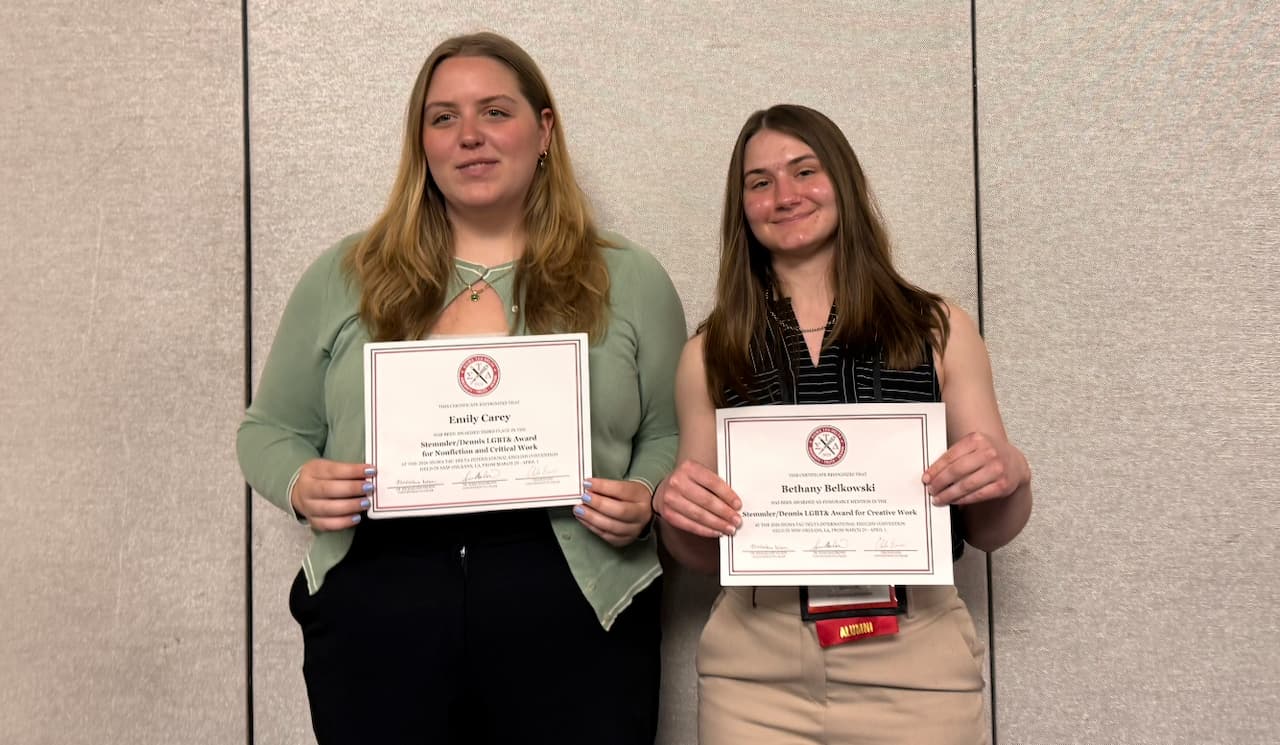
Two Scranton alumni also presented works of poetry, for which they won awards.
Bethany Belkowski ʼ24, who has a double-major in English and Public Policy and Service, presented “She Punctuates Her Conversation With Snatches of Song” and Elias Kerr ʼ23, who has a master’s degree in Occupational Therapy presented “trans [re]formation - part 1.”
Belkowski won an honorable mention for the Stemmler/Dennis LGBT Awards, while Kerr placed second, both in the creative works category.
In addition to the alumni, Carey won third place for the Stemmler/Dennis awards in the critical essays category for her work “Uttering Identity,” an essay that she wrote in a class that she took with Dr. Tadros.
 Likewise, Kerr’s poetry flourished while studying with Dr. Tadros during their undergraduate years at Scranton.
According to Kerr, that tutelage, along with presenting their work at Sigma Tau Delta’s conventions, helped them “become a more confident, empowered, and healed individual.”
Kerr also discussed how important the Sigma Tau Delta community is to them, and the meaningful impact they have had among the literary community.
“People will always come up to me after I speak on a panel or give a reading, often bringing up how they heard me read the previous year, or how my book has helped them through similar challenges,” Kerr said. “Being able to use the written word to share my personal story and experiences with others has made a world of difference for me; I feel like I am giving back to a community that has always given to me.”
Kerr also expressed a desire to stay involved with Sigma Tau Delta for a long time, saying that “I hope to continue to be a part of the convention for years to come, and share my work, my stories, and my experiences with other writers from around the country.”
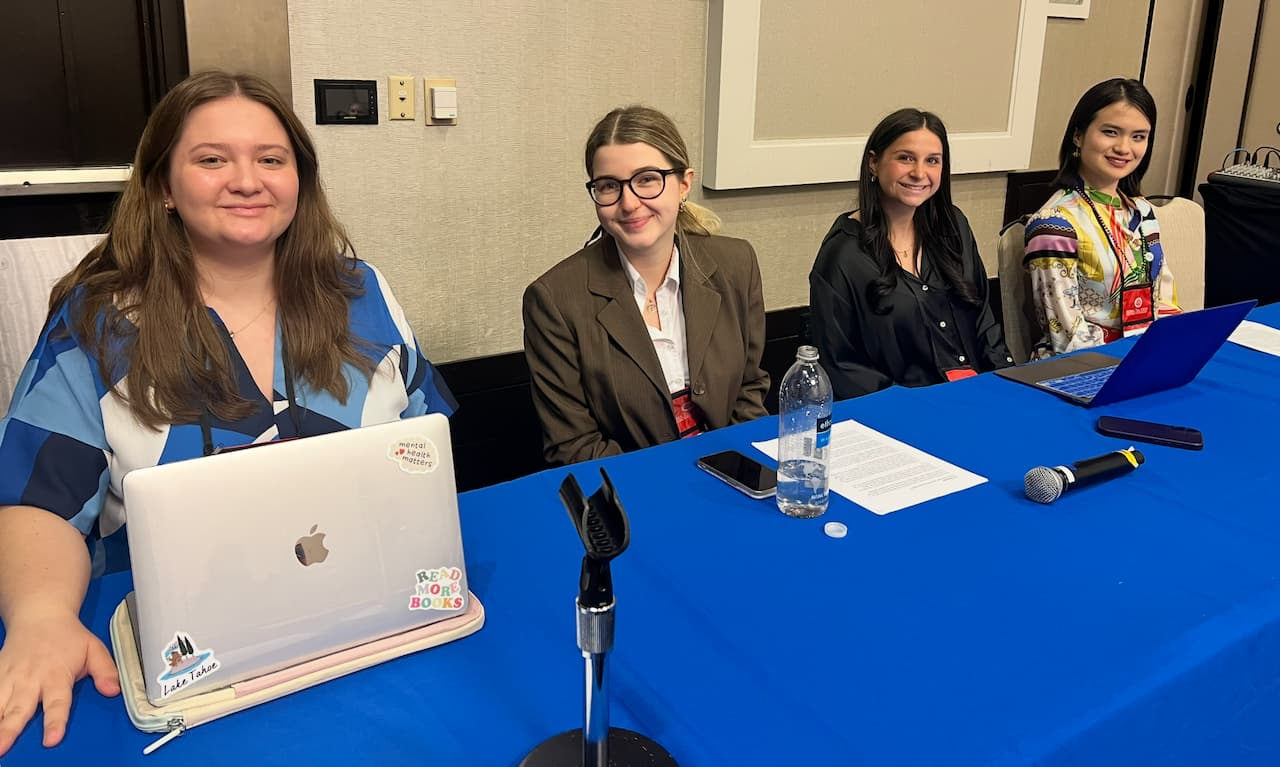
Additionally, Confer, DeSantis, LaBarca and Montagnino, Mu Omicron chapter’s executive board members, presented a Roundtable research discussion titled “What We Owe Each Other: Survival, Storytelling, and Care in Jesmyn Ward’s ‘Salvage the Bones.’”
Beyond the presentations and awards, members of Scranton’s chapter of Sigma Tau Delta were deeply involved in ensuring that the conference ran smoothly, ranging from serving as regional representatives to inaugural leaders of new groups, helping to give back to the literary community.
Dr. Tadros and Kerr were also both appointed as inaugural mentors for the new National English Honor Society Poets Laureate Award, where they will help aspiring poets in high school serve as poetic voices for their communities.
So far, they have mentored three young poets who gave a reading at the convention this year as a part of that program.
Both Kerr and Dr. Tadros were recognized for mentoring those students at the awards ceremony on April 1.
They both also took part in a panel called “Distinguished Voices in Contemporary Poetry,” where they discussed this new mentorship position.
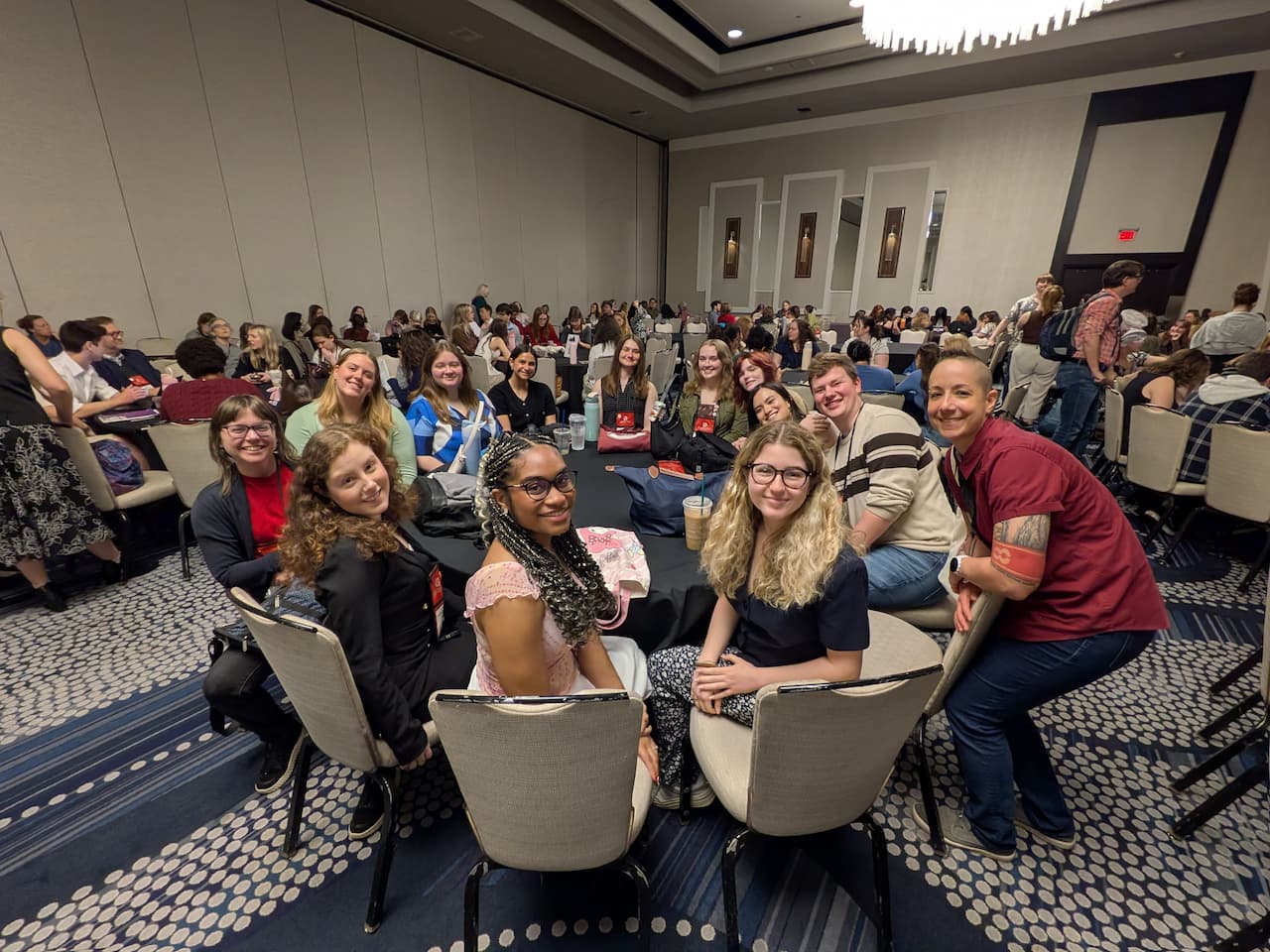
Scranton’s contributions did not stop there, though, as Montagnino, Mu Omicron’s president, served both onstage and behind the scenes as the 2025-2026 Associate Student Representative for the Eastern Region, a position that she described as “an incredibly fulfilling, albeit different, experience compared to my trips to St. Louis and Pittsburgh as a convention attendee.”
As a student representative, Montagnino took on numerous responsibilities, such as coordinating the schedules that helped the convention run smoothly, introducing keynote speaker Jesmyn Ward and running after-hours events for the convention attendees.
“I loved being able to introduce myself in person to the people I had been working to support for so long,” Montagnino said.
She also was excited to see everyone getting to know each other and making connections with people from other places.
“It was beautiful to witness the connections fostered by students from diverse parts of the country,” Montagnino said. “Watching attendees make friends from other universities, show up for one another, and encourage each other was truly moving, and I feel blessed to have had a hand in creating that space.”
Sigma Tau Delta recognizes and encourages excellence among undergraduate and graduate students in all aspects of English language, literature and related fields such as journalism, theatre, creative writing, media and film studies, communications, marketing, linguistics and education, including literacy initiatives.
Marcus Smith '27, Schuylkill Haven, is an English and theatre double major at Scranton.
Scranton English Department Leaves Mark at International Honor Convention
The University of Scranton Health Professions Organization (HPO) and Medical Alumni Council (MAC) hosted a joint event on Monday, May 1 on campus. Alumni and students in attendance participated in panel discussions, dinner and networking.
The presenters included Bernard Costello III, MD, DMD '91, and Katie Zefran, DMD, MPH'16. Panelists included Thomas Churilla, MD '09, Scott Peslak, MD, Ph.D. '06, and Alexandra Shomali '25.
HPO President William Vinsko, III ‘26, and Dan Marenda, Ph.D., associate dean of the College of Arts and Sciences, provided an introduction and conclusion, respectively.
Learn more about the HPO from Vinsko, a biology major from Wilkes-Barre, in a recent Club Spotlight interview with Royal News. Connect with the organization on Instagram @uofs_hpo.
The MAC seeks to assist undergraduate pre-health professional students through education in health-related programs, networking assistance and guidance on admission to health professional schools, and access to role models in various medical careers. The MAC also keeps alumni health practitioners informed about campus developments, nominates students and alumni for scholarships and awards, conducts symposia for alumni in the health professions and encourages financial support for the University from these alumni.
University Health Professions Organization and Medical Alumni Council Host Educational Event
The Staff Senate would like to thank all staff members who took the time to recognize and share their colleagues' accomplishments, sense of community, and dedication to excellence. The Meg Cullen Brown Magis Award would not exist without our caring community!
THE MEG CULLEN-BROWN MAGIS AWARD WINNER for May 2026 is:
Susan Falbo – Facilities
We would like to take this opportunity to congratulate and celebrate the good work that Susan does on a daily basis. We hope you will join us in personally congratulating Susan and all our nominees. Susan will receive a complimentary food donation at our fabulous University food service outlets. Each winner is also invited to the Staff Senate Recognition event in May 2027 to receive a certificate of appreciation.
We congratulate Susan and all the wonderful nominees for being recognized as “Magis” employees!
May 2026 Nominees
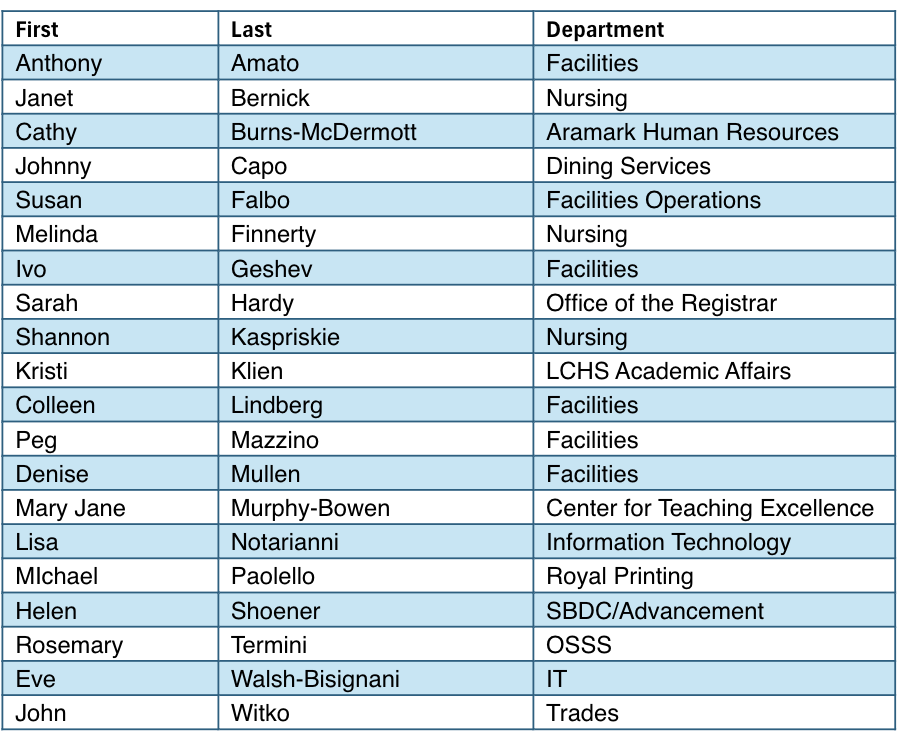
Nominations open for MAY Meg Cullen-Brown Magis Award.
Have you witnessed a University staff member, Aramark or Follett employee offer a simple act of kindness? Go above and beyond for others? Perhaps they embody our Jesuit mission or simply possess an incredible attitude. If so, please recommend this individual for this prestigious award.
Although only University staff members, Aramark, or Follett employees win the award, nominations may be made by any University of Scranton employee.
Meg Cullen-Brown Magis Award for May
The University of Scranton will host a debate at 6 p.m. Thursday, May 7, between incumbent Marty Flynn and Jeffrey Lake, candidates in Pennsylvania's 22nd Senate District Democratic primary election. It will be held inside the Pearn Auditorium at Brennan Hall and is open to the public.
The debate will be moderated by Brian Snee, director of the University's Center for Ethics and Excellence in Public Service, with a panel of local journalists who will ask the candidates questions.
University To Host State Senate District Democratic Debate May 7
At 6 a.m. EST, alumni, parents and friends of The University of Scranton around the globe received a special video communique from Iggy, the Royal Wolf, several University students, and Rev. Joseph G. Marina, S.J., University president. The message?
“It’s finally 5.06!”
And, with that rallying cry, the University officially kicked off 5.06.26, its 12th annual Day of Giving. Watch the video here.
Since its inception in 2015, 5.06 has evolved into a tradition of profound impact, creating a lasting legacy for current and future University students. As part of the celebration, alumni, parents, friends, faculty, students and staff are invited to show their Scranton pride by supporting the campus programs and causes that ignite their passion for Scranton.
As of press time, more than 1,800 donors had already raised more than $400,000 for Scranton scholarships, service programs, athletics and student organizations; make your gift before midnight to join the movement and help us reach this year’s goal of 2,500 donors.
Royals Unite in Purple and White for 5.06.26
The countdown to commencement is on.
The University of Scranton's 2025-26 academic year is winding down, as the last day of class is Friday, May 15, with undergraduate and graduate commencement ceremonies to follow on Sunday, May 24.
In case you missed it, here are some of the many University students, employees and groups putting in hard work to finish the year strong.
Scranton FBLA Students Win 4 State Championships, Place in 16 Events
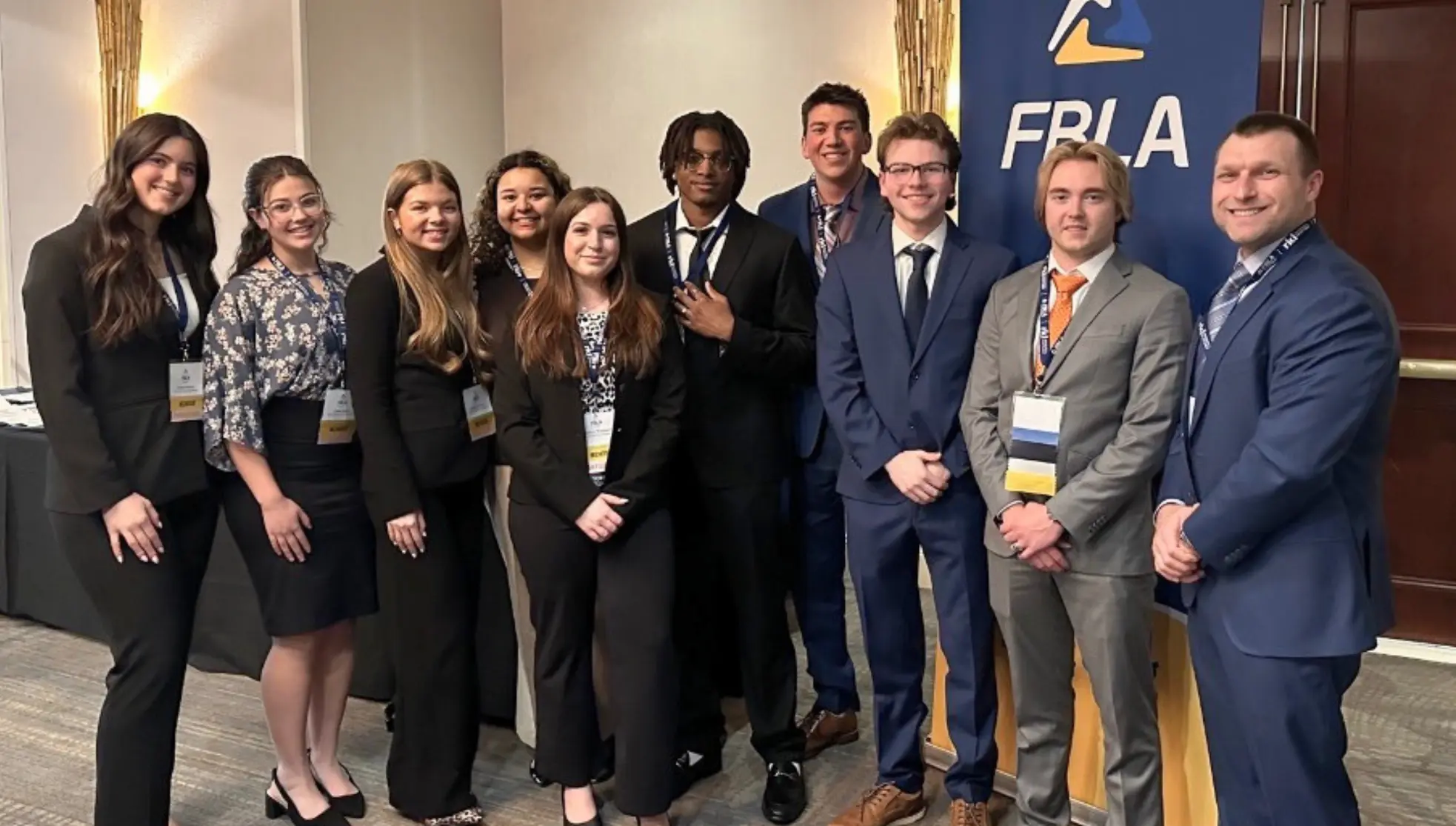
The University of Scranton’s rise to the top as a premier institution for Future Business Leaders of America (FBLA) continued with its most recent performance. Scranton students combined to place in 16 events, winning four state championships with five runner-up finishes, at the recent FBLA State Leadership Conference.
Click here to read more about this year's champions and the categories they won.
Restored 500-Year-Old Painting With Hidden Figure Unveiled at University of Scranton
The University held a public unveiling of "Madonna and Child with the Young St. John the Baptist," a 16th-century painting, which, during restoration, revealed an original background that was long covered.
For additional coverage, visit the Times-Tribune, Fox56 and WNEP.
Scranton Professors Win Coveted National Ethics Award a Third Consecutive Time
University of Scranton professors are influencing financial professionals worldwide, while their work earns top national honors. The Institute of Management Accountants (IMA) recently recognized the distinguished contributions of Douglas M. Boyle, DBA ’88, professor and chair of accounting, and Daniel P. Haggerty, Ph.D., professor of philosophy, two of three authors of the article that earned the 2026 Curt Verschoor Ethics Feature of the Year Award.
Click here to read more about Dr. Boyle, Dr. Haggerty and their award-winning research.
Alpha Sigma Nu Selects Top Teacher of 2026
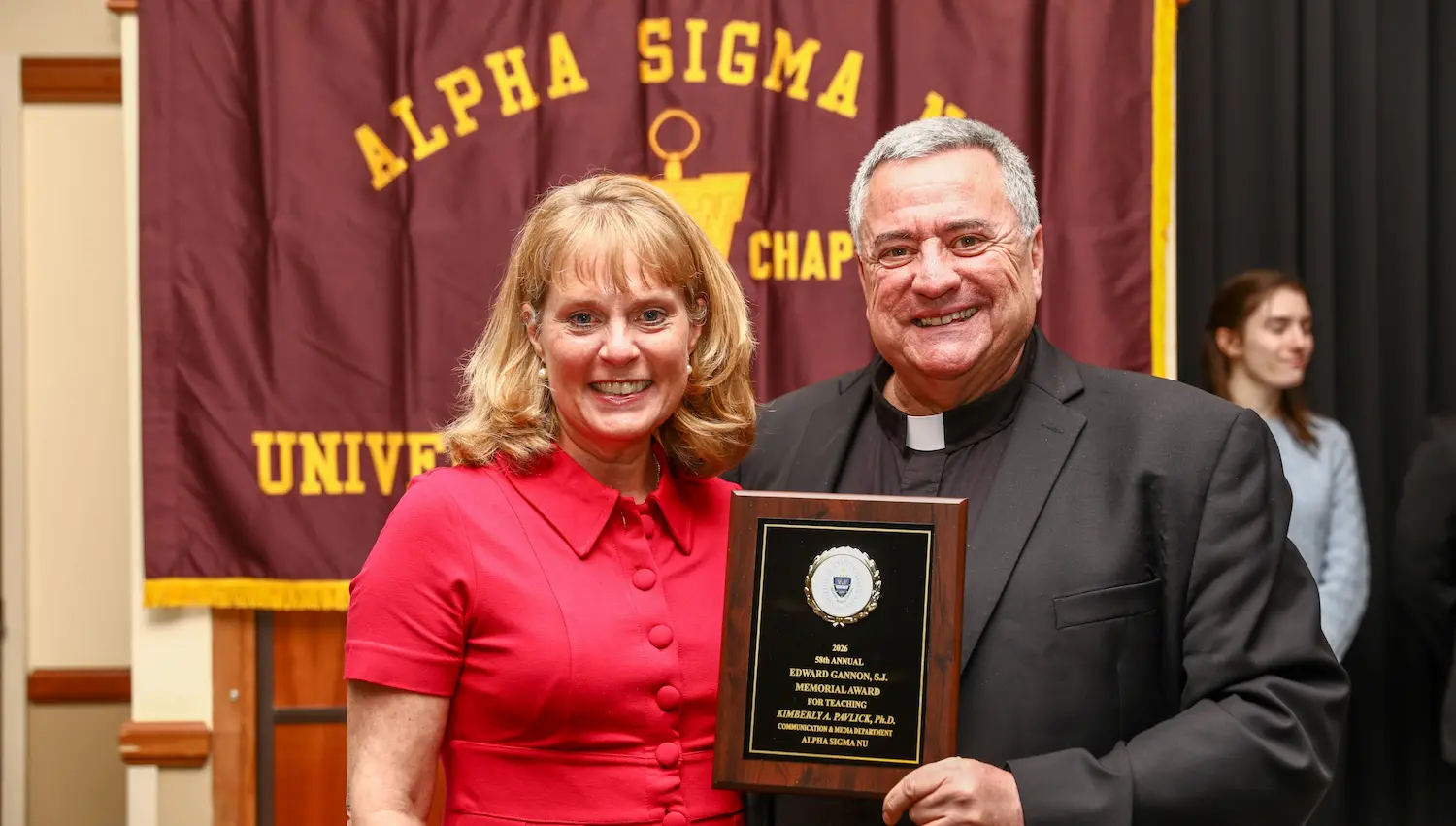
Student members of the University’s chapter of Alpha Sigma Nu, the national honor society for students in Jesuit colleges and universities, selected Kim Pavlick, Ph.D., assistant communication and media professor, as their Teacher of the Year.
Click here to read more about Dr. Pavlick's selection.
‘Go Baby Go’ a Meaningful, Practical Application of Students’ Skills (VIDEO)
The University’s Go Baby Go chapter had 70 students from 11 majors volunteer for this year’s program, working together to modify 10 custom, ride-on, toys cars that were adapted to meet childrens' unique needs.
Click here to read more about the third annual Go Baby Go event and follow this link for WBRE's coverage.
Scranton Teams Win Multiple Top Honors at IEEE Conference
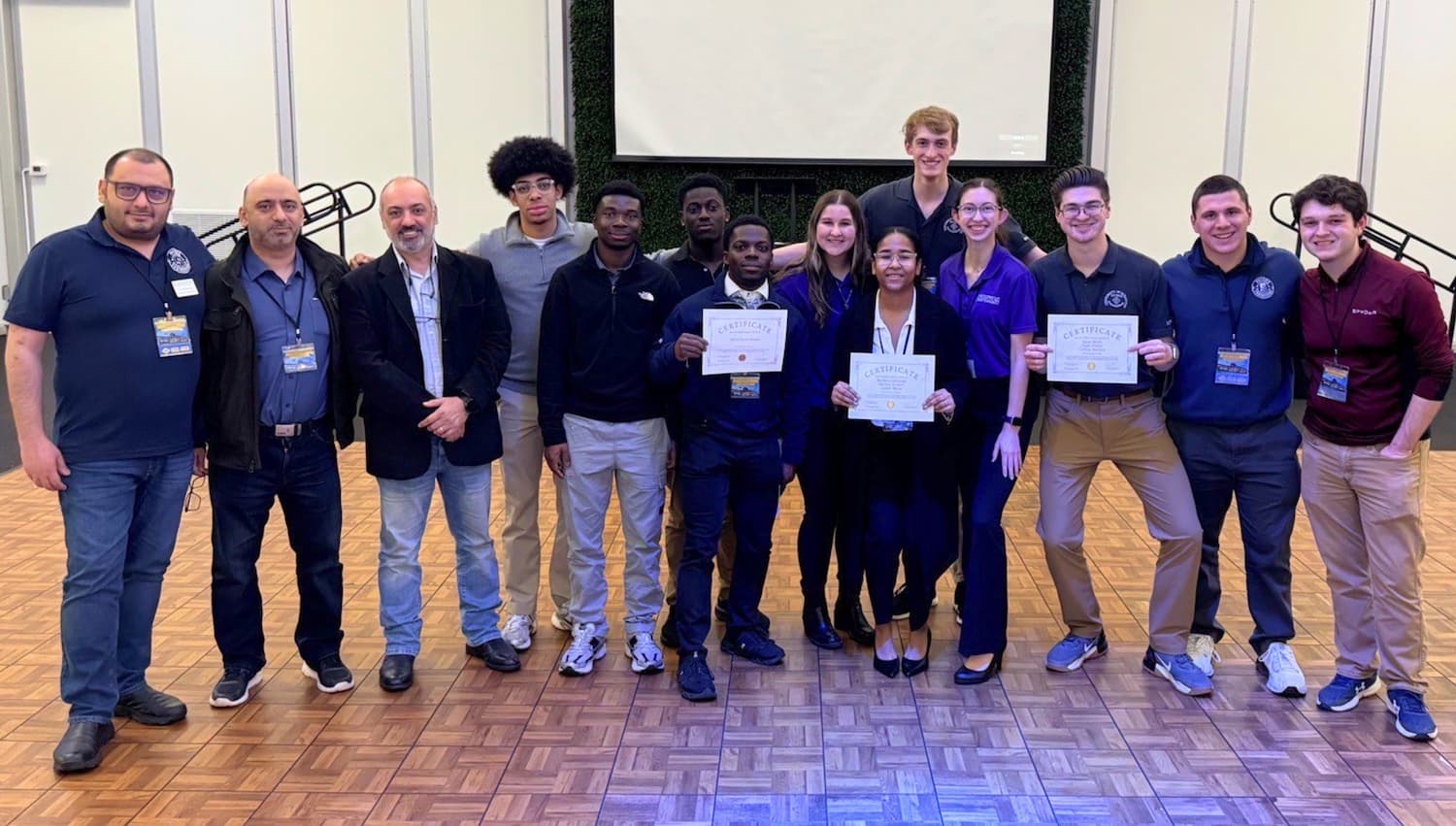
More than 300 students and faculty/staff members from 35 colleges and universities participated at the Institute of Electrical and Electronics Engineers (IEEE) Region 1 and 2 Student Activities Conference (SAC) in New Jersey. Only six events were held — and Scranton’s IEEE branch won two of them, placing first in the Mini Pupper and MicroMouse competitions.
Click here to read more about the regional competition that tested students' engineering, programming and problem-solving skills through robotics.
University of Scranton 10-Year Employees Honored at Pro Deo Event
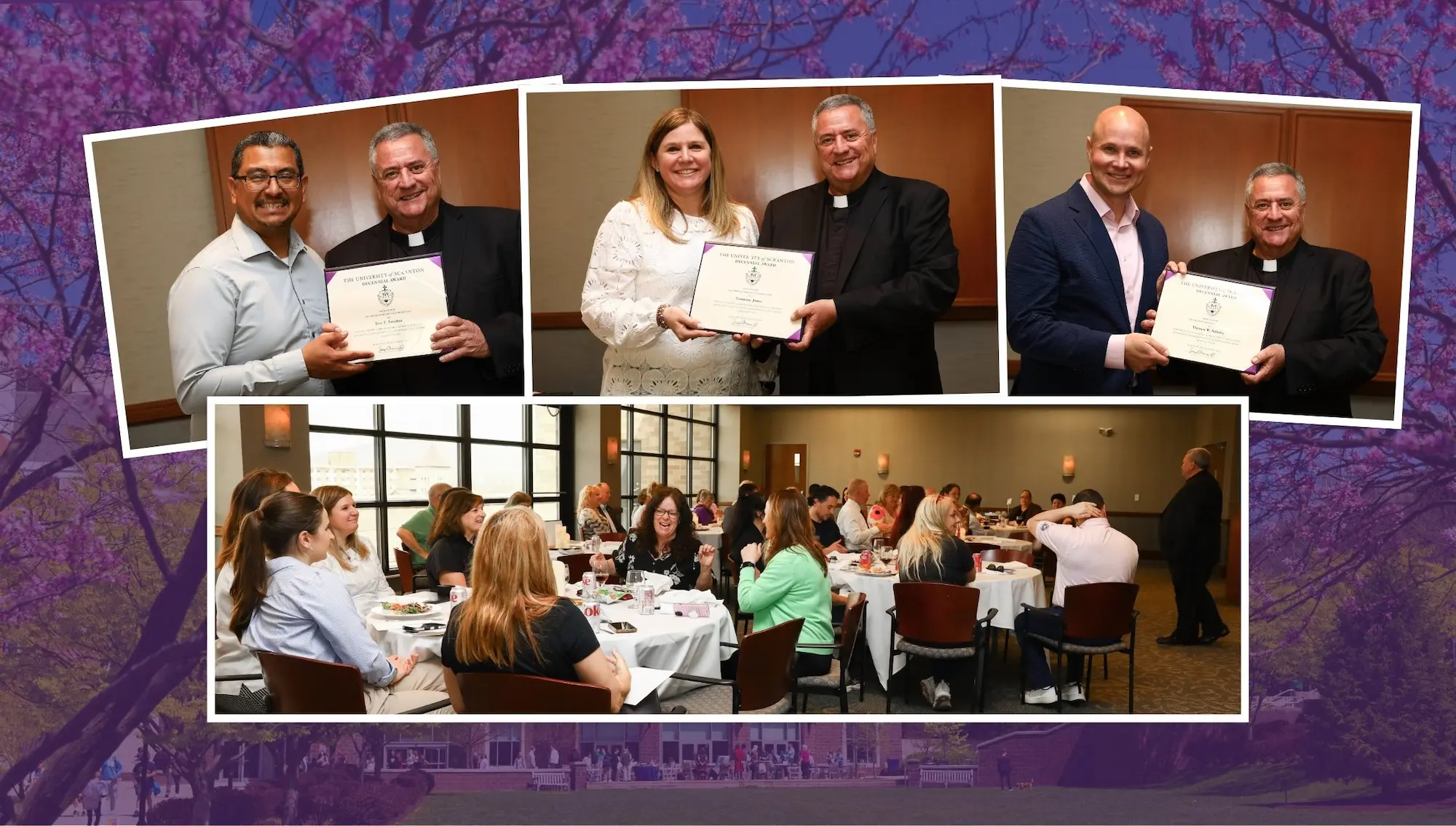
The University of Scranton’s Order of Pro Deo honored its newest group of silver medallion awardees — denoting 10 years of employment at Scranton — at a recent induction ceremony.
Click here to read more about who was honored by the organization that was established at Scranton in 1961.
Additional Headlines:
More Than a Dozen University of Scranton Grad Programs Ranked by U.S. News | Click to Read More
Hayes Family Science Competition Brings ‘Waves’ of Innovation to Scranton | Click to Read More
Organizers Share Takeaways from AI Conference | Click to Read More
Associate Provost Earns Selection to Leadership Institute | Click to Read More
ALL In Student Voting Honor Roll Recognizes Grace Lennox '26 | Click to Read More
Continue reading Royal News all year round to stay up-to-date on the latest happenings at Scranton.
Campus Catch-Up: April News and Notes From Scranton
What's new with you? To submit a Class Note, visit the Class Notes Submission Page.
John Zimmerman '67, Okatie, South Carolina, sold his cattle ranch in Shiner, Texas, and moved to Callawassie Island in the low country of South Carolina.
Joseph Sharp '78, Bensalem, was inducted in the Holy Ghost Prep Athletic Hall of Fame, recognizing over half a century of support for amateur athletics as an athletic trainer.
Linda Arthur Hebbard '85, Johnson City, New York, retired from the Laboratory at Guthrie Lourdes Hospital microbiology department after 40 years of service.
Scott Antoine, D.O. '89, Carmel, Indiana, has published "The Comprehensive Physician's Guide to the Management of PANS and PANDAS," an Amazon bestselling textbook for physicians. These conditions are subtypes of autoimmune encephalitis that affect children. This textbook has defined the standard of care in these conditions. Dr. Antoine continues to lecture across the United States as a subject-matter expert in these conditions.
Ryan C. Joyce '04, Boston, Massachusetts, was named vice president, development at Burke Rehabilitation. In this role, Joyce will lead the development and philanthropic strategy at Burke in close partnership with hospital leadership and its Board of Trustees to strengthen fundraising performance, deepen donor engagement and expand opportunities across individual giving, institutional philanthropy and government grants.
Andrew F. Prior '08, New York, commanded a New York Army National Guard unit and led the 1st Battalion, 69th Infantry Regiment, the “Fighting 69th,” in the New York City St. Patrick’s Day Parade, marking the regiment’s 175th time leading the parade.
John McKiernan G'12, Notre Dame, Indiana, has been named executive vice president and chief operating officer at Holy Cross College at Notre Dame, Indiana. When he begins in May of 2026, McKiernan will support President Marco Clark in operationalizing the College's many strengths as an institution for Catholic higher education.
Jeanne Rabel, Ed.D.'12, G'14, Scranton, successfully defended her dissertation, “Navigating Connection: A Case Study on the Sense of Belonging Among Undergraduate Students Experiencing Trauma-Informed Care” at Wilkes University. Dr. Rabel also holds a master’s degree in school counseling from The University of Scranton.
MARRIAGES
Megan Conley '09 to Ryan Arnold
Corey Gorman ‘12 to Ashley Mealey
Ryan Smith '16 to Loren Mastroberti '16
Gregory J. Lacey '19 to Briana N. Moritzen '20
Nora Murray '19 to Zachary Weinberg '19
Bailey McLaughlin '21, G'22 to Bryan Gorczyca '19, DPT'22
Elizabeth Ridge, D.O. '21 to Ed Burk '21
BIRTHS
A son, Bennett Thomas Grueter, to Jonathan '14 and Shannon O’Gorman Grueter '15; grandson to Jacqueline Christie O’Gorman '87 and James Grueter '85
A son, Jack, to Greg '15 and Sara Chapin Schwenk ’16
A son, Lucas Robert, to Jacob '15 and Lauren Stewart
A son, Patrick Thomas, to Christopher '18 and Tiffany Cecere O'Donnell '18 of Madison, New Jersey
A daughter, Emilia Diana, to Jonathan ’18 and Alexa Zirnheld ’19, G’20, Willow Grove
DEATHS
Robert L. Barrowcliff '51, Wilmington, Delaware
Carlo J. Celli '55, Peckville
John E. Swift, M.D. '58, Bonita Springs, Florida
Robert J. Kilgour '69, Conestoga
William M. Naughton '71, Scranton
James G. Burke G'77, Childs
Anne Scully Wettengel '77, Worcester, Massachusetts
Charles R. Costello '78, Brick, New Jersey
Jeffery W. Seitzinger, M.D. '81, Freeland
Jason Daria '91, Philadelphia
Michael Frazier '96, Olyphant
Deanna M. Zarzecki '02, New Milford
Bridget B. Flannery G'09, Binghamton
FRIENDS/FAMILY DEATHS
Dorothy Riley, mother of Mary Riley Elliott '88, Anne Riley Schiavo '89, and Thomas P. Riley '90, and mother-in-law of Anthony Schiavo '90
Tara Canally, wife of James Canally '95
Alumni Class Notes, May 2026
Reunion Weekend 2026 will take place June 5–7, and registration is open.
Alumni from class years ending in “1” and “6” will celebrate their milestone reunions during this special weekend filled with events, memories and time with your Royal Family in the place where it all began.
Be sure to register to secure your spot for this unforgettable weekend.
Reunion T-shirts are also available for purchase at $20 each. When ordering, you can choose to either pick up your T-shirt during Reunion Weekend or have it shipped directly to you.
For more information and to register, visit scranton.edu/reunion.
Register Today for Reunion Weekend 2026
With baseball season officially underway, it’s the perfect time to make plans to join fellow Royals at the ballpark.
We’re excited to invite you to a series of University of Scranton Alumni Baseball Outings planned over the coming months. These events are a great way to connect with alumni, enjoy America’s pastime and represent the Royal community in cities across the country.
Here’s what we have lined up:
Sunday, May 31: Philadelphia Phillies vs. Los Angeles Dodgers at Dodger Stadium
Friday, July 31: Texas Rangers vs. Houston Astros at Daikin Park
Thursday, August 27: Houston Astros vs. New York Yankees at Yankee Stadium
Tuesday, September 1: Seattle Mariners vs. Boston Red Sox at Fenway Park
Wednesday, September 16: Baltimore Orioles vs. New York Mets at Citi Field
Thursday, September 24: Milwaukee Brewers vs. Philadelphia Phillies at Citizens Bank Park
We hope to see you soon at a ballpark near you!
Step Up to the Plate With Royal Baseball Outings
Alumni, parents and friends are invited to join us for an afternoon at the Jersey Shore on Saturday, June 27, from 3–6 p.m. at the Belmar Fishing Club in Belmar, New Jersey.
Hosted by Karen Golding ’91, this gathering is a great opportunity to reconnect with fellow alumni and enjoy time by the ocean.
Royals To Gather at the Jersey Shore June 27
April
View April Listing Page
On Friday, May 8, Performance Music at The University of Scranton will present a concert featuring the University's String Orchestra. The concert will begin at 7:30 p.m. in the Houlihan-McLean Center, Mulberry Street and Jefferson Avenue, downtown Scranton. Admission is free and the concert is open to the public, with seating on a first-come, first-seated basis.
“The concert will take listeners on a journey through musical eras from baroque to modern, highlighting some connecting works," said Janelle Decker, Performance Music Executive Director and conductor.
The program will feature music by Karl Jenkins, Felix Mendelssohn, Giacomo Meyerbeer, W. A. Mozart, Vaclav Nelhybel and Dmitri Shostakovich, some of them in arrangements for string orchestra and others in their original form.
The University of Scranton String Orchestra is a 35-plus-member ensemble comprised of members of the University community from majors and departments spanning the curriculum — most of them undergraduate students, none of whom are music majors — joined by a few graduate students, alumni and members of the faculty who are all brought together by their mutual love of music-making.
The primary focus of Performance Music at The University of Scranton is its student choral and instrumental performing ensembles. There is no major in music at the University, and all enrolled Scranton students (undergraduate and graduate) are eligible for membership in the University Bands, University Performance Choirs, University String Orchestra and Ensembles and Steel Drum Ensemble. A few members of the faculty and staff and alumni from the region also perform with the groups. Each year, hundreds of students participate in the ensembles.
For additional information on the concert, call 570-941-7624, email music@scranton.edu or visit the University's website.
IF YOU GO:
What: IN CONCERT: The University of Scranton String Orchestra, presented by Performance Music at The University of Scranton
When: 7:30 p.m. Friday, May 8, 2026
Where: Houlihan-McLean Center, Mulberry Street and Jefferson Avenue, downtown Scranton
Admission: Free
University of Scranton String Orchestra To Perform on Friday, May 8
The world’s largest professional organization dedicated to the study of Latin America will benefit in the coming years from a University of Scranton faculty member as she joins its leadership team.
Yamile Silva, Ph.D., professor and chair of the Department of World Languages and Cultures, was elected as Representative of the Sections for the Latin American Studies Association (LASA). Dr. Silva’s three-year term with the organization’s Executive Council begins in June, following LASA2026, the Association’s International Congress, which will be held in Paris, France.
“In this role, I will represent the 42 sections of LASA, whose mission is to promote the common interests of Association members in specific areas of Latin American studies; foster communication among scholars with shared research interests; and make the Association more participatory and responsive to its constituencies,” Dr. Silva said. “As a voting member of the Executive Council, I will participate in monthly meetings and contribute to initiatives and projects that advance the Association’s goals.
“I am honored to serve in this capacity and look forward to representing the sections and their members on the Council.”
LASA has more than 13,000 members spanning 60 countries, bringing together scholars from all disciplines and professional backgrounds.
Dr. Silva has worked at the University since 2009. She received her undergraduate degree from the Universidad de los Andes, Bogotá-Columbia, and her master’s and doctoral degrees from the University of Massachusetts Amherst.
University of Scranton Professor To Serve as Representative for International Organization
The University of Scranton’s annual Earth Day Fair brought together students, campus partners and community organizations, all joining together to promote sustainability and environmental awareness.
The event, held Tuesday, April 21, attracted roughly 150 students who learned about environmental-friendly initiatives and efforts being made by more than a dozen participating vendors that set up tables at the lobby inside the Loyola Science Center.
“The Earth Day Fair was a huge success for the Society for Sustainability and Conservation and our partnership with the Jesuit Center,” said Samantha Kosmark ’26, an environmental science major from Old Tappan, New Jersey, and president of the University’s Society for Sustainability and Conservation. “Learning about the environmental efforts within our surrounding community and their positive impact on the world around us was reassuring and showed that we truly care.”
$content.getChild('content').textValueThroughout the event, Scranton students engaged directly with faculty, staff and community representatives to better understand how small, everyday choices can contribute to long-term environmental stewardship.
The University of Scranton is currently engaged in a multi-year effort to become designated a Laudato Si’ University, committed to environmental stewardship rooted in Jesuit values. The initiative integrates sustainability across academics, operations and beyond, advancing seven goals to meet Pope Francis’ call for “integral ecology.”
For additional coverage of the Earth Day Fair, please visit the following links:
WBRE — Students go green for Earth Day hands-on showcase
The Times-Tribune — U of S students learn of sustainable living ahead of Earth Day
$content.getChild('content').textValueEarth Day Fair Reinforces Commitment to Caring for Planet
Representatives from UGI Utilities, Inc., recently presented an energy efficiency rebate check for $100,000 to The University of Scranton.
The check was presented in the lobby of Robert S. '68 and Marilyn A. Weiss Hall, a four-story, nearly 90,000 square foot academic and workforce development facility that opened in August.
Weiss Hall was designed to meet Silver LEED Certification standards, highlighting the University's commitment to environmentally responsible construction and long-term operational efficiency. Weiss Hall uses 96% efficient boilers for heating and 96% water heaters. A computer-controlled building automation system monitors all room temperatures, air flows and occupancies to optimize the University's natural gas and electricity usage.
Founded in 1888, The University of Scranton is a Catholic and Jesuit university with 70 majors across the College of Arts and Sciences, the Kania School of Management and the Leahy College of Health Sciences, as well as 40-plus graduate programs tailored for part-time and full-time students. It has been recognized by publications, including The Wall Street Journal, Forbes, U.S. News and World Report and the Princeton Review, as one of the nation's best colleges.
Headquartered in Denver, Lancaster County, UGI Utilities, Inc., is a natural gas and electric utility company with more than 760,000 customers throughout Pennsylvania and Maryland.
UGI Presents Rebate Check to University of Scranton
Royal Restore campus food pantry concluded its regular hours May 8, but the pantry is committed to serving The University of Scranton campus community and ensuring students/staff/faculty have access to food resources when needed.
Now through the remainder of the semester, the pantry will be open by appointment only as the team prepares the space to use for their annual End of the Year Drive, which begins on Tuesday, May 12. For appointments for the pantry during working hours, please email Lorena.Pacheco@scranton.edu.
The Royal Restore campus food pantry, located at Ciszek Hall, 1120 Mulberry St., provides food, ready-made meals and toiletries to University of Scranton students, staff and faculty in need. Royal Restore is a welcoming space for University students and employees to have access to free nutritious food and personal care products. Royal Restore is rooted in the saying “take what you need, give what you can.”
Royal Restore Campus Food Pantry Reminder
The University of Scranton’s Office of Community Relations will host its spring political dialogue to commemorate the nation’s 250th birthday. The free event for students and the general public will take place on Monday, May 4, at 7 p.m. in the PNC Auditorium, Loyola Science Center 133. This event is part of the University’s longstanding series of political dialogues across differences. Students and community members from different political perspectives and backgrounds are invited to small-group dialogues to share their views and experiences and listen to one another to build a better understanding.
All who register must be present for the entire event, which is approximately two hours.
This event is sponsored by The University of Scranton Political Dialogues Initiative in collaboration with Student Government, College Democrats, College Republicans, the Philosophy Society, and Political Science Club.
This event is free and open to both students and the general public and is a great opportunity for inter-generational exchange. RSVP for this event.
Any questions about this event should be directed to community@scranton.edu
The University of Scranton Commemorates Nation’s 250th
The Mathematics Department held its annual induction ceremony of the Pennsylvania Mu Chapter of Pi Mu Epsilon, the National Mathematics Honor Society, at Brennan Hall, Room 509, from 5 - 6:30 p.m. on Friday, April 24. Ten students majoring in either mathematics or mathematical sciences, five faculty members from the Mathematics Department, and Carolyn McNamara Barry, Ph.D., dean of The University of Scranton's College of Arts and Sciences, attended this ceremony.
Students inducted into the Pennsylvania Mu Chapter of Pi Mu Epsilon,
the National Mathematics Honor Society include:
Matthew W. Rakauskas,
Thomas J. LeMay,
Allison M. Magee,
Daniel P. Cerra,
Katie N. Carrea,
Serhii Kuzmin,
Robert J. Newbeck,
Ashlyn Urbanski,
Alessandra Bellino,
Riley P. Clarke, and
Dr. Murong Xu.
Pi Mu Epsilon is dedicated to the promotion of mathematics and recognition of students who successfully pursue mathematical understanding. To promote mathematics, the National Pi Mu Epsilon Council sponsors an annual conference in conjunction with the American Mathematical Society (AMS) at the Joint Mathematics Meetings.
A person meeting any one of the following four sets of qualifications may be elected to membership by a chapter. This election shall be held irrespective of sex, religion, race or national origin:
- Undergraduate student who has completed at least the equivalent of two semesters of calculus and two additional courses in mathematics, at or above the calculus level, all of which lead to the fulfillment of the requirements for a major in the mathematical sciences. In addition, such students must have maintained a grade point average equivalent to that of at least 3.0 on a 4-point scale, both for all courses that lead to fulfillment of requirements for a major in the mathematical sciences, and for all courses that lead to fulfillment of requirements for an undergraduate degree.
- Graduate students whose mathematical work is at least equivalent to that required of qualified undergraduates, and who have maintained at least a B average in mathematics during their last school year prior to their election.
- Members of the faculty in mathematics or related subjects.
- Any persons who have achieved distinction in a mathematical science.
National Mathematics Honor Society Inducts 10
Through May 8 Art Exhibit: “Art Educators Make Art: Pennsylvania Art Educators Association Northeast Juried Exhibition.” Hope Horn Gallery, Hyland Hall. Free during gallery hours. Call 570-941-4214 or email darlene.miller-lanning@scranton.edu.
May 1-3 8 p.m. Wednesday, Thursday, Friday and Saturday; 2 p.m. Sunday. Performance: “The Apiary” presented by The University of Scranton Players. Studio Theatre, McDade Center for Literary and Performing Arts. Ticket prices vary. Call 570-941-4318 or email players@scranton.edu.
May 1 9 a.m. Applied Ethics in an Era of Globalization: Perspectives from East and West. PNC Auditorium, Loyola Science Center on April 30 and Pearn Auditorium, Brennan Hall on May 1. Free. Conference Program https://tinyurl.com/GlobalEthics2026Scranton. Email asianstudies@scranton.edu for questions.
May Online Hope Horn Gallery Art Exhibit: “The University of Scranton Student Show Online.” Visit https://www.scranton.edu/academics/hope-horn-gallery/index.shtml or email darlene.miller-lanning@scranton.edu.
May 2 9:30 a.m. NOYCE Science Camp. Sponsored by The University of Scranton NSF Noyce Program. Registration is free. Kane Forum, Leahy Hall. Call 570-941-7491 or email jason.graham@scranton.edu.
May 2 7:30 p.m. Performance Music: “43rd Annual World Premiere Composition Series Concert” featuring The University of Scranton Concert Band and Concert Choir performance of two new works by guest composer/conductor Ahmed Alom. Houlihan-McLean Center. Free. Call 570-941-7624 or email music@scranton.edu.
May 5 11:30 a.m. Schemel Forum’s World Affairs Luncheon Seminar: “Wise Words: Ancient Egypt’s Wisdom Tradition” presented by Jennifer Houser Wegner, Ph.D., curator, Egyptian section, Penn Museum, and adjunct associate professor in the Department of Middle Eastern Languages and Cultures at the University of Pennsylvania. Rose Room, Brennan Hall. Registration required. Fees vary. Call 570-941-4740 or email schemelforum@scranton.edu.
May 6 noon. Celebration of Student Scholars. Displays and presentations of undergraduate and graduate student research and scholarly projects. Loyola Science Center. Free. Call 570-941-7653 or email brooke.leonard@scranton.edu.
May 8 7:30 p.m. Performance Music: “In Concert” featuring The University of Scranton String Orchestra. Houlihan-McLean Center. Free. Call 570-941-7624 or email music@scranton.edu.
May 12 7:30 p.m. Judaic Studies Institute Lecture: “The Pope and the Rabbi: My Story of Friendship and Dialogue with Pope Francis” by Abraham (Armando) Skorka, Ph.D., author and Senior Research Fellow for Jewish Studies and Jewish-Catholic Relations, Georgetown University. Pearn Auditorium, Brennan Hall. Free. 570-941-7956 or marc.shapiro@scranton.edu.
May 16 7:30 p.m. Performance Music: “In Recital” featuring John Wilson, piano. Houlihan-McLean Center. Free. Call 570-941-7624 or email music@scranton.edu.
May 23 4 p.m. Commencement Baccalaureate Mass. Byron Recreation Complex. Call 570-941-7401 or email info@scranton.edu.
May 24 11 a.m. Undergraduate Commencement. Mohegan Sun Arena at Casey Plaza. Wilkes-Barre. Call 570-941-7401 or email info@scranton.edu.
May 24 4:30 p.m. Graduate Commencement. Mohegan Sun Arena at Casey Plaza. Wilkes-Barre. Call 570-941-7401 or email info@scranton.edu.
May 29 5:30 p.m. Schemel Forum Collaborative Program: “Vin et Vues: Loire Valley and its Wines” presented by David Falchek, CAE, IOM, CMP, wine writer and critic, including for Wine and Spirits Magazine and The Scranton Times-Tribune, and former executive director of the American Wine Society. Wine tasting, hors d’oeuvres, lecture, and discussion. Charles Kratz Scranton Heritage Room, Weinberg Memorial Library. Registration required. Fee $60. Call 570-941-4740 or email schemelforum@scranton.edu.
May Events Planned at the University
When a new extracurricular program is introduced, there’s no telling how long it may take to build name recognition and widespread participation.
The University of Scranton’s chapter of Go Baby Go, however, proved to be an instant success that continues growing as its third annual event approaches on Sunday, May 3.
“Nobody gets paid for this, it’s not a requirement for any classes,” said Kaitlyn Gelman, an occupational therapy graduate student from Hackensack, New Jersey. “Everyone just does it because they love it. They love what they do.”
And what they do is take miniature toy cars and implement modifications — such as replacing the foot pedal with a push button or switch, relocating the steering wheel or adding padded crossbars, among other measures — and then donating those cars to local children with disabilities. The process began months ago, when the University’s Go Baby Go volunteers met with the children and their families to best inform the type of modifications that were needed.
“The feeling at the end is so rewarding when you see the kids drive out from behind the curtain for the first time,” Gelman said.
The unveiling and first drive will happen at Sunday’s event, which will be held from 12 to 4 p.m. at the Byron Recreation Complex. It is open to the public and will feature food, games, a photo booth and more.
“Go Baby Go has been very special to me,” said Kathleen Egan, an occupational therapy graduate student from Rockville Centre, New York. “I’ve been a part of it for all three years of its chapter here at Scranton. I just think it’s such an exciting way to use the skills we learn in class for real-life application.
“A lot of times, you can sit in class and learn things. But to see them come to life — and see how mobility and independence can change a child’s life, through play — is so exciting.”
In total, the University’s Go Baby Go chapter had 70 students from 11 majors volunteer for this year’s program. Together, they worked as 10 teams to create 10 cars.
Go Baby Go is a national, community-based research, design and outreach program, which, at Scranton, is supported by the Edward R. Leahy Jr. Endowment.
“We really believe in mobility as a human right. Kids don’t just need medically assisted mobility; they need to have fun and they need to play,” said Stephanie DeNaples, occupational therapy faculty specialist. “This program really exemplifies the idea of working with each family and child and supplying their unique needs.”
For more information, visit the organization on Instagram and Facebook.
‘Go Baby Go’ a Meaningful, Practical Application of Students’ Skills (VIDEO)
Numerous University of Scranton students, faculty and staff members assisted in organizing, executing and scoring the annual Hayes Family Science Competition on April 16.
One of the most popular and interactive events held each year at the University, this year’s competition attracted nearly 200 registered high school students from Berwick, Carbondale, Crestwood, Delaware Valley, Dunmore, Hazleton Area, Honesdale, Lackawanna Trail, North Pocono, Scranton, Scranton Prep, Wallenpaupack and West Scranton.
In addition to learning key physics and engineering principles, the high school students applied their knowledge to compete for trophies and medals. Prizes were awarded to the teams that recorded the highest scores in the events corresponding to the theme, “Waves.” These events included a quiz and Jeopardy-style game show, as well as competitions focused on frequency, temperature and buoyancy, among other concepts.
The Hayes Family Science Competition’s signature event took place in the Byron Center, where everyone gathered to watch a student-programmed robot play Deep Purple’s “Smoke on the Water” on a guitar. The guitar was built by the department’s senior laboratory engineer Majid Mokhtari.
$content.getChild('content').textValue“We built a ‘to-scale’ guitar, two times the size of a regular guitar, with two robots,” said Patrick Feller ’27, a computer engineering major from Montgomery, New York, who took the lead in the presentation. “One of the arms is plucking the strings while another arm is pressing down the strings onto the frets to create a certain note. …
“It was a lot of fun. They were a pretty nice crowd and I appreciated their enthusiasm about it.”
The overall champion in Division 1 was a team from Delaware Valley, which beat out second- and third-place teams from Scranton and North Pocono, respectively. A team from North Pocono won Division 2, topping teams from Lackawanna Trail and Wallenpaupack.
$content.getChild('content').textValueList of Team Winners:
Division 1, First place: Delaware Valley (David Agron, Nathaniel Carso, Philip Fitzpatrick, Sarah Chalhoub, Terence Plummer, Grace Stevens)
Division 1, Second place: Scranton (Vini Ravel, Benjamin Shteynberg, John Hughes, Ellagrace Miseo, Peter Kwee, Noah Casey)
Division 1, Third place: North Pocono (Sean Gager, Phillip Mclaine, Jaden Mucha, Sarah O'Donnell, Will Eisley)
Division 2, First place: North Pocono (Bruce Cianfichi, Marlie DeRenzis, Gabe DeScipio, Jacob Motichka, Connor Simonson, Aaron Youngblood)
Division 2, Second place: Lackawanna Trail (Tyler Jervis, Holden Edwards, Avery Ronchi, Ethan Gorton, Lila Matuszewski, Alexandria Truitt, Giada Farrar)
Division 2, Third place: Wallenpaupack (Joe Pettinato, Nathan Freethy, Ashley DeJesus, Jude Mautz, Colby Bonagura, Chris Tufaro)
Hayes Family Science Competition Brings ‘Waves’ of Innovation to Scranton
Students in undergraduate and graduate nursing programs, and one nurse leader, earned entrance into Sigma Theta Tau International Honor Society of Nursing, Iota Omega Chapter, this spring at The University of Scranton.
Sigma Theta Tau International is the national honor society for nursing. Thirty-six Royals, including 31 undergraduate students, five graduate students, and one nurse leader, were inducted Saturday, April 18, at the society's 37th annual ceremony at the University.
Induction into Sigma Theta Tau International, Iota Omega Chapter, is offered to:
- undergraduate students in the upper 35 percent of their class,
- graduate nursing students who demonstrate academic excellence by maintaining a GPA of 3.5 or greater, and
- nurse leaders who demonstrate nursing excellence and commitment to the advancement of nursing.
Sigma Theta Tau Nursing Honor Society Inducts 36
By Marcus Smith '27, Student Correspondent
Len Gougeon, Ph.D., had a long and storied career in the Department of English and Theatre at The University of Scranton, where he taught for over 40 years until his retirement in 2021.
Since retiring, he has been far from idle, as he has recently completed his fifth book, which, he says, was “by far the most challenging project of them all.”
The book, “Old England, New England and the Civil War: How a Clash of Cultures Ignited a Global Campaign for Racial Equality and Civil Rights,” is available to purchase on Amazon in paperback, hardcover and digital formats.
It tells the story of the divide and conflict between English and American intellectual elites during the Civil War.
While the Civil War brewed in the United States, major thinkers from both New England and across the pond came into conflict over their ideas about equality. Many leading English thinkers sided with the Confederacy because of their ideas regarding equality and race.
“The British empire stood on a foundation of white supremacy as did the Confederacy. Both maintained a social hierarchy based on class, caste and race,” Dr. Gougeon explained. “The South was essentially an oligarchy ruled by aristocratic gentlemen who resembled their British counterparts.”
Those ideas caused thinkers such as Thomas Carlyle, Matthew Arnold and John Ruskin to clash with their New England counterparts such as Henry Wadsworth Longfellow, Oliver Wendell Holmes and Ralph Waldo Emerson.
That is where Dr. Gougeon’s specialties come into play, as he specializes in studies of Emerson, one of America’s most prominent literary figures and a leader of the Transcendentalist movement of the 19th century.
He served as president of the Ralph Waldo Emerson Society and received the society’s Distinguished Achievement Award in 2008.
Writing this book was no small undertaking for Dr. Gougeon, as over 10 years of research resulted in an initial draft that was well over half a million words, but he eventually managed to shave it down to a book of approximately 400 pages with 1,200 footnotes.
“The original manuscript was basically a Gutenberg Bible,” he said.
In writing “Old England, New England, and the Civil War,” Dr. Gougeon shows that certain ideas considered radical by some today can actually be traced back to the nation’s origins and the declaration that “all men are created equal.”
“I hope they will see that what today is referred to as D.E.I. (diversity, equality, inclusion) is not a new idea. It was ingrained in the nation’s DNA from the beginning. Bringing it forth in our society has always involved struggle,” Dr. Gougeon said.
Dr. Gougeon is the author of “Virtue’s Hero: Emerson, Antislavery and Reform;” “Emerson and Eros: The Making of a Cultural Hero;” and “Emerson’s Truth, Emerson’s Wisdom: Transcendental Advice for Everyday Life,” among numerous other publications including journals such as The New England Quarterly, American Literature, Walt Whitman Quarterly Review, Studies in the American Renaissance, Modern Language Studies and others. His essays have appeared in various collections, including The Oxford Handbook to Transcendentalism, Emerson Bicentennial Essays, The Cambridge Companion to Henry David Thoreau, Thoreau at 200: Essays and Reassessments, A Political Companion to Ralph Waldo Emerson, Emerson in Context, Teaching Emerson and others. In 2015, he received the University’s Excellence in Scholarly Publication Award.
During his distinguished career at Scranton, Dr. Gougeon served as a member of the Faculty Senate for 31 years, including as a member of the Senate Committee on Shared Governance and Leadership. He also served as chair of the University Senate and as a member of the Board on Rank and Tenure and the University Handbook Committee.
Dr. Gougeon earned his bachelor’s degree from St. Mary’s University Halifax, and his master’s degree and Ph.D. from the University of Massachusetts at Amherst.
Marcus Smith '27, Schuylkill Haven, is an English and theatre double major at Scranton.
Scranton Professor Emeritus, Emerson Scholar Publishes Fifth Book
The University of Scranton’s Order of Pro Deo honored its newest group of silver medallion awardees — denoting 10 years of employment at Scranton — at a recent induction ceremony.
The 10-year employees were formally recognized on Thursday, April 16, at the Rose Room inside Brennan Hall, where Rev. Joseph G. Marina, S.J., University president, presented the awards and provided a prayer and remarks. Thirty-one employees were honored.
The Order of Pro Deo was established at The University of Scranton in 1961 by Rev. John J. Long, S.J., University president from 1953-1963. Since its creation, the Order has conferred this distinction on 797 individuals, including the 2026 members, and counting.
The University of Scranton’s Order of Pro Deo honored its newest group of silver medallion awardees — denoting 10 years of employment at Scranton — at a recent induction ceremony.
The 10-year employees were formally recognized on Thursday, April 16, at the Rose Room inside Brennan Hall, where Rev. Joseph G. Marina, S.J., University president, presented the awards and provided a prayer and remarks. Thirty-one employees were honored.
The Order of Pro Deo was established at The University of Scranton in 1961 by Rev. John J. Long, S.J., University president from 1953-1963. Since its creation, the Order has conferred this distinction on 797 individuals, including the 2026 members, and counting.
Pro Deo 10-Year Recipients
Diane E. Barletta
James L. Caffrey
Joseph H. Cavanagh
Marleen Cloutier
Melinda J. Finnerty
Autumn M. Forgione
Ahmed A. Gomaa, Ph.D.
Mark C. Healey
Lucas Herbert
Michael S. Hill
Jessica B. Hughes
Robert Huston
Courtney Jones
John J. Kilker III
Colleen A. Lenzer
Tammy A. Manka
Jenny S. Mateo
Rose Merritt
Denise J. Mullen
Nicole Musto
Ismail Onat, Ph.D.
Vincent J. Rocco
Hollie R. Roscioli
Thomas W. Salitsky
Jose F. Sanchez
Ashley L. Stampone, Ph.D.
Mary Troy, Ph.D.
Andrew C. Venezia, Ph.D.
Traci E. Vennie
Allyson Vosburg
John P. Wiercinski
University of Scranton 10-Year Employees Honored at Pro Deo Event
Continuing its commitment to offering its students opportunities to work with world-class musicians, Performance Music at The University of Scranton is delighted to spotlight the work of Ahmed Alom at its 43rd annual World Premiere Composition Series Concert on Saturday, May 2.
The concert will begin at 7:30 p.m. in the Houlihan-McLean Center, Mulberry Street and Jefferson Avenue, downtown Scranton. Admission is free, with seating on a first-come, first-seated basis.
The World Premiere Composition Series provides students with the rare opportunity to perform the premiere of a work by a nationally or internationally known composer under the baton of that composer, getting a first-hand glimpse into the compositional process. Meanwhile, audiences get to experience the piece for the first time exactly as the composer intended.
At the concert, The University of Scranton Concert Choir and Concert Band will premiere two brand-new commissioned works by Alom, written specifically for the University’s student ensembles, entitled "A Night – There Lay the Days Between (for SATB choir)" and "A Cuban Landscape (for full concert band)."
"We are very excited to have Ahmed coming to work with our students and for them to have the honor of premiering his new works," said Cheryl Y. Boga, Artistic Director of Performance Music and conductor. “He first visited Scranton a few years ago with our longtime friend Caleb Hudson, and after hearing his incredible playing and moving compositions, we were delighted when he accepted our commission.”
As a pianist, composer and conductor, Alom’s boundary-crossing artistry has earned him worldwide recognition. His musical voice, shaped by the rigor of classical training and the rhythmic vitality of his Cuban heritage, bridges genres and traditions. His compositions have been championed by leading artists, most notably Yuja Wang, who premiered his "Displaced Étude No. 1" with New York Philharmonic. As a soloist, he has appeared with ensembles and orchestras throughout the Western Hemisphere.
A dynamic collaborator, Alom works with artists across genres, and his ensembles reflect his wide-ranging interests: Triple Cortado — a chamber trio with Caleb Hudson and Achilles Liarmakopoulos — merges classical virtuosity with contemporary works; while CrossCurrents, his duo with Pedrito Martínez, explores the intersection of Afro-Cuban traditions and European classical music. His debut album "Exilio (2023)" traced narratives of displacement through six Hispanic composers, including the first complete recording of Luis A. Calvo’s "Four Intermezzos."
Alom is also the youngest Artistic Director of the Washington Square Music Festival where he curates inclusive and forward-looking programming. His educational work includes masterclasses and lectures at Berklee College of Music, San Francisco Conservatory, Dartmouth, Peabody Institute, and the National Jazz Museum in Harlem.
$content.getChild('content').textValueThe University of Scranton Concert Band is a 70-member ensemble of full standard concert band instrumentation, and the Concert Choir is an SSATBB group. Both feature members of The University of Scranton campus community — the vast majority undergraduate students along with a few graduate students, alumni and members of the faculty and staff. The primary focus of Performance Music at The University of Scranton is its student choral and instrumental performing ensembles. There is no music major at the University, and all enrolled Scranton students (undergraduate and graduate) are eligible for membership in the University Bands, Choirs, and String Ensembles with neither an audition nor enrollment fee required for membership. Hundreds of students participate in the ensembles each year.
For further information on the concert, call 570-941-7624, email music@scranton.edu or visit the University's website. For more info on Alom, visit his website.
IF YOU GO:
What: 43rd annual World Premiere Composition Series Concert, presented by Performance Music at The University of Scranton
When: 7:30 p.m., Saturday, May 2, 2026
Where: Houlihan-McLean Center, Mulberry Street and Jefferson Avenue, downtown Scranton
Admission: Free
Ahmed Alom Featured Composer at 43rd Annual World Premiere Concert
The University of Scranton Campus Store will host a Grad Appreciation event Thursday, April 23, DeNaples Center, first floor. The event is open to students, faculty and staff.
Among Grad Appreciation offerings:
* Diploma frames, 20% off
* Clothing and Gifts, 20% off. Some exclusions apply.
Campus Store To Host Grad Appreciation Event April 23
For those seeking to fact-check claims or viral stories shared on TikTok, an upcoming presentation, "Information Literacy for Real Life: Using Library Resources to Debunk Misinformation on Social Media," will provide practical tools to evaluate online content.
Shelli Pratt-McHugh, associate professor and Library department chairperson, Learning Commons Coordinator, and Research and Instruction Librarian for Technology and Outreach, will present the next program of the Faculty Seminar Series on Friday, April 24, beginning at 3:15 p.m in Loyola Science Center, room 233.
Pratt-McHugh will examine social media and confirmation bias, and highlight an activity she integrated into information literacy sessions designed to help students critically evaluate messaging on sites like TikTok and Instagram.
Now in its 21st year, the Faculty Seminar Series provides a forum for faculty and staff to share research and ideas. The event is open to students, faculty, and staff, with refreshments provided.
For more information, contact Amelia Randich, program coordinator, at amelia.randich@scranton.edu.
Find Resources To Debunk Misinformation on Social Media April 24
On Thursday, April 23, at 6 p.m. in the PNC Auditorium, Loyola Science Center, room 133, The University of Scranton’s Office of Community-Based Learning (CBL) and Office of Community Relations, in collaboration with campus and community partners, will present the final "CBL Talks" installment for the semester.
The event will begin with a screening of the WVIA documentary "Making NEPA Home," which shares stories related to immigration in Northeast Pennsylvania from refugee and immigrant individuals and agencies that work with these communities. Following the screening, a panel discussion will include speakers Kara Washington, WVIA; Julie Schumacher Cohen, assistant vice president for community engagement and government affairs at The University of Scranton; Ushu Mukelo, Congolese Community of Scranton; Fikile Ryder, Catholic Social Services of the Diocese of Scranton; and Terilynn Brechtel and Audrey Golosky, United Neighborhood Centers of NEPA.
The CBL Talks are sponsored by the Office of Community-Based Learning, Office of Community Relations, and additional campus and community partners.
This event is free and open to the public. To RSVP for this event, please visit the following link: https://www.surveymonkey.com/r/Making-NEPA-Home-CBL-Talk
Questions about the event should be directed to community@scranton.edu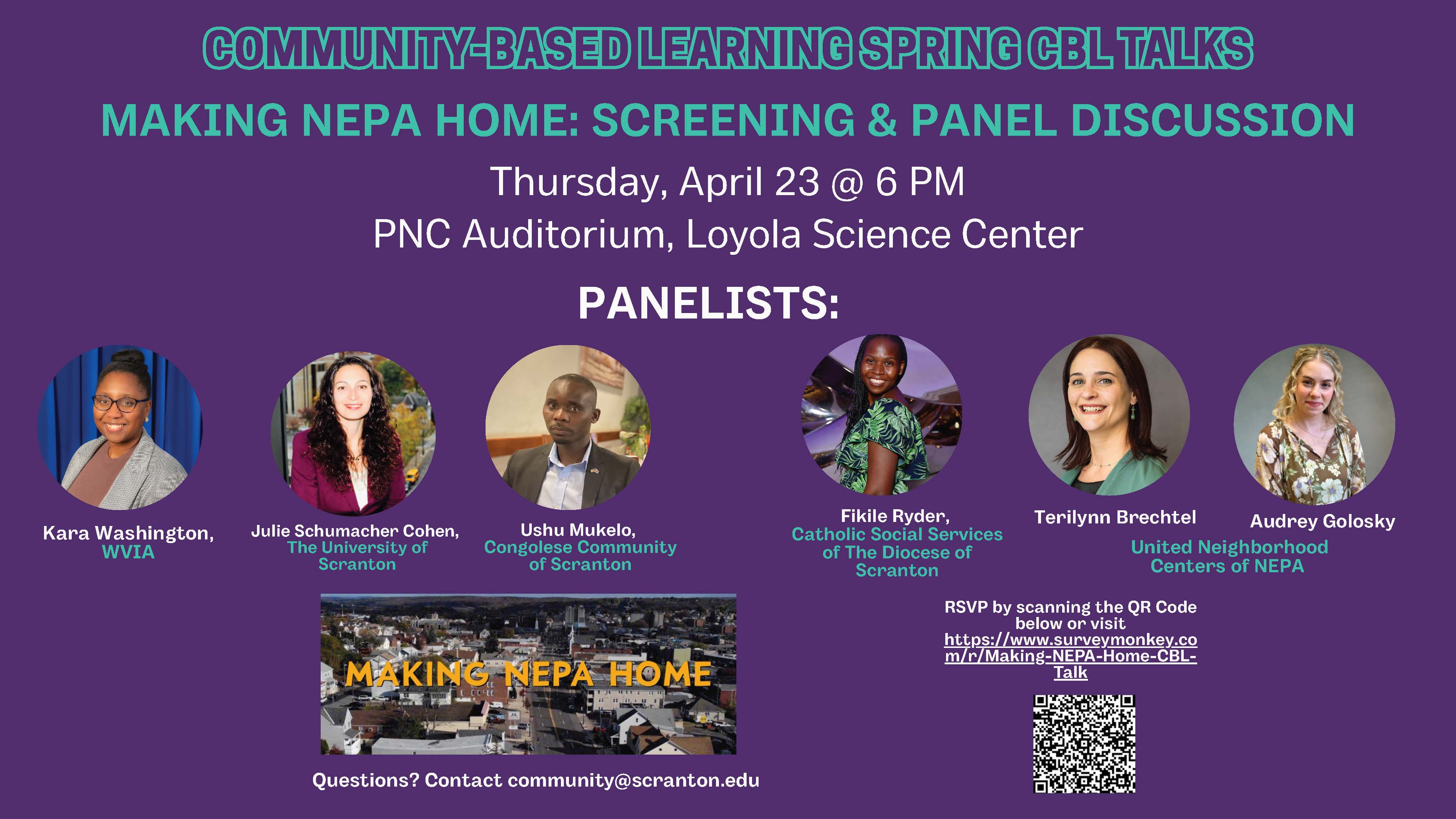
Spring Semester 'CBL Talks' Series To Conclude April 23
Students and staff represented The University of Scranton at the state Capitol in Harrisburg for this year’s Association of Independent Universities and Colleges of Pennsylvania (AICUP) Advocacy Day on Tuesday, April 14.
The University sends students annually to the state Capitol for AICUP Student Aid Advocacy Day to stress the importance of state financial aid for students pursuing higher education in the Commonwealth of Pennsylvania and support for independent colleges and universities such as The University of Scranton, with its Catholic and Jesuit mission.
AICUP Advocacy Day is an opportunity for students to meet with legislators and share their impactful stories, including their reasons for choosing The University of Scranton. Through this experience, students exercised their advocacy skills and highlighted the importance of higher education funding.
Students and staff in attendance this year were Cassidy Lowman ‘27, Philip Huffman ‘27, and Daysi Carreto ‘14, assistant director for community and civic engagement.
The students met with Pennsylvania State Senators Marty Flynn and Rosemary Brown’s legislative staff and with state Representatives Bridget M. Kosierowski, Kyle Donahue and Kyle Mullins.
Lowman ‘27 commented on the visit to Harrisburg.
“I had such an incredible time participating in AICUP's Advocacy Day. It was initially nerve-racking to meet and speak with the state legislators, but they were very engaged in what we were saying and receptive to the message we were trying to share," Lowman said. "I really value my education and all that it has done for me, and it was an honor to spend the day in Harrisburg advocating for more funding for higher education. This event has inspired me to continue speaking out about things that are important to me.”
Students Participate in Advocacy Day at State Capitol
David Dzurec, Ph.D., associate provost for academic affairs and professor of history at The University of Scranton, earned selection to the competitive Lilly Network Leadership Institute, which brings together administrators to explore leadership perspectives, practices and principles.
Through the institute, Dr. Dzurec will participate in a two-year program that includes paired mentorship and conferences held in conjunction with the Lilly Network Workshop for Senior Administrators.
Founded in 1991, the Lilly Network of Church-Related Colleges and Universities (formerly the Lilly Fellows Program) presents fellowships. The network is based at Christ College, the interdisciplinary honors college of Valparaiso University in Northwest Indiana, and is sustained by the support of Lilly Endowment Inc.
In September, Dr. Dzurec participated as a speaker in The Schemel Forum’s University for a Day, which featured a series of talks and discussions about topics related to health, economics, history and spirituality. His publications include a book, “Our Suffering Brethren: Foreign Captivity and Nationalism in the Early United States,” and numerous articles in scholarly publications that include The Historian, War in History, The Journal of New York History, Catholic Historical Review, and The Journal of the Early Republic. In 2015, he served as a Fulbright Core Scholar, teaching American history and politics at Trnava University in Slovakia.
During his time at Scranton, Dr. Dzurec has served as interim associate dean for the College of Arts and Sciences, interim executive director of the Slattery Center for the Ignatian Humanities, and was chair of the History Department from 2015 to 2021. He also served as vice president of the Faculty Senate, co-chair of the Faculty Senate Curriculum Committee, chair of the Conference Committee on Curriculum, faculty advisor, and held several leadership positions within the Faculty Affairs Council Executive Committee, including chair. He served as the University’s faculty athletics representative to the NCAA and as the faculty mentor for the University’s cross-country and track teams. In 2018, he received The University of Scranton Provost’s Award for Service and Leadership.
Dr. Dzurec earned his bachelor’s degree from Fairfield University, his master’s degree from the University of Connecticut and his Ph.D. from The Ohio State University.
Associate Provost Earns Selection to Leadership Institute
Asia Club members at The University of Scranton invite the local and campus community to celebrate shades of spring at a cultural event on Saturday, April 25.
The vibrant hues of Holi, a festival of colors which originated in India, can be seen - and thrown - on the Dionne Green from 1 to 4 p.m. The free event will provide a chance to sample Indian cuisine, throw colored powder and learn more about the traditions of Holi.
Deena Kahn, social media coordinator for the Asia Club, suggests that all who plan to attend should stay alert for weather advisories, as the event may have to be postponed or canceled.
For updates, visit RoyalSync and @uofs.asiaclub on Instagram.
Asia Club Invites All To Celebrate the Hues of Holi April 25
The University of Scranton recently brought together more than 100 professionals from 18 U.S. states and overseas, discussing artificial intelligence and presenting topical research.
AI presents both significant promise and real challenges, engaging a wide range of perspectives that were covered at the University’s first AI-themed interdisciplinary conference, Confronting the Ethics of Artificial Intelligence, held April 16-18.
Despite the countless points of view and interpretations about AI, however, common ground at the conference was found in the conscientious approach scholars have taken toward the technology and the unanimous agreement that it is here to stay.
“Our responsibility now is to determine how to live with it in ways that won’t diminish human lives and instead will promote the common good,” said George Aulisio, Ph.D., dean of the Weinberg Memorial Library. “I can think of no place more fitting than The University of Scranton to bring together scholars committed to exploring the ethical dimensions of a technology already shaping people’s lives.”
Dr. Aulisio was one of the event’s co-planners, along with Megan Heeder, Ph.D., assistant professor of theology and religious studies, and Daniel Marenda, Ph.D., associate dean of the College of Arts and Sciences.
$content.getChild('content').textValue“The conference was a major success,” Dr. Aulisio said. “One aspect of the conference that I particularly appreciated was its intentional interdisciplinarity. Having voices from the humanities, health sciences, business, libraries and the sciences brought a remarkable range of perspectives, each adding from its own area of expertise.”
Guests and participants considered AI's capabilities and its appropriate uses.
"We encountered a diverse range of perspectives from many disciplines on how to evaluate when to use AI in recognition of its dire environmental and human impact, as well as its expansive possibilities. AI skeptics conversed with AI enthusiasts throughout the conference, exploring not just what AI can do, but what it should do," Dr. Heeder said. "Our exceptional keynote speakers — Joe Vukov, from Loyola-Chicago’s Hank Center, and Paul Scherz, from the University of Notre Dame — shared their respective expert perspectives on how to understand human and post-human realities as an evaluative lens to guide our engagement with the world around us and how Alasdair MacIntyre‘s philosophy of social practices serves as tool to understand how AI might enhance or augment ways of engaging and working together. One of the great gifts of the conference was seeing new relationships flourish and hearing participants express the way in which the conference responded to a need in their professional and personal development."
The conference was sponsored by the Diocese of Scranton and Geisinger with support from the University’s Ethics Across the Curriculum initiative.
$content.getChild('content').textValueOrganizers Share Takeaways from AI Conference: ‘A Major Success’
The University of Scranton Players will soon present "The Apiary," written by Kate Douglas and directed by University of Scranton alum Sam Morales '11. "The Apiary" will feature original music by University of Scranton alum Kiley Lotz '13 and choreography by Kirsten Kaschock.
The production will run from Wednesday, April 29, to Sunday, May 3. All performances will be at 8 p.m. except for a Sunday show at 2 p.m. The performances will be in the Studio Theater in the McDade Center for the Literary and Performing Arts on The University of Scranton campus.
"The Apiary" takes place in a synthetic honeybee laboratory 20 years into the future. Three women working in the laboratory are tasked with trying to keep the last few bee colonies alive in a world where they are rapidly dying off. When an unfortunate incident leads to a shocking discovery and a sudden increase in the bee population, the women must decide how far they are willing to go to keep the population growing. "The Apiary" warns us that the key to protecting ourselves and the planet is right in front of us, if only we would listen.
The company of "The Apiary" features: Myracle Brunette of Rockaway Beach, New York; Cassidy Lowman of Harrisburg; Gabriella Palmer of Phoenixville; Arion Solomon of Queens, New York; Lauren Spratt of Philadelphia; Nicole Tonny of Scranton; and Ava Wheeler of Scranton.
Reservations can be made by following this link.
Tickets are $10 for general admission and $7 for senior citizens, students and University of Scranton faculty and staff. First-year students at the University can see the show for free on the first weekend.
For more information, contact the University Players box office at 570-941-4318 or visit the Players on Facebook and Instagram.
'The Apiary,' Presented by The University of Scranton Players: Showtimes and More
The University of Scranton will host an upcoming two-day conference — Applied Ethics in an Era of Globalization: Perspectives From the East and the West — where education leaders will speak and present on innovative ethics education.
The conference begins on Thursday, April 30, at the PNC Auditorium inside the Loyola Science Center. Thursday’s keynote speaker, Bryan W. Van Norden, Ph.D., professor and chair of philosophy at Vassar College, will at 9 a.m. present “On Living Well.” Dr. Van Norden’s presentation will explore how cultures across history have defined “living well,” from virtue and character to human nature.
The conference continues on Friday, May 1, at Brennan Hall’s Pearn Auditorium. Friday’s keynote speaker, Robin M. Wang, professor of philosophy at Loyola Marymount University, will at 9 a.m. present “Ethos of Healing: The Ancient Art of Proximal Attunement.” Dr. Wang’s talk will focus on 2015 Nobel Prize-winning Tu Youyou’s groundbreaking malaria treatment that drew on ancient Daoist medical texts.
Beyond the two keynote lectures, the conference will feature more than a dozen other presenters from Scranton, Georgetown, Penn State, National Taiwan University, Holy Cross, Chicago and other institutions of higher learning.
In addition to Dr. Van Norden’s lecture on Thursday, the conference will feature lectures on the following topics: Moral Psychology and the Function of Ritual and Music; Geriatric Care and Filial Piety; Filiality, Earth Care and Feminist Ethics.
Friday’s conference features lectures on these topics: Artificial Intelligence and Machine Ethics; Approaches to Human Rights; War, Politics and Humanistic Education.
Applied Ethics in an Era of Globalization: Perspectives From the East and the West was made possible through funding by Ethics Across the Curriculum with sponsorship from the College of Arts and Sciences, the Department of Philosophy and the Asian Studies Program.
The conference is free and open to the public, both in the University and Greater Scranton communities. Professors are encouraged to bring their class to any session that may enrich student learning as it relates to their course. A Royal Card reader will be on-site.
More information and a full program are available at this link.
Upcoming University of Scranton Conference Focuses on Ethics Education
The University of Scranton’s rise to the top as a premier institution for Future Business Leaders of America (FBLA) continued with its most recent performance.
Scranton students combined to place in 16 events, winning four state championships with five runner-up finishes, at the FBLA State Leadership Conference, held March 27-28 in Harrisburg.
It marks the greatest state championship performance yet by Scranton’s FBLA team, according to David Mahalak, D.Eng., club advisor and professor of operations and analytics. Last year, Scranton placed in eight events with one state champion and two runners-up.
This year’s top performers included the first-place finishers:
- Gary Mrozinski, a finance major from Taylor, earned a pair of state championships in finance case competition and foundations of economics.
- Joseph Kulikowski, a business analytics and finance major from Moosic, earned the state title in supply chain management.
- Joseph Walas, an accounting and finance double major from West Islip, New York, won the state championship in foundations of economics. He also placed second in foundations of finance.
Together, Mrozinski, Kulikowski and Walas joined forces and earned fourth in state of the chapter.
Second-place finishers included: Megan Cosklo, a business administration major from Fell Township, foundations of management; Kaeli Romanowski, a finance major from Lake Ariel, foundations of marketing; and Lillian Stein, a cybercrime and homeland security major from Lehighton, computer applications. Additionally, Madyson Spevak, an accounting and finance double major from Easton, and Mallory Woodland, an advertising/public relations major from Nazareth, placed second in community service project.
$content.getChild('content').textValueNext up, several of Scranton’s FBLA medalists will travel to Las Vegas for the FBLA Collegiate National Leadership Conference. It will be held June 6-8 at the Westgate Las Vegas.
The University had an outstanding performance at last year’s national conference with Romanowski and Walas each winning national titles and Mrozinski earning a seventh-place finish.
Established in 1942, FBLA is the world’s largest organization of its kind, annually helping 230,000-plus members in middle school, high school and college prepare for careers in various business fields.
The full list of Scranton’s medalists is below:
Individual Awards:
Joseph Kulikowski, a business analytics and finance major from Moosic, placed first in supply chain management
Gary Mrozinski, a finance major from Taylor, placed first in finance case competition; Mrozinski also placed first in foundations of economics
Joseph Walas, an accounting and finance double major from West Islip, New York, placed first in foundations of economics; Walas also placed second in foundations of finance
Megan Cosklo, a business administration major from Fell Township, placed second in foundations of management
Kaeli Romanowski, a finance major from Lake Ariel, placed second in foundations of marketing; Romanowski also placed third in foundations of management
Lillian Stein, a cybercrime and homeland security major from Lehighton, placed second in computer applications
Onyekachi Nubia, a finance major from Nazareth, placed third in foundations of economics
Mallory Woodland, an advertising/public relations major from Nazareth, placed third in foundations of digital design; Woodland also placed fourth in foundations of communication
Emma Sibbach, an accounting major from Palmyra, placed fourth in foundations of marketing
Madyson Spevak, an accounting and finance double major from Easton, placed fourth in retail management
Team Awards:
Madyson Spevak, an accounting and finance double major from Easton, and Mallory Woodland, an advertising/public relations major from Nazareth, placed second in community service project
Joseph Kulikowski, a business analytics and finance double major from Moosic, Gary Mrozinski, a finance major from Taylor, and Joseph Walas, an accounting and finance double major from West Islip, New York, placed fourth in state of the chapter
Scranton FBLA Students Win 4 State Championships, Place in 16 Events
By Marcus Smith '27, Student Correspondent
The University of Scranton’s professors are renowned for their ability to connect with their students on both an academic and personal level, a quality exemplified by Kim Pavlick, Ph.D., whose efforts won her recognition from her students.
Student members of the University’s chapter of Alpha Sigma Nu, the national honor society for students in Jesuit colleges and universities, selected Dr. Pavlick as their Teacher of the Year. Formally known as the Gannon Award for Teaching, the award is named for Edward Gannon, S.J., a 22-year employee of the University who taught philosophy until his death in 1986.
Dr. Pavlick, who was hired at Scranton in 2005 and is an assistant professor in the Department of Communication and Media, was presented the award at a ceremony on Sunday, March 8, at the Alpha Sigma Nu Honor Society Induction Ceremony. There, she was praised as “committed to helping her students grow both inside and outside the classroom” by one student nominator.
When she learned that she had been chosen to receive the Teacher of the Year award, Dr. Pavlick said she was “absolutely gobsmacked.”
“I see who gets it every year and they're smart, fabulous human beings and I think that's so well-deserved. I've always admired everyone who's been selected,” Dr. Pavlick said.
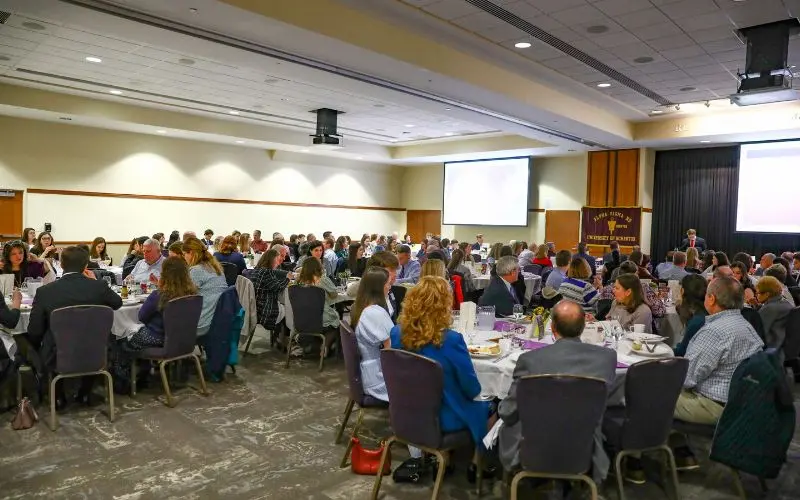
She also said that it is “the honor of my career that students would give me this type of award, and a lot of them said it was because I encourage critical thinking in my classes.”
In her classes, Dr. Pavlick tries to be up-to-date with current trends in education and pop culture, something that she always finds herself working to stay on top of.
“It's exciting to me to learn new material to teach students. I always try to be on the cutting edge. I'm always taking classes and webinars and getting certificates so that I can always bring something new into classes,” she said. “Right now, I've been working the last two years on ethical AI use, particularly in the field of communications … and I have now added ethics into all of my classes.”
She also serves as the NCAA faculty representative for Scranton’s student-athletes and faculty mentor for the University’s field hockey team, making her presence outside the classroom just as impactful as her teaching.
She describes herself as a mediator between the student-athletes and their professors in her capacity as the NCAA faculty representative.
“I love working with all students, and I love supporting all the student-athletes. I try to support them on the field, track or court, but particularly in the classroom. For example, I proctor exams for them remotely when they are playing away games,” she explained.
Dr. Pavlick’s abilities to care for her students were also praised by Grace DiCarlo ’27, a marketing and public relations major from Boonton, New Jersey.
DiCarlo said Dr. Pavlick’s involvement with students stood out the most during the classes she has taken under Dr. Pavlick.
“She really wants all of her students to succeed and she does that by going around the room, giving active feedback as we are doing work," DiCarlo said. "She's easily accessible. You can find her anytime and you can talk about whatever you want with her."
$content.getChild('content').textValueShe also said that Dr. Pavlick is “a lovely human being and I can't think of a professor who would deserve the award more than her.”
Dr. Pavlick received her bachelor’s degree from West Virginia University, master’s degree from The University of Scranton and her doctorate from Marywood University.
The Gannon Award for Teaching was established in 1969. Dr. Pavlick is the 57th recipient of the award, which recognizes outstanding efforts in educating students.
The Scranton chapter of Alpha Sigma Nu was founded in 1943 and is the oldest honor society at the University. Juniors, seniors and graduate students at the University who have distinguished themselves in scholarship, loyalty and service are eligible for membership.
Marcus Smith '27, Schuylkill Haven, is an English and theatre double major at Scranton.
Alpha Sigma Nu Selects Top Teacher of 2026
Earth Day week will be especially enriched by Lenape heritage during special events on Sunday, April 19. A new “Spirit of Lenapehoking in Nay Aug Park” Interpretative Sign will be dedicated at The Greenhouse Project in the city of Scranton’s Nay Aug Park from 12 noon – 12:30 p.m. Following the dedication ceremony, the community will be invited to enjoy a Lenape Cultural Program that includes language, storytelling, and the planting of indigenous seeds to take home for their own gardens. The program will be led by Lenape leader, Curtis Zunigha, from 12:30-1:30 p.m.
Zunigha is an enrolled member of the Delaware Tribe of Indians in Oklahoma, a citizen of the Cherokee Nation of Oklahoma, and a veteran of the U.S. Air Force. Through programs in culture and art, he helps build understanding and community around the return of Lenape people to their ancestral homeland, Lenapehoking, after generations living through the traumas of forced removal. His educational programs seek to connect people through developing relationships with one another and with the earth.
“This new Interpretive Sign is another seed planted in the soil of the relationship between Scranton and the Lenape people, which is flourishing thanks to Curtis’ gracious leadership and collaboration,” said Julie Schumacher Cohen, assistant vice president of community engagement and government affairs at The University of Scranton, who initially brought Zunigha to Scranton during the “Scranton’s Story, Our Nation’s Story” project in 2023.
Funding for this project and these events has been provided in part by The University of Scranton, the Greenhouse Project, the Lackawanna County Arts & Culture Department, the Lackawanna Heritage Valley National and State Heritage Area in partnership with the National Park Service, and in local partnership with Scranton Municipal Recreation Authority and The City of Scranton.
Both the dedication and the program are open to the public, reconnecting residents to the deep roots of Lenape people in this region they call Lenapehoking, and the role that the Lenape historically and currently play in the journey of our nation.
To learn more about these two events, please visit this link: https://scrantongreenhouse.org/lenape/
Seeds Planted in Scranton Symbolize Relationship with Lenape People
The University of Scranton and the ALL IN Campus Democracy Challenge (ALL IN) honored Grace V. Lennox ‘26 as part of the fourth annual ALL IN Student Voting Honor Roll. The 2026 ALL IN Student Voting Honor Roll recognized 168 students across the country for their contributions to creating a more civically engaged culture within their campus communities. From civic learning to voter participation, these students lead by example and empower their peers to become lifelong participants in democracy.
Lennox, a senior political science and philosophy double major with a history minor and legal studies concentration from Peckville has been recognized for her outstanding commitment to promoting civic and voter engagement efforts across the University of Scranton.
“I’m honored to be recognized for the Student Voting Honor Roll! Working to make our classmates more politically aware and engaged alongside many friends has easily been one of my favorite parts of college. I’m deeply grateful to have worked with so many bright and passionate students who recognize the importance of paying attention and using their voices. Democracies can only succeed in reflecting the interests of people if people make their interests known! As college students, we are constantly preparing for our futures, but making our voices heard in politics is essential not only for shaping the world we’re stepping into, but also for representing ourselves and our neighbors today,” said Grace Lennox ‘26.
“Grace has exuded a tremendous passion for student and civic engagement in her time at The University of Scranton. This work is deeply meaningful to her as she is always seeking to highlight student voices on campus. Grace has coordinated various voter registration drives, served as a resource for her peers, and continues to collaborate across various clubs to promote civic and voter engagement. An integral member of the Royals Vote Coalition and champion of civic and voter engagement, Grace enriches our campus with her drive to uplift and support students,” said Daysi Carreto ‘14, assistant director for community and civic engagement.
“From hosting registration drives to initiating conversations with classmates in the hallway, our 2026 Student Voting Honor Roll is filled with students who exemplify what it means to be a leader in civic engagement. As college students face increasing barriers to voting while on campus, these students are making nonpartisan voter participation a lifelong habit for themselves, their peers and their campuses. We are thrilled to celebrate their accomplishments and excited to see their continued impact as we approach this year’s midterm elections,” said Jen Domagal-Goldman, Executive Director of the ALL IN Campus Democracy Challenge.
ALL IN supports more than 1,000 campuses and 10 million students nationally to make nonpartisan civic engagement an ongoing part of campus life. Members of the 2026 Student Voting Honor Roll were nominated by campus leaders for their dedication and excellence in voter education, registration and turnout in 2025.
The full list of 2026 Student Voting Honor Roll award winners can be viewed here.
ALL IN Student Voting Honor Roll Recognizes Grace Lennox ‘26
The Commuter Student Association (CSA) is sponsoring their annual "CSA Restaurant Fest" on Thursday, April 30 from 11 a.m. – 2 p.m. For the event, the CSA is sponsoring meals for 108 University of Scranton students. Meals will include an appetizer, entrée, and dessert, each from a different downtown Scranton restaurant.
The goal of this event is to promote downtown restaurant businesses and encourage University students to explore the many diverse food options in downtown Scranton. The event includes six different meal routes. Each route will offer University students a different appetizer, entrée, and dessert from three different downtown spots. The routes will be assigned at random to participating University students, mindful of any dietary needs and offer students the chance to both try new downtown restaurant businesses while also enjoying a walk around downtown Scranton.
“Each year we do Restaurant Fest; I hear students tell me how much they loved trying new food without having to pay for it. Restaurant Fest is one of my favorite CSA events because students are offered a free, full-course meal that supports small, local businesses. I have found some of my favorite places to eat from this event that make Scranton feel even more special,” said Jessica Ely ’26, CSA president and biology major.
"Restaurant Fest gives students the chance to explore downtown Scranton, try new restaurants and support our thriving business community. It’s honestly one of my favorite events of the year! It’s such a fun way for students to experience the local food scene with options that make it inclusive for everyone, including vegan and vegetarian students," said Nora Flannery '27, CSA vice president and pre-med physiology and philosophy double major.
For more information about the CSA Restaurant Fest, please contact commuter@scranton.edu. To register for the event, please visit the following link on Royal Sync https://cglink.me/2rM/r385360.
$content.getChild('content').textValueCSA To Offer Annual Restaurant Fest
Sara Larson, Executive Director, AWAKE, will present "No Going Back: What Abuse Survivors Can Teach Us About Being Catholic Today" on Monday, April 20, 2026, at 5 p.m. Brennan Hall #228, Pearn Auditorium
Awake includes a nationwide community of abuse survivors, concerned Catholics, and allies responding to the wounds of sexual abuse in the Catholic Church.
Larson will address the question of what it means to be Catholic, here and now, in response to what is often called the ongoing “abuse crisis” in the church. It is a difficult topic, but Larson infuses all of her work, including outreach to abuse survivors, with a perspective of hope.
The event, open to the public, is sponsored by the Ellacuria Initiative and the Slattery Center at The University of Scranton.
AWAKE Director Sara Larson To Speak April 20
The Staff Senate would like to thank all staff members who took the time to recognize and share their colleagues' accomplishments, sense of community, and dedication to excellence. The Meg Cullen Brown Magis Award would not exist without our caring community!
THE MEG CULLEN-BROWN MAGIS AWARD WINNER for April 2026 is:
Mary Lou Perri – Facilities
We would like to take this opportunity to congratulate and celebrate the good work that Mary Lou does on a daily basis. We hope you will join us in personally congratulating Mary Lou and all our nominees. Mary Lou will receive a complimentary food donation at our fabulous University food service outlets AND a reserved parking space in the DeNaples Parking Pavilion for April. Each winner is also invited to the Staff Senate Recognition event in May 2026 to receive a certificate of appreciation.
We congratulate Mary Lou and all the wonderful nominees for being recognized as “Magis” employees!
April 2026 Nominees
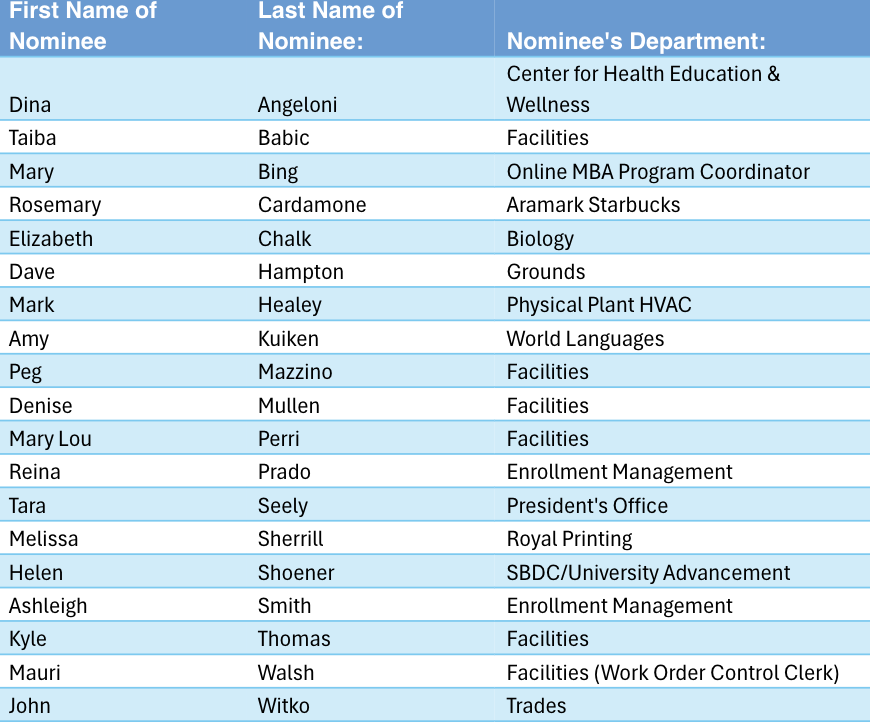
Nominations open for MAY Meg Cullen-Brown Magis Award.
Have you witnessed a University staff member, Aramark or Follett employee offer a simple act of kindness? Go above and beyond for others? Perhaps they embody our Jesuit mission or simply possess an incredible attitude. If so, please recommend this individual for this prestigious award.
Although only University staff members, Aramark, or Follett employees win the award, nominations may be made by any University of Scranton employee.
Meg Cullen-Brown Magis Award for April
Graduating seniors are invited to remember a faculty member whose teaching has inspired them when they vote for the 2026 "Teacher of the Year."
Each year, the graduating senior class selects its "Teacher of the Year."
Through Friday, April 17 at 4 p.m., seniors are requested to vote for the full-time faculty member who they believe best exhibits the following characteristics:
- Maintains the highest standards of academic excellence and fairness.
- Inspires interest in the discipline through personal enthusiasm and dedication.
- Is consistently effective in communication.
- Is available outside of the classroom.
The Teacher of the Year award will be presented during Class Night on Friday, May 16.
HOW TO VOTE:
To cast your electronic ballot, access www.scranton.edu/toy
WHEN TO VOTE:
Now through Friday, April 17, 4 p.m.
Seniors: Vote for 'Teacher of the Year' By April 17
The University of Scranton Center for Service and Social Justice is still looking for dogs to come to campus for our bi-annual Pet Therapy event. All dogs should be fully vaccinated and comfortable around other dogs and lots of people.
Register your dog by Friday, April 24 for "Canines on Campus."
According to organizers, anyone with a very social and fully vaccinated dog is welcome to attend on Tuesday, April 28, from 11:30 a.m. -1 p.m. The event will be hosted at Dionne Green if the weather permits; at Byron Center if the weather is inclement.
Email Ellen.Judge@scranton.edu with any registration issues. All participants must be over age 18. Waivers for both the owner and their dog(s) will be emailed.
Want to refer someone you think would like to bring their dog? Send them this information.
To view photos from last semester’s event? Follow the CSSJ social channels:
Dogs Still Needed for Pet Therapy; Register by April 24
University of Scranton professors are influencing financial professionals worldwide, while their work earns top national honors.
The Institute of Management Accountants (IMA) recently recognized the distinguished contributions of Douglas M. Boyle, DBA ’88, professor and chair of accounting, and Daniel P. Haggerty, Ph.D., professor of philosophy, two of three authors of the article that earned the 2026 Curt Verschoor Ethics Feature of the Year Award.
Building on their previous article, “Aristotle and Accounting: Building Virtue to Fight Fraud,” which won the 2025 Verschoor award, Dr. Boyle and Dr. Haggerty retained their top billing with “Fraud and the Capital Vices: Pride, Envy and Greed.” Published in Strategic Finance, their latest article examines how the vices of pride, envy and greed contribute to fraud risk. It also provides organizations with practical strategies to strengthen ethical culture and prevent fraud by addressing these behavioral drivers.
The award-winning scholarship is especially notable in that it represents collaboration between faculty from two different colleges — Dr. Boyle of the Kania School of Management, Dr. Haggerty of the College of Arts and Sciences — highlighting the University’s interdisciplinary excellence.
“Kudos to Drs. Boyle and Haggerty for achieving this great honor, once again,” said Carolyn Berry, Ph.D., dean of the College of Arts and Sciences. “Their ongoing scholarly collaboration utilizes their Catholic, Jesuit-grounded expertise to create new and synergistic scholarly works that strives to improve the world around them.”
“Drs. Haggerty and Boyle’s recognition for their publication in a top practice journal demonstrates that the intersection between business and the humanities continues to resonate with the business community,” added Mark Higgins, Ph.D., dean of the Kania School of Management.
Strategic Finance is the IMA’s flagship publication, reaching a global audience of about 140,000 finance leaders, practitioners and scholars from more than 105 countries. The Verschoor award honors the most outstanding ethics-focused article published annually in Strategic Finance. The award is named for Curt Verschoor, a distinguished accounting scholar and ethicist recognized for his contributions to promoting ethical standards and integrity in the accounting profession. Submissions are evaluated for quality, originality, relevance and practical impact in promoting ethical awareness.
University of Scranton professors have set a new benchmark in business ethics scholarship, earning the Verschoor award three consecutive years (2024-2026) and five times overall. Dr. Boyle has won the Verschoor award four times (2020, 2024-2026), an unparalleled distinction for any scholar, and Dr. Haggerty has now won the award twice (2025-2026). The article’s third author, Dana R. Hermanson, Ph.D., is an accounting professor at Kennesaw State University.
In addition to serving as professor and chair in the Department of Accounting, Dr. Boyle is the director of the University’s Ph.D. program in accounting. A Certified Public Accountant and Certified Management Accountant, he brings 30-plus years of executive experience, having held positions as CEO, CFO and COO. He currently serves as board chair for Allied Services Healthcare System and is ranked No. 1 worldwide for publication productivity in top accounting education journals and No. 1 nationally in practice-focused accounting journals. He earned a bachelor’s degree from Scranton, an MBA from Columbia University and a doctorate from Kennesaw State.
Beyond serving as professor in the Department of Philosophy, Dr. Haggerty directs the University’s Special Jesuit Liberal Arts Honors Program. Dr. Haggerty’s research focuses on moral psychology, ethics and epistemology, examining how virtue, reasoning and emotions influence decision-making and ethical behaviors. He has published extensively on classical and contemporary philosophy and has received University awards including Teacher of the Year — from Scranton’s graduating class in 2018 and also from Alpha Sigma Nu in 2011 — and the 2016 Magis Award. He earned a bachelor’s degree from Saint Joseph’s University and a doctorate from Syracuse University.
Founded in 1888, The University of Scranton offers 70 majors and has been recognized in recent national rankings by U.S. News and World Report, The Wall Street Journal, Princeton Review and Forbes.
Scranton Professors Win Coveted National Ethics Award a Third Consecutive Time
Engineering students from The University of Scranton delivered a standout performance, among peers from colleges throughout the region, at a competition testing their engineering, programming and problem-solving skills through robotics.
More than 300 students and faculty/staff members from 35 colleges and universities participated at the Institute of Electrical and Electronics Engineers (IEEE) Region 1 and 2 Student Activities Conference (SAC), held March 21 at Rowan University in New Jersey. Only six events were held — and Scranton’s IEEE branch won two of them, placing first in the Mini Pupper and MicroMouse competitions.
IEEE Regions 1 and 2 comprise much of the Northeast United States from Ohio and West Virginia through Maine. Other top finishers at the event hailed from Penn State, West Virginia, Maryland, Rutgers, Temple, Ohio Northern, York College, Montclair State and Wilkes.
The Mini Pupper competition challenged students to program a small, dog-like robot to complete a set of tasks. Students used their coding skills to make the robot move and behave like a dog. Students also controlled the robot’s responses during a tug-of-war against other robots. Mini Pupper teammates included Rachel Lendzinski, Deanna Holbert and Lailah Merai.
"Even though this was my first time going to SAC, I didn't have to worry about feeling left behind. I got to work with two amazing seniors, and we put a lot of time and energy into our project, so to win our division meant a lot," said Lendzinski, president of the University's student-led Laboratory for Research and Innovation in Computer Engineering (RICE Lab). "I got to bond with several upperclassmen who not only helped me when I didn't quite understand something — but also told me a lot about what I had to look forward to in my engineering courses here at Scranton."
The MicroMouse competition tasked the group with designing and 3D printing a small, autonomous robot that could sense walls inside a maze. The robot needed to solve the maze on its own, using sensors and intelligently programmed logic to escape. MicroMouse teammates included Carlton J. Hackett, Noah Millett and Ryan Merlo.
Additionally, Alfred Kumi-Atiemo Jr. placed third in Brown Bag, a hands-on engineering challenge where student teams were given a bag of unknown components. Using only those components and their own knowledge, competitors, participating as teams of one to four students, had to design and build a working solution to a surprise problem.
The following students attended the conference:
- Emmanuel O. Awuah, a computer engineering major from Somerset, New Jersey
- Eldridge G. Charway, a computer engineering major from Somerset, New Jersey
- Carlton J. Hackett, a computer engineering major from Lansdale
- Deanna Holbert, an electrical engineering major from Simpson
- Alfred K. Kumi-Atiemo, an electrical engineering major from Stroudsburg
- Rachel A. Lendzinski, a computer engineering major from Lansdale
- Lailah D. Merai, a computer engineering major from White Plains, Maryland
- Ryan A. Merlo, a computer engineering major from Macungie
- Noah W. Millett, an electrical engineering major from Swarthmore
- Joseph R. Mpasiakos, a computer engineering major from Harriman, New York
- James W. O’Malley IV, a computer engineering major from Ambler
All logistics related to the trip, including coordination and transportation, were supported and managed by Farshad Merrikh Bayat, Ph.D., assistant professor of physics and engineering, working with the University’s IEEE student chapter. Dr. Bayat assigned the Mini Pupper portion to the University’s student-led RICE Lab group, whose faculty advisor is Navid Shahrouzi, Ph.D., assistant professor of physics and engineering. Majid Mokhtari, senior laboratory engineer, provided essential technical support and preparation.
The IEEE is the world’s largest technical professional organization dedicated to advancing technology for the benefit of humanity. In addition to competitions, the SAC featured hands-on workshops and opportunities to network with fellow students and industry leaders.
Scranton Teams Win Multiple Top Honors at IEEE Conference
By Marcus Smith '27, Student Correspondent
Students at The University of Scranton can look forward to quality-of-life improvements in their dining for the 2026-27 school season, thanks to the Pennsylvania Department of Education (PDE), which recently announced Scranton as a recipient of its PA Hunger-Free Campus grant funding.
Adrianna Smith '22 G'23, student life special projects coordinator for The University of Scranton, outlined how the University plans to use its grant allocation.
“We can increase the availability of grab-and-go meals, meal ingredient kits and emergency dining support while also piloting a micro-pantry and expanding access to hygiene products,” she explained. “Additional funding will allow for expanded grocery shuttle services, cooking workshops and SNAP education and application support to connect eligible students with crucial resources.”
Smith said the grant represents a new ability for campus-wide collaboration among several departments.
“This funding will support a collaborative initiative between the Division of Student Life and Center for Service and Social Justice, enhancing both immediate access to food and long-term resources for students,” Smith said.
Smith also discussed the grant’s ability to help the University ensure that it lives up to its Jesuit ideals by recognizing and assisting with students’ physical, not just academic, needs.
“By prioritizing dignity, we will continue to foster an environment where all students are supported and thriving both inside and outside the classroom,” Smith said.
PDE awarded $1 million worth of PA Hunger-Free Campus grants to 30 colleges and universities across the state of Pennsylvania.
The University of Scranton received $40,000 in grant funds from PDE to help improve the dining experience on campus.
PA Hunger-Free Campus grants are awarded by the Pennsylvania Department of Education to help schools address food insecurity on campus, including expanding access to food options, creating awareness initiatives and upgrading facilities.
Marcus Smith '27, Schuylkill Haven, is an English and theatre double major at Scranton.
University of Scranton Awarded PA Hunger-Free Campus Grant
A group of students from The University of Scranton is once again organizing SoccerFest, a community-focused soccer tournament designed to bring together local youth athletes for a day of competition, teamwork and community engagement.
SoccerFest will take place on Saturday, May 9, at Fitzpatrick Field on the University's campus, featuring a fast-paced 6-v-6 tournament format. Teams of up to 10 players will compete in multiple divisions: U10 coed, U12 coed, U12 male, U14 girls, U14 male, high school male and high school female.
The event is entirely planned and executed by students as part of a sports event management course, giving them hands-on experience in organizing a large-scale athletic event — from marketing and registration to scheduling and game operations.
The tournament is open to players of all skill levels, offering each team a guaranteed set of games throughout the day. Participants will also receive event T-shirts. Registration is available through the SoccerFest website.
The goal of the event is to grow the community and bring people together for a fun day. In addition to providing a competitive outlet for young athletes, all SoccerFest proceeds support the charitable initiative of Friends of the Poor.
Student organizers are actively promoting the event across local community spaces, emphasizing the importance of teamwork, inclusivity and community connection.
Registration for SoccerFest 2026 is currently open, with early registration pricing available through April 17 and final registration closing May 3.
For more information, to register a team or to volunteer, visit the SoccerFest website.
Student-Run SoccerFest Tournament Returns to Scranton
The University of Scranton Jazz Band will take the stage Saturday, April 18, with acclaimed trombonist Jennifer Krupa joining them as the evening’s featured guest artist. Presented by Performance Music at The University of Scranton, the concert begins at 7:30 p.m. in the Houlihan-McLean Center, Mulberry Street and Jefferson Avenue, downtown Scranton. Admission is free and the concert is open to the public. Seating is on a first-come, first-seated basis.
“Our students are excited to work with Jen again after a very successful week last year of preparing and performing premieres of the works she and Wycliffe Gordon composed for them," said Performance Music Executive Director and conductor Janelle Decker.
“Krupa is truly a part of our Performance Music program here at Scranton — her musical and technical mastery and collaborative, respectful and intuitive teaching style have consistently had a strong positive impact on the musical experiences of our student musicians, staff and audiences throughout her many years of visits," said Cheryl Y. Boga, Artistic Director of Performance Music and conductor.
An acclaimed trombonist, musician, music educator, conductor, composer and arranger, Krupa has written original works and arrangements for a wide variety of ensembles that have been featured in recordings and performances across the globe. Her extensive discography spans nearly 40 recordings. She performs with many of the most highly regarded jazz artists of our time, serves as lead trombonist with the Smithsonian Jazz Masterworks Orchestra and the DIVA Jazz Orchestra, co-leads the Krupa/Pilzer Quartet, is an in-demand soloist throughout the U.S., and maintains a very active career as a player, guest conductor, composer/arranger and teacher in the New York City and Washington/Maryland areas.
Krupa leads clinics, masterclasses and adjudications and guest conducts nationwide; conducts the Juilliard Jazz Orchestra and Jazz Combos; and has presented at the Jazz Educators Network, Midwest Clinic and the International Trombone Festival. Recently retired from her two-decade tenure with the United States Navy Band Commodores Jazz Ensemble, Krupa held multiple key roles with that ensemble, including Music Director, arranger, tour manager, operations and personnel manager and trombonist. She is currently on the faculty of The Juilliard School where she directs the Juilliard Jazz Orchestra.
The University of Scranton Jazz Band is a 25-member ensemble of big band style instrumentation, made up of University of Scranton student musicians from majors spanning the curriculum. They perform five or more times per year. The majority of their performances are open to the public, free of admission charge, and often feature a nationally or internationally renowned guest soloist.
Krupa received her first critic’s review as a professional in “The Scranton Tribune” for a performance in the University’s Houlihan McLean Center in 2000, performing with The Wycliffe Gordon Quintet.
For further information on the concert, call 570-941-7624, email music@scranton.edu or visit the University's website. For more info on Krupa, visit jenkrupa.com.
IF YOU GO:
What: IN CONCERT: The University of Scranton Jazz Ensemble featuring guest soloist Jennifer Krupa, trombone, presented by Performance Music at The University of Scranton
When: 7:30 p.m., Saturday, April 18, 2026
Where: Houlihan-McLean Center, Mulberry Street and Jefferson Avenue, downtown Scranton
Admission: FREE
Jennifer Krupa, Acclaimed Trombonist, To Perform With University Jazz Band
As The University of Scranton’s programs that serve community members in need have expanded, so has the need for more space. The Center for Service and Social Justice’s many programs, previously held in the Arrupe House, have now moved to a larger, more modern space in Ciszek Hall on Mulberry Street.
$content.getChild('content').textValueA new kitchen and hall in the lower level will serve as a new space for the We Care Meal Program, through which students volunteer to prepare and package 50-100 meals weekly for community members in need. The meals include a main course, side, drink, snacks, dessert, utensils and a handmade card. The cards are made in the Crafts room on the first floor of Ciszek Hall. Meals have been donated to Community Intervention Center, Friends of the Poor and low-income housing developments such as Delaware Towers, Valley View, Bangor Heights, Hilltop and Jackson Terrace.
$content.getChild('content').textValueThe first floor of Ciszek Hall includes the Royal Restore Food Pantry, which provides free, nutritious food and personal care products to University students and employees in need, and Teen Threads, a student-run program that offers clothing giveaways at area high schools and other programs for young adults. The hall also includes a meeting space for groups associated with the Center for Service and Social Justice.
The new space was showcased and blessed at an Open House in March. Participating in the event were Daniel Cosacchi, Ph.D., vice president for mission and ministry; Patricia Vaccaro, director of the Center for Service and Social Justice; and University students Patrick George, Endwell, New York; Bridgid Guarnuccio, Scotch Plains, New Jersey; Bradly Kaufman, Scranton; Christina Kennedy, Morristown, New Jersey; and Frank McCann, Glenside.
$content.getChild('content').textValueCiszek Hall Reconfigured to Serve Others
The University of Scranton has more than a dozen graduate programs ranked among the best in the nation, according to one of the leading authorities in assessing academic quality and reputation.
U.S. News and World Report’s “Best Graduate Schools” report, released April 7, features 14 University of Scranton master’s and doctoral offerings ranked in their respective categories.
Among Scranton’s highest-ranked and fastest-rising programs are the following:
- No. 43 (tied), Best Rehabilitation Counseling Programs — up six spots from No. 49 in 2025
- No. 59 (tied), Best Occupational Therapy Programs — up 20 spots from No. 79 in 2025
- No. 99 (tied), Best Nurse Anesthesia Programs — up 12 spots from No. 111 in 2025
In rehabilitation counseling, Scranton ranks first in Pennsylvania and shares the No. 43 ranking with the likes of Texas Tech and the University of Alabama.
Scranton also held strong in the Best Healthcare Management Programs category, ranking 53rd nationally, tied with Creighton University, Texas State University, the University of Memphis and the University of North Carolina-Charlotte, among others.
Additionally, after not being ranked in 2025, the University placed in the following categories:
- No. 109 (tied), Best International Business Programs
- No. 139 (tied), Best Management Programs
- No. 154 (tied), Best Marketing Programs
- No. 166 (tied), Best Supply Chain Management Programs
The University also received recognition in multiple other categories: Best Part-Time MBA Programs, No. 105 (tied); Best Physical Therapy Programs, No. 115 (tied); Best Business Analytics Programs, No. 115 (tied); Best Nursing Schools: Doctor of Nursing Practice, No. 137; Best Accounting Programs, No. 148 (tied); and Best Finance Programs, No. 170 (tied).
The methodologies used by U.S. News to rank programs are constantly updated, refined and tailored to each category. Among the factors that go into U.S. News rankings are the results of surveys of educational and professional personnel, faculty student ratios and student test scores. In addition to U.S. News, The Wall Street Journal, Princeton Review and Forbes are among the other publications that have recently recognized the value of a Scranton education with noteworthy rankings.
The University of Scranton has more than 40 graduate programs covering specialties within the fields of business, health administration, health sciences, social sciences and STEM.
According to the most recent Roche Family Center for Career Development’s First Destination Survey, graduate students from the Class of 2024 reported a 100% success rate with 95% of them employed full-time. The graduates’ mean annual salary was $82,932, up 15% from just three years earlier.
For more information, visit The University of Scranton’s graduate admissions website.
More Than a Dozen University of Scranton Grad Programs Ranked by U.S. News
In conjunction with the closing of the Environmental Art Show at the Weinberg Memorial Library, members of the University community are invited to join for "Waymarks Toward Reunion: Making Beauty as a Return to the Earth," an artist talk with Patrick Beldio, Ph.D. and Waymarks Fellow Gabriella Palmer '26 on April 21 at 5 p.m. in the Charles Kratz Scranton Heritage Room.
What does it mean to return — to the earth, to ourselves, to what is sacred in the ordinary? This talk brings together a sculptor and a playwright at a shared creative threshold:
* Beldio, Artist-in-Residence at the Franciscan Monastery of the Holy Land and Visiting Assistant Professor of Theology and Religious Studies at The University of Scranton, introduces his grant-funded program Waymarks Toward Reunion and reflects on his own creative and spiritual practices, and how these inform and are informed by his scholarship and teaching in the classroom.
* Palmer '26, a Scranton student and Waymarks Fellow, shares her latest original play: a retelling of "The Prodigal Son" as family drama with magical realism, that also examines the theme of reunion with nature.
Beldio and Palmer will discuss what making art asks of both artist and audience, what the word reunion means in a week devoted to the Earth, and how they each entered the creative threshold from different doors. The talk concludes with a Q&A.
Planning To Attend? Get the Details.
This event is free and open to the public. Light refreshments will be available.
The 2026 Environmental Art Show runs from April 13 to 22 in the Charles Kratz Scranton Heritage Room and is open to the public during the library's operational hours.
Direct questions regarding this event to Marleen Cloutier via email at marleen.cloutier@scranton.edu
Artists To Discuss 'Making Beauty as a Return to the Earth' at Environmental Art Show
A pioneer in integrating artificial intelligence (AI) into leadership education, Dan Jenkins, Ph.D., has been at the forefront of leveraging generative AI tools like ChatGPT to transform teaching and learning. On Tuesday, April 14 he will present "Keeping the Student in the Loop: Ethics, Critical Thinking and Human Judgement in the Age of AI" at 11:30 in the Pearn Auditorium, room 228 Brennan Hall at The University of Scranton.
Dr. Jenkins, a professor of leadership and organizational studies at the University of Southern Maine, is recognized through his certificate in teaching with AI, webinars, workshops and frequent conference panels guiding educators to navigate AI’s role in leadership development.
An award-winning international speaker and facilitator, Dr. Jenkins has engaged thousands of leadership educators, scholars, students and professionals worldwide. His talks blend theoretical insight with practical strategies, offering actionable approaches to creating personalized, impactful leadership development experiences enhanced by technology.
His leadership roles include serving as co-founder of the International Leadership Association’s (ILA) Leadership Education Academy, past chair of the ILA Leadership Education Member Community, vice-chair of the Collegiate Leadership Competition, co-lead of the Association of Leadership Educators’ Teaching and Pedagogy/Andragogy Focus Area Network, and associate editor of the Journal of Leadership Studies. He is also co-host of The Leadership Educator Podcast.
Pioneer in Integrating AI Into Leadership Education To Speak at Scranton
The University of Scranton’s Jane Kopas Women’s Center (JKWC) will host its annual Take Back the Night on April 23, continuing a longstanding campus tradition rooted in advocacy, education and community care.
Held during Sexual Assault Awareness Month (SAAM), this year’s event is inspired by the national theme, “25 Years Stronger: Looking Back, Moving Forward,” which recognizes the resilience of people who have experienced sexual, interpersonal and gender-based violence and the collective progress made in prevention and response efforts. In alignment with this national reflection, The University of Scranton centers its 2026 Take Back the Night theme: “What’s Hidden Still Grows.”
This theme acknowledges that healing is not always visible. Like roots beneath the soil, growth and resilience often develop quietly and over time. It affirms that while some individuals may choose to share their experiences, others may choose to heal more privately; both paths are valid, and both deserve recognition and support.
Take Back the Night is a globally recognized movement dedicated to ending sexual violence and supporting people who have been impacted. At The University of Scranton, the event reflects the institution’s Jesuit mission, particularly its commitment to cura personalis and the inherent dignity of every individual.
“Take Back the Night invites our community to hold space for one another in meaningful and compassionate ways,” said Brandice Ricciardi, Assistant Director of the Jane Kopas Women’s Center. “This year’s theme reminds us that even when healing is not visible, it is still present and worthy of care. At the same time, we recognize the power of shared voice and collective witness. Our goal is to create a space where all forms of healing are respected.”
Interested in Attending?
The evening will begin with a Pre-Rally from 5–6:30 p.m. on the Dionne Green, featuring campus and community organizations offering resources, education and opportunities for engagement. This portion of the event serves as a critical opportunity for awareness-building and connection.
At approximately 6:45 p.m., participants will gather for a march across campus, symbolizing unity and a shared commitment to ending sexual, interpersonal and gender-based violence. The event will conclude with a Speak-Out and Candlelight Vigil on the Alumni Memorial Green, where individuals may share their experiences or stand in support of others in a space grounded in dignity, respect, and care.
Take Back the Night remains one of the Cultural Centers' most significant community events, offering students, faculty and staff an opportunity to come together in support of people who have experienced harm, to deepen their understanding of interpersonal violence, and actively contribute to a culture of accountability and compassion.
“Guided by our Jesuit values, we are called to be a community that shows up for one another,” Ricciardi added. “Through awareness, presence and shared responsibility, we continue the work of building a safer and more just campus.”
All members of the University community are invited to attend. Participation is welcome at any level, whether individuals choose to march, listen, learn or simply stand in solidarity.
For more information, please contact the Jane Kopas Women’s Center at jkwc@scranton.edu.
University To Host Take Back the Night: 'What’s Hidden Still Grows'
A discussion on undocumented immigration and Catholic teaching will take place on Monday, April 13, from 6 - 7:15 p.m. in Brennan Hall 228 (Pearn Auditorium).
Dr. Terence Sweeney, a professor in the Honors Program at Villanova University, will discuss the right to migrate and the obligation to welcome migrants in terms of traditional Catholic principles of natural law and the universal destination of goods.
These principles challenge some current views among Americans about undocumented immigrants, providing a theological foundation for recognizing moral obligations toward them.
Undocumented Immigration, Catholic Teaching Discussion April 13
Graduating seniors are invited to remember a faculty member whose teaching has inspired them when they vote for the 2026 "Teacher of the Year."
Each year, the graduating senior class selects its "Teacher of the Year."
Beginning Monday, April 13, at 9 a.m., seniors are requested to vote for the full-time faculty member who they believe best exhibits the following characteristics:
- Maintains the highest standards of academic excellence and fairness.
- Inspires interest in the discipline through personal enthusiasm and dedication.
- Is consistently effective in communication.
- Is available outside of the classroom.
The Teacher of the Year award will be presented during Class Night on Friday, May 16.
HOW TO VOTE:
To cast your electronic ballot, access www.scranton.edu/toy
WHEN TO VOTE:
Monday, April 13, 9 a.m. - Friday, April 17, 4 p.m.
Seniors: Vote for 'Teacher of the Year' Who Inspires
By Marcus Smith '27, Student Correspondent
Hundreds of students filled The University of Scranton’s Byron Center gymnasium on March 26, gaining a headstart on their future careers at the Spring 2026 Career Expo.
“I have some really good candidates that we may able to fill roles with,” said Stacy Karvoski, a senior talent acquisition business partner at Lehigh Valley Health Network.
Karvoski’s organization was one of 65 organizations that attended the expo, matching potential employers with students from a wide range of majors offered at Scranton.
Hosted by the Roche Family Center for Career Development, the bi-yearly expo helps introduce students to potential employers and begin making plans for their futures after graduation.
Rose Jacklinski, the Center’s career relations manager for career development, says coordinating the event is a big part of her job.
“I am the bridge between our students and our employers,” Jacklinski explained. “So, I build relationships with our employers, recruiters, talent acquisition and bring them to campus to get in front of our students.”
In total, 425 students attended the event — the biggest student turnout at any University of Scranton Career Expo since fall 2017.
“We're always … taking a look at our majors here that we offer and how we can match our student majors up with what our employers have to offer,” Jacklinski said.
$content.getChild('content').textValueRepresenting Lehigh Valley Health Network, Karvoski said the Spring Career Expo was the first one she’s attended at Scranton. Karvoski said many of the students she’d talked with were interested in rehab, which is what she hires for, but she also explained that she was looking for future employees in almost every field.
“We have a variety of positions available, everything from direct patient care, like RNs and physical therapy, to not taking care of patients, so security, payroll, human resources,” she said.
Scranton students were also hopeful that the career expo be fruitful for them, such as Liam Clare '27, a criminal justice major from East Stroudsburg, who hopes to work in homeland security.
“I feel I’ll gain some connections here and grow in the future with my career,” Clare said.
He also credited Scranton’s ROTC program for helping him become more disciplined and goal-oriented.
“Waking up early at 6 a.m., doing PT, that camaraderie and moving forward with your goals … I think it really put me on task, motivated me a little bit more, gave me a drive,” Clare explained.
The career expos have great effect since Scranton students are hired at remarkable rates.
Ninety-nine percent of members in Scranton's undergraduate Class of 2024 have reported success in their intended fields, according to the most recent First Destination Survey conducted by the Center for Career Development.
Marcus Smith '27, Schuylkill Haven, is an English and theatre double major at Scranton.
Career Expo Helps Students Jumpstart Future, Draws Largest Crowd in Years
The University of Scranton will host a three-day national interdisciplinary conference, bringing together educators, students and professionals to explore the wide-ranging implications of rapidly advancing artificial intelligence.
The conference, titled “Confronting the Ethics of Artificial Intelligence,” will be held Thursday, April 16, through Saturday, April 18, on the University’s campus. Registration is open with pricing ranging from $50 to $150. Included in the cost is unlimited access to the conference’s panels and workshops, as well as entry into a Thursday night mixer and Friday night dinner. Conference sponsors are the Diocese of Scranton and Geisinger.
Notable presenters include Ryan Struyk, director of AI innovation at CNN; Thursday’s keynote speaker Joe Vukov, Ph.D., associate director of Loyola University Chicago’s Hank Center for the Catholic Intellectual Heritage and associate professor of philosophy; and Friday’s keynote speaker Paul Scherz, Ph.D., Our Lady of Guadalupe professor of theology at Notre Dame, program chair of the Notre Dame-IBM Technology Ethics Lab and member of the Vatican Centre for Digital Culture’s AI Research Group.
Thursday’s programming begins at 5 p.m. with a welcome by Tracy Stewart, Ph.D., The University of Scranton’s interim provost and senior vice president for academic affairs, along with conference co-planners George Aulisio, Ph.D., dean of the Weinberg Memorial Library; Dan Marenda, Ph.D., associate dean of the College of Arts and Sciences; and Megan Heeder, Ph.D., assistant professor of theology and religious studies.
On Friday, the conference will offer a staggering 28 breakout sessions across nine time slots, beginning in the 9 to 9:40 a.m. window and ending at 4:30 to 5:10 p.m.
Presenters are coming from across the U.S. to discuss topics including but not limited to arts and humanities; business; education; environmental impact; healthcare and medicine; law and policy; library and information science; philosophy; science; theology; social justice and equity; and social sciences.
A full conference schedule and list of presenters are now available on the University’s website.
Upcoming University of Scranton AI Conference To Feature National Presenters
The University of Scranton will welcome Harvard University faculty member Brandon Terry, Ph.D., as the speaker at this year’s Sondra H’87 and Morey Myers H’12 Distinguished Visiting Fellowship in the Humanities and Civic Engagement Lecture.
Dr. Terry, Harvard’s John L. Loeb associate professor of the social sciences and co-director of the Institute on Policing, Incarceration and Public Safety at the Hutchins Center for African and African American Research, will speak at 5:30 p.m. Thursday, April 23, at the Pearn Auditorium inside Brennan Hall. The lecture is free and open to the public.
Dr. Terry’s lecture is titled “Shattered Dreams, Infinite Hope,” the same title as his 546-page book released in October 2025.
The book was selected by The New York Times as one of “100 Notable Books of 2025.”
“The civil rights movement has been enshrined in American history as an exemplary model of transformative social action,” the newspaper wrote. “Terry, a Harvard scholar, upends the conventional wisdom, rejecting both romanticized versions of the past and pessimistic accounts of the present to offer a nuanced theory of the movement — and of social movements in general — predicated on a rigorous philosophical vision of what he calls ‘tragic hope.’”
Housed in The University of Scranton’s Slattery Center for the Ignatian Humanities, the Myers lecture was created to advance the University’s efforts in bringing renowned scholars, artists and thinkers to campus to share their work and enrich cultural and civic activity.
Sondra Myers was a longtime director of the University’s Schemel Forum whose career has focused on strengthening democracy and civic engagement through cultural programming, public policy work and humanities scholarship. Morey Myers, a civil rights activist and accomplished jurist, is a graduate of the Yale University School of Law and Syracuse University.
For more information, visit the Myers lecture’s webpage on the Slattery Center website.
Harvard’s Brandon Terry to Deliver Myers Lecture
It's almost time for the best day of the semester — "Pet Therapy: Canines on Campus!"
But the University's Center for Service and Social Justice (CSSJ) can't do it without you.
According to event organizers, anyone with a very social and fully vaccinated dog is welcome to attend on Tuesday, April 28, from 11:30 a.m. -1 p.m. The event will be hosted on the Dionne Green if weather permits; Byron Center if the weather is inclement.
Participants are asked to register no later than Friday, April 24.
Email Ellen.Judge@scranton.edu with any registration issues. All participants must be over age 18. Waivers for both the owner and their dog(s) will be emailed. Please print, sign and bring to the event the week prior.
Want to refer someone you think would like to bring their dog? Send them this information.
To view photos from last semester’s event? Follow the CSSJ social channels:
Register Your Dog for Pet Therapy by April 24
Feeling overwhelmed, disconnected or unsure how to navigate life's day-to-day stressors? Peacemakers Group invites students to attend sessions this month to gain insight and strategies.
Small, reflective group gatherings for students who want space to slow down and breathe will take place Wednesdays, from April 8 - 29 at McGurrin Hall, 4th floor, from 7 - 8:30 p.m.
To register or get details, contact krisy.elrod@scranton.edu.
According to event organizers, "Peace dwells in each one of us; it is a part of our very being. Peace is energy. Peace is a reality to be nurtured within each person, among us and in our environment. Peace provides us with the tools to make peace outside of ourselves. ... Peacemaking includes making peace with our bodies, each other, the earth and our world. Peacemaking is more than conflict resolution and goes beyond tolerance. We are carriers of peace to all who share life with us."
Feeling Overwhelmed? Group Offers Students a Place for Reflection
The University will hold the 2026 Carlesimo Golf Tournament and Award Dinner Monday, June 15, at Canoe Brook Country Club in Summit, New Jersey. Register here to reserve your spot today.
The University is once again partnering with the Quandel Construction Group as the title sponsor for this event. If you have any questions or would like to learn more about the event or sponsorship opportunities, contact Eric Eckenrode, assistant vice president of Development, at eric.eckenrode@scranton.edu.
Founded in 1901, Canoe Brook Country Club offers 36 holes of championship golf. Recognized as a 5-Star Platinum Club of the World, the club has played host to a number of significant events, including U.S. Open and British Open qualifiers and the U.S. Women's Amateur.
Named in honor of the late Peter A. Carlesimo, former University of Scranton coach and athletics director, the Carlesimo Golf Tournament and Award Dinner celebrates athletics at The University of Scranton and honors a person who has made special contributions to athletics and Catholic education. The Golf Tournament and Award Dinner serves as a fundraising event to support and enhance the student-athlete experience at Scranton. All proceeds will directly benefit the Department of Athletics and nearly 600 students it serves. See photos from the 2025 event here.
University To Hold Carlesimo Golf Tournament and Award Dinner June 15
Mark your calendars for a fun afternoon at the Jersey Shore on Saturday, June 27, from 3–6 p.m. at the Belmar Fishing Club in Belmar, New Jersey.
Hosted by Karen Golding ’91, this gathering is a great opportunity to reconnect with fellow alumni and enjoy time by the ocean.
More details and registration information will be shared soon.
We hope to see you there!
Save the Date: Jersey Shore Alumni Gathering
What's new with you? To submit a Class Note, visit the Class Notes Submission Page.
Jim Rauer ’78 was inducted into the South Jersey Soccer Hall of Fame on March 15 at the Valleybrook Country Club in Blackwood, New Jersey. Rauer, who is also a member of The University of Scranton Athletic Wall of Fame, was joined at the event by several of his former Scranton teammates and fellow alumni, including Joe Sharp ’78, Dennis Guida ’75, Steve Jiulianti ’78, Kevin McGeever ’78, Ron Rauer ’78, Don Appenzeller ’76, Jack Vogel ’78, and Dan Amspacher ’80. Former Scranton soccer coach Steve Klingman was also in attendance.
Attorney John A. Donovan Jr. ’83, West Pittston, was awarded the 2025 President's Award by the Wilkes-Barre Law and Library Association of the Luzerne County Bar Association.
Lawrence A. J. Spegar, Esq. ’84, Jessup, continues to enjoy a successful career as an attorney, in addition to his pursuits as a sports enthusiast and influencer. In 2026, he attended the College Football National Championship in Miami, Super Bowl LX in San Francisco, and the opening rounds of the men’s basketball tournament in Philadelphia.
Meg Powers '96, Richmond, California, earned a Master of Education in Curriculum and Instruction from the University of Virginia.
Scranton friends share a bond like no other. More than 30 years later, the Class of 1998 friendship remains strong. The “408 girls” (Robin Brooks Johnson ’98, Jennifer Weaver Musser ’98, Andrea Russo Hankey ’98, and Gianna Famulari ’98) gathered in February 2026 in Punta Cana, Dominican Republic, to celebrate more than 30 years of friendship and their 50th year.
Kristen Mucci-Mosier '00, Cranford, New Jersey, had her debut book, Restless: How to Stop Living an If-Only Life, published. The book became available on April 14, 2026, and examines the psychological, emotional and cultural roots of restlessness, that persistent feeling that something better must be just around the corner, guiding readers toward greater presence, clarity and meaning in their lives. After a decade working as a journalist, with roots in her Scranton education and time as a campus newspaper editor, she transitioned into psychotherapy. The skills she honed across both careers are woven into every page of the book.
Peter Castagna '03, West Chester, defended his dissertation to earn his Ed.D. from Saint Joseph’s University.
Bobby Davis ’03, Ed.D., served on the dissertation committee.
Dillon Chorba '15, Red Bank, New Jersey, has been appointed by Vincent Solomeno ’07, New Jersey’s Commissioner of Veterans Affairs, to serve as Chief of Staff of the New Jersey Department of Veterans Affairs.
MARRIAGES
Matt Nardo '18 to Lea Zaengle '18
Luis Melgar '18 to Catherine Bruno '18
DEATHS
Gerald M. Barbour '58, East Rockhill Township
Elbert H. Rowlands '59, Stroudsburg
Flora M. Cupple '62, Scranton
Charles H. Castellino '63, Pittston
Robert M. Costello '63, Elizabethtown, Kentucky
Rose Ellen Miller G'65, Falls
John W. Nebzydoski, M.D. '65, Fayetteville, New York
Hugh Donald Burns, Ph.D. '68, Harleysville
Rose Mary E. Lynch G'69, Wilkes-Barre
Rev. Gregory N. Maslak '69, Bristol
Gerald J. Reisch '74, Luzerne
Joan Lengel G'75, Roaring Brook Twp.
Robert C. Mesko '75, Scranton
Ann Marie Crow G'78, Harrisburg
Dennis J. Matzoni G'78, Newport Township
Brian P. McKenna '85, Bethlehem
Ann Marie Dixon Bestany '91, Malverne
Alumni Class Notes, April 2026
Make plans to come together with fellow Royals, parents and friends for an inspiring Day of Service on Saturday, April 25, 2026. Alumni across the country will unite to give back, strengthen their communities and live out the spirit of service that defines The University of Scranton.
Service opportunities are available in California, Illinois, Massachusetts, New York, North Carolina, Pennsylvania and Washington, D.C., offering a variety of ways to get involved and make an impact.
To view a list of confirmed service sites and register, visit scranton.edu/dayofservice, where you’ll find site details and registration information.
Let’s serve together and show what it means to be part of the Scranton community!
Questions? Email alumni@scranton.edu
University To Host Annual Day of Service April 25
With baseball season officially underway, it’s the perfect time to make plans to join fellow Royals at the ballpark.
We’re excited to invite you to a series of University of Scranton Alumni Baseball Outings planned over the coming months. These events are a great way to connect with alumni, enjoy America’s pastime and represent the Royal community in cities across the country.
Here’s what we have lined up:
Sunday, May 31: Philadelphia Phillies vs. Los Angeles Dodgers at Dodger Stadium
Friday, July 31: Texas Rangers vs. Houston Astros at Daikin Park
Thursday, August 27: Houston Astros vs. New York Yankees at Yankee Stadium
Tuesday, September 1: Seattle Mariners vs. Boston Red Sox at Fenway Park
Wednesday, September 16: Baltimore Orioles vs. New York Mets at Citi Field
Thursday, September 24: Milwaukee Brewers vs. Philadelphia Phillies at Citizens Bank Park
We hope to see you soon at a ballpark near you!
Step Up to the Plate With Royal Baseball Outings
Reunion Weekend 2026 will take place June 5–7, and registration is now officially open.
Alumni from class years ending in “1” and “6” will celebrate their milestone reunions during this special weekend filled with events, memories and time with your Royal Family in the place where it all began.
Be sure to register to secure your spot for this unforgettable weekend.
Reunion T-shirts are also available for purchase at $20 each. When ordering, you can choose to either pick up your T-shirt during Reunion Weekend or have it shipped directly to you.
For more information and to register, visit scranton.edu/reunion.
Reunion Weekend 2026 Registration Is Now Open
March
View March Listing Page
A few weeks remain to submit a nomination for the Department of Communication and Media Hall of Fame. The deadline for submissions is April 30, 2026. Nominations opened last fall at the annual Careers in Communication alumni panel to align with the celebration of the 50th anniversary of the department's first graduating class (1975 – 1976).
The University of Scranton Communication and Media Department Hall of Fame honors distinguished alumni, living or deceased, who have made extraordinary and lasting contributions at the highest levels of public service, industry, the military or academia for at least 20 years. Eligible nominees do not need to be retired professionals. All graduates of the University, no matter their degree at the time of their graduation, are eligible for nomination.
The awards will be presented at a special department event in September of each year, with a panel discussion for all students, followed by a networking event and a formal induction ceremony.
Hall of Fame Criteria
To be considered a Hall of Fame candidate, an individual’s nomination should clearly demonstrate the following:
* Superior service and achievement in the nominee’s respective field(s); nominations should highlight merits of accomplishment and may also highlight previous awards and honors.
* Significant impact of professional contributions at the organizational, local, regional, national or international levels.
* Outstanding leadership, character, values and ethical conduct.
* Jesuit model of being men and women for others.
Fields for Consideration
Any area of the communication arts will be considered for this honor. Examples include communications planning, social media, media relations, marketing, public relations, advertising, journalism, business communication, broadcasting, video and audio production and graphic arts.
What to Include in a Nomination Packet
All packets should include the following:
- A two-page narrative of the nominees’ accomplishments and qualifications for receiving the award
- The candidate’s resume
- A list of any awards received
- Encouraged but not necessary are: Letters of support, endorsement, or recommendation
Need Additional Information?
Questions can be directed to Stacy Smulowitz, Ph.D., Associate Professor and Chair, Department of Communication and Media, stacy.smulowitz@scranton.edu or to Richard H. Breen, Jr., Communications Alumni Advisor, richard.breen@live.com.
Communication and Media Hall of Fame Deadline April 30
Get a preview of the 2026 spring issue of The Scranton Journal!
The cover story of the University alumni magazine's spring issue focuses on Scranton’s alumni mentoring culture and the moments that spark it. Across disciplines, Royal alumni support career growth through guidance, hiring and networking. Find out more about how these relationships foster connection and shape students’ paths long after graduation.
- [Video interview] At a Royals 2 Royals networking reception, students connect with alumni across generations for honest, unscripted career advice.
- Kania School of Management makes mentorship a priority.
What else is inside this issue?
Time capsule: Take a walk through history, with highlights on Royal classes celebrating their milestone years in 2026. From fitness to fit checks, musical theater to campus transformations, the photos and details bring to life events that occurred during those anniversary years.
Also, features, alumni profiles, photo collections from signature events, and campus news On the Panuska Commons, including:
- Lady Royals team makes history with stunning win over Pitt
[Video] Scranton Community Celebrates Lady Royals at John Long Center -
Former U.S. Senator Bob Casey discusses his enduring bond with Scranton and his new role engaging Royals to service as the University's Leahy Distinguished Fellow
- Alumnus charts a global path to public service in Washington, D.C.
- CAS Dean Carolyn McNamara Barry, Ph.D. speaks One-on-One with The Scranton Journal.
- The University unveils a new strategic plan rooted in Jesuit values and a renewed vision
And, don't forget about Class Notes and online exclusives, including Alumni Photo Central.
Read all this and more in the fall issue of The Scranton Journal online at scranton.edu/journal.
The Spring 2026 Scranton Journal is Here!
The University of Scranton will host a Junior Open House on Saturday, April 25, welcoming high school juniors and their families to campus for a dynamic introduction to college life. Online registration is open for the event, which runs from 9 a.m. to 1 p.m. at the DeNaples Center.
Admissions counselors and current students will help facilitate campus tours and interactive sessions with faculty and representatives from the College of Arts and Sciences, the Kania School of Management and the Leahy College of Health Sciences. The event is designed to answer questions and offer insight into the opportunities available in and beyond the classroom.
“Our Junior Open House is an exciting opportunity for prospective students to experience Scranton firsthand — connecting with our admissions team, hearing from current Royals and exploring our academic programs alongside our college deans," said Hugh Doyle '17, G'20, director of undergraduate admissions. "Families will also enjoy a tour of our beautiful campus, including our facilities and residence halls, and begin to picture what their future at Scranton could look like.”
Founded in 1888, The University of Scranton is a Catholic and Jesuit university with 70 majors across its three colleges. Recent graduates have exceeded national benchmarks in achieving successful, post-graduation outcomes, demonstrating the value of a Scranton education. The Wall Street Journal, Forbes, U.S. News and World Report and the Princeton Review are among the publications that have recently touted Scranton as one of the nation’s best colleges.
High School Juniors Invited To Tour Scranton on April 25
The University of Scranton’s Graduate Open House is set for Wednesday, April 22, at the DeNaples Center, where attendees will gain insight into the University’s graduate academic offerings, learning formats and career outcomes. Online registration is now open.
Held on the DeNaples Center’s fourth floor, the Graduate Open House is open to individuals who are interested in exploring an advanced degree. Program directors and faculty members will be in attendance and able to answer questions about Scranton’s 40-plus graduate programs. Graduate admissions staff members will also be at the event to explain the application process and answer questions about next steps.
The evening begins with optional campus tours at approximately 4:30 p.m., followed by check-in and refreshments at 5:30 p.m. Attendees will then take part in an opening session at 6:15 p.m. before breaking into program-specific information sessions at 6:45 p.m.
“Our Graduate Open House is a great opportunity for prospective students to experience Scranton firsthand,” said Melissa Afshari ’10, G’16, director of graduate and international admissions. “On April 22, they can connect with program directors, faculty and current students, while learning more about their program of interest. It gives them a chance to see what makes Scranton such a special place.”
The University of Scranton was founded in 1888 and is a Catholic and Jesuit university. The Wall Street Journal, Forbes and the Princeton Review are among the publications that have recently touted Scranton as one of the nation’s best colleges.
Five of The University of Scranton’s graduate programs are ranked in the top 50 in the nation, according to the most recent U.S. News and World Report “Best Graduate Schools” rankings. The Roche Family Center for Career Development’s Class of 2024 First Destination Survey revealed a 100% success rate and mean annual salary of nearly $83,000 for alumni who completed their graduate studies from summer 2023 through spring 2024.
University of Scranton To Host Graduate Open House on April 22
The University of Scranton recently marked the opening of Waymarks Toward Reunion, a yearlong pilot program in sacred art and theology, with an opening event, titled, “A Feast in the Wilderness.”
Directed by visiting assistant professor Patrick Beldio, MFA, Ph.D., the March 8 gathering featured a lecture, meal and concert at the DeNaples Center and an evening Mass at Madonna della Strada Chapel.
“What filled the day was love, intention and care,” Dr. Beldio said.
In his opening remarks, Dr. Beldio reflected on major spiritual milestones that have shaped his own formation. He pointed to the Council of Nicaea in 325, the death of St. Francis of Assisi in 1226, St. Ignatius of Loyola’s turning away from military life during his time in Manresa, the beginning of Meher Baba’s decades-long silence in 1925 and the founding of the Sri Aurobindo Ashram in 1926 as helping frame the program as a meeting point of his work as an artist, scholar and teacher.
$content.getChild('content').textValueFollowing Dr. Beldio’s remarks, Rev. Paul Kollman, C.S.C., associate professor of theology at the University of Notre Dame, began the program by offering a profound keynote speech introducing the contemplative vision of the late Rev. John S. Dunne, C.S.C., a shared mentor of his and Dr. Beldio.
The day continued with a lunch prepared by catering chef Larry Mullally, an afternoon concert by a devotional folk music trio from California-based Sufism Reoriented and an evening Mass.
“Waymarks Toward Reunion” is supported by a $100,000 grant from the Creative Arts Collective for Christian Life and Faith (CAC). It is a Jesuit-Franciscan partnership between Scranton and Georgetown University’s Berkley Center for Religion, Peace and World Affairs, with the Franciscan Monastery of the Holy Land in Washington, D.C., as artistic home.
$content.getChild('content').textValueWaymarks Toward Reunion’s ‘Feast’ Held at Scranton
One of the greatest teams of any sport to ever represent the purple and white of The University of Scranton, the 2025-26 Lady Royals women's basketball team ended its season on Saturday.
After stringing together seven consecutive postseason wins in the Landmark Conference and NCAA tournaments, the Lady Royals advanced to the national championship game. Denison University ended Scranton's perfect season, winning the title game, 55-41.
The trip to Salem, Virginia, was not without highlights, however, as Scranton defeated New York University, 60-52, in the Final Four, snapping NYU's historic 91-game winning streak.
Sandwiched between the NYU and Denison games on Thursday and Saturday, the Lady Royals (32-1) volunteered on Friday with Feeding Southwest Virginia. The organization annually distributes nearly 19 million pounds of food to those in need.
"In this, the Lady Royals gave witness to what it means, in the Jesuit tradition, to be women 'for and with others,'" University president Rev. Joseph G. Marina, S.J., said in a community email honoring the team. "By choosing presence over convenience and service over self, the team embodied the University's ideals of placing human dignity at the heart of all we do."
$content.getChild('content').textValueAcross the two games, senior Kaci Kranson scored 15 points, surpassing 2,000 in her career. Senior Kaeli Romanowski scored 23 points with a staggering 33 rebounds.
Meghan Lamanna scored 28 points and Elizabeth Bennett added 19 points, while Katie Gorski, Sophia Talutto and senior Jenna Sloan also played key roles for head coach Ben O'Brien.
In reflecting upon the championship game at his postgame press conference, O'Brien described the final game as a roller-coaster. Denison led, 19-11, at halftime. Scranton came back and led, 34-33, at the end of the three quarters. Both teams struggled mightily from beyond the 3-point line.
The NYU game also tested Scranton's resolve, as the Lady Royals jumped out to a 17-5 lead before being outscored, 47-43, the rest of the way.
Yet, Scranton persevered far more often than not — winning an 11th consecutive conference championship and playing in the national title game for the first time in 41 years — a credit to the team's leadership.
"To see Kaci, Kaeli, Jenna and the team navigate their way through that the way that they do — it's inspiring," O'Brien said. "These are young women who are going to go on to unbelievable careers. To see them on this stage, in this kind of game, navigating through that — it's unbelievable to watch.
"It just makes you so proud to have been a part of their journey here."
In his email, Father Marina expressed gratitude to the players, coaches, fans, families and friends of the Lady Royals.
"Please join me in congratulating the Lady Royals on a historic season that will be remembered with pride and gratitude," Father Marina said. "They have left a lasting mark and serve as a powerful testament of what it means to be a student at The University of Scranton."
The University will honor the team with a celebration at 11:30 a.m. Tuesday, March 31, inside the Long Center.
$content.getChild('content').textValueHistoric Lady Royals Team To Leave a 'Lasting Mark'
The Faculty Research Seminar Series continues in its 21st year of enhancing education through presenting scholarly works for the University and the surrounding communities.
On Friday, March 27, beginning at 3:10 p.m., three University professors from diverse disciplines will present "Einstein Day" in the PNC Auditorium, Loyola Science Center, room 133. No registration is required.
Declan Mulhall, Ph.D., professor in physics and engineering, and program organizer, will discuss "Why Einstein Was a Big Deal."
Matthew Meyer, Ph.D., professor of philosophy, will discuss "Nietzsche's Response to Einstein."
Stephen Whittaker, Ph.D., professor of English, will discuss "Eins within a space": Joyce's Mythopoeic Relativity.
For more information, contact amelia.randich@scranton.edu.
Faculty Research Seminar Series Presents 'Einstein Day'
Global Insights invites all faculty, staff and students to join the final spring program on April 15, beginning at 11:30 a.m., featuring Eva Grohs, Fulbright Foreign Language Teaching Assistant (FLTA) for German, who will present "Bavaria." The program will be hosted in the Rose Room, Brennan Hall rm. 509. Registration is required.
Grohs currently teaches three German courses for the University: Beginning German II, Contemporary German Narratives (a course focusing on German culture), and an Individual Study course about German literature and film.
Grohs offered a preview of her presentation.
Share some interesting aspects of Bavaria that you find unique to the state.
I think Bavaria is mostly known internationally for some world-famous celebrations like the Oktoberfest. But there is more to the state than just this, so I want to introduce the audience to some lesser-known, perhaps more localised, celebrations and traditions as well — there are some very interesting ones!
What is an activity you enjoy in Bavaria that you will discuss more in the presentation?
Exploring the landscapes and nature. You can go hiking, swimming, biking and much more in so many nice spots in the state.
What do you miss/enjoy most about being in Bavaria?
Bavaria is really well-connected with public transport, which means that you can get from Munich to the mountains and beautiful lakes or to many different cities in a matter of a few hours at most. I also do find myself longing for some of the food, especially the bakeries and baked goods. The bakeries have so much variety and a German pretzel is just different to the ones here.
What is your favorite location to visit?
There are many wonderful places to see, but I think one of my favorites is the Ammersee, shown below, a pretty big lake close to my hometown. It's a beautiful place to enjoy the sun in the summer and swim, to take in nature, to go on walks year round, or to just sit and relax with friends.
Briefly describe the people and culture. What values or traditions help to shape both?
I think people from Bavaria can be described as very friendly and diverse. Regional identity and tradition shape daily life. It is also a place that I find to be welcoming and open to new things and people.
Join Eva Grohs for the free luncheon getaway and cultural tour of Bavaria on April 15. Cultural cuisine will be offered.
Register for Global Insights Bavaria.
This program is sponsored by The Office of Global Education, and co-hosted with the Office of Institutional Compliance and Title IX, the Cultural Centers and Office of Residence Life.
For more information, please contact international@scranton.edu or 570-941-4841.
Fulbright Scholar Eva Grohs Presents 'Bavaria'
The Counselor Training Center is seeking children ages 8-11 to join their Peacemakers: Kids group.
Peacemakers is a free, four-week program where children ages 8 -11 learn peacebuilding skills, connect through play and creative activities, and learn to bring peace into their schools, homes, and communities
Peacemaker: Kids will take place on Thursdays, April 9, 16, 23 and 30. The group will meet from 4-5:30 p.m. at McGurrin Hall. All materials are provided for this free program.
Email krisy.elrod@scranton.edu with questions or to register.
Peacemakers Kids Group Seeking Clients
Attend The University of Scranton's most important graduate admissions event of the year.
Whether you know exactly what you want to study next or have a broader interest in a particular field, you are invited to visit the University's Graduate Open House on Wednesday, April 22.
With more than 40 graduate programs, Scranton is dedicated to providing a high-quality educational experience. While most programs are offered on campus, select programs also provide online options.
Register today!
Advance Your Career at Scranton's Graduate Open House April 22
Ready to work? The University of Scranton's Roche Family Center for Career Development is hosting the 2026 Spring Career Expo on March 26, from noon to 3 p.m. in the Byron Center.
Don't miss this opportunity to find a full-time job, internship, long-term service, or interact with representatives from graduate and professional schools and the military.
All candidates should dress to impress and bring plenty of resumes to distribute to employers and graduate schools.
Those in need of professional attire for the event are invited to visit Royal Threads, the Roche Family Center for Career Development's free professional clothing closet at Loyola Science Center, room 235. Call 570-941-7630 or schedule an appointment in Handshake.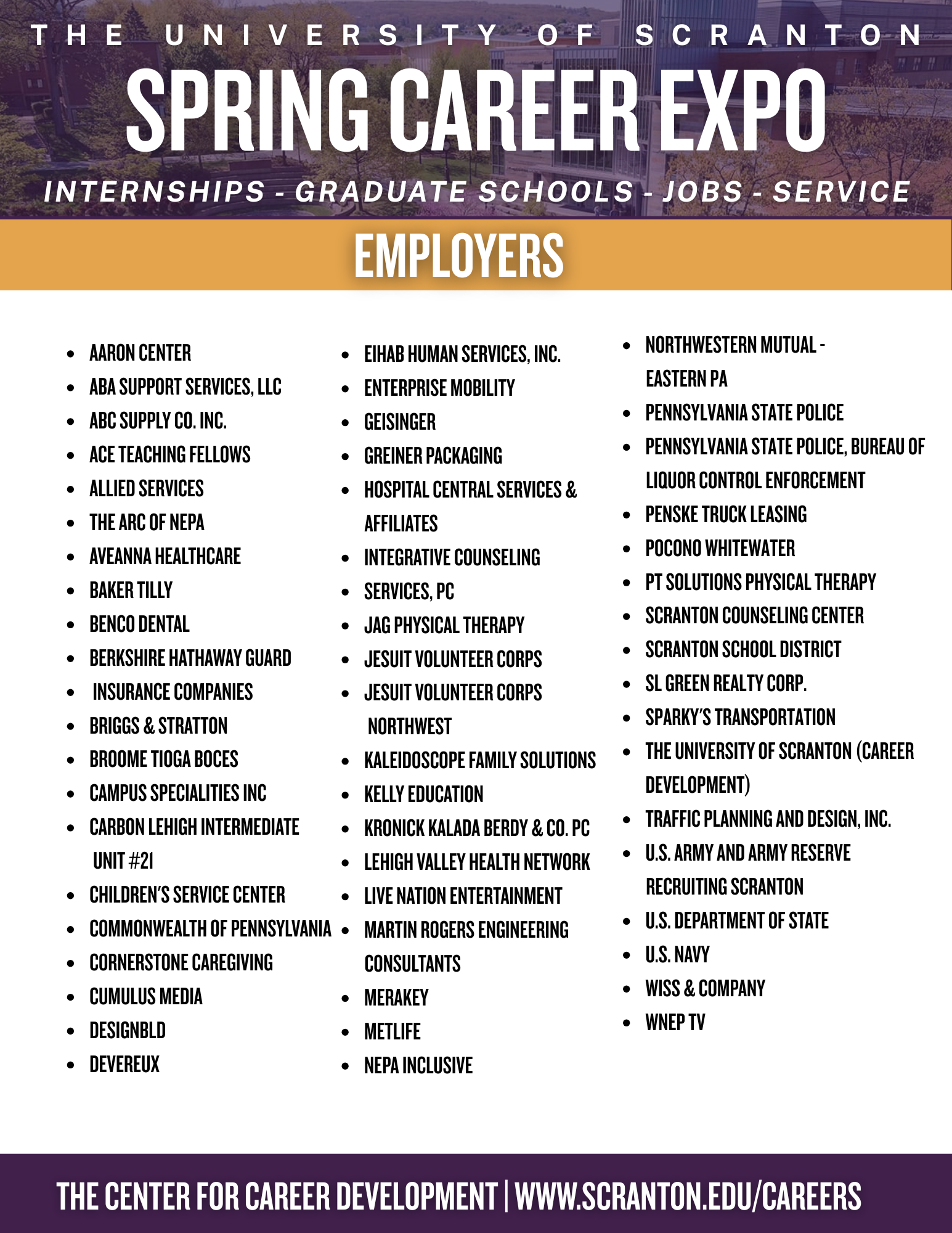
Need Tips to help prepare for the Expo?
The Roche Family Center for Career Development compiled the resources listed below to help attendees present their best professional image at upcoming events:
What to Expect at a Career Expo
What to Wear—Dress to Impress! Consider utilizing Royal Threads, a professional clothing closet.
What to Say—The Introduction and Elevator Pitch
Resume Writing Tips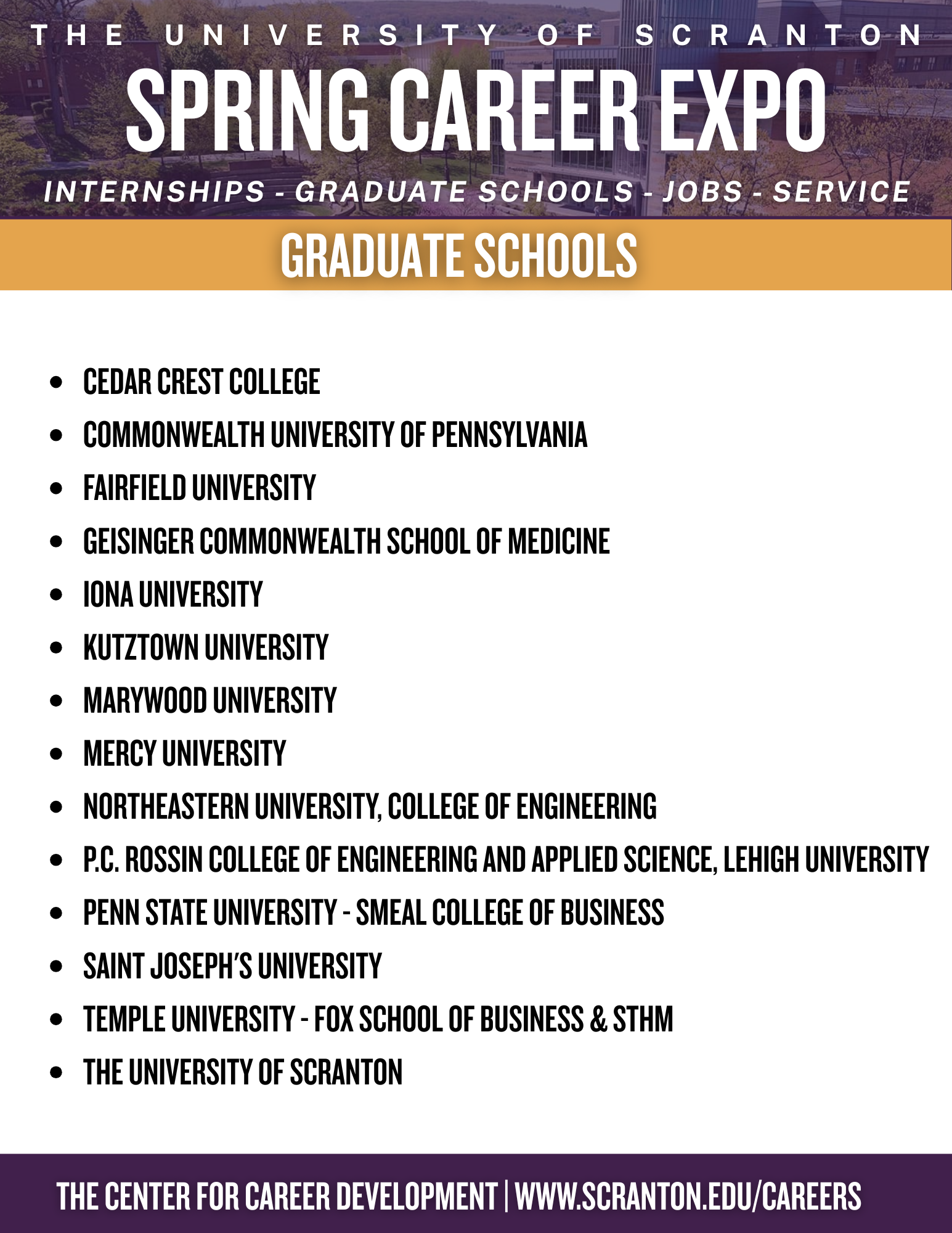
Students, Alumni: Work the Room at March 26 Spring Career Expo
Volunteers and judges are requested for the Pennsylvania State Finals of National History Day at the University of Scranton.
A training session for employees, faculty and students interested in participating will be held on Thursday, April 23 at 6:30 p.m. in Saint Thomas Hall 311.
The History Day event will take place Saturday, April 25, from 11 a.m. to 8 p.m. and Sunday, April 26, from 9 a.m. to 3 p.m. Volunteers will not be needed for the entire event.
Interested in volunteering? Contact Dr. Sean Brennan at sean.brennan@scranton.edu
National History Day Volunteers, Judges Needed for State Finals
The Staff Senate would like to thank all staff members who took the time to recognize and share their colleagues' accomplishments, sense of community, and dedication to excellence. The Meg Cullen Brown Magis Award would not exist without our caring community!
THE MEG CULLEN-BROWN MAGIS AWARD WINNER for March 2026 is:
Dolores Rozelle – Health and Human Performance
How long have you worked at the University?
I have worked at the University for 18 years.
What is your title?
I am the Administrative Assistant for Health and Human Performance.
What do you like best about your job?
I’ve met a number of people over the last 18 years who were so helpful and welcoming, many of whom I consider friends. I love the daily interaction with the people I work with and the students, because every day is a new experience. I work with the best group and work-study students!
What do you like to do for fun?
I love spending time with my family, both human and fur! I also enjoy sewing, quilting, crafting and listening to live music.
We would like to take this opportunity to congratulate and celebrate the good work that Dolores does on a daily basis. We hope you will join us in personally congratulating Dolores and all our nominees. Dolores will receive a complimentary food donation at our fabulous University food service outlets AND a reserved parking space in the DeNaples Parking Pavilion for March. Each winner is also invited to the Staff Senate Recognition event in May 2026 to receive a certificate of appreciation.
We congratulate Dolores and all the wonderful nominees for being recognized as “Magis” employees!
March 2026 Nominees
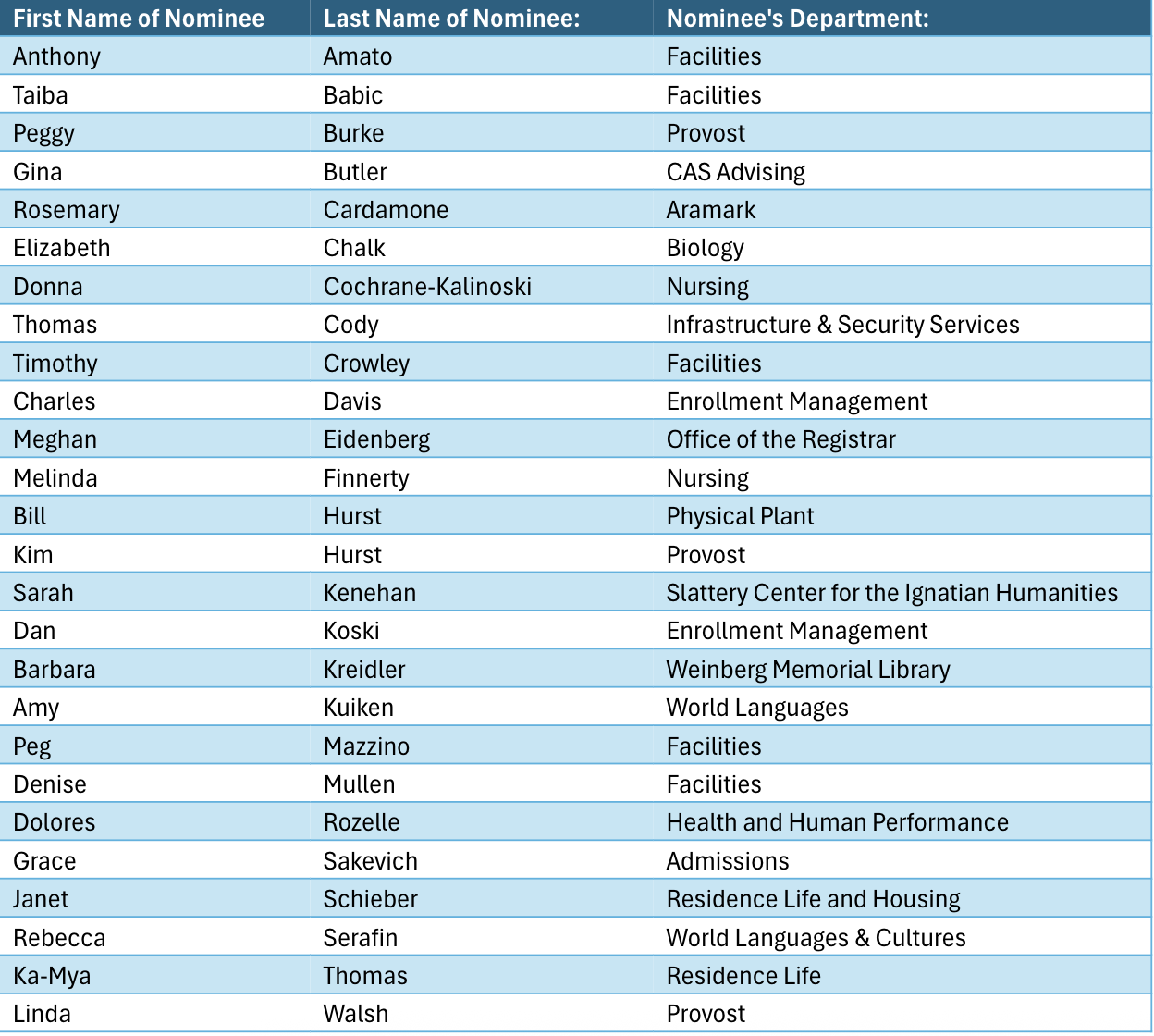
Nominations open for March Meg Cullen-Brown Magis Award.
Have you witnessed a University staff member, Aramark or Follett employee offer a simple act of kindness? Go above and beyond for others? Perhaps they embody our Jesuit mission or simply possess an incredible attitude. If so, please recommend this individual for this prestigious award.
Although only University staff members, Aramark, or Follett employees win the award, nominations may be made by any University of Scranton employee.
Meg Cullen-Brown Magis Award for March
News is happening all the time at The University of Scranton.
Look no further than March, when school is out of session for one week for spring break, but the announcements and events continue.
In case you missed it, here are some of the stories we've been working on:
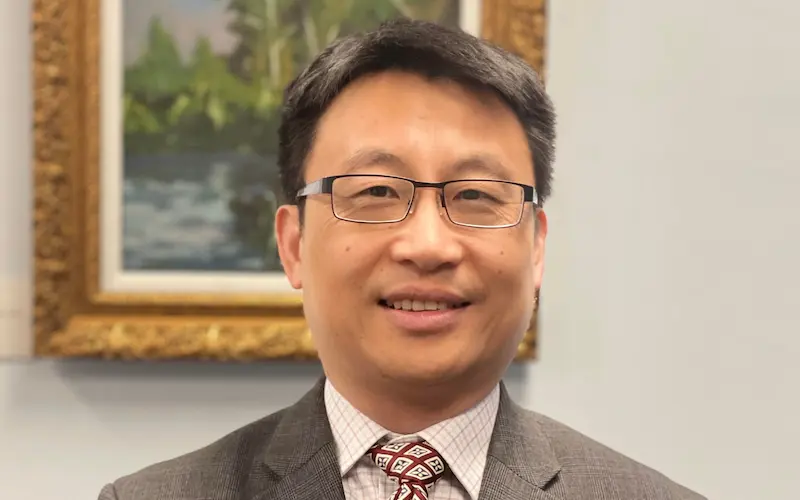
Incoming Provost and Senior VP for Academic Affairs Announced
WeiDong Zhu, Ph.D., will serve the University as its next provost and senior vice president for academic affairs, beginning in July.
Read more about Dr. Zhu, who comes to Scranton by way of Jesuit sister institution Saint Peter's University, at this link.
KSOM's "Gold Standard" Accreditation Extended Through 2031
Only 6% of business schools in the world earn AACSB accreditation. The University's Kania School of Management is included in that group.
Click to read more about the accreditation review process and what the recognition means for KSOM.
Pope Francis Coauthor and Friend to Speak at the University
Rabbi Abraham Skorka, Ph.D., a renowned scholar, author and longtime friend of Pope Francis will soon visit the University.
Dr. Skorka will deliver the Judaic Studies Institute Lecture on Tuesday, May 12. Follow this link for more details about Dr. Skorka's upcoming lecture.
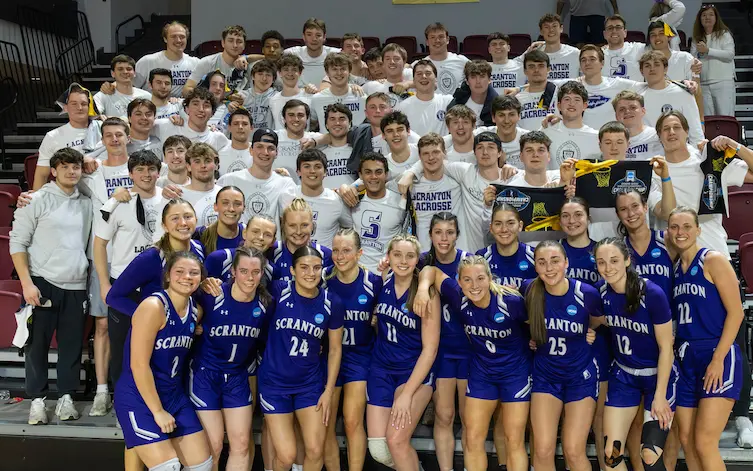
Lady Royals in the Final Four
The University of Scranton's women's basketball team completed a historic season in which it went 32-1.
Rev. Joseph G. Marina, S.J., University president, hailed the team as serving as a "powerful testament to what it means to be a student" at Scranton.
For additional coverage, please see WNEP and the Times-Tribune's live reporting from Salem, Virginia. WVIA also profiled the Lady Royals before they traveled to the Final Four.
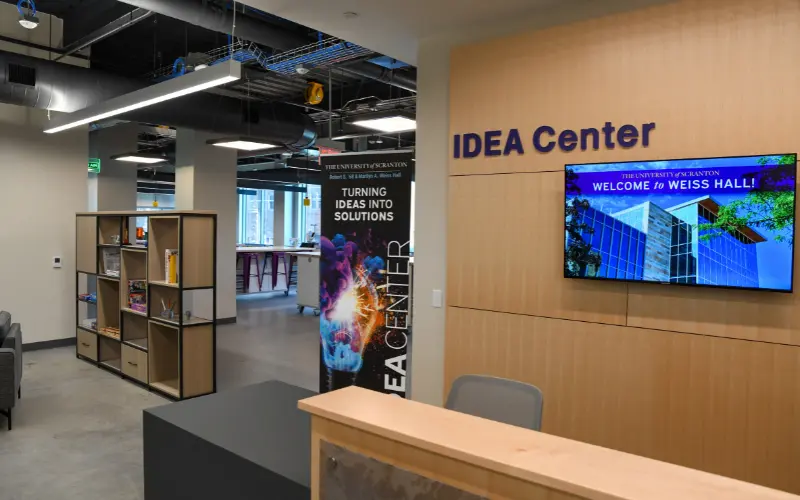
Weiss Hall's IDEA Center Begins to Fulfill Its Promise
The 2025-26 academic year began with the opening of Robert S. '68 and Marilyn A. Weiss Hall.
One of Weiss Hall's signature facilities is the IDEA Center, where University of Scranton students and Greater Scranton community members and organizations are putting its cutting-edge facilities to use. Click to read more statistics and examples about how the IDEA Center is being used.
Additional Headlines:
University Library Book Sale Date, Details Announced | Click to Read More
Scranton Students and Professor Make Major Breakthrough in Nanoparticle Research | Click to Read More
Psychology Department Members Present Research at Conference | Click to Read More
Scranton Students Perform in 78th Pennsylvania Intercollegiate Band Festival | Click to Read More
Speaker Announced, Date Set for Spring Henry George Seminar | Click to Read More
Continue reading Royal News all year round to stay up-to-date on the latest happenings at Scranton.
Campus Catch-Up: March Headlines From Scranton
Need a project done in record time with stellar results? Call a Royal.
In just over one month, two departments united to reimagine and reconstruct an interior area on campus for the benefit of many. The result: a reimagined space at the Weinberg Memorial Library that could be a contender in HGTV's "Small Space, Big Potential."
In the weeks between finals and the spring semester, University of Scranton Facilities and Library teams contributed their vision and skills to complete a Media Room renovation in record time.
“The timeframe for the project was set to work around students' studies, finals and utilize intersession. (From) December 15 to January 23 … the majority of work was completed,” said Michael Ridder, director of maintenance operations at Scranton.
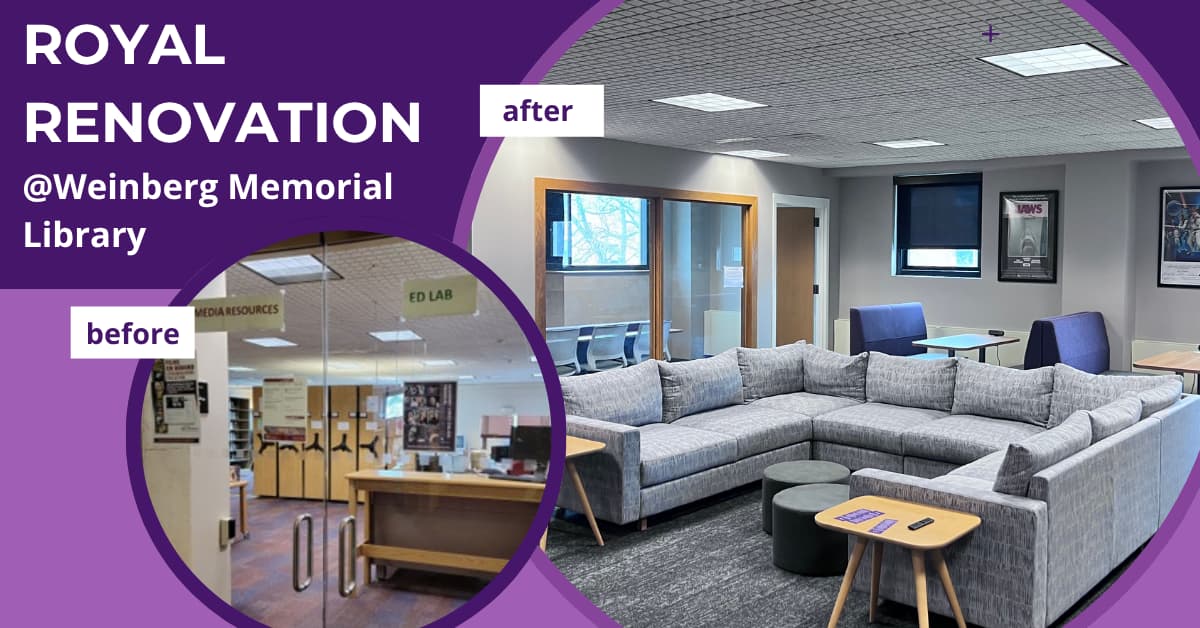
Dean of the Weinberg Memorial Library George Aulisio explains the why behind the project.
“The concept grew out of a broad vision for the Library to be a place for all types of learners. We recognized that a section of the Library housing compact rolling shelving for DVDs, VHS tapes and CDs could be transformed into a dynamic student space with a clear purpose. The goal was to create a flexible, modern space that supports students and faculty while retaining media for curricular needs and personal viewing interests,” Aulisio said.
“This renovation reflects the direction the Library has been moving for several years, making a shift from being primarily a physical resource repository toward a dynamic center and service point that actively meets the evolving needs of our community,” he added.
He outlines the results:
- a dedicated Media Viewing Room,
- a dedicated space for the Education Laboratory and
- an open space with lounge seating, individual reading and study space and booths for collaborative learning
A resource reallocation made it possible to “flip the orientation of the room,” according to Aulisio.
“To do this, we carefully curated the Media collection so that actively used, new and popular titles could take up a smaller footprint in the space itself, and less frequently used materials could be relocated to basement storage.
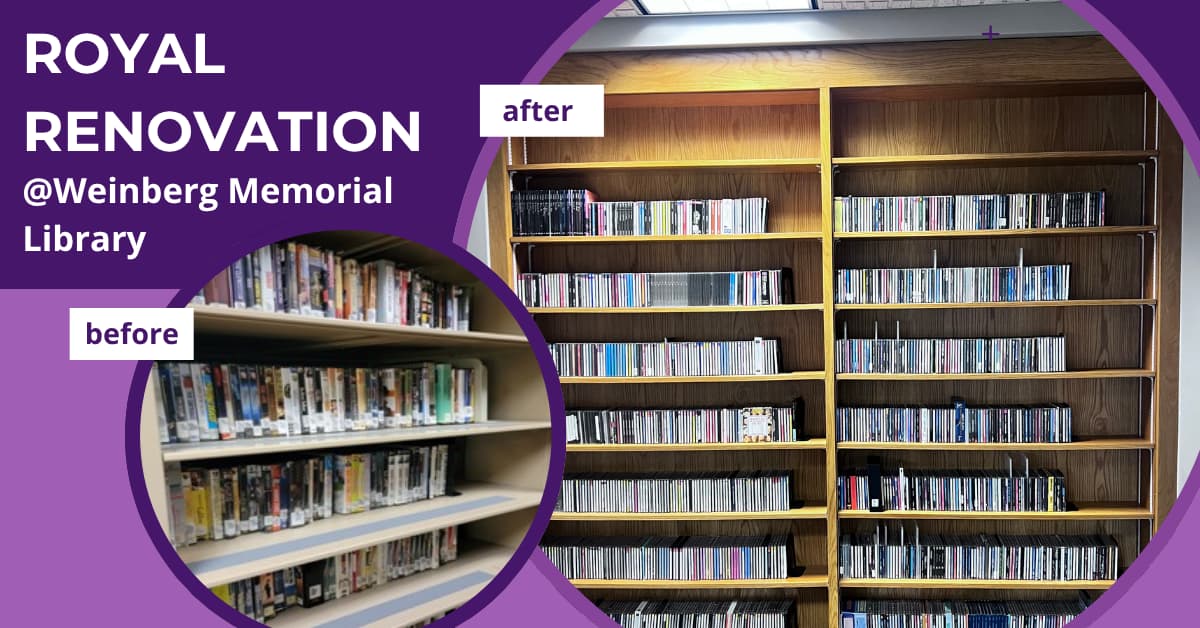
This called for collaboration.
“From the Library's perspective, this project was about reimagining how the space functions, not just how it looks. Working closely with the Facilities team, we translated that vision into a practical design with a new layout, updated technology infrastructure, including new displays, refreshed furnishings and an environment that feels welcoming and contemporary,” Aulisio said.
Bringing that vision to life: the highly skilled Scranton staff.
“Internal staff completed this work, including Library maintenance Jake Harris and Anjelica Vaccaro, carpenters James Shygelski and Michael Tuffy, electrician Ed Piasecki, plumber Frank Lynott, painters Mark Burke and Jared Reznick, locksmith Joe Wright, and members of our IT Department Jason Wimmer and Jason Oakey,” Ridder said. 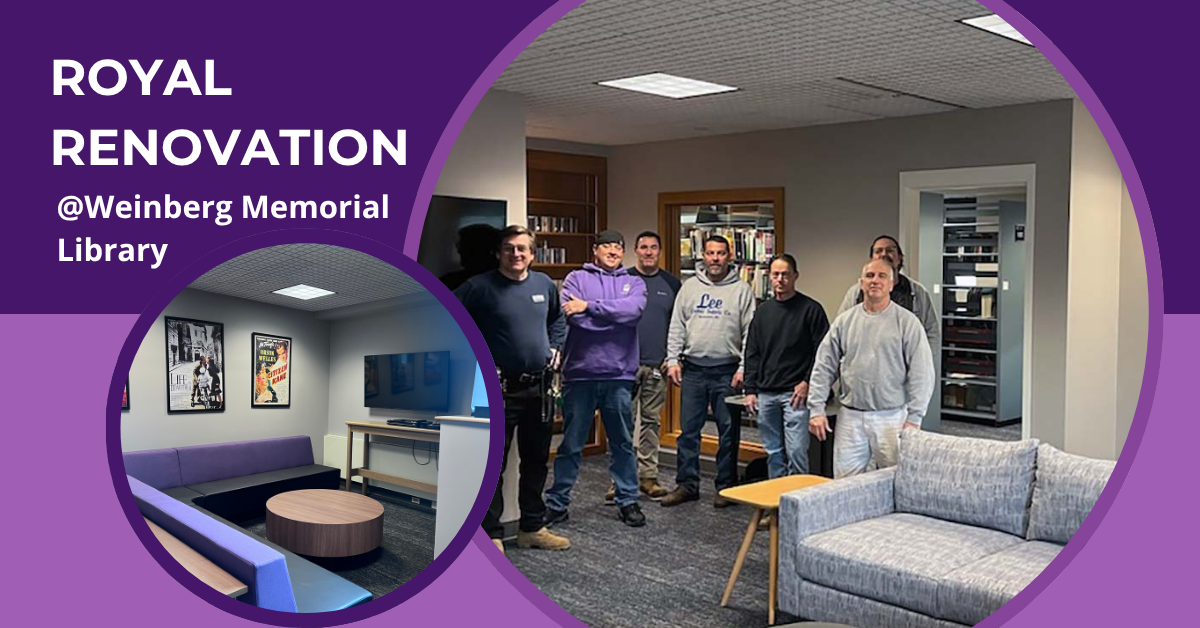
Outside vendors included Premier Environments for carpeting and furniture, JP Jay for shelving units, Stone Office Furniture to disassemble, relocate and reinstall mobile shelving in the Performance Music department, and Sierra Six for data connections.
Ridder outlined the scope of work:
- Demolition of existing shelving units, removal of old flooring, cabinetry and some existing walls
- Construction of the new layout per design, including the walls and new custom wood-trimmed windows and shelving unit, completed onsite
- Installation of new flooring and shelving by Premier Environments
- Completion of electrical work, Spackle and painting, ceiling changes, data and new electronics, such as TVs
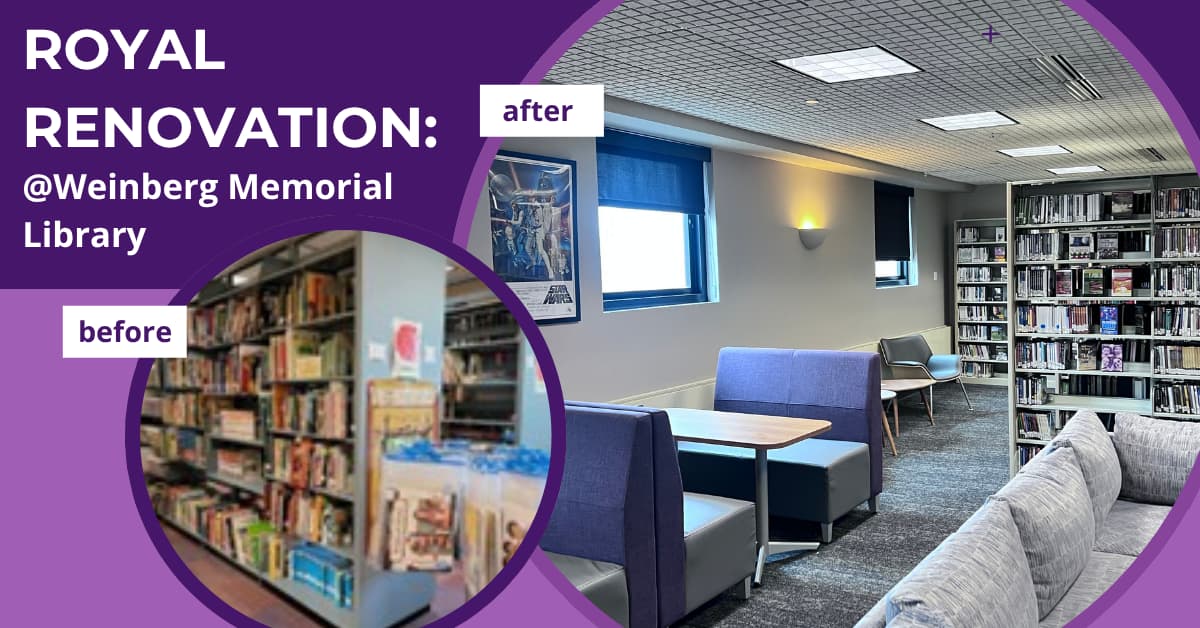
“An added bonus was that we were able to relocate the Library's rolling compact shelves to Houlihan-McLean Center so that the Performance Music department could benefit from it. It was a genuine collaboration between Library and Facilities, and the result speaks to what's possible when both teams are aligned around a shared goal.”- George Aulisio, Dean of the Weinberg Memorial Library
Viola! Feedback from Library patrons and staff suggests that the renovation, completed in a brief window of time, delivered a significant impact.
"The response has been positive and overwhelmingly strong. Students have embraced the space quickly. In fact, while painters were still putting finishing touches on the walls, students were settling in to study. The staff has also noticed that the collection is more approachable now. Compact rolling shelves are not ideal for discoverability, but now that the collection is on stationary shelves and is curated, it's easier to explore and find a new or classic film for assignments and personal viewing," Aulisio said.
“This is exactly the type of response I had hoped for! It's gratifying to see a vision come to life and to watch the community make it their own. I'm proud to say we have a strong Library culture at Scranton, and we take that responsibility seriously.”
Renovations in Record Time at the Weinberg Memorial Library
The gold standard for business school accreditation has been reaccredited for the next six years at The University of Scranton.
Scranton’s undergraduate and master’s programs in business offered by the Kania School of Management (KSOM) have been accredited by the Association to Advance Collegiate Schools of Business (AACSB International) since 1995. The accreditation process requires schools to submit a comprehensive, 360-degree review every six years to prove that the college continues to offer students an exceptional and relevant business education.
Approximately 6% of business colleges worldwide — 1,072 schools of business in 70 countries — hold the prestigious AACSB accreditation.
“When we meet with parents and students, they not only recognize the value of a Jesuit education but recognize that one with AACSB accreditation assures that their son or daughter will receive a high-quality business education grounded in the liberal arts,” said Mark Higgins, Ph.D., dean of the Kania School of Management.
The accreditation review is conducted by deans from other AACSB-accredited schools and includes a comprehensive written report along with an on-site visit. During the visit, the deans meet with faculty, staff, students, the provost, the president and members of the KSOM advisory board. The review examines a school’s course development or innovation, the delivery or engagement of faculty, staff, students and other stakeholders and the outcomes or assessment of learning, all the while gathering evidence that the college’s education remains relevant to current business needs.
“In various aspects of the report, the peer review team noted how the faculty and staff take a very student-centric approach,” Dr. Higgins said.
The peer review team also noted teaching effectiveness and research as clear strengths of the business school. The team also highlighted that the Accounting program ranked second nationally in education research over both six- and 12-year windows, according to Brigham Young University’s Accounting Research Rankings, with Douglas M. Boyle, DBA ’88, professor and chair of Scranton’s Accounting Department and director of the Ph.D. program, ranking among the top accounting education researchers in the country.
The report also highlighted that KSOM fulfills its Jesuit mission by incorporating a societal impact course into every major, noting that it is recommending this as a best practice for all schools to follow.
The peer review team said it was impressed with how the school incorporates career orientation, beginning with a student’s first year, and the outstanding placements the school has in the New York and Philadelphia region. The team also mentioned the Henry George Lecture Series, which, overseen by the Economics, Finance and International Business Department, has brought 13 Nobel Prize winners to campus. Finally, the team spoke highly of Scranton’s Small Business Development Center’s (SBDC) dynamic director, Lisa Hall Zielinski, and the integration of the SBDC and the Women’s Entrepreneurship Center with KSOM.
The SBDC program resides in the KSOM, leveraging University financial support to secure additional funding that facilitates student learning activity and community economic improvements.
Undergraduate Kania School of Management programs include bachelor’s degree programs in accounting, business administration, business analytics, economics, finance, international business, management, marketing and supply chain.
Graduate-level Kania School of Management programs include a master’s in accountancy; a master’s in finance; a master’s in business analytics; and a master of business administration (MBA) in general management or with a specialization in accounting, business analytics, finance, healthcare management, international business, marketing, and operations management. Combined bachelor’s and master’s level programs include accounting BS/MBA and finance BS/MBA, as well as accelerated programs in a number of areas.
KSOM’s ‘Gold Standard’ Accreditation Extended Through 2031
One of the Weinberg Memorial Library’s most popular events — and for good reason — is returning in April.
The Friends of the Weinberg Memorial Library announced it will host the 2026 Book Sale on Saturday and Sunday, April 25-26. Hours are 9 a.m. to 8 p.m. on Saturday and noon to 4 p.m. Sunday. It is open to the public.
A special preview sale — open to current members of the Friends of the Weinberg Memorial Library, current members of the Schemel Forum and current University of Scranton students, faculty and staff — will be held from 4 to 9 p.m. Friday, April 24. Current students, faculty and staff must bring their valid and unexpired Royal Card for entry.
The sale will offer a wide selection of paperback and hardcover titles, ranging from popular leisure reading to academic works with fiction, nonfiction, children’s, young adult, cookbooks and various other genres. A variety of CDs, DVDs and select vinyl records will also be on sale.
Sales benefit the Friends of the Weinberg Memorial Library Endowment.
Cash, check and credit card payments will be accepted.
Additionally, the library will accept donations of clean books in good condition now through Friday, April 10.
For more information, to volunteer or to schedule a donation appointment, please contact Melisa Gallo at 570-941-6195 or email melisa.gallo@scranton.edu.
University Library Book Sale Date, Details Announced
On Saturday, March 28, Performance Music at The University of Scranton will present a concert featuring the University’s Concert Choir and Symphonic Band. The concert will begin at 7:30 p.m. in the Houlihan-McLean Center, Mulberry Street and Jefferson Avenue, downtown Scranton. Admission is free and the concert is open to the public, with seating on a first-come, first-seated basis.
According to conductors Cheryl Y. Boga and Janelle Decker, the concert will feature a short program by each group, as well as three or four pieces by the combined groups.
“Usually the two groups only perform together at our Commencements, so it is unusual and special for our Houlihan-McLean audience to have the opportunity to hear them combine forces," Decker said.
“We are looking forward to having the groups perform together in our own concert hall, a decidedly more intimate venue acoustically than the Commencement arena they usually team up in," Boga added.
The University of Scranton Concert Choir and Symphonic Band are 50- and 70-plus member groups, respectively, comprised of members of the University community. Their majors and departments span the curriculum. The vast majority of them are undergraduate students, joined by a few graduate students and members of the faculty and staff, none of whom are music majors. They are all brought together by their mutual love of music-making and sharing their love of music with their audiences.
$content.getChild('content').textValueThe primary focus of Performance Music at The University of Scranton is its student choral and instrumental performing ensembles. There is no major in music at the University, and all enrolled Scranton students (undergraduate and graduate) are eligible for membership in the University Bands, University Performance Choirs, University String Orchestra and Ensembles and Steel Drum Ensemble. A few members of the faculty and staff and alumni from the region also perform with the groups. Each year, hundreds of students participate in the ensembles.
For additional information on the concert, call 570-941-7624, email music@scranton.edu or visit the Performance Music website.
IF YOU GO:
What: IN CONCERT: The University of Scranton Concert Choir and Symphonic Band, presented by Performance Music at The University of Scranton
When: Saturday, March 28, 2026, 7:30 p.m.
Where: Houlihan-McLean Center, Mulberry Street and Jefferson Avenue, downtown Scranton
Admission: FREE
University Concert Choir and Symphonic Band Performing Saturday, March 28
The Department of World Languages and Cultures welcomed over 200 guests for the 2026 Annual World Languages Day on March 5 at The University of Scranton, providing students, faculty, staff and language students and teachers from local high schools with a unique and unforgettable program.
More than 150 students from 10 local high schools joined dozens more from the University to hear a message about the value of World Languages. Interactive presentations were delivered in six languages. Participants engaged with World Languages instructors during break-out sessions featuring American Sign Language (ASL), Arabic, French, German, Italian, Japanese, Mandarin, Russian and Spanish. College of Arts and Sciences Dean Dr. Carolyn Barry welcomed a packed room.
The theme of this year’s World Languages Day: “Make Yourself More (interesting than AI). Dr. Amy Kuiken, Coordinator of the Language Learning Center at the University, explained that “we find ourselves once again living through an era when humans need to think about how to set ourselves apart from emerging technology when it threatens to do all the things we can do.”
Dr. Kuiken said AI-driven translation apps can now “handle everything from grammar and vocabulary to the trickier things related to tone and style. … Where we used to have to, in some cases, agonize over the best way to say something…we go straight to a translator that can increasingly handle more and more of that for us. But I think it’s important to keep in mind that if we’re outsourcing everything to an AI, we’re already replaceable by an AI.”
Kuiken maintained that those who do learn a language are investing in themselves: “Now you’re noticing cultural, linguistic, psychological, historical, social patterns, rules, alternatives, mechanics, properties…You see the matrix. This is how you grow and make yourself more interesting than AI.”
Kuiken appealed to those “who may be thinking that language learning might be one of the first things to go in an AI age” by sharing a personal story about how language learning “can set people apart while bringing people together.” Using social media, she unintentionally befriended a community leader in Tanzania after responding to a call to help translate for local French-speaking families in Scranton. This led to an international educational partnership that benefits hundreds of students today.
“We have an ever-evolving sense of what language is. People are starting to recognize that language is much more than translation, vocabulary and grammar. It’s about context, creativity, strategy, identity and community,” Kuiken said.
Dr. Yamile Silva, Chair of the Department of World Languages and Cultures, put it powerfully: “From the very first cry of a newborn to the last words whispered by an elder, language accompanies every moment of our lives. It is how we express love, resolve conflict, pass down wisdom, tell stories and make sense of a world that is often complex and uncertain. Language is not simply a tool for communication — it is the very fabric of who we are.”
Silva pointed out that “the study of world languages and cultures is not a luxury…It is one of the most urgent and practical investments a young person can make in their future — and one of the most meaningful contributions a university can make to the world…When you learn another language, you do not simply gain a new set of vocabulary words or grammar rules. You gain access to an entirely different way of thinking…You realize that the world is wider, and richer than you ever imagined…in that realization, something profound happens — you become a better thinker, a more empathetic human being, and a more effective citizen of the world.
Silva said, “Here at The University of Scranton, we take that mission seriously. Our Department of World Languages is not simply a place where conjugations are memorized and textbooks are studied…Our students take those lessons beyond the classroom — into study abroad programs, community engagement, research and careers that make a difference in the lives of others.
“Today's celebration is a testament to that commitment. It is a reminder of why we do what we do.”
Special Thanks to WLC Instructors Who Contributed to the Event:
Mandarin Chinese - Professor Chih-Yi Wu, Taiwanese Government Chinese language instructor
Spanish – Professor Agustina Santivañez, Spanish language Fulbright Teaching Assistant from Argentina
Japanese – Professor Kazumasa Fujita, ALLEX Foundation Japanese language instructor
German – Professor Eva Grohs, German language Fulbright Teaching Assistant from Germany
Arabic - Professor Mohamed El Ghanam, Arabic language Fulbright Teaching Assistant from Egypt
Italian – Professor Franca Kelly, University of Scranton adjunct professor of Italian
American Sign Language (ASL) – Professor MaryAnn Stefko, University of Scranton adjunct professor of ASL
Russian – Professor Anastasia Maume, University of Scranton adjunct professor of Russian
French and General Linguistics – Dr. Amy Kuiken, Language Learning Center coordinator
With support from the World Languages and Cultures full-time faculty:
Dr. Yamile Silva, chair of the Department of World Languages and Cultures
Dr. Marzia Caporale
Dr. Virginia Picchietti
Dr. Habib Zanzana
Local High Schools Attending the Event:
Dallas
Honesdale
Lakeland
Old Forge
Riverside H
Scranton
Valley View
Wallenpaupack
Western Wayne
West Scranton
Third Annual World Languages Day: “Make Yourself More (Interesting Than AI)”
The University of Scranton community is invited to mark the beginning of Holy Week at Palm Sunday Liturgy on Saturday, March 28, at 4 p.m. Please note that this year, Palm Sunday will be observed with a Vigil Mass on Saturday.
The Mass will be celebrated in the John Long Center. Rev. Joseph G. Marina, S.J., University president, will serve as celebrant and homilist.
Palm Sunday marks the first day of Holy Week and commemorates Jesus Christ’s triumphal entry into Jerusalem. The liturgy will begin with the traditional blessing of palms and Palm Sunday procession. Participants are invited to gather outside on the DeNaples Patio at 4 p.m. for the blessing of palms before processing to the Long Center for Mass.
Those who cannot attend in person may watch the Mass via livestream.
For more information, please contact the Campus Ministry Office at 570-941-7419 or campusministry@scranton.edu.
University Palm Sunday Liturgy March 28
Tea Across Asia, a new event hosted by the Asia Club, invites students to sample teas from Asia and experience cultural traditions. Students, faculty and staff from The University of Scranton, as well as Asia Club members, will have an opportunity to experience handmade ceremonial iced matcha and masala chai paired with biscuits, donuts and more.
The event will take place from 6:30 to 8:30 p.m. on Thursday, March 26, at Brennan Hall, Rose Room 509.
An event for tea lovers, Tea Across Asia is designed to provide time to take a breather from exams and de-stress. It also allows those on campus to make new friends and enjoy an evening with tea, snacks and chill vibes.
Club To Host Tea Across Asia March 26
On Monday, March 30 from 6 - 7:30 p.m., The University of Scranton will host a program titled, “The High Cost of AI: How Data Centers Are Reshaping Pennsylvania’s Energy Landscape,” which discusses the impact AI and data centers have on their environments and utility and energy costs. This event will take place in the Pearn Auditorium, Brennan Hall (320 Madison Ave).
Featured speakers include Eleanor Breslin, the senior attorney for the Clean Air Council, Josephine Gingerich, the Health Advocacy Outreach Coordinator for Physicians for Social Responsibility Pennsylvania, and Eva Morgan, the Project Manager of the Clean Energy Group.
This event is free and open to the public. To register for this event, please click here: https://www.surveymonkey.com/r/Data-Centers-Event
This event is co-sponsored by The University of Scranton (Laudato Si’ community engagement and ecological education subcommittees, Office of Community Relations, Environmental Studies Concentration and Ethics Across the Curriculum) together with Marywood University Environmental Studies Program; Sisters, Servants of the Immaculate Heart of Mary; the Clean Energy Group; Clean Air Council and Physicians for Social Responsibility PA.
Questions about this event, please contact Julie Schumacher Cohen at julie.cohen@scranton.edu
Program on the Impact of AI and Data Centers on March 30
The University of Scranton is offering a series of pysanka workshops in advance of the Easter holiday to teach the art of decorating Ukrainian Easter eggs with traditional folk designs using a wax-resist method. One hundred percent of the workshop fee will be donated to humanitarian aid in Ukraine. Participants will be taught how to write pysanky or Ukrainian Easter eggs. All materials will be provided, and each participant will take home their own, blown-out pysanka. Anyone who attended a workshop last year is encouraged to return to develop their skills and learn more advanced folk designs.
This workshop series was first offered in spring 2022. This year, the University is offering four workshops. Four pysanka workshops will be offered as follows: Sunday, March 22, from 1-3 p.m. and 3:30-5:30 p.m., and Sunday, March 29, from 1-3 p.m. and 3:30-5:30 p.m.
All workshops will take place in the Smurfit Arts Center, Scranton, on the corners of Vine Street and Madison Avenue. Each workshop is limited to 15 people, and children must be accompanied by an adult. The workshop cost is $30, payable by cash or check. Registration is required.
The workshops will be led by Dr. Amelia Randich, assistant professor of biology at The University of Scranton. Dr. Randich is a fourth-generation Ukrainian-American, and this art has been passed down through the women in her family. She has been writing pysanky for over 30 years and teaches pysankarstvo (the art of writing pysanky) at various retreats in the U.S.
“While we hope the Russian aggression on Ukraine will end soon, the country will be in turmoil for a long time yet. Please join us in writing pysanky and donating to humanitarian aid in Ukraine,” said Dr. Randich.
Dr. Randich has a dedicated website, “Saving the World One Egg at Time,” to illustrate her work in Pysanka along with the meaning and importance of their creation.
To learn more about Dr. Randich and her work creating and teaching the art of pysanka, please visit https://pysankypower.wordpress.com/ or read this profile in The Scranton Journal.
View Dr. Randich’s work and follow her on social media on Facebook: @pysankypower and Instagram: @AmeliaRandich.
These workshops are offered by The University of Scranton and are cosponsored by the Hope Horn Gallery and the Office of Community and Government Relations. For questions, please contact community@scranton.edu.
Spring 2026 Pysanka Workshops To Benefit Humanitarian Relief in Ukraine
The University of Scranton Lady Royals departed from campus Tuesday afternoon.
Next stop: Salem, Virginia, home of the NCAA Division III women's basketball Final Four.
Having successfully defended their home court at the Long Center through four rounds of play — the first and second rounds, Sweet 16 and Elite 8 — the Lady Royals (31-0) will play New York University (29-0) at 7:30 p.m. Thursday. The winner advances to the national title game against the University of Wisconsin-Oshkosh (28-3) or Denison University (28-2).
In the Elite 8 win against Concordia-Moorhead, 67-42, senior Kaci Kranson, the D3Hoops.com Region 5 Player of the Year, scored a team-high 15 points. Katie Gorski, Meghan Lamanna and first team all-region selection Kaeli Romanowski also scored in double-figures. Jenna Sloan and Elizabeth Bennett added seven points each. Freshman Sophia Talutto, the D3Hoops.com Region 5 Rookie of the Year, added four points. The Lady Royals are led by head coach Ben O'Brien, the D3Hoops.com Region 5 Coach of the Year.
The Lady Royals have won 11 consecutive Landmark Conference championships. They're back in the Final Four for the first time since 2019. The team won a national title in 1985.
Continue reading to learn more about the matchup and how can you watch and follow:
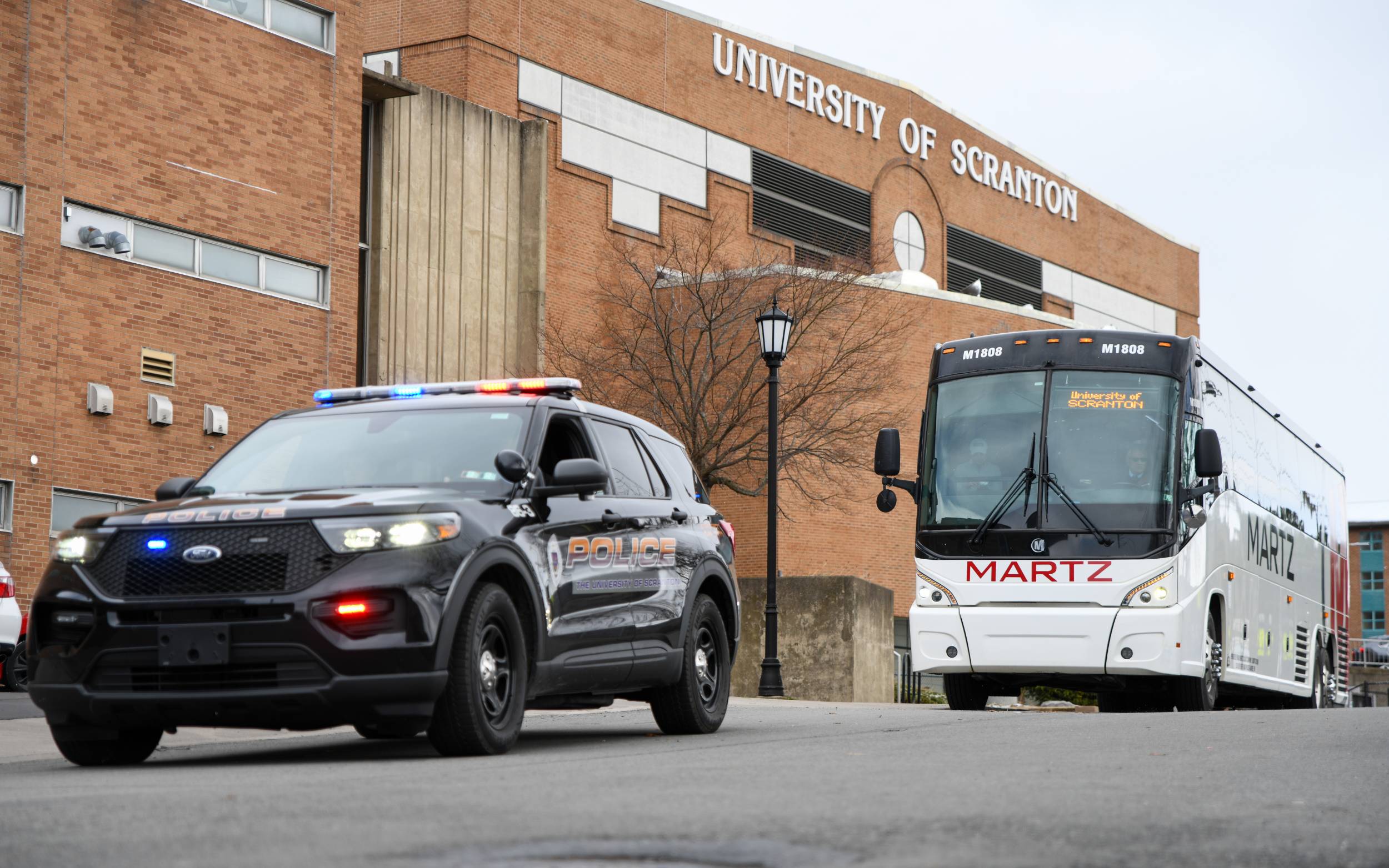
University of Scranton Lady Royals (31-0) vs. NYU Violets (29-0)
What: NCAA Division III women's basketball national semifinal
When: 7:30 p.m. Thursday, March 19
Where: Cregger Center in Salem, Virginia
Watch online: The game will be streamed live on ESPN+. ESPN+ is a premium streaming service with original online content, including live sporting events. For more information or to purchase an ESPN+ subscription, visit the ESPN+ website.
Watch in-person: Fans are invited to join fellow fans at the University's Watch Party, which will be held at the McIlhenny Ballroom on the fourth floor of the DeNaples Center. Doors open at 7 p.m. Light appetizers and refreshments will be served and the game will be shown on the big screen. RSVP at this link.
Follow: The Lady Royals' Instagram handle is @ScrantonLadyRoyals and Twitter/X is @ScrantonWBB. The University's athletic department is on Instagram @RoyalAthletics and Twitter/X @RoyalAthletics. Additionally, live stats during the game will be published by the NCAA.
Tickets: Available for purchase via HomeTown Ticketing.
Up next: The winner advances to play in the national championship game against the University of Wisconsin-Oshkosh (28-3) or Denison University (28-2). The national championship will also be streamed on ESPN+ at 4 p.m. Saturday, March 21.
Lady Royals in the Final Four: Schedule, Streaming, Social Media and More
Throughout construction of Robert S. ’68 and Marilyn A. Weiss Hall, the 10,000 square-foot area on the first floor’s northwest wing always had a purpose.
The vision was that it would serve as a “makerspace” or “innovation hub,” two terms often used to describe the facility before it took on its official name: the IDEA Center — short for Innovation, Design, Education, Application — four things happening every day as it nears seven months of serving The University of Scranton and local communities.
"Whether you’re doing an in-class project and need to bring ideas to life, or just trying to find a creative outlet, the Center has so many resources available for students, faculty and the surrounding community,” said Allison Kipp ’29, an IDEA Center work study and business analytics major from Pittston.
$content.getChild('content').textValueThe IDEA Center has assisted 185-plus students and counting with class or personal creative projects, using 3D design, CNC fabrication, graphic design or media production. The podcast studio alone has accommodated approximately 90 reservations.
Additionally, more than 400 community members have come through its doors, according to IDEA Center director Thomas Bryan, and it has served more than 200 of them with applied resources and programming.
"The Center has become a regional hub where educators, civic leaders, corporate teams and students collaborate through design-based learning, innovation and workforce-aligned experiences,” Bryan said.
Recent visitors have included several dozen attendees at Campaign School, a free workshop organized by the University's Center for Ethics and Excellence in Public Service. The event provided aspiring political candidates and staffers with opportunities to network and learn what it takes to run a political campaign. Using the IDEA Center’s large classroom space, the three current Lackawanna County Commissioners, former U.S. Sen. and current University of Scranton Leahy Distinguished Fellow in Public Service Bob Casey, and prominent marketing professionals offered guidance at the event.
$content.getChild('content').textValueMany school-age children have visited the IDEA Center as well, including students from the NEPA PAC After School Program who used the IDEA Center’s industry-level design and fabrication tools to create personal brand images that were engraved onto wooden plaques. Students also went home with custom NEPA PAC T-shirts that they personally hand-pressed.
The visit, which included five Geisinger Commonwealth School of Medicine students who volunteered to help, made for “an evening of creativity, innovation and hands-on learning,” Bryan said.
“Experiences like that embody the mission of the IDEA Center,” Bryan said. “Moving learners from consumers to creators and empowering young people across our region to see themselves as innovators, leaders and makers of their own future.”
Weiss Hall also serves as the headquarters for the Departments of Psychology and of Criminal Justice, Cybersecurity and Sociology; the Small Business Development Center; Student Health Services; the University of Success; and the Center for Health, Education and Wellness.
Together, these academic units, student-support offices and University programs fulfill the charge given years ago by one of the building’s benefactors.
"Get the idea, do basic research, apply the idea,” Robert S. Weiss '68 said at the 2024 naming announcement. “Then go out and ‘set the world on fire.’”
Weiss Hall’s IDEA Center Begins To Fulfill Its Promise [VIDEO+PHOTOS]
Twelve undergraduate students, one recent graduate and five professors from The University of Scranton had six research posters presented at the 2026 Eastern Psychological Association Conference in Boston on Feb. 27-28.
The following students had research presented at the conference:
Gianna Assuncao ʼ26, a neuroscience major from Clark, New Jersey, presented research titled “Phineas Gage Case Study: A Hyperbolic Depiction Across Introductory Textbooks” with faculty member Patrick Orr, Ph.D., associate professor of psychology.
Joseph Battaglia ʼ26, a neuroscience major from Campbell, New York, presented research titled “Phineas Gage Case Study: A Hyperbolic Depiction Across Introductory Textbooks” with faculty member Patrick Orr, Ph.D., associate professor of psychology.
Annabelle Berry ʼ27, a psychology major from Pringle, presented research titled “The Influence of Contextual and Confirmation Bias On Views Of Source Probability” with Joshua Reynolds, Ph.D., assistant professor of psychology.
Emma Caldwell ʼ26, a psychology major from Little Neck, New York, presented research titled “Phineas Gage Case Study: A Hyperbolic Depiction Across Introductory Textbooks” with Patrick Orr, Ph.D., associate professor of psychology.
Erica Czerwinski ʼ26, a psychology major from Burlington, Massachusetts, presented research titled “Courses Required For Admission To Doctoral Programs In Clinical Psychology” and “Theoretical Orientations Of Clinical Psychology Faculty: Contemporary Data and Historical Patterns” with John Norcross, Ph.D., distinguished professor of psychology and Michael Sayette, Ph.D., distinguished professor of psychology at the University of Pittsburgh. Czerwinski also presented research titled “The Effect Of Different Types Of Lies On Destination Memory” with Jill Warker, Ph.D., associate professor of psychology.
Sophia da Costa ʼ26, a neuroscience major from Ambler, presented research titled “Phineas Gage Case Study: A Hyperbolic Depiction Across Introductory Textbooks” with Patrick Orr, Ph.D., associate professor of psychology.
Connor Gannon ʼ27, a psychology major from West Orange, New Jersey, presented research titled “The Influence of Contextual and Confirmation Bias On Views Of Source Probability” with Joshua Reynolds, Ph.D., assistant professor of psychology.
Anna Gowarty ʼ26, a psychology major from Scranton, presented research titled “The Influence of Contextual and Confirmation Bias On Views Of Source Probability” with Joshua Reynolds, Ph.D., assistant professor of psychology.
Leah Nealon ʼ26, a psychology major from Clarks Green, presented research titled “Phineas Gage Case Study: A Hyperbolic Depiction Across Introductory Textbooks” with Patrick Orr, Ph.D., associate professor of psychology.
Edisa Reynoso ʼ27, a psychology major from New York City, presented research titled “Phineas Gage Case Study: A Hyperbolic Depiction Across Introductory Textbooks” with Patrick Orr, Ph.D., associate professor of psychology.
Joseph Vazquez ʼ26, a psychology major from Nutley, New Jersey, presented research titled “College Studentsâ View Jane Elliot's Brown-Eye Blue-Eye Exercise As Ethical” with Jessica Nolan, Ph.D., professor of psychology.
Maria Vyzaniaris ʼ27, a neuroscience major from Furlong, presented research titled “Phineas Gage Case Study: A Hyperbolic Depiction Across Introductory Textbooks” with Patrick Orr, Ph.D., associate professor of psychology.
Gabrielle Jamieson Gʼ25, a psychology major from Bradley Beach, New Jersey, presented research titled “College Students View Jane Elliot's Brown-Eye Blue-Eye Exercise As Ethical” with Jessica Nolan, Ph.D., professor of psychology.
Berry, Caldwell, Czerwinski, da Costa, Gannon, Gowarty, Vazquez, and Jamieson all attended the conference to present their work.
Also in attendance were their professors: Jessica Nolan, Ph.D., John Norcross, Ph.D., Patrick Orr, Ph.D. ʼ06, Joshua Reynolds, Ph.D., Jill Warker, Ph.D.
$content.getChild('content').textValuePsychology Department Members Present Research at Conference
Through April 23 Art Exhibit: “Early 20th Century Celebrity Portraits by P. W. Costello.” Charles Kratz Scranton Heritage Room, Weinberg Memorial Library. Free during library hours. Call 570-941-6341 or email michael.knies@scranton.edu.
Through April 23 Art Exhibit: “Banknotables: Commemorative Currency Art.” Charles Kratz Scranton Heritage Room, Weinberg Memorial Library. Free during library hours. Call 570-941-6341 or email michael.knies@scranton.edu.
April 7 through May 8 Art Exhibit: “Art Educators Make Art: Pennsylvania Art Educators Association Northeast Juried Exhibition.” Hope Horn Gallery, Hyland Hall. Free during gallery hours. Call 570-941-4214 or email darlene.miller-lanning@scranton.edu.
April 9 4 p.m. Humanities Forum event sponsored by The Slattery Center Lecture: “America, Viet Nam, and the ‘White Space’ of History” presented by Jonathan Nashel, Ph.D., professor of history at the University of Indiana South Bend. PNC Auditorium, Loyola Science Center. Free. Call 570-941-4700 or email sarah.kenehan@scranton.edu.
April 9 6 p.m. Performance, lecture and reception: “George Gershwin: Music and Healing,” by Richard Kogan, M.D., professor of psychiatry, Weill Cornell Medical College, and artistic director, Weill Cornell Music and Medicine Program, presented by the Schemel Forum and the Geisinger Commonwealth School of Medicine Collaborative Program. Geisinger Commonwealth School of Medicine Auditorium. Registration required. Fee $40. Call 570-941-4740 or email schemelforum@scranton.edu.
April 10 5 p.m. Art Gallery Panel Discussion: “Pennsylvania Art Educators Association Northeast Juried Exhibition.” Pearn Auditorium, Brennan Hall. Free. Reception to follow at the Hope Horn Gallery. Call 570-941-4214 or email darlene.miller-lanning@scranton.edu.
April 11 9 a.m. Accepted Students Day for students and their families of The University of Scranton’s Class of 2030. Meet representatives from academic departments, student activities/services, financial aid, athletics and tour campus. Various locations on campus. Call 570-941-7540 or email admissions@scranton.edu.
April 13-22 Environmental Art Show: “Nature Reimagined.” Charles Kratz Scranton Heritage Room, Weinberg Memorial Library. Free during library hours. Call 570-941-4740 or email marleen.cloutier@scranton.edu.
April 15 4 p.m. Spring Henry George Seminar “How We Got to Now (The Henry George Edition)” presented by Philip E. Auerswald, Ph.D., professor of public policy, George Mason University, Schar School of Policy and Government. McIlhenny Ballroom, DeNaples Center. Free. Call 570-941-4048 or email pamela.turbessi@scranton.edu.
April 16 8:30 a.m. Hayes Family Science Competition for high school physics and engineering students. Byron Complex. Registration required. Call 570-941-7509 or email salisa.brown@scranton.edu.
April 16-18 8 p.m. Thursday and Friday; 2 p.m. and 8 p.m. Saturday. Performance: “Oklahoma!” presented by The University of Scranton Liva Arts Company. McDade Center for Literary and Performing Arts. Ticket prices vary. Visit https://livaartscompany.ludus.com for tickets or email livartscompany@gmail.com.
April 18 8 a.m. Scranton Brain and Behavior Conference for neuroscience and psychology education and research. Loyola Science Center. Fees vary. Registration is required to attend. Visit the conference website for more information, or email robert.waldeck@scranton.edu.
April 18 7:30 p.m. Performance Music: “In Concert” featuring The University of Scranton Jazz Ensemble and guest soloist Jennifer Krupa, trombone. Houlihan-McLean Center. Free. Call 570-941-7624 or email music@scranton.edu.
April 22 5:30 p.m. Graduate Open House. DeNaples Center, 4th floor. Registration required. Free. Call 888-SCRANTON or email gradadmissions@scranton.edu.
April 22 6 p.m. Humanities Forum Lecture sponsored by The Slattery Center: “Shame must change sides: How Gisèle Pelicot, Trauma Studies and Survivor-centered Storytelling Can Inform a New Paradigm on Gender-based Violence” presented by Alexis Paige, author of two award-winning memoirs: "Work Hard, Not Smart: How to Make a Messy Literary Life" and "Not a Place on Any Map." Pearn Auditorium, Brennan Hall. Free. Call 570-941-4700 or email sarah.kenehan@scranton.edu.
April 23 5 p.m. Campus Take Back the Night. Dionne Green. Free. Call 570-941-6194 or email brandice.ricciardi@scranton.edu.
April 23 5:30 p.m. Myers Fellow Lecture sponsored by the Sondra H’87 and Morey Myers H’12 Distinguished Visiting Fellowship in the Humanities and Civic Engagement housed in The Slattery Center: “Shattered Dreams, Infinite Hope” presented by Brandon Terry, Ph.D., John L. Loeb Associate Professor of the Social Sciences at Harvard University and the co-director of the Institute on Policing, Incarceration, and Public Safety at the Hutchins Center for African and African American Research. Pearn Auditorium, Brennan Hall. Free. Call 570-941-4700 or email sarah.kenehan@scranton.edu.
April 23 6 p.m. Community-Based Learning Talk: "Making NEPA Home: Screening and Panel Discussion." This event will include a screening of the WVIA documentary "Making NEPA Home," which shares stories related to immigration in Northeast Pennsylvania (NEPA) from refugee and immigrant individuals and agencies that work with these communities. After the film, a panel discussion will include speakers: Kara Washington, WVIA; Fikile Ryder, Catholic Social Services; Ushu Mukelo, Congolese Community of Scranton; Terilynn Brechtel and Audrey Golosky, United Neighborhood Centers of NEPA; Julie Schumacher Cohen, University of Scranton. PNC Auditorium, Loyola Science Center. Registration required at https://www.surveymonkey.com/r/Making-NEPA-Home-CBL-Talk. Email community@scranton.edu with any questions.
April 25-26 8 a.m. National History Day State Competition for qualifying students from Pennsylvania. Pre-registration required. Call 570-941-4549 or email nhdparegion2@gmail.com.
April 25-26 9 a.m. Saturday; noon Sunday. Friends of the Library Book Sale. Charles Kratz Scranton Heritage Room, Weinberg Memorial Library. Call 570-941-6195 or e-mail melisa.gallo@scranton.edu.
April 25 9 a.m. Junior Open House. DeNaples Center, 4th floor. Registration required. Free. Call 888-SCRANTON or email admissions@scranton.edu.
April 28 3:45 p.m. Math Integration Bee. Calculus-based high school math competition. McIlhenny Ballroom, DeNaples Center. Registration required. See https://www.scranton.edu/academics/cas/math/bee.shtml for more details or email stacey.muir@scranton.edu.
April 29, 30, May 1-3 8 p.m. Wednesday, Thursday, Friday and Saturday; 2 p.m. Sunday. Performance: “The Apiary” presented by The University of Scranton Players. Studio Theatre, McDade Center for Literary and Performing Arts. Ticket prices vary. Call 570-941-4318 or email players@scranton.edu.
April 30 5:30 p.m. Lecture, exhibit and light refreshments for Schemel Forum with the Friends of the Weinberg Memorial Library and Hope Horn Art Gallery Collaborative Program: “Unveiling Niccolò Betti’s Madonna and Child with the Young St. John the Baptist” presented by John Powell, art restorer, co-owner, Chelsea Restoration Associates and Robert Simon, Ph.D., president, Robert Simon Fine Art. Charles Kratz Scranton Heritage Room, Weinberg Memorial Library. Registration required. Free. Call 570-941-4740 or email schemelforum@scranton.edu.
April 30, May 1 9 a.m. Applied Ethics in an Era of Globalization: Perspectives from East and West. PNC Auditorium, Loyola Science Center on April 30 and Pearn Auditorium, Brennan Hall on May 1. Free. Conference Program https://tinyurl.com/GlobalEthics2026Scranton. Email asianstudies@scranton.edu for questions.
April Events Planned at the University
Six student musicians from Performance Music at The University of Scranton performed in the annual Pennsylvania Intercollegiate Band Festival. Accompanied by their directors Cheryl Y. Boga and Janelle Decker, the six students participated in the event Friday, March 10, through Sunday, March 12, at the oldest continuously running intercollegiate band festival in the nation. It is run by the Pennsylvania Collegiate Bandmasters Association.
This year's festival was hosted by Bucknell University and its director of bands, William Kenny and led by acclaimed composer/conductor Frank Ticheli. A number of Ticheli's compositions were featured on the program.
The Scranton students who were selected and participated:
- Joseph Dolan '26, a computer science major from Conshohocken – Tenor Saxophone
- Michael Duarte '29, a computer science major from Ambler – Percussion
- Danielle Fernandez '26, an occupational therapy major from, Chatham, New Jersey – Flute
- Liam Gronwall '26, a finance major from Sidney, New York – Tenor Saxophone
- Thomas Marine '26, a biochemistry major from Cockeysville, Maryland – Trumpet
- Caitlin Wilson '27, a biology major from Harrisburg – French Horn
The primary focus of Performance Music at The University of Scranton is its student choral and instrumental performing ensembles. There is no music major at the University, and all enrolled Scranton students (undergraduate and graduate) from every major are eligible for membership in the University Bands, Performance Choir, String Orchestra and Ensembles, and Steel Pans, with neither an audition nor enrollment fee required for membership. Hundreds of students participate in the ensembles each year. Other programs within the department, including guest artist concerts, World Premiere Composition Series, Nelhybel Collection, and Scranton Brass Orchestra, closely coordinate programming with the student ensembles and offer unique opportunities for student musicians in the ensembles to hear, observe interact and perform with numerous world-class musicians and artist-teachers.
High school juniors and seniors who are considering applying to Scranton are encouraged to contact Performance Music to arrange to sit in on a rehearsal, meet the staff, attend a concert or tour the building.
For further information on the Performance Music, call 570-941-7624, email music@scranton.edu or visit the Performance Music website.
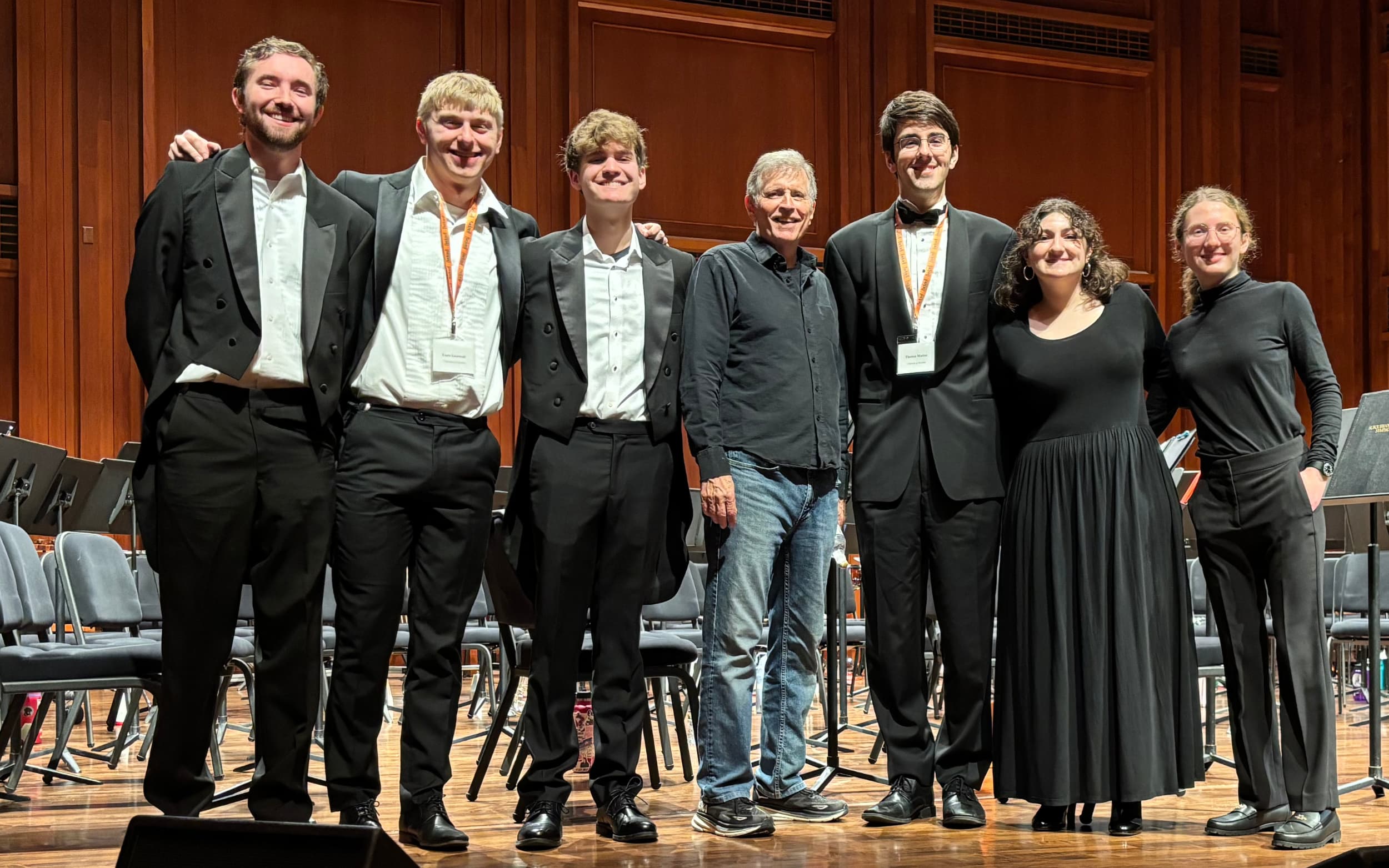
Scranton Students Perform in 78th Pennsylvania Intercollegiate Band Festival
The Scranton Brain and Behavior Conference will return to The University of Scranton on Saturday, April 18, further highlighting the University’s role as an important hub for neuroscience and psychology education and research.
The undergraduate-focused conference will be held at the Loyola Science Center with registration beginning at 8 a.m. The conference begins at 9 a.m. and will feature panels, poster presentations and a keynote lecture.
While registration fees are $5 for college students and $15 for faculty/staff, the conference is free to attend for high school students and includes lunch.
“This is a good place to see undergraduate students, college students, showing their research and for high school students to see what that looks like and learn about what it involves,” said Robert Waldeck, Ph.D., director of the University’s neuroscience program.
Lisa Gabel, Ph.D., a neuroscience professor at Lafayette College, will deliver the keynote speech on the topic, “Decoding Dyslexia: Translating Neuroscience Through Multidisciplinary Collaboration.”
Faculty, staff and undergraduate and graduate students are encouraged to participate in an abstract (talk/poster) submission. The submission form is live. The deadline to submit is Friday, March 27.
To attend the conference, please register by Monday, April 13. For more information, please visit the Brain and Behavior Conference website.
Brain and Behavior Conference to Feature Speakers, Research, Networking
The University of Scranton will host Rabbi Abraham Skorka, Ph.D., a renowned scholar, author and longtime friend of Pope Francis, at the upcoming Judaic Studies Institute Lecture.
Dr. Skorka will deliver his lecture, titled, “The Pope and the Rabbi: My Story of Friendship and Dialogue with Pope Francis,” at 7:30 p.m. Tuesday, May 12, at the Pearn Auditorium inside Brennan Hall. Dr. Skorka’s presentation is open to the public and free to attend.
Dr. Skorka is the former rabbi of the Benei Tikva Congregation and Rector of the Seminario Rabínico Latinoamericano, both in Buenos Aires, Argentina. Like Pope Francis, Dr. Skorka was born in Buenos Aires.
In addition to being fellow Argentinians and friends, Dr. Skorka and Pope Francis cowrote the 2013 book, “On Heaven and Earth: Pope Francis on Faith, Family and the Church in the 21st Century.”
“As soon as he was elected Pope, Francis called me on the phone and gave me the email address we could use to keep in touch with each other,” Dr. Skorka wrote in a letter for Georgetown University, where he is a senior research fellow for Jewish Studies and Jewish-Christian Relations. “Our friendship began in the second half of the 1990s and has been characterized by mutual respect and sincere, direct dialogue ever since. Gradually, we revealed ourselves to one another, opening our hearts.”
For more information, please contact Marc B. Shapiro, Ph.D., professor and chair of theology and religious studies at the University at 570-941-7956 or email marc.shapiro@scranton.edu.
Pope Francis Coauthor and Friend To Speak at University of Scranton
The Center for Service and Social Justice (CSSJ) will welcome visitors in their new satellite space on Thursday, March 24, from 12-1 p.m. in Ciszek Hall, 1120 Mulberry St.
Tours will be offered, and the event will include a brief dedication and blessing of the space, and light refreshments. Open to the University community.
Ciszek now houses the campus Royal Restore Food Pantry, the We Care Meal program, Teen Threads closet and a student meeting space.
For more information or questions, please contact Patricia.Vaccaro@scranton.edu or call the CSSJ office at 570.941-7429.
Center for Service and Social Justice Hosts Open House
Applications for Pi Gamma Mu, the International Honor Society in Social Sciences, are available online, at the Psychology Department secretarial office (Weiss Hall 324), or by emailing donna.rupp@scranton.edu. Applications are due by April 8.
Eligibility:
- Must have completed a minimum of 45 credit hours
- Top 35% of class -- overall GPA of at least 3.61
- Earned a grade of B or better in seven graded courses in any combination of economics, history, human services, political science, psychology and sociology
- AP and TC courses are not considered for eligibility.
Pi Gamma Mu Honor Society Applications Available
University of Scranton president Rev. Joseph G. Marina, S.J., announced that WeiDong Zhu, Ph.D., has been named provost and senior vice president for academic affairs, effective July 2026.
Dr. Zhu was selected following a highly competitive national search and will join the president’s cabinet, providing academic and strategic leadership to advance the University’s mission. Working closely with deans and faculty, the provost helps guide the development of curricula and directs academic programming across the University’s three colleges. The provost is responsible for providing leadership and oversight for the academic division’s budget; undergraduate and graduate programs; teaching and research activities; the University’s library; and the faculty.
Dr. Zhu comes to Scranton from Saint Peter’s University, a Jesuit sister institution in New Jersey, where he has served in numerous academic leadership roles since being hired in 2007. He is currently the interim vice president for academic affairs at Saints Peter’s. Since assuming this role in August 2024, he has guided Saint Peter’s through a period of significant institutional evolution, creating its newest strategic plan, restructuring academic departments for mission-aligned relevance and infusing Ignatian values into faculty development, core revision and high-impact practices.
“Dr. Zhu brings a breadth of experience and mission-centered leadership to The University of Scranton,” Fr. Marina said in a community email announcing the hire. “He is a deeply accomplished academic leader and scholar whose record and achievements reflect both intellectual distinction and a deeply humanistic approach to higher education, especially in a Catholic and Jesuit setting.”
Beyond his recent work as chief academic officer at Saint Peter’s, he was the co-director and later director of its Center for Microplasma Science and Technology from 2009-2018; chair of the Department of Applied Science and Technology, 2014-2018; vice president and briefly president of the faculty senate, 2016-2018; and dean of the College of Arts and Sciences, 2018-2024.
As a dean, Dr. Zhu led the largest college at Saint Peter’s, focusing on academic innovation and financial and strategic stewardship. Earlier, as department chair, he helped establish new academic concentrations, implement revised curricula and enhance lab-based learning for biochemistry, biotechnology and physics programs, as well as dual-degree engineering partnerships.
Dr. Zhu helped secure more than $2 million in research grants and the establishment of the federally-funded Center for Microplasma Science and Technology. Through collaborations with partner institutions, Dr. Zhu mentored high school, undergraduate and graduate students, helping develop future scientists.
A first-generation college student, Dr. Zhu was born in China. He came to the U.S. to pursue a doctoral degree at Stevens Institute of Technology. He credits his personal journey, including early challenges with language and cultural adjustments, for shaping his compassionate, community-focused approach to leadership.
Dr. Zhu earned a Bachelor of Science in physics and education and a Master of Engineering in material science and engineering from Soochow University in China. He also holds a Ph.D. in physics from the Stevens Institute of Technology. He is a graduate of the 18-month Ignatian Colleagues Program, which included formative experiences such as a silent retreat at the Sacred Heart Jesuit Retreat Center in Colorado and an immersion trip to Lima, Peru.
An accomplished researcher and scholar in plasma physics, he holds two patents in the United States and six in China, and has had numerous peer-reviewed journal and conference publications.
Incoming Provost and Senior VP for Academic Affairs Announced
Philip E. Auerswald, Ph.D., professor of public policy at George Mason University, will deliver the keynote speech at this spring’s Henry George Seminar.
Dr. Auerswald will present his lecture, titled, “How We Got to Now,” at 4 p.m. Wednesday, April 15, at the McIlhenny Ballroom (Room 407) inside The University of Scranton’s DeNaples Center. It is free and open to the public.
Dr. Auerswald's research interests include innovation, entrepreneurship and economic development with an emphasis on technology-driven growth. He currently serves as cochair and executive director of the Global Entrepreneurship Research Network, an initiative of the Kauffman Foundation. He is a Senior Fellow at George Mason's Mercatus Center and is the cofounder and editor of "Innovations," a quarterly journal about entrepreneurial solutions to global challenges published by MIT Press.
A distinguished author, Dr. Auerswald's most recent book, "The Code Economy: A Forty-Thousand Year History," was released in 2017. The book discusses the ways in which code has driven human development throughout history.
Dr. Auerswald received a Ph.D. in economics from the University of Washington and a Bachelor of Arts in political science from Yale University. From 2010 to 2013, he was an advisor to the Clinton Global Initiative.
Financial support for the Henry George Seminar is provided by a grant from the Progress and Poverty Institute. The lecture series is organized and presented by the Kania School of Management's Department of Economics, Finance and International Business and the XI chapter of Omicron Delta Epsilon. The series is named in honor of the 19th century American economist and social reformer and has hosted many of the world's leading economists.
For more information about the spring Henry George Seminar, please call 570-941-4048 email pamela.turbessi@scranton.edu.
Speaker Announced, Date Set for Spring Henry George Seminar
High school students from around the region competed in the 25th annual Northeastern Pennsylvania Brain Bee, an academic competition designed to inspire an interest in neuroscience. The event was held Saturday, Feb. 21, at the PNC Auditorium inside the Loyola Science Center.
Among the participants was the winner Muyan Liu, a junior from Germantown Friends School in Philadelphia. Liu’s victory advanced her to the National Brain Bee that will be held Saturday, April 25, at the University of California, Irvine. She also received a $1,000 scholarship to The University of Scranton, if she attends the University, and a cash prize.
“Most people take biology in high school. Maybe they’ve had psychology, but generally, they don’t have neuroscience,” Robert F. Waldeck, Ph.D., director of the neuroscience program at Scranton and the NEPA Brain Bee coordinator, told the Times Leader. “So it seems like a really complicated topic and they don’t really know much about it, because they don’t know anybody doing it.”
Dr. Waldeck explained that’s where an event like the NEPA Brain Bee proves useful, as it is a competitive, fun and informal way of expanding one’s knowledge on the topic.
For additional coverage, please visit the Times Leader, WNEP and Fox56.
Additionally, the Scranton Brain and Behavior Conference is fast approaching on Saturday, April 18. For more information, please visit the conference’s website.
University of Scranton Hosts 25th Annual NEPA Brain Bee
The University of Scranton welcomed aspiring authors, filmmakers, researchers and historians to campus on Saturday, Feb. 28, as part of a regional National History Day (NHD) competition.
The University’s DeNaples Center opened its doors to 60 students from Bedford, Lackawanna, Luzerne, Monroe, Pike, Sullivan and Wayne counties. Participants competed across five categories — documentaries, exhibits, papers, performances and websites — in Junior (Grades 6-8) and Senior (Grades 9-12) divisions. Submitted projects aligned with this year’s theme “Revolution, Reaction and Reform.”
Wyalusing Senior High School was Best School, Senior Division, while Harlan Rowe Middle School won Best School, Junior Division.
The event served as the Pennsylvania Region 2 contest, setting the stage for the upcoming Pennsylvania State Finals, which will also be hosted at the University. The state championship will be held April 25-26.
NHD is a nonprofit education organization, established in 1974 and dedicated the improving the teaching and learning of history.
For more information, visit the National History Day page on the University’s website. If you have any questions about the regional or state competition, please contact Sean Brennan, Ph.D., professor of history, at sean.brennan@scranton.edu.
University of Scranton Hosts Regional National History Day Competition
The University of Scranton’s University of Success, a four-year, pre-college mentorship program, is now accepting applications for the upcoming 2026 academic year that begins this summer. It is open to students currently in eighth grade.
The University of Success is an academic, social and cultural enrichment program funded entirely by corporate and foundations grants, so there is no charge to students and their families. The program's goal is to assist first-generation, college-bound students to successfully complete high school and gain entrance into a college or university. Last year's freshman class included students who graduated eighth grade from All Saints Academy, Northeast Intermediate School, North Pocono Intermediate School, West Scranton Intermediate School, South Scranton Intermediate School, Riverside Junior High School, Carbondale Area Junior High School, Abington Heights Middle School and Dunmore Junior High School.
Accepted students will begin the program with a residential summer academy, which will be held at The University of Scranton's campus from Sunday, July 12, to Tuesday, July 21. Upon completing the summer program students will continue to meet for enrichment sessions throughout their high school career.
The deadline for submission of applications is Wednesday, April 1, 2026.
Applications may be obtained by emailing Margaret Loughney, University of Success program director, at margaret.loughney@scranton.edu. Applications may also be obtained online at the University of Success website.
Applications Open, Deadline Set for University of Success 2026
By Marcus Smith '27, Student Correspondent
It’s not every day that students get to work on prominent scientific research, but several graduate and undergraduate students from The University of Scranton had that opportunity last year at the helm of Riddhiman Medhi, Ph.D., from the University’s Chemistry Department.
The group of seven students worked closely with Dr. Medhi to figure out a solution to a problem that has plagued chemists for years.
“Metal nanoparticles in our field of research so far have been mostly made in water, and the moment you try to put them into any other liquid, they aggregate. These particles have optical properties, but when they aggregate, they lose their optical properties,” Dr. Medhi explained.
Over the course of three years and with the help of his student researchers, Dr. Medhi succeeded in stabilizing various metal particles, especially gold and silver, to a point where they could resist solvents that are used in chemistry research.
The ways metal nanoparticles can be studied have expanded dramatically because of the group’s research.
“Reactions that cannot be done in water can now be done, because now we're able to transfer them into other solvents and liquids where different kinds of chemistry are possible,” he said.
Madison Waltz ʼ27, a chemistry and history double-major from Dunmore, was one of the undergraduate students who took part in the lab research.
Working with Dr. Medhi was her first experience doing lab work when she joined the project in her freshman year at Scranton.
“Dr. Medhi was my general chemistry professor and I saw that he put some of his work with the nanoparticles on his lecture slides. I thought it was really cool, so I went to his office hours and the rest is history,” Waltz said.
She said that working on such groundbreaking scientific research was surprising, and not something she expected to be able to do as an undergraduate student.
Not only that, helping Dr. Medhi write the research paper proved to be helpful in her other classes, as well.
“Writing up certain sections, doing the background research for some of the work has been foundational to my abilities that I use now in my classes because it's just a different type of writing, very different to traditional stuff,” she explained.
In addition to working with students from Scranton, Dr. Medhi also collaborated with John C. Deàk, Ph.D., from Scranton’s Department of Chemistry, and T. Randall Lee, Ph.D., from the University of Houston in Houston, Texas, to conduct imaging of the nanoparticles being studied.
“We need to look at the properties of the particles we made, so we measured their size using dynamic light scattering and high-resolution electron microscopy, and they helped with that,” Dr. Medhi said.
Given the significance of the work Medhi and his team carried out, their paper was chosen as the cover article for the Nov. 2 issue of the scientific journal “Materials.”
“The main kind of advantage of our work is that it's a problem that a lot of researchers face,” Dr. Medhi said. “So I think when we published this work as a solution to this common problem, I think that's what kind of caught their attention and they made it a cover story because of the wide application…our work showed a broad scope of our methods being applicable and consistent across different types of particles.”
Waltz advised anybody considering conducting scientific research at an undergraduate level to just go out and communicate with their professors.
“Be upfront, talk to professors if you're interested in getting into research, send an email, go to their office hours. That’s what I did,” she said. “And over time, you learn, especially here at Scranton, that you have plenty of people around you to help you get better at research.”
Marcus Smith '27, Schuylkill Haven, is an English and theatre double major at Scranton.
Scranton Students and Professor Make Major Breakthrough in Nanoparticle Research
Chair yoga for staff and faculty will be offered on campus beginning March 9, with a session led by Michelle Smith.
No experience, yoga mat or gym clothes are needed.
Registration is open for the March 9 session, which will take place from 12:15 to 12:50 p.m. at the Weiss Hall Well-being Room, basement 016 at 335 Madison Ave., Scranton.
Register for the March 9 session.
Chair yoga is a gentle form of yoga that is practiced while sitting on a chair or using a chair for support. It is especially beneficial for individuals with chronic pain, limited mobility or conditions such as arthritis, fibromyalgia or back pain.
This practice adapts traditional yoga poses to be more accessible, reducing strain on joints and muscles while still providing the benefits of movement, stretching and relaxation.
Watch for details on additional sessions hosted by the Center for Health Education and Wellness (CHEW) that will take place March 23, April 13 and 20.
Chair Yoga for Staff and Faculty To Begin March 9
The Diversity Initiatives Review Board is accepting applications for grants to support creative educational programs that provide opportunities for inter-cultural engagement and expand opportunities for multicultural experiences in our community
Some of the campus initiatives that have been made possible by this grant are:-
TA Talks featuring the teaching assistants in the World Languages and Cultures Department;
-
Festival of Nations hosted by the Multicultural Center;
-
Holi Festival of Colors through the Asia Club and Asian Studies Department;
-
Annual U.S. Conference on Disability keynote speakers, including R.J. Mitte, through the Leahy College of Health Sciences
-
Justice on Tour through the Office of Community Outreach;
-
Weinberg Library International Film Festival;
-
Hope Horn Gallery exhibitions and lectures;
-
El Carnaval, Association of Latin American Students
-
Eid al-Fitr Celebration, Muslim Student Association
-
Cultural Carefest, Counseling and Human Services Department
-
art exhibits, multicultural music events
The Diversity Initiatives Fund is available to students, faculty and staff, campus groups, departments or individuals seeking to promote a greater understanding of diversity through inclusive pedagogies, educational opportunities, multicultural activities and community outreach programs. The grant is intended to launch new, innovative or educational opportunities for the University community. Recurring projects may apply for funding as well.
Please visit the Diversity Initiatives webpage for a full list of recent award winners, and to access the guidelines and application.
Applications will be accepted, reviewed and approved on a rolling basis. Semester deadlines for applications are April 30 and Nov. 30. Questions on the application process may be sent to the Office of Institutional Compliance and Title IX at 570-941-6645 or Jennifer.pennington@scranton.edu.
Open Up Our World: Apply for a Diversity Initiatives Grant
As The University of Scranton approaches its 140-year anniversary, it has released a new roadmap designed to empower the institution to meet the challenges and seize the opportunities of today and those that lie ahead.
“Strategic Plan 2030: Forging Our Future” is built around four goals: a future-oriented enrollment strategy; student success and retention; next-generation learning and innovation; and organizational effectiveness. The execution of these four goals will ensure sustainability, innovation, student success and long-term institutional strength. The steps to achieving these goals — along with supporting objectives and more detailed outcomes — are laid out in a newly launched webpage on the University’s website.
The Strategic Plan has and will continue to engage offices and departments throughout campus as a collaborative, institution-wide effort. While areas of the University will advance the plan’s goals according to their own expertise and operations, the Strategic Plan is universally rooted in a commitment to the University’s mission, vision and values.
“Our work is grounded in a mission that calls us to not only maintain the University, but to nurture and strengthen it,” Rev. Joseph G. Marina, S.J., University president, said in a campus-wide email announcing the Strategic Plan. “Together, we will advance this shared responsibility, moving forward with a readiness to meet change, to embrace innovation and to shape students who will lead productive lives with integrity.”
$content.getChild('content').textValueThe Strategic Plan’s cooperative effort was spearheaded by Tracy M. Stewart, Ph.D., interim provost and senior vice president for academic affairs, and Kate Yerkes, assistant provost for planning and institutional effectiveness. The Plan is the product of a year’s worth of research and analysis led by the Provost’s Office and informed by campus-wide input.
It is the University’s first such planning document since “Our Core, Our Community, Our Commitment” was released in 2020.
“It is common practice for institutions like ours to create and refresh strategic plans every few years,” Father Marina said. “The preparation of this Strategic Plan, however, was not merely an administrative task. It was a necessary act of stewardship led by the representative University Planning Committee. I am deeply thankful to the committee members and all faculty, staff, students and trustees who shared their thoughtful input, insight and wisdom as part of a University-wide discernment process.”
The Strategic Plan will be implemented through the University’s integrated planning and institutional effectiveness model, which will allow the University to track progress and illustrate the work being done. The initial stages of implementation will include the establishment of team leads and priorities, divisional planning and self-study assessments. Execution of the Plan will continue through 2029 and into 2030.
The multi-level planning and execution of the Strategic Plan, which transcends academic departments, administrative divisions and student-facing units, will be aligned with the University’s Jesuit values. Cura personalis (care of each individual and our campus community) and cura apostolica (care of our institution and its resources) are among the prime influences.
The University of Scranton is a Catholic and Jesuit university with 70 majors across the Colleges of Arts and Sciences, the Kania School of Management and the Leahy College of Health Sciences, as well as 40-plus graduate programs tailored for part-time and full-time students. The Wall Street Journal recently touted the value of a Scranton degree, as the University ranks highly and is trending positively in categories related to return on investment. Recent graduates have exceeded national benchmarks in achieving successful, post-graduation outcomes. Forbes, U.S. News and World Report and the Princeton Review have also selected Scranton as one of the nation’s best colleges.
For more information, please visit “Strategic Plan 2030: Forging Our Future” on the University’s website.
$content.getChild('content').textValueStrategic Plan: University ‘Forging Our Future’ in New Guide
The Office of Community-Based Learning (CBL) announces the third cohort of the CBL Student Fellows Program. CBL is an academic experience that involves students working with community partners — individuals, groups and local organizations — in ways that meet community-defined needs. The Student Fellowship Program aims to foster the professional and personal growth of students who are pursuing a CBL project alongside a faculty mentor.
Projects focus on a plethora of areas and interests such as exploring the benefits and limitations of AI use in English Language instruction, understanding the lived experiences of women and their healthcare needs, coordinating a career exploration workshop for youth in Scranton, assessing food insecurity in Scranton through program assessment and client experience, early language and literacy development for preschool children and identifying gaps in access to pet healthcare services and providing educational resources to pet owners in Scranton.
All projects are in collaboration with community partners and aim to improve or expand the services they provide. The fellowship program will run throughout the spring semester.
The Spring 2026 CBL Student Fellows are listed below, including their involvement and a description of each intended project.
Lauren DeSantis ’26
 Lauren DeSantis ‘26 is a senior from Copiague, New York, in the College of Arts and Sciences studying English and philosophy. Her project focuses on understanding how free, accessible AI tools can support English Language Learning (ELL) instructors. The project centers on educator perspectives on the benefits and limitations of AI use in real classrooms.
By grounding her research in the lived realities of local instructors, the project aims to identify tools that are innovative and culturally responsive, and practical while considering the community’s existing resources. DeSantis seeks to offer a free training workshop to give instructors hands-on exposure to AI tools they choose to incorporate into their teaching. This project moves to inform broader conversations among educators, community organizations and institutions in the local Scranton community about how emerging technologies can be utilized responsibly to support language learning.
Jessica Ely '26
 Jessica Ely ‘26 is a senior from Dimock in the College of Arts and Sciences. She has a major in biology, a minor in psychology and a health humanities concentration. Her project aims to use graphic medicine to center the lived experiences of women and other marginalized patients navigating healthcare in the Scranton community. The project highlights healthcare as a deeply human journey shaped by access, cost, policy and emotional well-being. Project partners include Maternal and Family Health Services and the Edward R. Leahy Jr. Clinic for the Uninsured.
Ely aims to hear from students and community members connected to organizations in the area through anonymous surveys to gather firsthand perspectives on women’s health concerns. These local perspectives will inform a public-facing educational comic that reflects the realities and challenges faced by people in the region, making complex topics more approachable and visible.
By distributing the comic at partner organizations and online, Ely aims to increase awareness and empower individuals to make better-informed decisions about their health. Grounded in The University of Scranton’s Jesuit values of cura personalis and social justice, this project blends art, public health and advocacy to foster a more informed and connected community.
Gianna Familetti '28
 Gianna Familetti ‘28, is a sophomore from Dalton, in the Leahy College of Health Sciences. She has a major in communication sciences and disorders as well as a minor in psychology. Familetti will be teaming up with Marywood University’s after-school program, Students Together Achieving Remarkable Success (STARS), to expand post-secondary education and career awareness through interactive, panel-style workshops.
The youth participating in the STARS program will have the opportunity to engage directly with students, faculty, and staff from The University of Scranton about college life, academic majors and diverse career pathways. By pairing peer-to-peer conversations with faculty insight and interactive campus activities, the workshops aim to make higher education feel more accessible and achievable for local students. Drawing on her own experience as a first-generation college student, Familetti brings empathy and mentorship to students facing uncertainty in their academic paths. This project supports the local community by empowering youth to envision meaningful futures.
Fiona Killeen '26
 Fiona Killeen ‘26 , is a senior from Sparkill, New York, in the College of Arts and Sciences. She has a major in psychology, along with a minor in political science. Her project, Navigating Nourishment, addresses food insecurity in the Scranton community by focusing on program assessment and client experience at Friends of the Poor. The project centers on the experiences of community members navigating shifting eligibility requirements and access barriers. Through the development and administration of a client survey, Killeen is examining how effectively the pantry meets the needs of the community it serves. By analyzing client feedback and overall program effectiveness, this project aims to understand how local food assistance organizations can respond to community needs with greater accessibility and dignity. Grounded in the Jesuit value of being men and women for others, this work promotes dignity, equity and care for the whole person.
Tia Varghese ‘27
 Tia Varghese ‘27, is a junior from Catonsville, Maryland in the Leahy College of Health Sciences. She is majoring in communication sciences and disorders. Her project, Little Voices, Big Futures, supports early language and literacy development for preschool children from multicultural families in the Scranton community. She is teaming up with The University of Scranton Early Learning Center to provide weekly interactive language sessions focused on storytelling, music and play, alongside take-home kits in English, Spanish, and Hindi to extend learning into the home. The program draws on evidence-based practices in early language intervention to ensure activities are engaging and accessible for children of varied language backgrounds and abilities. This project responds directly to a community-identified need for equitable early childhood support by addressing early language gaps, which can hold long-term academic and social consequences. Varghese aims to empower families with tools and strategies to support language growth at home, while preschool staff gain a sustainable model for inclusive language enrichment.
Olivia Zrebiec '28
 Olivia Zrebiec ’28 is a sophomore from Belford, New Jersey in the College of Arts and Sciences. She is majoring in biology with minors in biochemistry and history; as well as being on the Pre-Veterinary track. Through her project, Care for Every Paw, she aims to partner with the Scranton Area Community Foundation’s NEPA Animal Welfare Collaborative to identify and address gaps in access to preventative pet healthcare and veterinary education in underserved Scranton communities. By working with the NEPA Animal Welfare Collective, Zrebiec aims to identify common preventable medical issues, seasonal trends, and patterns linked to environmental factors. This data-driven approach would allow shelters to better anticipate medical needs and use limited resources more efficiently.
Zrebiec hopes to develop accessible materials, such as pamphlets and social media content as well as engaging with the public through workshops or information tables at adoption events. This project extends care to the full ecosystem of families, communities and animals that provide much-needed companionship and emotional support.
The Office of Community-Based Learning is excited to see how these programs develop and to see the impact that they will have on the Scranton community. For more information on CBL at the University visit www.scranton.edu/cbl
Office of Community-Based Learning Announces Student Fellows
By Marcus Smith '27, student correspondent
Marissa Manzo ʼ28 is an occupational therapy major with a guaranteed seat in her master’s program from Shelton, Connecticut. During winter intersession, she served as the peer facilitator for a domestic service trip to Syracuse that was run by The University of Scranton’s Center for Service and Social Justice.
With five other Scranton students, and University chaperones Reina Prado, graduate admissions counselor and Traci Vennie, assistant registrar, Manzo volunteered with L’Arche Syracuse, a residential service that helps people with intellectual disabilities live independently.
On campus, Manzo is an aide for CSSJ’s SMART program, a student tutor, a member of the women’s crew team, a board member of the neurodivergent inclusion association, and a participant in the Occupational Therapy Department’s Go Baby Go program.
She recently sat down for an interview with Royal News student correspondent Marcus Smith '27 about her experience as a peer facilitator.
Q: How did you find out about domestic service trips?
A: CSSJ, the Center for Service and Social Justice, does a bunch of service trips throughout the year. We do domestic and international trips. I did FIRST, which is First-years Involved in Reflective Service Together. [KGC1] So, that was my intro. Before I even came to college, I went for a week there. Then I was involved with them through other service trip-esque kinds of stuff. I did something called SPARK. I'm doing something called SMART right now. Both work with at-risk youth.
On the intersession service trip, we worked with a community called L'Arche, which supports adults with mental, physical and developmental disabilities, which was intriguing for me as an OT major. I was like, oh, this is right up my alley. So, I really wanted to go, but I didn't think I was going to be a peer facilitator.
Q: What were some of the things that you would do as a peer facilitator?
A: Once we got our group, we had weekly meetings. Ours was on a Tuesday night. … We talked about what we expected for the trip, any apprehensions we had about it, if we wanted to do fundraisers … just kind of getting to know each other. I would also meet with the chaperones and I'd keep everyone in the loop before the trip started. Then, during the trip, I would lead reflections. I created reflections, like any kind of service trip you go on or any retreat at Chapman Lake. I kind of based my reflections on themes of L'Arche like acceptance, diversity, living the Gospel. Then when we were there, I would lead the reflections. I was also like a point of contact for the person at L'Arche so, I had someone to contact with our itinerary.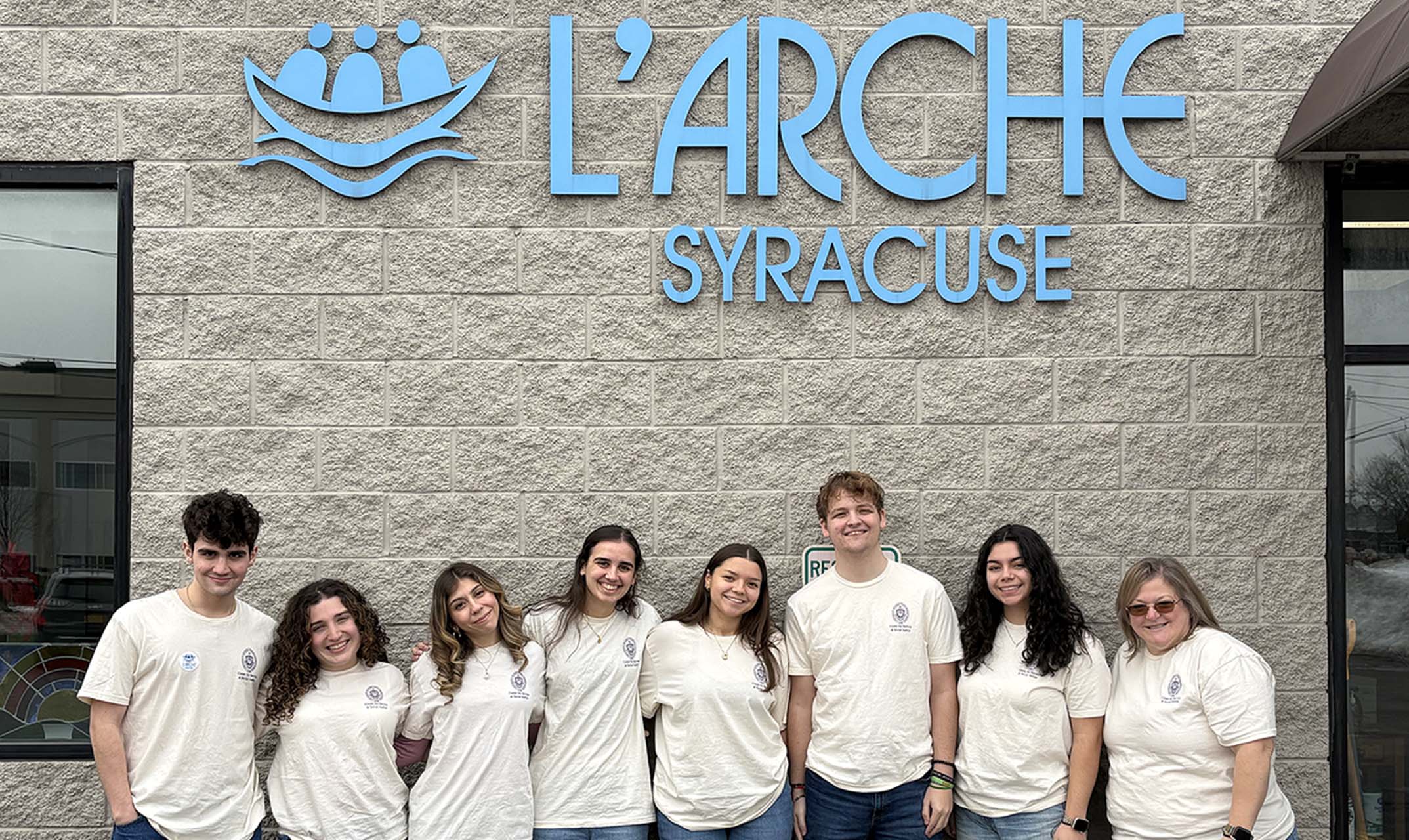
Q: What expectations did you have going into the trip? How did it live up to or surpass those expectations?
A: I did service trips throughout high school, and they were very much based on active service, like building houses. This …was an immersive service trip, which I'd never been on. An immersive service trip is less about doing; it is more just being with the people, which at first was kind of scary for me. I have to be doing something at all times, my hands have to be busy, or I have to be talking or moving. So, it was definitely a change of pace to just sit and hang out. Maybe I was coloring with someone. Maybe I was sitting in silence. By day three, I kind of got comfortable with it. It was definitely different from anything I've ever done before.
Q: How would you say it fits into the Jesuit teachings and ideals that we try to follow here at Scranton?
A: L’Arche’s whole idea is that we're working with an underserved and very vulnerable population. The way L'Arche looks at it is: Yes, this person may have autism, but this person was also, in their youth, on the Olympic or Paralympic bowling team. The members of L'Arche community have all lived such interesting lives. I think learning about them kind of fits into cura personalis and searching for more.
Q: How does going on a domestic trip compare to doing a service trip abroad?
A: I understand the temptation to want to go abroad and see a whole different culture, but I still think I got just as much cultural understanding as I would have if I went abroad. In the United States, we have so many different cultural pockets that are so different from each other.
Q: Do you have a particular favorite memory or moment from the trip that stand out to you?
A: The core members, the people who live in this community, are very funny and very vibrant. They tell you exactly how it is. We went bowling with them. I'm not the best bowler. I was bowling and I thought I did pretty well; I hit four pins down. I turned around all happy. I looked behind me and three people (from L'Arche) were sitting booing me.
Q: Any advice for students who are interested in service trips but still on the fence about committing?
A: Yes. I say like Nike, ‘Just do it,’ and don't say no. I'm someone who has a lot of apprehensions about new things. However, I think if I hadn't gone on this trip, my life wouldn't be going on the route it's on. I think it really has changed me for the better. Whatever service trip you go on, it is meant for you; the service trip finds you. I think if anybody has apprehensions, just go into it with an open mind and heart and really just dive right into it.
Q: Do you plan to participate on more service trips with CSSJ?
A: Yes, absolutely! I definitely hope to do more service trips in the future.
Read about CSSJ intersession domestic service trips to Florida, Phoenix and Washington, D.C.
Student Spotlight: Marissa Manzo ’28 Discusses Service Trip
Reunion Weekend 2026 will take place June 5–7, and registration officially opens on March 16.
Alumni from class years ending in “1” and “6” will celebrate their milestone reunions during this special weekend filled with events, memories and time with your Royal Family in the place where it all began.
Be sure to register when the site goes live and add your name to the “Planning to Attend List” to let your friends and classmates know you’ll be there. For more information, visit scranton.edu/reunion and check future editions of Royal News for updates.
Reunion 2026 Registration Opens March 16
What's new with you? To submit a Class Note, visit the Class Notes Submission Page.
Belinda Juran '81, Lowell, Massachusetts, was sworn in as a city councilor in Lowell, Massachusetts, in January 2026.
Carol A. Peters '82, Scranton, celebrated 52 years with Peters Design Group Inc. Architectural engineering and Design.
Rich Bevilacqua, DMD, M.D. ’83, was named chief, oral and maxillofacial surgery, Hartford Healthcare and associate chief, craniofacial trauma system, Hartford Healthcare.
Doreen Madeira Matzerath ’83 and Joseph Matzerath ’84, Scranton, celebrated their 40th wedding anniversary last September 2025. Joining them were fellow University of Scranton alumni John Cannon ’85, John Matzerath ’87, and Darsh Dhaded ’15.
Jayden Walsh ’29 and Ruby McGrath ’28 attended the Society of Irish Women’s annual Top O’ the Morn Brunch on Sunday, Feb. 22, along with alumna Catherine Alu ’86. The students, both Reddington Scholars from Ireland, offered grace in fluent Irish, adding authenticity to the cultural heritage event.
MARRIAGES
Mariah Vellek '15, G'16 to Connor Shanahan '15, G’16
Ryan Smith '16 to Loren Mastroberti '16
John “Buddy” Stocks ’17, G’20 to Kaitlin Rush ’18
Nick D’Alonzo '19 to Julia Kerr '19
Kaitlin Memmen '20 to Emery Lease
Briana Moritzen ’20 to Gregory Lacey ’19
DEATHS
Joseph A. Moran '55, Millstone Township, New Jersey
Thomas J. Dougherty '62, Dunmore
Joseph J. Magalski Sr., D.D.S. '62, Forest City
Thomas G. Behonick '67, Endicott, New York
Allen J. Duricko, Ph.D. '67, Gouldsboro
Joseph Sakelaridas G'68, Sugar Notch
Walter P. Andreski '72, Jefferson Twp.
Carl S. Scarantino '76, Pittston
Joseph B. Campbell G'83, Matamoras
Mary I. Herman G'90, Macungie
Jason A. Daria '91, Moorestown, New Jersey
FRIENDS/FAMILY DEATHS
Valerie Majez Evans, sister of Carol (Majez) Ginster G’84 and Jacalynne (Majez) Lopata '85
Alumni Class Notes, March 2026
Join us for a Networking Reception with University of Scranton students and alumni on Thursday, April 9, from 5–7 p.m. at McGillin's Olde Ale House.
This reception provides a valuable opportunity for alumni to connect with current students and network with fellow alumni in a relaxed setting.
The cost is $20 per person, and cocktails and appetizers will be served.
Register today to reserve your spot.
Questions? Email alumni@scranton.edu
University to Host Networking Reception in Philadelphia April 9
We are excited to announce the return of our virtual Book Club! This semester, we are once again partnering with the Jesuit Center to read one book together as a community.
Our spring selection is "My Son, the Priest: A Mother’s Crisis of Faith" by Kristin Gilger.
The discussion will be held in two virtual sessions:
Tuesday, April 14, at noon
Tuesday, May 12, at noon
The links to join will be sent prior to each discussion date.
The conversation will be facilitated by Tim Dulle, Ph.D., Executive Director of the Jesuit Center at The University of Scranton. He looks forward to joining alumni, parents and friends for thoughtful conversation and fellowship.
The book is available in print and Kindle formats on Amazon.
We hope you’ll join us for this meaningful community discussion.
If you wish to join our book club, https://bit.ly/RoyalBookClub
Virtual Book Club Returns This Spring
Make plans to come together with fellow Royals, parents and friends for an inspiring Day of Service on Saturday, April 25, 2026. Alumni across the country will unite to give back, strengthen their communities and live out the spirit of service that defines The University of Scranton.
To view a list of confirmed service sites, visit scranton.edu/dayofservice, where you’ll find site details and registration information.
Let’s serve together and show what it means to be part of the Scranton community!
Questions? Email alumni@scranton.edu
University to Host Annual Day of Service April 25
Members of the Classes of 2022–2026 are invited to the 16th annual Shamrockin’ Eve on Friday, March 13, from 8:30–11 p.m. at the Byron Recreation Complex.
Get ready for a night of food, drinks, green T-shirts and memory making with your fellow Royals! Registration is $40, with $5 supporting the Magis Fund, which provides scholarships and financial aid to current students.
Register today on the Shamrockin’ Eve Alumni Registration Page. Already registered? Invite your classmates to make this year’s celebration even more memorable!
Shamrockin’ Eve Returns for the 16th Year
More than 100 individuals, spanning both The University of Scranton and Greater Scranton communities, gathered in Brennan Hall’s Rose Room on Feb. 19 to celebrate the Lunar New Year.
Hosted by the Asian studies program and the Department of World Languages and Cultures, the festive event featured Asian cuisine, cultural presentations and hands-on activities including a lively chopstick relay, horse-themed origami, calligraphy and lantern decorating.
Ann A. Pang-White, Ph.D., professor of philosophy and director of the Asian studies program, noted that volunteers from the Asia Club and Japanese and Chinese classes arrived at 5 p.m. for setup. The event began at 6:30 p.m.
“It is a selfless service for others,” Dr. Pang-White said.
The festivities also included Chih-Yi (Arena) Wu and Kazumasa Fujita, instructors in the Department of World Languages and Cultures, leading presentations and workshops that “captured the audience’s attention and made the evening a great success,” Dr. Pang-White said.
$content.getChild('content').textValue“We are grateful for the University’s support for this important holiday and cultural marker for East Asian community,” she continued. “It is truly a manifestation of our Jesuit mission of ‘finding God in all things’ and ‘care for the whole person (cura personalis),’ in real action in real world that touches the shared life of spirit, body and mind of the members in our community.”
Lunar New Year is one of the most important events in China and for Chinese communities around the world. This year marks the Year of the Horse.
For additional coverage, please visit WVIA, Fox 56 and the Times-Tribune.
$content.getChild('content').textValueCommunity Unites for Lunar New Year Celebration (Photos)
Four staff members, whose collective experience as members of The University of Scranton community spans nearly a century, were celebrated as the newest winners of the Sursum Corda (Lift Up Your Hearts) Awards.
The awards, presented Feb. 19 at the McIlhenny Ballroom inside the DeNaples Center, recognized the dedication, service and outstanding contributions the four individuals have made in performing their duties, nurturing a sense of a belonging and playing an important role in supporting members of the community as they strive to embody the University’s mission and values in their daily lives.
This year’s recipients of the Sursum Corda Awards are:
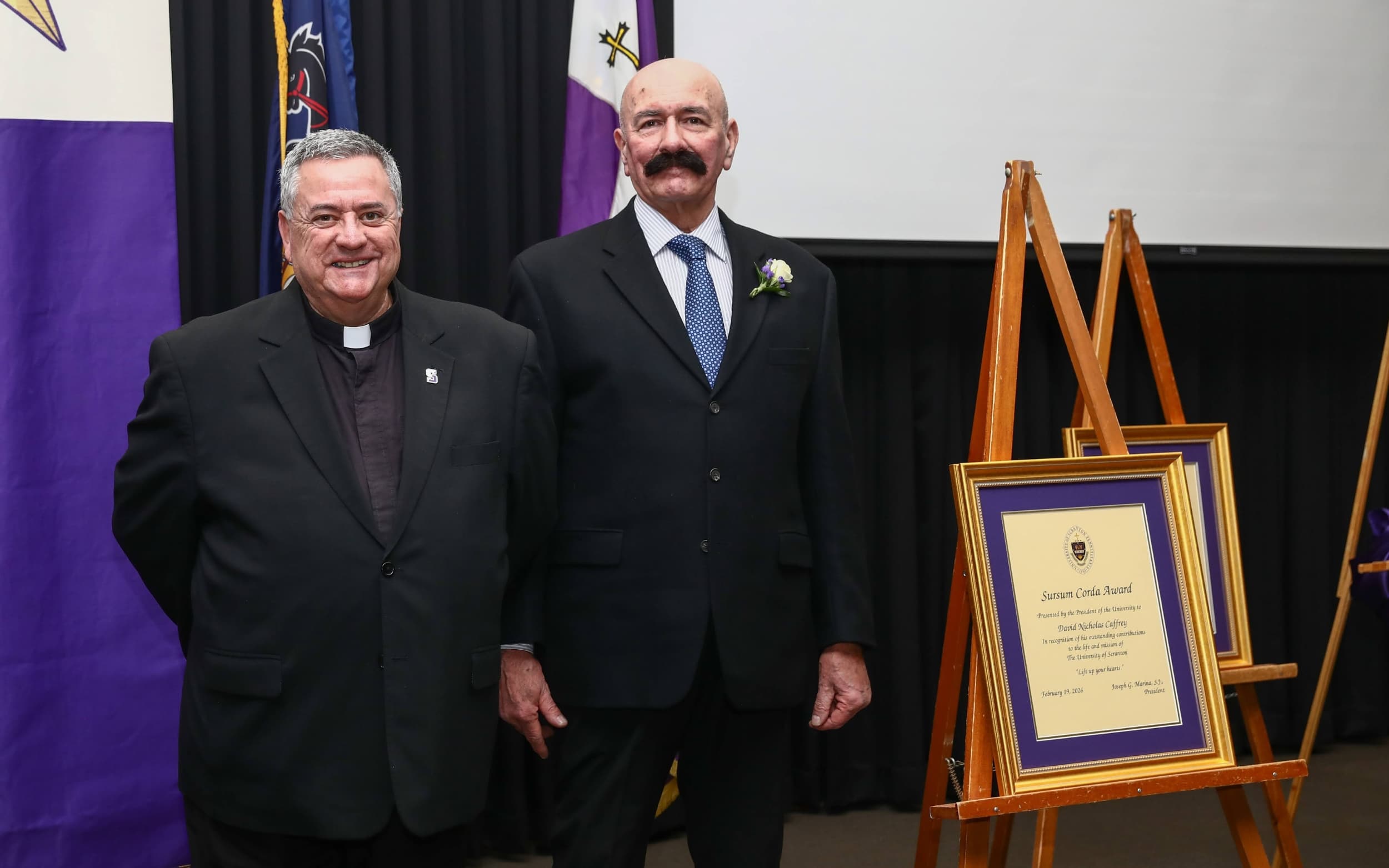
David Caffrey, public safety officer for the University Police Department
Caffrey began working at Scranton in 1989, policing the Hill section out of his own car.
In the 35-plus years since, Caffrey has been a steady and dependable presence who’s led by example through his consistency, reliability and commitment to excellence. Caffrey’s longevity stands as a testament to his devotion to law enforcement and the University.
Caffrey takes great care to ensure that University facilities, equipment and grounds are always secure, creating a safe and supportive environment for students, faculty, staff and visitors. He has a deep sense of duty and pride in public service, going far beyond what is expected.
A U.S. Navy veteran, Caffrey enjoys spending time with family, including his sister, her children and grandchildren.
Hugh Doyle ’17, G’20, director of undergraduate admissions within enrollment management
Just two weeks after graduating, Doyle joined the admissions staff and has since served in several leadership roles at the University.
Doyle brings exceptional dedication, creativity and intentionality to his duties and considers the University’s mission and the needs of its students in all he does. Bringing a philosophy of “mission first, people always,” Doyle manages his team with compassion and care and consistently models integrity, trust and mutual respect.
Doyle volunteers with a local nonprofit organization that supports individuals with mobility limitations. Similar to his interactions with students and colleagues, he approaches his voluntary work with humility and a genuine love for others.
A fan of the great outdoors, Doyle enjoys spending time with his wife, Elizabeth ’17, and their son, Finnen.
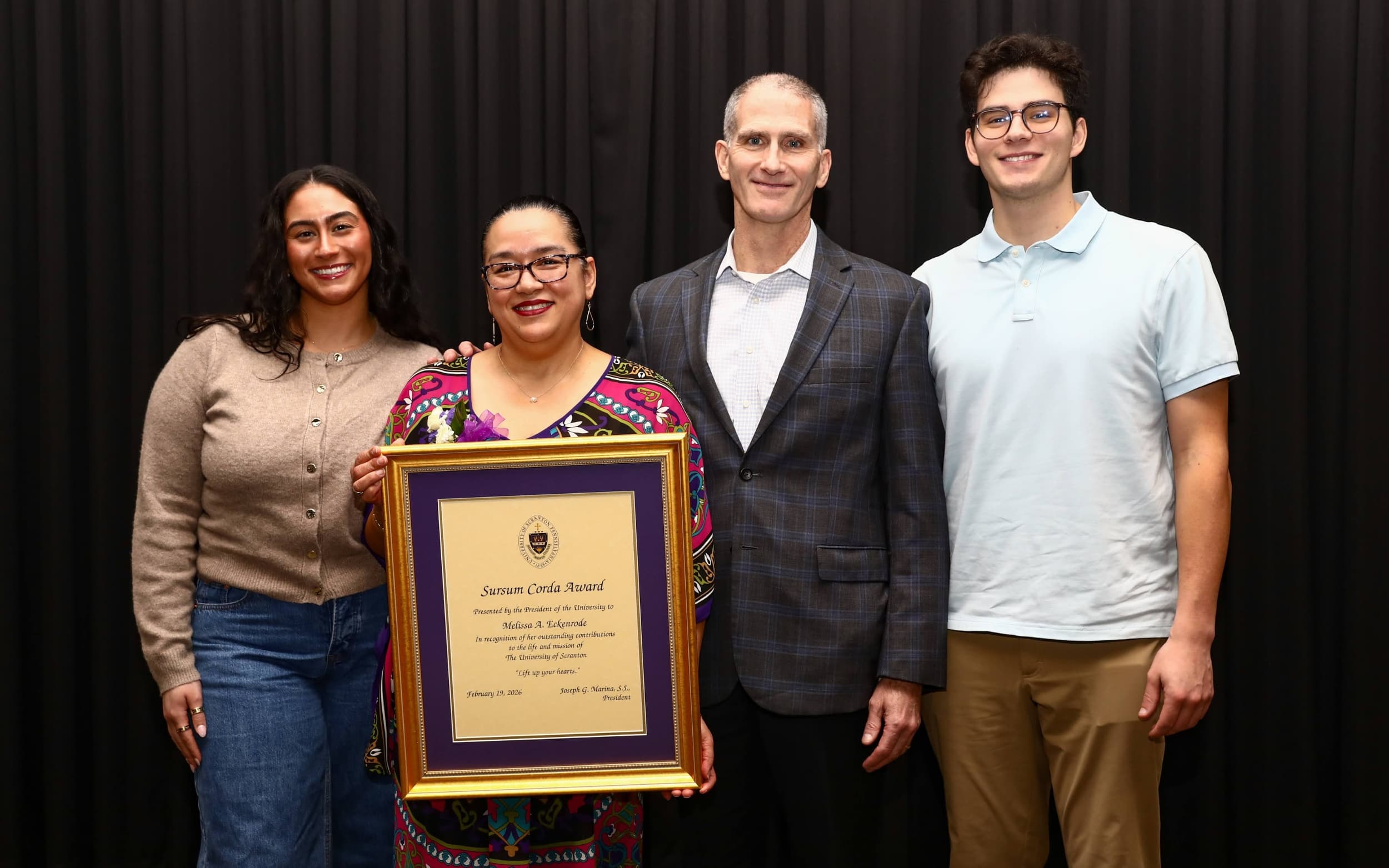
Melissa Eckenrode, administrative assistant to the Department of English and Theater
Known for her compassion and unwavering support of students, offering encouragement and guidance to all who come through the department, Eckenrode has served the University for more than a decade.
Since 2021, she has been an active member of Staff Senate and now co-chairs the Social Events and Community Building Committee, strengthening connections across campus while also volunteering with additional committees.
Deeply committed to service, Eckenrode chaperones annual student service trips. This past year, she generously chaperoned two international service trips.
Eckenrode and her husband, Paul, volunteer for the Feed a Friend program, providing essential resources to individuals and families in need. She and Paul are the proud parents of four children — Monica, Abigail, Matthew and Isabel.
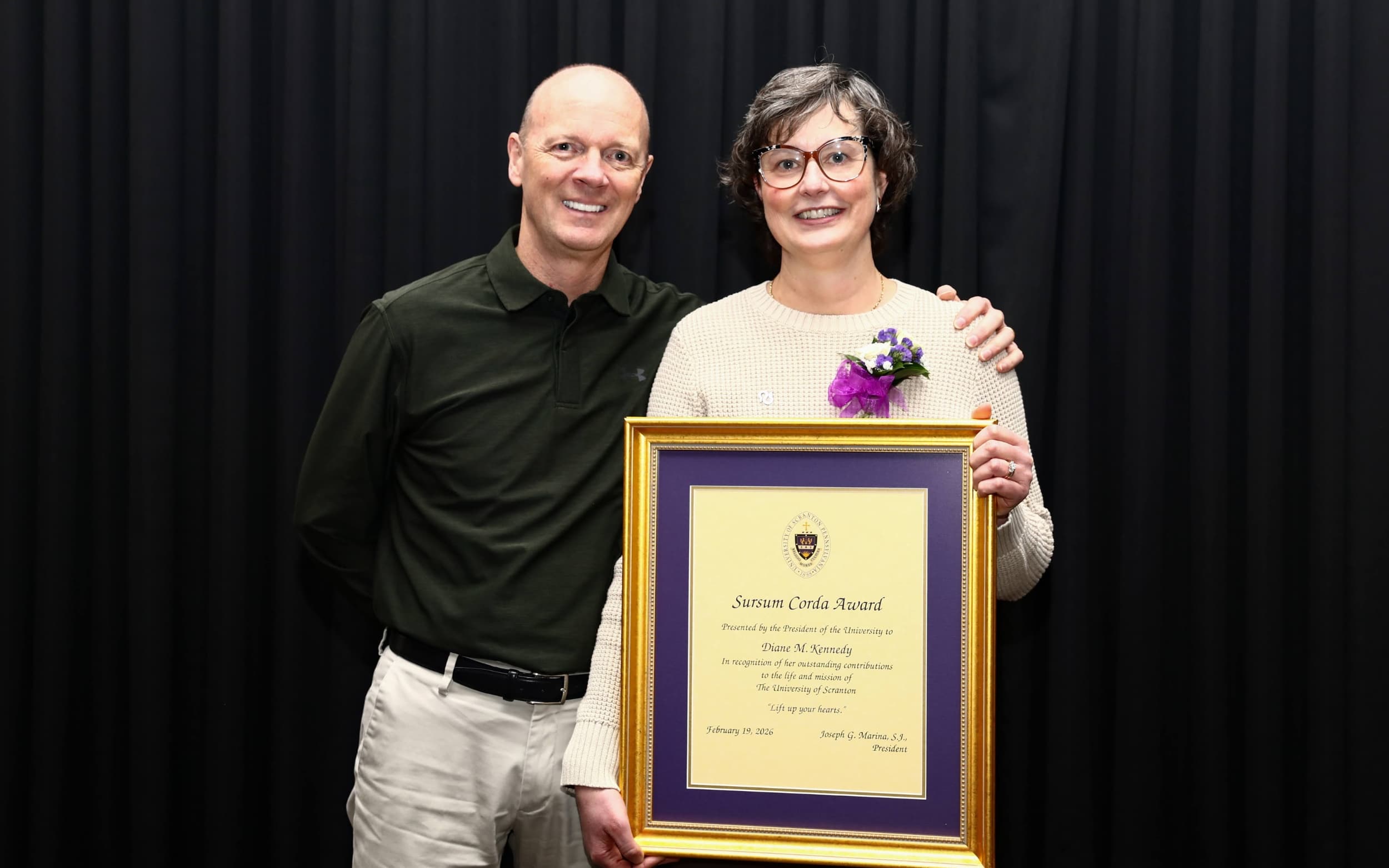
Diane Kennedy, IT client services analyst in the division of information technology
For nearly three decades, Kennedy has been an influential, reliable and dedicated University community member who has played key roles in several major technological transitions.
Notably, Kennedy assisted in the University’s move to Microsoft email and calendaring and the redesign of an outdated asset tracker system.
Kennedy’s commitment extends far beyond her professional responsibilities. She has long visited nursing homes, hospitals, youth groups and libraries with her therapy dogs, Opel and Uwe, offering comfort and connection.
Kennedy’s service took on new meaning in 2024 after her husband, Rob, was diagnosed with early-onset Alzheimer’s. Together, they have become advocates for dementia awareness and caregiver support, helping raise funds and engaging in various outreach activities and initiatives.
$content.getChild('content').textValueSursum Corda Awards: Caffrey, Doyle, Eckenrode, Kennedy Honored
February
View February Listing Page
Students in The University of Scranton’s cybercrime investigation and cybersecurity master's program are on the cutting edge of financial fraud detection and ransomware research, as detailed in a series of articles on the University’s graduate admissions website.
Julia Ciaccio ’27, a double major in cybercrime/homeland security and criminal justice who is also pursuing a cybersecurity master’s degree through Scranton’s accelerated BS/MS program, was among the featured students.
Ciaccio worked alongside Ismail Onat, Ph.D., associate professor, to investigate ATM and point-of-sale skimming, a growing and costly form of cyber-enabled financial crime. Together, Ciaccio and Dr. Onat used emerging prevention tools to analyze offender profiles and track system vulnerabilities. Ciaccio’s work, which included evaluating existing countermeasures and proposing forward-looking solutions, earned national recognition. She presented a research paper at the annual conference of the American Society of Criminology.
“I never imagined that a semester paper would be picked up and turned into a publication,” Ciaccio said. “This opportunity has significantly improved my academic confidence, enhanced my research skills and deepened my understanding of cybercrime.”
$content.getChild('content').textValueAnother featured student was Buse Onat ’26, a triple major in cybercrime/homeland security, criminal justice and philosophy. Like Ciaccio, Onat is also pursuing a master’s in cybercrime investigation and cybersecurity through the University’s accelerated program.
Partnering with Sinchul Back, Ph.D., associate professor, Onat explored how digital guardianship — from secure passwords to AI-driven anomaly detection — reduces fraud risk in credit card transactions. Onat and Dr. Back’s hands-on research included studying more than 568,000 anonymized credit card transactions.
“Working with Dr. Back has been one of the best parts of my time at Scranton,” Onat said. “It gave me real research experience and showed me how classroom knowledge applies to real problems. …
“That perspective has helped me think more critically and practically as a grad student.”
While Ciaccio and Onat are simultaneously managing rigorous undergraduate and graduate work, Noah Mumma ’25 is a recent graduate who is solely pursuing a master’s degree in cybercrime investigation and cybersecurity.
Working closely with Dr. Onat, Mumma has conducted outside-the-box research on cybercriminals’ behaviors and motivations. These individuals, Mumma said, often target states with higher median household incomes and greater internet access.
“This suggests cybercriminals are more concerned with overall income and digital connectivity than physical infrastructure,” Mumma said.
Ciaccio, Onat and Mumma are entering a growing field, as the U.S. Bureau of Labor Statistics reports a projected 29% increase in security analyst jobs from 2024 to 2034.
According to the most recent Roche Family Center for Career Development’s Class of 2024 First Destination Survey, University of Scranton cybercrime and homeland security majors entered the field with an average starting salary of $70,122. Graduate students who earned master’s degrees in cybercrime investigation and cybersecurity had an average starting salary of $82,710.
“Scranton’s program stands out because it teaches not only technical skills to defend against cyberattacks, but also computer crime law and cybercrime criminology,” Mumma said. “This gives students a lot more experience with different roles they can eventually apply for.”
For more information, please visit the University’s cybercrime and homeland security undergraduate page and the University’s cybercrime investigation and cybersecurity master’s program webpage.
Student Researchers Drive Cybersecurity Innovation at University of Scranton
The University of Scranton’s Schemel Forum will offer Collaborative Programs exploring unique topics in music, art and wine. The events are sponsored by Munley Law.
On Thursday, April 9, Richard Kogan, M.D., professor of Psychiatry, Weill Cornell Medical College, and artistic director, Weill Cornell Music and Medicine Program, will return for a presentation — hosted in collaboration with the Geisinger Commonwealth School of Medicine (GCSOM) — exploring the life and music of George Gershwin. The event, “George Gershwin: Music and Healing,” will include a performance and lecture, followed by a reception.
A child of immigrants in New York City, Gershwin was a hyperactive, behaviorally challenged youngster whose life was transformed when he heard a classmate’s violin recital through an open window. He was a creative phenomenon, a man who was able to extract music out of what others considered to be merely noise, a man who was inspired to write “An American in Paris” after hearing the sounds of Parisian taxi horns.
Dr. Kogan will reveal Gershwin’s thought processes during his artistic journey from “Rhapsody in Blue” to “Porgy and Bess” until his death at age 38 from a brain tumor. His presentation will be illuminated with performances of some of Gershwin’s most beloved music.
The event will begin at 6 p.m. at GCSOM, 525 Pine St., Scranton. Admission to the event, which includes a reception, is $40 for the general public and free for Schemel Forum members and University of Scranton and GCSOM employees and students.
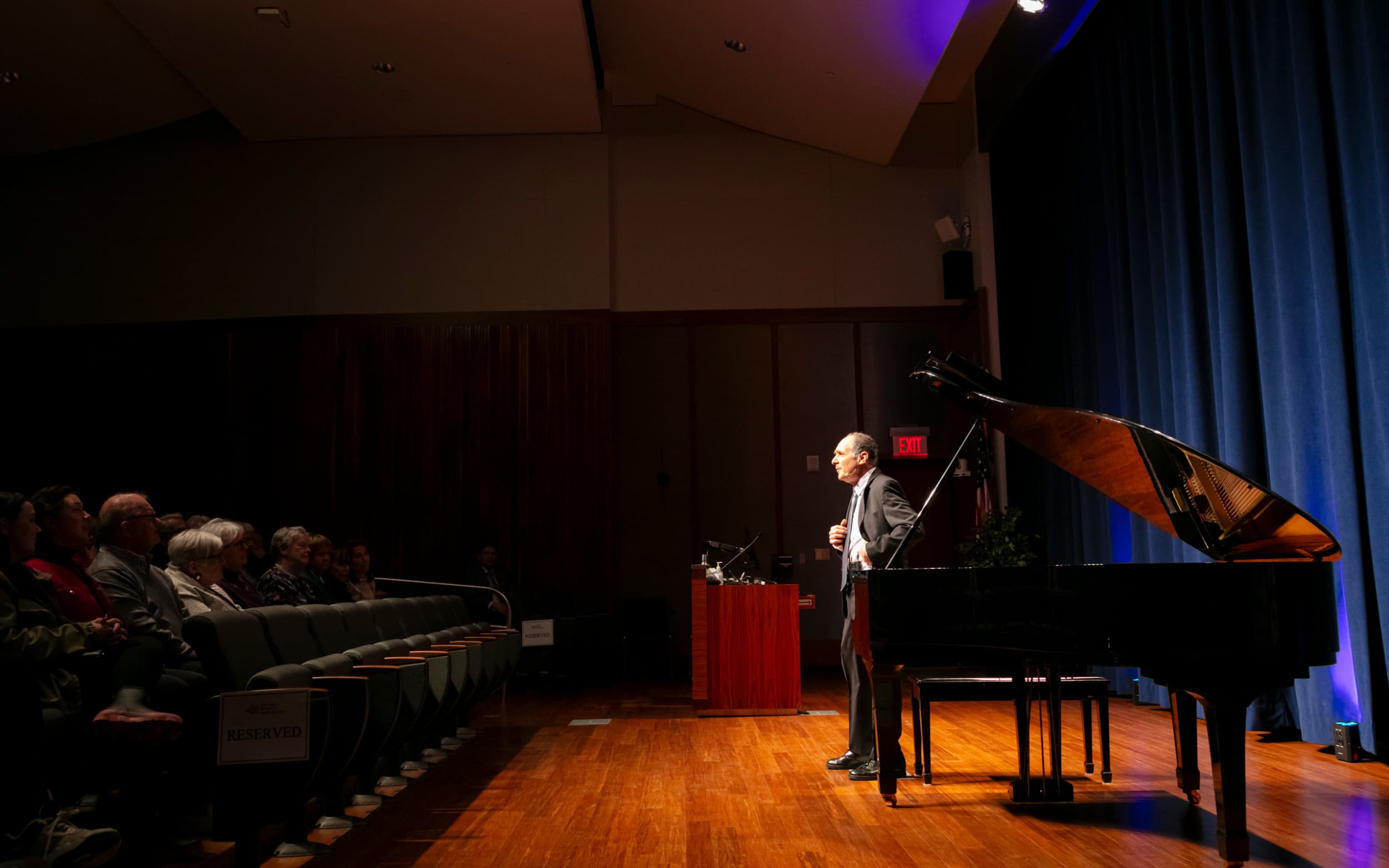
On Thursday, April 30, the Schemel Forum will partner with Friends of the Weinberg Memorial Library and the Hope Horn Gallery for an unveiling of Niccolò Betti’s “Madonna and Child with the Young St. John the Baptist.”
The public unveiling of this newly restored treasure will feature insights from art restorer John Powell, co-owner, Chelsea Restoration Associates, and art historian Robert Simon, Ph.D., president, Robert Simon Fine Art. A reception will follow.
When the Morgan family gifted a remarkable Madonna and Child painting to The University of Scranton, its black, featureless background suggested a work of quiet simplicity. During restoration, however, conservators made an astonishing discovery — the black backdrop had been added long after the painting’s creation.
The reveal came through a meticulous process by Powell, a skilled restorer of fine art whose clients include the Everhart Museum in Scranton. Given the age of this piece, Powell said it was important to proceed slowly and with caution.
After first securing any loose elements to prevent further loss, Powell cleaned the surface of years of soot and dirt to brighten the colors in the painting. From there, he used solvents to selectively remove old varnishes and previous restoration, starting with the lighter, more stable colors. It wasn’t until he began working with the background that Powell began to wonder what might be beneath the black paint.
“There was just something about how stark the figures of Mary and Jesus were against the backdrop,” Powell said. “It seemed unresolved.”
As he continued to work, some flesh colors began to emerge.
“I thought to myself, ‘This is interesting,’” he said.
And then, the figure of an infant St. John the Baptist emerged.
“There was this beautiful figure so typical of Florentine Renaissance painting, which is precisely the work I love,” he said.
The addition of a third figure against a rich, dark woodland setting changes the character of the painting, said Powell, with action and more depth.
Working in collaboration with art historian Dr. Simon, the work has been attributed to the 16th-century Italian Renaissance painter Niccolò Betti, best known for “The Sack of Corinth” in the Studiolo of the Palazzo Vecchio in Florence.
The collaborative process between in-house curators and conservators is typically found in museums, and not the private sector, said Dr. Simon, adding that he and Powell were able to profit from each other's expertise in order to tease out the background and historical context of the painting.
“In this case it helped that my academic specialty is Florentine painting of the 16th century,” said Dr. Simon. “Each painting that one studies, whether in the conservation lab or in the library, is a puzzle — here a 500-year-old puzzle in which we try to understand who painted the work of art, what was originally intended, the religious significance, what changes have been made to the picture over time, and how can we make it understandable to today's audience. Paintings like this are like messages in a bottle, coming from across the planet and centuries in time.”
It’s uncertain why the original work was painted over, although it appears to have something to do with the top panel, according to Powell.
“The original panel had some kind of damage at some point, and a piece of wood was added,” he said.
The event, which will begin at 5:30 p.m. in the Charles Kratz Scranton Heritage Room of the Weinberg Memorial Library, is open to the public free of charge, courtesy of the Friends of the Weinberg Memorial Library and the Hope Horn Gallery. The restored painting will be on permanent display on the fourth floor of the Weinberg Memorial Library.
On Friday, May 29, the Schemel Forum will host “Vin et Vues: Loire Valley and its Wines.” This hands-on wine education event will feature a four-course wine tasting, hors d’oeuvres, a presentation on wines of Loire Valley, France, and an interactive discussion led by wine writer David Falchek, CAE, IOM, CMP.
Participants will explore France’s under-appreciated wine region, Loire Valley. The region looms large in French consciousness for history, the arts and agriculture, yet is less recognized for wine, despite pioneering a number of varieties and styles. Falchek will lead participants in a deep dive of this influential region carved by Europe’s longest wild river and will host a sampling of a range of wine styles.
Falchek is a wine writer and critic for publications including “Wine & Spirits Magazine” and The Scranton Times-Tribune and is former executive director of the American Wine Society.
The event will begin at 5:30 p.m. in Charles Kratz Scranton Heritage Room of the Weinberg Memorial Library.
The cost for the wine tasting, hors d’oeuvre and lecture is $60 per person, $110 per couple for non-Schemel Forum members. There is no additional fee for Schemel Forum Members, Angels, and Archangels to attend this event. University of Scranton and GCSOM students, staff, and faculty must purchase tickets. All participants must be 21years or older.
For additional information or registration information, call 570-941-4740 or email schemelforum@scranton.edu.
Additional Schemel Forum events can be found on the Schemel Forum’s webpage.
Schemel Forum Announces Collaborative Programs for Spring
Dan Marenda, Ph.D., associate dean of the College of Arts and Sciences, epigenetics, Syracuse University; Post-doctoral Fellow, neurobiology and behavior, Emory University School of Medicine, will present the first faculty research seminar on Feb. 27 beginning at 3:10 p.m. in Loyola Science Center, room 233. All are welcome to attend.
Dr. Marenda is married to a poet, and in this presentation, he will craft short stories in poetic verse that highlight his research career, spanning epigenetic factors that control axon pruning in the brain, to creating a model of Alzheimer's disease in the fruit fly, to the accidental patent for a human-safe insecticide. He will end the seminar by discussing favorite projects funded during his time as program director at the National Science Foundation.
The Research Seminar Series was established to provide a time and place for faculty and staff to exchange research information.
In its essence, the series is intended to build community and collegiality by setting a venue to communicate scholarly work to others.
Feb. 27: Daniel Marenda - 20 Years of Brains, Bugs, and Budgets: My Journey to the Electric City
March 6: Margarete Zalon, nursing, Waking the Sleeping Giant: Nurses at the Ballot Box
March 27: Declan Mulhall et. al. - Einstein Day
April 17: Declan Mulhall, physics/engineering - TBA
April 24: Sheli Pratt-McHugh, library - TBA
May 1: Joyanna Hopper et. al. - Earth Day
May 15: Katherine Stephanelli, counseling and human services - The Impact of Mindfulness Programming on Stress, Anxiety and Resilience in Undergraduate Students
Join the Faculty Seminar Series on select Fridays from 3:10 - 4:30 pm, Loyola Science Center, room 233. Refreshments will be served.
Questions? Contact series coordinator Amelia Randich at amelia.randich@scranton.edu.
20 Years of Brains, Bugs and Budgets: My Journey To The Electric City, presented by Dan Marenda, Ph.D.
The Center for Health Education and Wellness (CHEW) introduces the spring semester Employee Wellness offerings for the campus community. Whether you’re managing stress, recharging during the workday or building healthy habits, CHEW invites faculty and staff to explore the programs listed below and make wellness part of your spring routine.
This semester, all meditation and yoga Weekly Wellness Classes will be held in the new Weiss Hall Well-being room 016, basement, a dedicated space designed for CHEW wellness programs that support relaxation and mindfulness.
Weekly Wellness Classes
These drop-in classes, led by professional instructors, support stress relief while building strength, flexibility and mindfulness. Classes are open to students, faculty and staff. Yoga and Mindfulness classes have moved to the Weiss Hall, Well-being room 016, basement. Classes are limited to participants.
Mindfulness Meditation – Monday, 5 p.m.
Calm and Strong Yoga – Tuesday, 5:30 p.m.
Evening Rest and Restore Yoga – Tuesday, 7 p.m.
Functional Movement Yoga – Wednesday, 12:15 p.m.
Empowered Yoga Flow – Thursday, 5:30 p.m.
Yoga for Stress & Tension Relief – Friday, 12:15 p.m.
Employee-Only Weekly Wellness Classes (located in the Byron Gym)
Drop-In Pickleball – Tuesday, 12 –1 p.m., Main Gym, Byron Center
Light Weights and Abs – Wednesday, 5 p.m., Royals Room, Byron Center
Save the Date
Employee Wellness Kick-off to Summer Lunch Event, Wednesday, June 10
Questions? Contact CHEW at chew@scranton.edu or 570-941-4253
Check out more employee wellness information @ https://www.scranton.edu/employeewellness
Center for Health Education and Wellness Introduces Spring Semester Employee Wellness Offerings
Author and political theorist Laura K. Field, joins The University of Scranton to discuss her book "Furious Minds: The Making of the MAGA New Right," which examines how the political moment surrounding the 2016 presidential election reshaped the American conservative intellectual landscape.
Field argues that while President Donald Trump himself was not a traditional ideological thinker, his rise created space for a network of academic, public intellectuals and influencers who have contributed to what she describes as the "MAGA New Right."
The free event, open to the public, will take place Thursday, March 5 at 5:30 p.m. at the Pearn Auditorium, Brennan Hall 228.
Sponsored by the Gail and Francis Slattery Center for Ignatian Humanities, Special Jesuit Liberal Arts Honors Program, College of Arts and Sciences Dean's Office, Political Science Department, History Department and Legal Studies.
Questions? Contact matthew.meyer@scranton.edu.
'Furious Minds The Making of MAGA New Right' Author To Speak March 5
Students from The University of Scranton traveled to communities across the United States in January for domestic service trips organized by the University's Center for Service and Social Justice (CSSJ).
Each trip was led by a peer facilitator, individuals who played a leadership role and supported their fellow students throughout the experience. Their efforts combined direct service with opportunities to build relationships and reflect on issues such as homelessness, poverty and access to resources.
Patrick George '26, a graduate operations and supply chain management student from Endwell, New York, helped lead a group of seven students and three chaperones to Washington, D.C. The volunteers partnered with organizations supporting individuals experiencing homelessness and food insecurity.
The Royals worked primarily with the Father McKenna Center, assisting with meal preparation, organizing donations and building relationships with clients.
Connecting with the people they served was the greatest emphasis of their work in D.C. “It was our goal to remind the clients of their humanity and give them genuine human connection and relationship,” George said.
Students also volunteered with We Are Family and the Catholic Worker, distributing food and supplies and participating in outreach throughout the city.
Daily reflections rooted in the Jesuit Examen helped students process their experiences and remain focused on four themes: presence, patience, perspective and moving forward.
According to George, the relationships formed during the week had the greatest impact. "There was a genuine exchange of love in both directions."
The experience had a lasting impact on George, particularly in his career discernment.
“This trip to D.C. solidified to me that I can do the most amount of good by working at a place like the Father McKenna Center,” he said. "Since coming back from this trip, I have committed myself to finding a job where I can lead people and serve the marginalized in a manner that glorifies God."
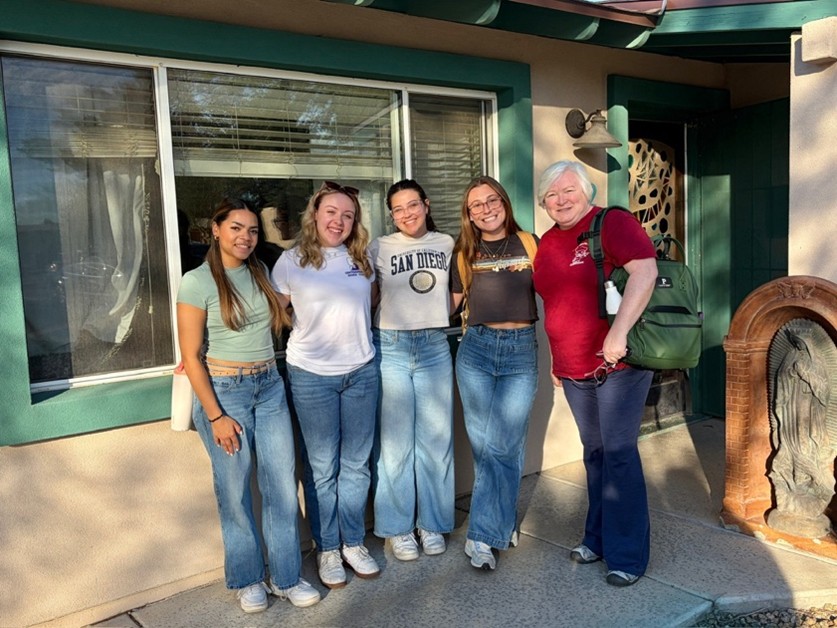
Rachel Alesso '27, a counseling and human services major from Manasquan, New Jersey, facilitated a service trip to Phoenix focused on supporting mothers experiencing homelessness.
The group partnered with Maggie's Place, an organization that provides housing and support for pregnant women and mothers with newborns. Seven students and two chaperones participated.
Each day, students visited homes, shown above, assisting with cleaning, organizing donations and preparing meals while spending time with residents.
Alesso said the experience deepened her understanding of poverty, particularly during a simulation that required students to navigate public transportation to access social services.
She noted that small acts of service often carried the greatest meaning.
“What stands out most is how something small like cooking dinner for a home felt deeply meaningful,” Alesso said. “Knowing it made the mom's night a little easier showed me the power of simple service.”
Since returning to campus, Alesso said the trip has influenced her professional goals.
“I can truly see myself working as an in-house counselor for an organization like Maggie’s Place and helping mothers rebuild their lives,” she said.
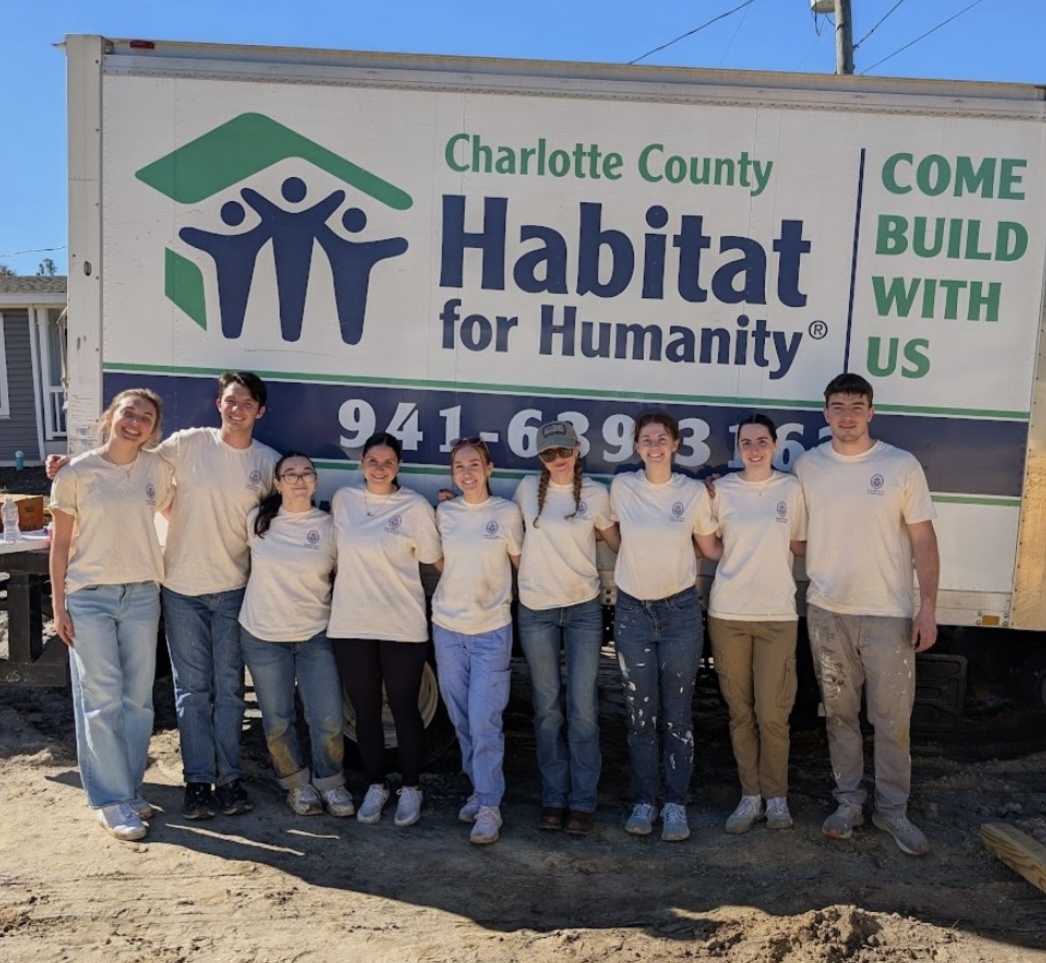
Peer facilitator Luke Flanagan '27, a business administration major from Pearl River, New York, led a trip to Florida to work with Habitat for Humanity.
At two Habitat ReStore locations in Charlotte County, students sorted clothing and organized donations.
Flanagan guided a group, shown above, of six students and two chaperones who spent the week assisting with multiple housing projects in Charlotte County, Florida. Service activities included painting interiors and exteriors of homes, completing finishing touches such as baseboards and doors, and helping raise walls and install plywood sheathing for a new home build. The students also sorted clothing and organized donations at two Habitat ReStore locations.
On one of the final days, students met the future homeowners whose house they helped construct. The impact of their work stood out the most to Flanagan.
Leading nightly reflections challenged him to grow as a leader while drawing on the principles of his Jesuit education.
“I learned that leadership is not about being the loudest in the room, but more about listening and asking thoughtful questions,” Flanagan said.
He added that the shared experience of service strengthened the group’s sense of community.
“The week of living, serving and reflecting together created a level of trust and vulnerability that doesn’t always happen on campus,” Flanagan said.
Flanagan's experience has deepened his awareness of housing insecurity and commitment to serving those in need.
“I’ve become more aware of the realities of housing insecurity, and it’s pushed me to think beyond temporary service and toward long-term impact,” he said.
The domestic service trips are designed to immerse students in impactful community-based service while encouraging reflection rooted in Jesuit values.
A fourth domestic service trip to Syracuse, New York, will be highlighted in an article scheduled for publication in an upcoming issue. In this piece, student correspondent Marcus Smith '27 interviews peer facilitator Marissa Manzo '28 about her group’s experience serving in the Syracuse community.
Royals Provide Acts of Service Nationwide for Those Facing Housing Insecurity
The Staff Senate would like to thank all staff members who took the time to recognize and share their colleagues' accomplishments, sense of community, and dedication to excellence. The Meg Cullen Brown Magis Award would not exist without our caring community!
THE MEG CULLEN-BROWN MAGIS AWARD WINNER for February 2026 is:
Eric Gatto – Financial Aid
How long have you worked at the University? I have been here a little over two years now, starting in January of 2024.
What is your title? Assistant Director of Financial Aid.
What do you like best about your job? Being able to help our students and families.
What do you like to do for fun? I love to golf and have a newborn daughter who I am trying to keep up with.
We would like to take this opportunity to congratulate and celebrate the good work that Eric does on a daily basis. We hope you will join us in personally congratulating Eric and all our nominees. Eric will receive a complimentary food donation at our fabulous University food service outlets AND a reserved parking space in the DeNaples Parking Pavilion for February. Each winner is also invited to the Staff Senate Recognition event in May 2026 to receive a certificate of appreciation.
We congratulate Eric and all the wonderful nominees for being recognized as “Magis” employees!
February 2026 Nominees
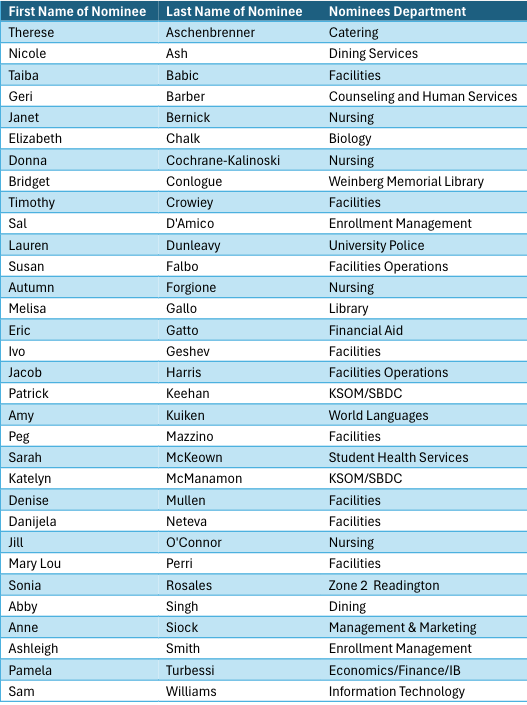
Nominations open for March Meg Cullen-Brown Magis Award.
Have you witnessed a University staff member, Aramark or Follett employee offer a simple act of kindness? Go above and beyond for others? Perhaps they embody our Jesuit mission or simply possess an incredible attitude. If so, please recommend this individual for this prestigious award.
Although only University staff members, Aramark, or Follett employees win the award, nominations may be made by any University of Scranton employee.
Meg Cullen-Brown Magis Award for February
Some of the world’s most productive and reputable accounting faculty members work in The University of Scranton’s Department of Accounting, which, itself, retained a No. 1 national ranking with a program that continues to lead international rankings.
According to two newly released, researched-based evaluations by leading authorities in the field:
- Douglas M. Boyle, DBA ’88, Accounting Department chair, professor, retained his No. 1 national ranking for practitioner-focused research
- Dr. Boyle is also tied for No. 1 worldwide for accounting education research
- The University’s Accounting Department retained its No. 1 national research ranking for contributions to leading U.S. practitioner journals
- The University’s Ph.D. in Accounting program retained its No. 1 worldwide research ranking for productivity in accounting education publications
“We are proud to have our research recognized at the highest levels nationally and internationally,” Dr. Boyle said. “Our work informs the profession and accounting education, guides future research, and is integrated directly into our students’ learning experience.”
The No. 1 national rankings for Dr. Boyle and the Department of Accounting come from “Management Accounting Quarterly (MAQ),” in the study, “Academic Contributors to Leading U.S. Practitioner Accounting Journals.” The report was authored jointly by faculty at Kennesaw State University and The University of Scranton. MAQ, a peer-reviewed journal of the Institute of Management Accounting with roughly 160,000 professional readers, evaluated scholarly contributions to five leading U.S. practitioner-focused accounting journals.
The No. 1 worldwide recognition is courtesy of the Brigham Young University 2025 Accounting Research Rankings, widely regarded as the gold standard in accounting for measuring research productivity in top academic journals. The BYU rankings are categorized by topic, research method and post-graduate window, highlighting the impact of faculty and alumni scholarship over the most recent six-year period.
“By earning No. 1 research rankings nationally and worldwide — at the individual, Ph.D. program and departmental levels — The University of Scranton continues to set the standard for accounting scholarship that advances education, informs corporate governance and business ethics, strengthens organizational performance and shapes the future of the profession,” Dr. Boyle said.
As the author of 19 articles in top practitioner journals during the ranking period, Dr. Boyle continues to lead at both national and global levels. He surpassed the second-ranked scholar by 11 publications. His. No. 1 national ranking reflects sustained leadership in practitioner-focused research, while he also held the top spot in the prior five-year period. He is tied for No. 1 worldwide in accounting education research after placing No. 2 in the previous ranking. Over the past six years, Dr. Boyle contributed 14 education articles to the BYU study, underscoring his sustained influence on accounting scholarship.
The Kania School of Management’s Ph.D. in Accounting program retained its No. 1 worldwide research ranking from BYU, ranking first in the Main Ph.D. Program Rankings for All Education Publications over the most recent six- and three-year periods. Ph.D. graduates contributed 20 articles over the most recent six years and 17 articles over the most recent three years. Scranton Ph.D. alumni now hold positions at leading institutions of higher learning, including Villanova University and Virginia Tech. The program was also No. 1 in the prior evaluation period.
The University’s Accounting Department remained No. 1 nationally for contributions to U.S. practitioner journals, producing 22 publications during the ranking period — nearly double the output of its closest peer institutions.
In addition to Dr. Boyle, several Ph.D. faculty members earned BYU global research rankings:
- James F. Boyle, DBA ’86, associate professor: No. 16 (tied) in All Education Publications
- Amanda S. Marcy, Ph.D. ’10, G’11, Ph.D.’20, assistant professor: No. 66 (tied) in All Education Publications
- Ashley L. Stampone, Ph.D. ’10, G’11, Ph.D.’23, assistant professor: No. 211 (tied) in All Education Publications, No. 88 in Accounting Information Systems (AIS) research
Other practitioner-focused rankings from MAQ include: Daniel J. Gaydon, Ph.D., DBA ’21, adjunct accounting professor, tied for No. 5; Daniel P. Mahoney, Ph.D. ’81, G’85, professor of accounting, tied for No. 13; and Dr. James F. Boyle tied for No. 25.
These achievements build on additional distinctions for the Kania School of Management, recently named one of the nation’s Best Business Schools by the Princeton Review. U.S. News and World Report also ranked the accounting program among the top 40 nationally.
Scranton Accounting Research: Chair, Ph.D. Program, Department Earn No. 1 National and Worldwide Rankings
The University of Scranton invites the public to campus on Sunday, March 8, for Waymarks Opening: A Feast in the Wilderness. It is the inaugural celebration of Waymarks Toward Reunion, a yearlong program in sacred art and theology funded by the Creative Arts Collective for Christian Life and Faith.
Structured as a four-movement day, the event begins at 10 a.m. with a keynote lecture by Rev. Paul Kollman, C.S.C., associate professor of theology at the University of Notre Dame. Father Kollman, a theologian and scholar of world Christianity, will explore how beauty guides us toward freedom and reunion with God.
Father Kollman, the author of “The Evangelization of Slaves and Catholic Origins in Eastern Africa” and numerous other publications, has served as executive director of Notre Dame’s Institute for Social Concerns, president of the American Society of Missiology and president of the International Association of Mission Studies.
The lecture will be held at the Ann and Leo Moskovitz Theater inside the DeNaples Center. It is free and open to the public.
Following Father Kollman's lecture and beginning at 12 p.m. is a shared feast by invitation. The meal, also at the DeNaples Center, is offered as an act of hospitality and celebration.
The afternoon features a live concert by Paul, Terrell and Farrin, a devotional folk music trio from Sufism Reoriented. The concert will be held from 2:15 to 3:30 p.m. at the Moskovitz Theater.
The day will conclude with an evening Mass, beginning at 4:30 p.m., inside the Madonna della Strada Chapel on campus. All are welcome.
Waymarks Toward Reunion is rooted in the conviction that beauty is not merely ornament but a path — a waymark in the wilderness that points toward God's life, light and love. This opening day embodies that vision: an invitation to gather across differences and follow the road of the heart's desire together. Three of the four movements of the event are free and open to the public.
The project is anchored in a Jesuit-Franciscan partnership between The University of Scranton and Georgetown University's Berkley Center for Religion, Peace & World Affairs, with the Franciscan Monastery of the Holy Land in Washington, D.C., as artistic home.
For information, please email program director Patrick Beldio, MFA, Ph.D., sculptor, comparative theologian, and visiting assistant professor at The University of Scranton at patrick.beldio@scranton.edu.
Waymarks Opening: 'A Feast in the Wilderness' to Feature Lecture, Concert and More
The University of Scranton celebrated the graduation of 19 community leaders who participated in Cohort 5 of its Nonprofit Leadership Certificate Program (NLCP). Classes for the 13-month program, which seeks to develop future executives to serve area nonprofit institutions, began in January 2025.
The University’s Nonprofit Leadership Certificate Program, housed in the Kania School of Management, seeks to support and advance nonprofit professionals through a comprehensive and academically rigorous leadership program to develop future executives to serve at NEPA nonprofit institutions.
Douglas Boyle, DBA'88, CPA, CMA, Accounting Department chair and founder of the Nonprofit Leadership Certificate Program, noted the program fulfills a critical need in the region.
“The NLCP creates an ecosystem for new and emerging leaders to collaborate on solving an organizational challenge and strengthening their leadership skills," he said. "The cohort-based approach assures that by building strong relationships, each participant gains a network of peers with specialized skills that they can gain insights from long after graduation. The program assists the organizations with succession planning, nurtures future collaborations with the nonprofit sector and, most importantly, yields strong and resilient leaders.”
$content.getChild('content').textValueSince the program’s inception in 2017, 87 nonprofit professionals from more than 70 regional organizations have graduated from the program representing 10 counties. The program has created a network of high-performing individuals serving at nonprofit institutions, in addition to building an informal regional network of mentors and coaches for emerging nonprofit leaders.
Members of the 2025-2026 cohort of Scranton’s Nonprofit Leadership Certificate Program and the organizations they represent are:
Pam Anslinger, business development officer I, PA Housing Finance Agency (PHFA)
Jessica Baab, philanthropic services coordinator, The Luzerne Foundation
Jessica Freyne, executive director, Providence Pregnancy Center
Rossanna Gabriel, executive director, Hazleton Integration Project, Inc.
Heather Greene, business manager, Jewish Family Services
Nicole Guzenski, workforce development LEAD center manager, Outreach
Jennifer Hayes Housel, executive director, Association of Catholic Mental Health Ministers
Eileen Howells, designated institutional administrator, The Wright Center
Tara B. Jones, executive director, Lackawanna River Conservation Association
Alyse Kerr, executive director, Integrative Mind and Body
Marianne Linko, deputy chief operating officer, The Wright Center for Community Health
Amanda Masters, youth program manager, The Cooperage
Christine S. Pirillo, DHA, senior director, laboratory medicine, Geisinger Health System
Dani Ruhf, chief executive officer and founder, Child Hunger Outreach Partners (CHOP)
Helen Schmid, president and chief executive officer, Telespond Senior Services
Conor Simon, grants and outreach manager, Wayne County Community Foundation
Rachael Stark, NEPA program coordinator, Pennsylvania Environmental Council
Jill Avery Stoss, president and CEO, The Institute
Gina Suydam, director, external affairs, Pennsylvania Chamber of Business and Industry
For additional information, visit the Nonprofit Leadership Certificate Program webpage or call 570-941-4047.
$content.getChild('content').textValueNonprofit Leadership Program Celebrates 2026 Graduates
On Saturday, Feb. 28, Performance Music at The University of Scranton will present a recital featuring acclaimed baritone vocalist Sidney Outlaw and renowned multi-keyboardist Christopher Johnson. The concert begins at 7:30 p.m. in the Houlihan-McLean Center, Mulberry Street and Jefferson Avenue, downtown Scranton. Admission is free and the concert is open to the public. Seating is on a first-come, first-seated basis.
"Anytime Chris Johnson steps into Houlihan-McLean, it is sure to be a terrifically musical performance," said Performance Music Executive Director Janelle Decker. "To have him teamed with a singer as formidably gifted as Sidney Outlaw promises to be a next-level concert experience.”
Lauded by The New York Times as a “terrific singer” with a “deep, rich timbre,” Grammy Award-nominated baritone Outlaw is an internationally acclaimed opera and concert artist known for his powerful, forthright sound, bringing equal authority and artistry to the operatic, symphonic and concert stages. Since bursting onto the global stage as the Grand Prize winner of the Concurso Internacional de Canto Montserrat Caballé, he has appeared with leading opera companies and orchestras across the U.S. and abroad, earning praise for signature roles such as Don Giovanni and Figaro. A dynamic recitalist and recording artist, Outlaw received a Grammy nomination for his role as Apollo on the Naxos Records recording of Darius Milhaud’s 1922 opera trilogy, "L’Orestie d’Eschyle," and is also showcased on the Grammy-nominated album "Black Pierrot." Outlaw currently serves on the faculties of Manhattan School of Music and Brooklyn College, where he balances an active performing career with teaching and mentoring the next generation of classical musicians.
A native of Tulsa, Oklahoma, Johnson is a member of acclaimed chamber orchestra The Knights. He serves as Director of Music and Organist at Covenant Presbyterian Church in Scranton and as Director of Chapel Music at The Interchurch Center in New York City on Manhattan’s Upper West Side. In addition to previous appointments as Director of Music and Organist at The Riverside Church in New York City, Artist-in-Residence at Union Theological Seminary and Director of Music and organist for the Woodstock/St. Paul Community at Columbia University, he also served as assistant organist at Christ Church United Methodist in Manhattan. As a flautist and organist, he performs regularly with Ensemble Eccolo, a chamber ensemble based in Altenburg, Germany, presenting concerts throughout Europe and the Middle East. An enthusiastic and avid flyer of airplanes and lover of languages, Johnson is a type-rated commercial pilot with five flight and ground instructor ratings and dabbles in German, Norwegian and Egyptian Arabic.
For more information on the concert, call 570-941-7624, email music@scranton.edu or visit the Performance Music website. Visit the following links for more info on Outlaw and for more info on Johnson.
If You Go:
What: IN RECITAL: Sidney Outlaw, baritone voice, and Christopher Johnson, keyboards
When: 7:30 p.m., Saturday, Feb. 28
Where: Houlihan-McLean Center, Mulberry Street and Jefferson Avenue, downtown Scranton
Admission: FREE
'Next-Level' Concert, Featuring Sidney Outlaw and Chris Johnson, on Feb. 28
John C. Norcross, Ph.D., ABPP, distinguished professor of psychology at The University of Scranton, ranks among the top 0.05% of scholars worldwide for his career contributions, according to the analytics platform ScholarGPS.
Dr. Norcross ranks fifth in the Psychotherapy-Lifetime category, as his peers in the top 10 include educators from Harvard University, Northwestern University, Vanderbilt University, Yale University and other leading institutions of higher learning.
ScholarGPS’ ranking methodology was developed on “simplicity, transparency and fairness,” and it ranks authors on purely quantitative data that assesses their productivity, impact and quality. Dr. Norcross has authored more than 400 publications and has written or co-written 22 books. According to his ScholarGPS profile page, Dr. Norcross' work has been cited a predicted nearly 28,000 times.
A graduate of Rutgers University, where he earned a bachelor’s degree, and the University of Rhode Island, where he earned master’s and doctoral degrees, Dr. Norcross has worked at The University of Scranton since 1985. He is an award-winning, internationally recognized expert on behavior change and psychotherapy. He is also a clinical professor of psychiatry at the State University of New York Upstate Medical University and a board-certified clinical psychologist.
Scranton’s Dr. John Norcross Celebrated as a ‘Top 0.05%’ Scholar
Campus Ministry invites all interested to take part in the 2026 Lent Retreat in Daily Life. In addition to the regular liturgical schedule, a Eucharistic Exposition will take place from 12:30-1:30 p.m. each Friday in the Chapel of the Sacred Heart.
- Ash Wednesday Masses today, Feb. 18, will be held in the McIlhenny Ballroom on the fourth floor of the DeNaples Center at 12:05, 4:40 and 8 p.m.
- The Center for Service and Social Justice welcomes all to take part in activities, such as We Care and the Royal Restore Food Pantry, in the new location in Ciszek Hall.
- The Jesuit Center again is providing daily reflections through Lenten Devotionals. Sign up to receive these emails each day.
- Mission and Ministry sends special good wishes to all the Muslim members of the University community who began the sacred days of Ramadan last evening.
- The Muslim Student Association will host an upcoming Ramadan Retreat. Find event details and register with the association on Instagram @msa.at.uofs
Worship Opportunities During the Holy Seasons
An Israel-Palestine winter movie series will highlight two documentary films that cover topics related to October 7 and Gaza and Israel’s occupation of the West Bank. University of Scranton co-sponsoring offices include the Ellacuria Initiative, Peace and Justice Studies Program, Office of Community Relations, Theology/Religious Studies Department and Political Science Department.
'Holding Liat' Feb. 21 Field Trip to Dietrich Theatre
On Saturday, Feb. 21, University and Scranton community members are invited to a field trip to the Dietrich Theater in Tunkhannock to view the film, "Holding Liat," which begins at 2:15 p.m. (Attendees can gather on campus by 1 p.m. to depart to Tunkhannock by 1:15 p.m.)
Film description: In the weeks unfolding after Liat is kidnapped during Hamas’ October 7 attack on southern Israel, her father resists efforts to use her captivity to justify escalating violence in Gaza. This documentary film exposes political and emotional rifts within the family as they struggle to find a way to bring Liat home.
Tickets are available directly through the Theatre ($8.50). Free student tickets are available through Peace and Justice Studies. Attendees are invited to a post-film discussion. Registration is required. Please visit this link to register. (Students can also contact will.cohen@scranton.edu directly.)
'No Other Land' Campus Screening March 25
On Wednesday, March 25, at 7 p.m. in DeNaples Center Room 405, University and Scranton members are invited to attend a screening of the Oscar-winning documentary, "No Other Land."
Film description: Palestinian activist Basel Adra documents the destruction of his community in Masafer Yatta under Israeli occupation. He forms an unlikely alliance with Israel journalist Yuval. For years, they fight against mass expulsion – forging a complex bond haunted by the extreme inequality between them.
Attendees are invited to a post-film Q&A discussion with Fr. Michael Azar, Theology and Religious Studies, and Julie Schumacher Cohen, community engagement. Registration is required for campus screening and discussion. Please visit this link to register.
Questions about the movie series? Please contact community@scranton.edu
Israel-Palestine Winter 2026 Movie Series
The University of Scranton Political Dialogue Initiative will host two spring 2026 dialogues. The first dialogue will explore the theme of Political and State Violence and will take place on Tuesday, Feb. 24 from 7-9 p.m. in the PNC Auditorium, Loyola Science Center, room 133. Students will have the opportunity to share their perspectives and listen to and learn from others in small-group facilitated dialogue sessions that are interactive.
On Monday, May 4, from 7-9 p.m., University and Scranton community members are invited to the second dialogue, America at 250. This dialogue will take place in the PNC Auditorium, Loyola Science Center, Room 133. Students and community members from a range of perspectives and backgrounds are invited to attend and reflect on the 250th anniversary of the United States.
Pre-registration is required for the dialogues.
This event is co-sponsored by the Political Dialogues Working Group together with Student Government, College Democrats, College Republicans, the Philosophy Society and the Political Science Club.
These dialogues are part of an ongoing “Bursting Our Political Bubbles” Dialogue Initiative, which blends the reflective, structured dialogue methods of national non-profit Essential Partners with St. Ignatius of Loyola’s teachings of discernment and reflection. During the session, participants will have a chance to engage and encounter each other's experiences and views - not debate or persuade - through structured dialogue to build understanding.
If you have questions about this dialogue or the political dialogues initiative, email community@scranton.edu .
Bursting Our Political Bubbles: Spring Dialogues
"People are there for their belief but also bond deeper connections and human touch with strangers who also live in this land." - Chih-Yi (Arena)
Global Insights visits the lush Pacific island, Taiwan! Chih-Yi (Arena), visiting instructor from the 'Visiting Mandarin Chinese Teacher Program' sponsored by the Taiwanese Ministry of Education, will present the next spring Global Insights event on Thursday, March 12, beginning at 11:30 a.m. in the Rose Room, Brennan Hall 509.
All students, staff, and faculty are invited to the free lunch-and-learn program. Cultural cuisine will be provided. Registration is required.
Global Insights interviewed Arena about her upcoming presentation.
Where did you study to prepare to teach? Which courses are you teaching at Scranton?
I studied at National Taiwan Normal University and majored in Teaching Chinese as a Second Language. I teach Elementary Chinese, Intermediate Chinese and Politics in Chinese (an independent study course) this semester.
What is an interesting, lesser-known fact you will speak more about in your presentation?
Taiwanese people are so good at puns. Since the same pronunciation can have five maximum tones, each tone can have many different characters with all different meanings. This wordplay includes tones, pronunciation and characters in Mandarin, as well as combining Taiwanese, English and Japanese. We not only apply this skill in daily conversation, but also in naming a restaurant or store. For example, there's a gym called '益(yì)身(shēn) GYM', which sounds similar to '益生菌(yì shēng jùn)', probiotic in Mandarin, and it has a healthy connotation as a gym.
 What are some favorite activities in Taiwan?
I would like to share our folk religion and rituals. ... We use sticks to pray to multiple gods in a temple. Each god is in charge of different matters, like romance, giving birth, safety, for fishermen, for police, for test-takers, etc.
Every March in the Lunar Calendar (around April or the end of March), people are crazy about the Mazu Pilgrimage. There are two main pilgrimages in central Taiwan; the route is around 250 miles long. … Since sometimes the route and time to start and end in a day are uncertain, food and accommodations are what people have to consider before starting this trip, but during the pilgrimage, you can see Taiwanese hospitality and generosity. Residents on/around the route supply free food/beverages, and volunteers offer free rides when they see anyone who needs to take a rest. People are there for their belief, but also bond deeper connections and human touch with strangers who also live in this land.
(Photo: Songshan Ciyou Temple in Taipei City shown above)
What do you miss/enjoy most about being in Taiwan?
Super convenient public transportation in Taipei, especially the metro. Stations are with AC, super clean and bright, since you are not allowed to eat and drink, even water, in stations and cars. People follow lines on the ground to line up and wait to get into cars.
I really enjoy all kinds of cheap street food in Taiwan, such as $2 boba tea, $2 braised pork rice, $6 beef noodles, $3 dumplings, $9 Din Tai Feng soup dumplings and $1 deep-fried sweet potato balls in night markets. Yum yum yum.
(Photo: Raohe Street Night Market in Taipei City shown below)
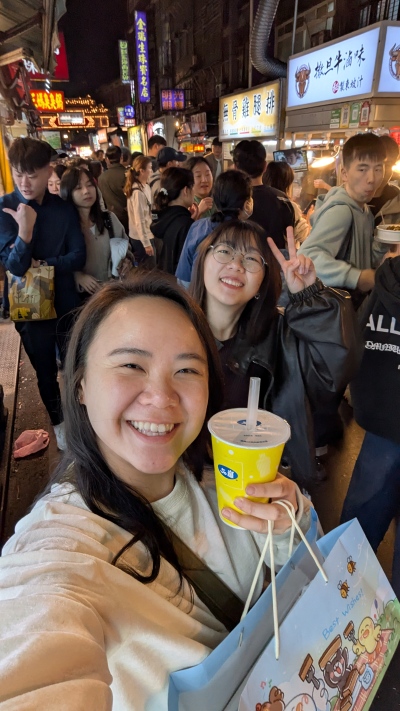 Where is your favorite place to visit?
I love the east coast very much. We call the counties on the east side the pure land in Taiwan, which have much lower population density. The coastline and mountains face the Pacific Ocean. You can travel between mountains and beaches by buses or trains, visiting a deep gorge and a blue and spectacular ocean. They are the best places for urban people who want to relax, have a slow-paced trip and get closer to Mother Nature.
Briefly describe the people and culture. What values or traditions help to shape both?
Taiwan is an immigrant society and has a complicated history. We not only have "Han" people who moved from Mainland China around the 16th century, but also we own the Dutch and Spanish colonized heritages in language and architecture left in the 17th century, and all the infrastructures built during the Japanese colonial time in the early 20th century. However, we still preserve our aboriginal people's cultures and languages, even though they were banned and endangered when the foreign authority, Chiang Kai-shek, came to Taiwan in 1949.
The chaos of the authority changes has shaped Taiwanese people to be resilient and hardworking. No matter how complex it is for Taiwanese people to find our own identities, starting from the older generations who desired to escape poverty and the damages left by the war, and over the decades, Taiwan has been established as a technology island and is known for its semiconductor manufacturing technique.
Register for Taiwan.
Global Insights is hosted by the Office of Global Education, the Cultural Centers, Residence Life and the Office of Institutional Compliance and Title IX. For more information, please contact international@scranton.edu or 570-941-4841.
Global Insights 'Taiwan' Set for March 12
The University of Scranton this spring will welcome national thought leaders as part of a series of lectures on topics including ethics, history, religion and social issues.
First, on Thursday, Feb. 19, Meghan Sullivan, Ph.D., the Wilsey Family Collegiate Professor of Philosophy at the University of Notre Dame, will present “Loving Strangers” as part of the University’s Ethics Across the Curriculum initiative. Dr. Sullivan is the founding director of Notre Dame’s Institute for Ethics and the Common Good and has received millions of dollars of grants to support ethics-based work and research.
Dr. Sullivan’s lecture is scheduled to begin at 5:30 p.m. at the PNC Auditorium inside the Loyola Science Center.
A series of Gail and Francis Slattery Center for Ignatian Humanities-sponsored lectures — with support from various other offices and departments — begins Wednesday, Feb. 25, and closes on Thursday, April 23, with the annual Sondra H’87 and Morey Myers H’12 Distinguished Visiting Fellowship in the Humanities and Civic Engagement Lecture.
All lectures are free and open to the public.
Here is a list of the upcoming events:
When: 5 p.m. Wednesday, Feb. 25
Where: Pearn Auditorium, Brennan Hall
Who: Amy Jill-Levine, Ph.D., Rabbi Stanley M. Kessler Distinguished Professor of New Testament and Jewish Studies at Hartford International University for Religion and Peace and University Professor of New Testament and Jewish Studies Emerita at Vanderbilt University
What: “The Bible, Gender and Sexuality: Historical Insight and Contemporary Relevance”
When: 6 p.m. Thursday, Feb. 26
Where: Rose Room, Brennan Hall
Who: Michelle Lelwica, Ph.D., Professor of Religion at Concordia
What: “The Religion of Thinness: How Faith, Culture and Body Ideals Shape Our Relationship With Ourselves and Each Other”
When: 5 p.m. Wednesday, March 4
Where: Pearn Auditorium, Brennan Hall
Who: Rev. James Alison, Catholic priest and theologian
What: “The Catholic Church and Matters LGBT: How Did We Get Here and Where Are We Going?”
When: 5 p.m. Wednesday, March 11
Where: Heritage Room, Weinberg Memorial Library
Who: Andrew Hartman, Ph.D., Distinguished Professor of History at Illinois State University
What: “Karl Marx in America”
When: 5:30 p.m. Thursday, March 26
Where: Pearn Auditorium, Brennan Hall
Who: Michelle Loris, Ph.D., Associate Dean in the College of Arts and Sciences at Sacred Heart University
What: “Gay and Catholic: A Long and Winding Road to Faith and Flourishing”
When: 4 p.m. Thursday, April 9
Where: PNC Auditorium, Loyola Science Center
Who: Jonathan Nashel, Ph.D., Professor of History at the University of Indiana South Bend
What: “America, Vietnam and the ‘White Space’ of History”
When: 6 p.m. Wednesday, April 22
Where: Pearn Auditorium, Brennan Hall
Who: Alexis Paige, award-winning author
What: “Shame Must Change Sides: How Gisele Pelicot, Trauma Studies and Survivor-Centered Storytelling Can Inform a New Paradigm on Gender-Based Violence”
The Sondra H’87 and Morey Myers H’12 Distinguished Visiting Fellowship in the Humanities and Civic Engagement Lecture
When: 5:30 p.m. Thursday, April 23
Where: Pearn Auditorium, Brennan Hall
Who: Brandon Terry, Ph.D., John L. Loeb Associate Professor of the Social Sciences at Harvard University and co-director of the Institute on Policing, Incarceration and Public Safety at the Hutchins Center for African and African American Research
What: “Shattered Dreams, Infinite Hope”
Ethics Across the Curriculum, Slattery Center Lectures Upcoming
By Marcus Smith '27, Student Correspondent
Stepping foot into the Royal Theater in the McDade Center for Literary and Performing Arts, the bustle of urban downtown Scranton gives way to the small backwoods town of Gilead, Wisconsin, for the spring musical “The Spitfire Grill.”
The musical, written by James Valcq and Fred Alley, tells the story of a young parolee named Percy who helps bring new life to the dying town when she takes a job at the titular Spitfire Grill diner.
The Players will perform "The Spitfire Grill" on Friday, Feb. 27; Saturday, Feb. 28; Sunday, March 1; Friday, March 6; Saturday, March 7; and Sunday, March 8. The Friday and Saturday shows are at 8 p.m. and the Sunday shows are at 2 p.m.
Tickets are $10 for general admission or $7 for students and faculty/staff and can be bought online or at the door.
Michael O’Steen, MFA, associate professor and the musical’s director, said the themes of found family and acceptance are more important in 2026 than ever.
“We see several broken families in the Spitfire Grill and they find a new family to fit into,” O’Steen said. “It’s also about accepting those who are different, people who are different from us, who might have iffy backgrounds that we can write off as the Other.”
O’Steen described The Spitfire Grill as “an intimate, lovely musical” that he especially enjoyed because it is an ensemble piece.
“Every actor in the show plays a significant character, carries significant vocals and significant scenes and themes,” he explained. “It’s a challenge for these young actors who want to improve as actors, designers or directors or theater technicians. The Players use everything as a learning tool and I think it's great.”
Devon Donnelly '29, an advertising and public relations major from Chester, New Jersey, plays Percy Talbott in her debut with the University of Scranton Players, but already has become comfortable with the company.
“I'm very fortunate to have friends in the cast that are my age that I talk to, so it's easing me into this new experience…I feel like I found my groove,” she said.
$content.getChild('content').textValueDonnelly explained how important her character’s story of recovery and healing is for people to witness.
“It’s a tale of power and perseverance. She took a terrible hand she was dealt in life, and she was able to turn that around and make herself a new life with new friends and a whole entire new family,” she said. “It's important for people in this day and age to really look back and reflect that no matter what happened to you, no matter what you've gone through, you can always make light of any situation and always try to find something new for yourself.”
She also said that working in the company’s professional environment has been unlike any experience she has had before in the theater.
“It’s more in-depth and the type of musical we are doing is much more heavy,” she said. “I got a chance to take on something big and do something that almost feels too challenging, but I feel like I'll be able to do it. I'm just excited.”
The company features Scranton students Donnelly of Chester, New Jersey; Lauren DeSantis of Long Island, New York; Gabriella Palmer of Phoenixville; Cassidy Pfeiffer of Old Forge; Alexander Smulowitz of Shavertown; Marcus Smith of Schuylkill Haven and James Stensland of Huntington, New York.
For more information, contact the University Players box office at 570-941-4318 or visit the Players on Instagram @scranton_players.
The University of Scranton Players bring exceptional theatre to Northeastern Pennsylvania every season. The Players’ productions feature University of Scranton students in a mix of classical and contemporary works under the direction and mentorship of award-winning faculty and guest artists.
Marcus Smith '27, Schuylkill Haven, is an English and theatre double major at Scranton.
Photographs are by Grace DiCarlo '27, a marketing major from Boonton, New Jersey.
Scranton Players To Tell Story of Renewal in Spring Musical
This spring, student teachers from The University of Scranton are performing their duties at numerous classrooms across public and private schools in the Greater Scranton Area.
In total, 14 undergraduate and seven graduate students will serve and gain valuable experience at primary and secondary schools in the Dunmore, North Pocono, Riverside and Scranton School Districts, as well as at Scranton Preparatory School and with Northeastern Educational Intermediate Unit No. 19 and the Diocese of Scranton.
Below is a list of the undergraduate and graduate students who are serving local schools as student teachers:
Bridget Basile, of Rockville Centre, New York, will teach at Moscow Elementary Center
Alessandra Bellino, of Schwenksville, will teach at Dunmore Junior/Senior High School
Chloe Colozza, of Old Forge, will teach at Riverside Junior/Senior High School
Sean Comiskey, of Dublin, Ireland, will teach at Dunmore Junior/Senior High School
Paige Conflitti, of Moosic, will teach at Isaac Tripp Elementary School
Gretchen Haray, of Haworth, New Jersey, will teach at Moscow Elementary Center
James Kane, of White Plains, New York, will teach at Riverside Junior/Senior High School
Faith Kwasnik, of Fair Lawn, New Jersey, will teach at Charles Sumner Elementary School
Alexis Maese, of Marlton, New Jersey, will teach at Riverside Junior/Senior High School
James McGrath, of Dunmore, will teach at Scranton Preparatory School
Jessica Middleman, of Huntingdon Valley, will teach at John F. Kennedy Elementary School
Alexis Nardella, of South Setauket, New York, will teach at the SOAR Program
Anthony Normile, of Lindenhurst, New York, will teach at Dunmore Junior/Senior High School
Emma O’Hara, of Commack, New York, will teach at Dunmore Learning Center
Timothy Prothero, of Scranton, will teach at Riverside Junior/Senior High School
Julia Santacreu, of Westbury, New York, will teach at Riverside Junior/Senior High School
Molly Schollenberger, of Sayville, New York, will teach at Dunmore Junior/Senior High School
Katherine Smith, of Sparta, New Jersey, will teach at Scranton High School
Ryan Sophabmixay, of Scranton, will teach at West Scranton High School
Somer Walsh, of Scranton, will teach at St. Clare/St. Paul School
Stevie Wilkinson, of Moscow, will teach at Dunmore Junior/Senior High School
University of Scranton Student Teachers Begin Assignments at Local Schools
The University of Scranton’s Schemel Forum World Affairs Luncheon Seminars will explore everything from artificial intelligence and ancient wisdom traditions to insights on the federal government and the American Revolution.
A buffet lunch is included for the four seminars, which will take place from 11:30 a.m. to 1 p.m. on the University’s campus. The Schemel Forum is sponsored by Munley Law and is free for University of Scranton and Geisinger Commonwealth School of Medicine students, faculty, staff and Schemel Forum members. For non-members, the seminars are $30 in-person; remote access, when available, is $15.
George Aulisio, Ph.D., dean and professor of the Weinberg Memorial Library and director of the Schemel Forum, recently appeared on WVIA's "ArtScene with Erika Funke" to discuss the upcoming events.
Among the presenters is former U.S. Sen. Bob Casey, who joined the University in August as a Leahy Distinguished Fellow in Public Service. Casey, Of Counsel, Dilworth Paxson LLP, will discuss “The Federal Government Today: Institutional Pressures and the Way Forward,” with a luncheon presentation that will be held Thursday, March 26, in the McIlhenny Ballroom of the DeNaples Center.
At a time of heightened public concern about governance, trust and democratic stability, Casey will offer a thoughtful examination of how the federal government operates today. He hopes attendees will gain a better understanding of “what federal institutions are supposed to be about and what they must deliver for citizens.”
“We are at a time in history when we all need to be reminded about how government is supposed to work at every level,” said Casey, who served during four presidencies. “It’s our responsibility as citizens to understand how government works.”
Drawing on 18 years in the U.S. Senate representing Pennsylvania, Casey will explore the role of federal institutions, the norms and constraints that guide them, and the pressures they face in an era of polarization, rapid change and public skepticism.
Casey will discuss how governing systems work in practice — where they remain resilient, where they are under strain, and how accountability and constitutional guardrails function across branches of government. His talk will focus on the judicial branch of the federal government, which is currently under significant strain. This, he says, underscores the importance of becoming informed and engaged in our political systems.
“Our democracy doesn’t function on autopilot. It only functions well if citizens become full, active participants,” said Casey, who also served as State Treasurer and Auditor General of the Commonwealth of Pennsylvania.
Casey’s talk concludes by considering a constructive path forward, including the roles of civic engagement, institutional responsibility and, most importantly, informed public participation in sustaining democratic life.
“I think the way forward is engagement by informed citizens,” he said, noting that it’s easy to take things for granted when institutions are functioning as they should.
Casey also reflected on the challenges of information overload in today’s world.
“We hear a lot of information but not enough information that is factual,” he said.
The spring luncheon series begins Friday, Feb. 27, with the talk “Advancing Decision Sciences with Artificial Intelligence: Swarm Intelligence, Predictive Analytics and Executive AI Leadership,” presented by Anasse Bari, Ph.D., professor of Computer Science, Courant Institute School for Mathematics, Computing and Data Science, New York University (NYU); director, NYU’s Predictive Analytics and AI Research Lab; and contributor, CNN and the Washington Post. The luncheon presentation will be held in the Rose Room of Brennan Hall.
Dr. Bari has led transformative research in artificial intelligence and predictive analytics — work that has saved lives through early disease prediction, reshaped Wall Street with AI-driven investment tools, accelerated the discovery of new energy sources, and strengthened civic engagement, election forecasting and political strategy.
This talk will explain how swarm intelligence — AI-inspired by the collective behavior of bird flocks, dolphin pods and ant colonies — is driving new algorithms that generate forward-looking insights in complex environments. It will feature case studies led and deployed by Dr. Bari, including predictive modeling for COVID-19 severity, real-time election forecasting and public opinion modeling, swarm-based trading and AI tools accelerating research and commercialization in emerging energy sources such as Low Energy Nuclear Reactions. Dr. Bari will also introduce the BARI AI Enterprise Transformation Framework for Executives.
Next, on Friday, March 6, James McKane, living history interpreter and artisan, will present “Commemorating and Interpreting the American Revolution 250 Years Later.” His luncheon presentation will be held in the Rose Room of Brennan Hall.
With America preparing to celebrate the 250-year anniversary of the Declaration of Independence, McKane’s presentation is both timely and enlightening. The years 2025–2033 mark the 250th anniversary of the American Revolutionary War. While major milestones often dominate public commemoration, the defeats, glories, stories and often-overlooked faceless individuals of the Revolution merit equal attention, according to McKane, who served as an advisor for Ken Burns’ “The American Revolution.” A leader of multiple living history organizations, McKane has a deep understanding of the period’s challenges.
During the luncheon presentation, he will examine the American Revolution through living history, drawing upon his extensive experiences organizing, leading and participating in historical reenactments. These experiences include rowing across the Delaware River on Christmas Day, recreating hundreds of period-accurate uniforms, and even constructing eighteenth-century fortifications for Ken Burns’ recent documentary on the war.
McKane, who earned his bachelor’s degree in history from The University of Scranton, is also a design patent examiner for the U.S. Patent and Trademark Office.
The spring luncheon series will conclude Tuesday, May 5, with a presentation by Jennifer Houser Wegner, Ph.D., curator, Egyptian Section, Penn Museum, and adjunct associate professor in the Department of Middle Eastern Languages and Cultures at the University of Pennsylvania. Dr. Houser Wegner will discuss “Wise Words: Ancient Egypt’s Wisdom Tradition” at a luncheon in the Rose Room of Brennan Hall.
The literary genre known as “instructions” or “wisdom literature” is among the earliest in ancient Egyptian writing. This talk will examine the central themes and motifs found in Egyptian wisdom literature and consider how they resonate with didactic traditions from neighboring ancient cultures.
Emerging in the Old Kingdom, these texts continued to be composed for more than two millennia, extending into the Ptolemaic and Roman eras. While their structure and tone evolved over time, their fundamental purpose remained consistent. Instruction texts were typically framed as a father addressing his son and conveyed moral, ethical and practical guidance for achieving a successful life. As such, the texts present the compiled wisdom of the society that produced them. This tradition reflects the broader Egyptian interest in divine wisdom, embodied in deities such as Thoth and Maat, who oversaw knowledge, writing and the proper order of the world.
To register for the seminars, call 570-941-4740 or email schemelforum@scranton.edu.
To pay online or for additional information about Schemel Forum events, please visit the Schemel Forum’s webpage.
Schemel Forum Spring Luncheon Seminars Announced
Join an evening of good food and international cultural learning on Feb. 19 at 6:30 p.m. at Brennan Hall, room 509 (Rose Room) at The University of Scranton. Try your hand at a chopstick competition, Chinese calligraphy, lantern-making and Japanese origami workshop. RSVP required.
The event is co-sponsored by the Asian Studies Program and the Department of World Languages and Culture, with Assistance from the Asia Club.
Register here.
Or, use the QR code on the poster below:
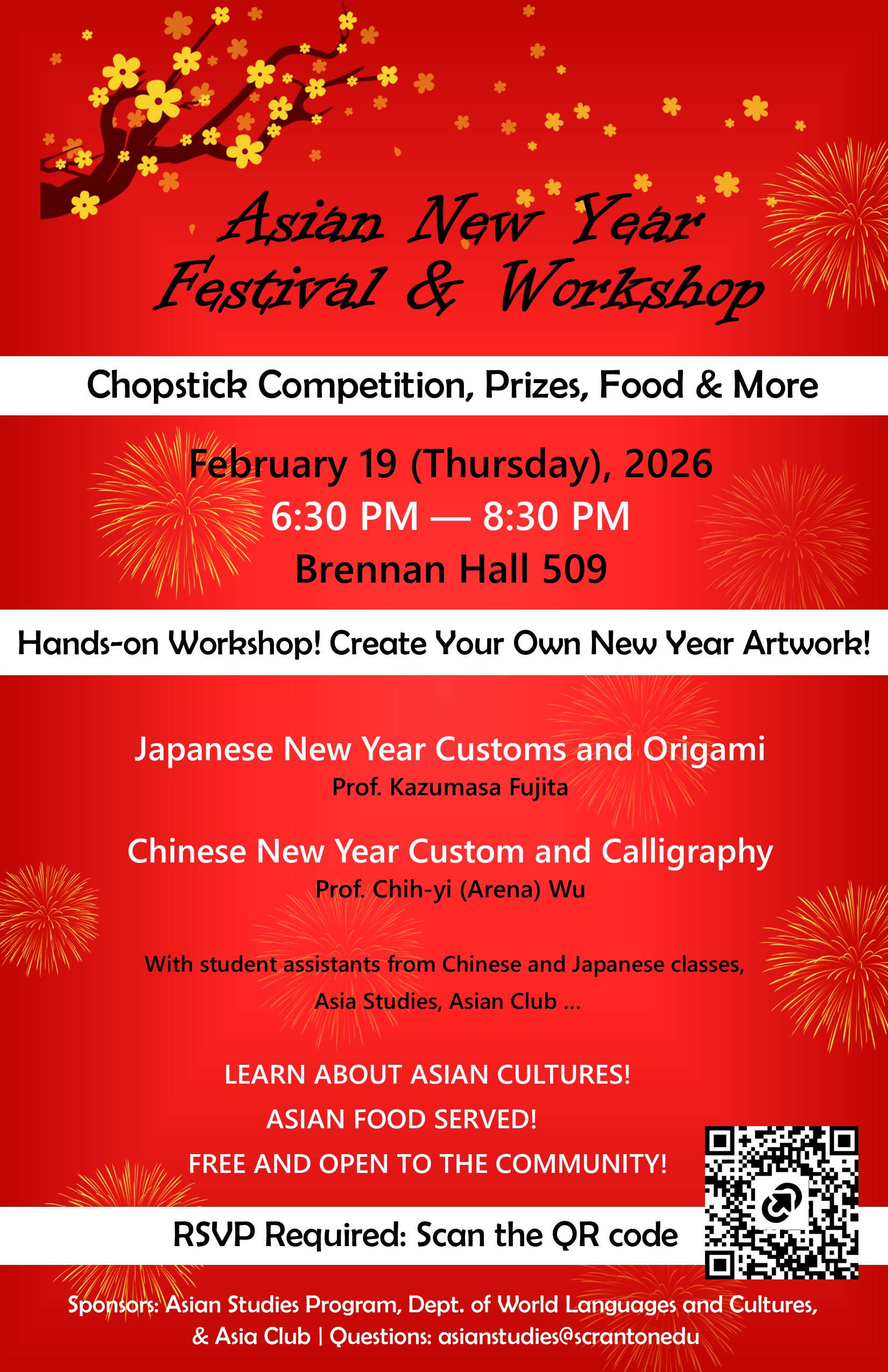
Asian New Year Festival and Workshop
By Samantha R. Kosmark, ‘26, student correspondent
The University of Scranton is reinforcing its commitment to sustainability through the construction of Robert S. '68 and Marilyn A. Weiss Hall, a new academic building on the 300 block of Madison Avenue. Designed to achieve LEED Silver certification, Weiss Hall embodies the University’s dedication to environmental responsibility and forward-thinking design. A centerpiece of this effort is the innovative use of mass timbers, a bio-based material that is reshaping modern construction practices.
Ken Ruby of HC Architects, the building’s architect, collaborated with the University to ensure that Weiss Hall harmonizes with our environment. “Trees are the best natural carbon-scrubbing machines,” Ruby said, quoting a climate forest specialist. “And when you cut a tree down, and you mill it into lumber, that carbon is retained in the wood.”
By choosing mass timber, the University is not only reducing the environmental footprint of Weiss Hall but also supporting long-term planetary health. Natural wood finishes, stone, and tile have been integrated to create a sense of connection between the building and the natural world. One of the most striking design elements is the two-story-tall first-floor lobby, supported by mass timber columns and ceilings, with additional timber used throughout the upper floors to create spacious and warm classrooms. This design feature demonstrates that thoughtful material choices can shape both the appearance of a building and the future of our environment.
Mass timber is sourced from forests managed under sustainable forestry practices, ensuring construction materials contribute to environmental health rather than deforestation. Unlike concrete and steel, which require energy-intensive processes and release significant carbon emissions, mass timber offers a renewable alternative.
“The architect’s choice to use mass timber as a significant part of the building design truly shows they were listening when the University said they want this to be an environmentally friendly building and an example of the University’s commitment to sustainability," said Mark Murphy, director of design and construction for the University who has worked closely on the project.
Mass Timber, Major Impact: Robert S. '68 and Marilyn A. Weiss Hall Green Innovation
The Office of Community-Based Learning (CBL), in collaboration with campus partners, is pleased to offer a series of three "CBL Talks" in the spring 2026 semester. The goal of these talks is to provide University students and the surrounding community with information and insights into the major challenges and opportunities facing the Scranton area, and how they can be part of positive change. This spring semester’s "CBL Talks" are as follows: "Healthcare Across the Lifespan," "Community Solutions: Affordable Housing in NEPA,” and "Making NEPA Home."
Each CBL Talk will begin with a presentation from guest speakers, followed by Q&A. These sessions will also be recorded to serve as a resource for CBL courses. These events are a special collaboration of the Office of Community-Based Learning with the Leahy College of Health Sciences T.A.P.E.S.T.R.Y. program. The talks are also open to the broader University and Scranton communities.
Details on The Spring 2026 CBL Talks
“Healthcare Across the Lifespan”
On Thursday, Feb.12, at 11:30 a.m. in the DeNaples Ballroom, DeNaples Center room 407, Dr. Maria Montoro Edwards, Maternal Family Health Services and Dr. Maria Vital, Edward R. Leahy Jr. Clinic, will highlight health and healthcare issues across the lifespan impacting individuals at different ages, from different populations and with diverse needs.
* Event update: This event is now full. We encourage prospective attendees to sign up for the following CBL talks listed below.*
“Community Solutions: Affordable Housing in NEPA”
On Thursday, March 4, at 6 p.m. in the PNC Auditorium, Loyola Science Center, room 133, Joy Hubshman, United Neighborhood Centers of NEPA, Sara Cruz, Scranton Housing Authority, and Kecia Snyder, Lackawanna County, will discuss issues related to affordable housing in NEPA.
“Making NEPA Home”
On Thursday, April 23, at 6 p.m., in the PNC Auditorium, all are invited to a screening of the WVIA documentary "Making NEPA Home," which shares stories about immigration in NEPA from refugee and immigrant individuals and agencies that work with these communities. After the film, a panel discussion will include speakers: Kara Washington, WVIA; Fikile Ryder, Catholic Social Services; Ushu Mukelo, Congolese Community of Scranton; Terilynn Brechtel and Audrey Golosky, United Neighborhood Centers of NEPA; Julie Schumacher Cohen, University of Scranton.
The CBL talks are sponsored by the Office of Community-Based Learning, Office of Community Relations, and additional campus and community partners. Questions? Contact Daysi Carreto, assistant director of Community and Civic Engagement, at daysi.carreto@scranton.edu or (570)-941-4419.
Community-Based Learning Talk Series Returns for Spring 2026
On Monday, February 16 at 6:30 p.m. The University of Scranton will host “Trivia Night: Contributions of Black Northeast Pennsylvanians Across the Eras – From the Underground Railroad to Black Scranton” featuring Glynis Johns, CEO and Founder of Black Scranton Project, and E.J. Murphy, Program Manager at the Destination Freedom Underground Railroad Walking Tour at the Waverly Community House.
This Trivia Night event will feature opening comments by the two speakers, trivia questions and prizes, and Q&A and discussion. The event is free and open to the public. Light refreshments will be provided.
This event is co-sponsored by: The University of Scranton Offices of Community Relations, Cross-Cultural Centers and the Louis Stanley Brown Black Student Union together with the Black Scranton Project and the Waverly Community House Destination Freedom Program.
Register for the in-person event
Please direct questions to the Office of Community Relations at community@scranton.edu.
Black History Month Trivia Night Event on Feb. 16
The University of Scranton will test its emergency notification system on Thursday, Feb. 12.
The University uses Everbridge to send notices of emergencies, school closing and weather delays to members of the campus community via employee office phones, Scranton email addresses and numbers registered by employees and students to receive these notices on cell phones by voice or text.
Members of the University community are reminded to register, verify or update contact information for emergency notices, which can be done through the My.Scranton portal. Just choose “Emergency Notification” link in the announcement at the top of the page, or use the search box to find “Emergency Notification System Registration.”
The University’s emergency text alerts originate from 893-61 or 878-44. The email address for alerts is alerts@scranton.edu and phone alerts will also display 570-941-5427. Students, faculty and staff are asked to save these numbers to their contacts in order to identify future emergency notification alerts.
Emergency Notification System Test Set for Feb. 12
The National History Day contest for Region 2 of the state of Pennsylvania will be held at The University of Scranton on Saturday, Feb. 28, from 8:30 a.m. to 3:30 p.m. It will involve about 50 students from grades 6-12 throughout northeastern Pennsylvania who will submit entries such as websites, papers, documentaries, exhibits and performances.
Judges and volunteers are needed for the event. Those interested should contact Dr. Sean Brennan, Department of History, at extension x4549 or at sean.brennan@scranton.edu
National History Day Contest for Region 2 Set for Feb. 28
The University of Scranton, Condron Sweda Advertising and three of the area’s most experienced politicians are combining forces on an event later this month.
Registration is open for Campaign School, a free workshop for aspiring political candidates, staff members, volunteers and anyone in Northeastern Pennsylvania with an interest in politics. The event is scheduled to run from 9 a.m. to 12 p.m. Saturday, Feb. 21, on the University’s campus.
The University of Scranton’s Leahy Distinguished Fellow in Public Service and former U.S. Sen. Bob Casey is among those who will share his insights in speaking with attendees. Lackawanna County Commissioners Chris Chermak, a Republican, and Thom Welby, a Democrat, will also present on what it takes to meet the challenges of campaigning in NEPA.
“Campaign School offers an invaluable opportunity for anyone interested in local politics and the political process to meet and learn from elected officials, former candidates, campaign strategists and advertising executives,” said Brian Snee, Ph.D., associate professor of communication and media and director of the University’s Center for Ethics and Excellence in Public Service (CEEPS).
Dr. Snee’s on-campus program, CEEPS, has partnered with Condron Sweda Advertising, a Clarks Summit-based, full-service agency, to bring the event to life.
While Campaign School will take place on the University’s campus, the final location will be confirmed closer to the event date. Registrants will receive an email with the precise location.
For more information, please visit the event’s registration page and follow CEEPS on social media, including Facebook.
Experienced Political Figures To Lead Free ‘Campaign School’ Workshop
More than 1,750 students were named to The University of Scranton’s Dean’s List for the 2025 fall semester. The Dean’s List recognizes students for academic excellence. A student must have a grade point average of 3.5 or better with a minimum number of credit hours during the semester to make the Dean’s List. The list includes students from the Jesuit university’s College of Arts and Sciences, Kania School of Management and the Leahy College of Health Sciences.
A list of students making the fall 2025 Dean’s List can be seen here.
University Announces Fall 2025 Dean’s List
Are you thinking of continuing your graduate education at Scranton? The application for Graduate Assistant positions is open. The priority deadline is March 1.
Apply now!
Graduate Assistant Application is Open!
The following students were added to The University of Scranton Dean’s List for the spring 2025 semester after publication of the list in June of 2025.
The Dean’s List recognizes students for academic excellence during the 2025 spring semester. A student must have a grade point average of 3.5 or better with a minimum number of credit hours to make the Dean’s List. The list includes students from the Jesuit university’s College of Arts and Sciences, the Kania School of Management and the Leahy College of Health Sciences.
Students added to the spring 2025 Dean’s List are:
Sarah E. Baker, Yardley;
Nicholas L. Carr, Clarks Summit;
Carson L. Salvatore, Philadelphia;
Melissa J. Schweizer, Sparta, New Jersey.
Students Added to Spring 2025 Dean’s List
Sheldon Myers ʼ26 is a biochemistry major on the pre-med track from Downingtown who recently presented cross-disciplinary research discussing the intersectionality of video games, method acting and theater at the Mid-Atlantic Popular American Culture Association (MAPACA) Conference. The conference was held in November in Philadelphia.
Myers' presentation represents a special interest of his, stemming from a class he took on drama in the United States with Hank Willenbrink, Ph.D., professor of English and theatre at The University of Scranton. Although Myers' presentation at MAPACA in Philadelphia was not a complete research project, it gave him feedback and inspiration for future projects.
Myers is also involved in organic chemistry research and plays various intramural sports at Scranton.
He recently sat down with Royal News student correspondent Marcus Smith '27 to discuss his research and the video game industry.
Q: The research you presented actually came from a final project for a drama class. What did you put together for that final project?
A: I had a final for Dr. Willenbrink's class where there were two or three prompts you could choose from. I suggested this project where I looked at the intersections among video games, theatricality and method acting. Concisely, I'd say the project suggests that video games are a new kind of medium that, through their interactive aspect, are uniquely suited to convey a type of narrative empathy that all forms of media like literature and theater serve to communicate. Because of the interactive aspect of video games where the player ideally feels that they're the ones making the decisions, or at least that they agree with the decisions that they're kind of pushed to make by that agency, the narrative empathy that they experience is deepened.
Q: How did you end up bringing this class project to the MAPACA?
A: I finished it for the final, and I didn't really feel like I was quite done with it. And particularly, I noticed that people had only really discussed this topic tangentially, which is exciting because I have the opportunity to break the ice on it. There's some work discussing whether video games can be a form of art, especially in the 2010s when they were much newer, and discussing their place in society’s conception of art, but there really isn't much looking into this aspect of them. So, with this interest, Dr. Willenbrink suggested I get some feedback at that conference, so I presented and heard people’s feedback about it.
Q: What was that experience like: Having a project that you're working on get accepted to be presented at the conference, and then putting it out there in the world?
A: Despite the work I've done here with chemistry, I haven't presented at a conference before. So, I wasn't sure what to expect, especially because the only work that I presented previously was a poster presentation. This was a speech I gave to a group, so the format was certainly different and something that I had to prepare for, but it was interesting. I got a lot of good feedback from people much more knowledgeable in the field than I was, who could point me toward some good resources.
Q: Was there any particular feedback that stood out to you?
A: One person gave me a bunch of good resources to read for my own project, which was very helpful since he had a similar interest. I haven’t gotten through reading all of them, so I'm not sure I can pick out one particular piece. But their feedback was helpful to ground my ideas in the current climate of the field, and I enjoyed listening to all the other people's presentations in that section.
Q: What did the development of this project look like from those early stages in class, to where it is now?
A: A lot of trimming it down. That was definitely the hardest part for me. I have a tendency as a writer to try to put it all out there and see what sticks, but that's not great when you have to give a speech in a time limit. There were a lot of aspects that I would have liked to present about, but just didn't have the time. I also had to figure out how to condense more complex ideas that I might have one or two pages of explanation for into a couple sentences to quickly get that point across.
Q: Where do you see this going in the future, and how are you planning to achieve that if you have any plans at this moment in time?
A: Most of the work that I've written so far is defending the position that some types of video games are this kind of interactive theatrical experience and that deepens narrative empathy. From what I can tell, people largely agree. I'd like to move on to talking about or trying to look into how we might be able to write or direct video games, what aspects of them we should focus on in order to catalyze the maturation of the form from what it is now into a more narrative-driven medium. In similar ways, we've seen past forms of media go from kind of “lower” forms of media, to “higher” forms of media. In the U.S., theater went from a hedonic pleasure in vaudeville-era theater to a more introspective, “higher media” with the trend toward realism. I would love to play a part in catalyzing a similar trajectory with video games.
Q: What do you think are some of the biggest struggles that we might have in reaching this point of creating video games that are genuine art? How would you overcome them?
A: A significant barrier is the amount of labor that's required to make something that big. In the digital stage of a video game, it's such an enormous world that creating something that's able to deterministically or otherwise guide a player through a narrative is so labor-intensive. Certainly, some games seem to have been able to do that, such as the first "Portal" game or "Subnautica."
Q: How has the University helped with this project?
A: I've worked a lot with Dr. Willenbrink, who's been very helpful in the project. I think the class that I took with Dr. Willenbrink helped me learn to unpack the narratives in the pieces we read. I gained a lot of writing skills from my other classes, as well.
Q: Is there any advice you'd like to give to anybody who might be reading this, students or otherwise?
A: Research doesn't have to be focused on exploring a state-of-the-art procedure, reaction or phenomenon; it only needs to be a novel topic you're interested in exploring. It's often those topics that yield more productive results than those driven just by the allure of working on the cutting edge. So, if there's a topic you're interested in exploring, even if it seems to be out of your wheelhouse, consider turning that interest and thought into a more productive pursuit by creating something that can be shared and published to add to the discussion you're interested in.
Student Spotlight: Sheldon Myers Presents Research on Video Games, Theater
Patrick Beldio, Ph.D., visiting theology/religious studies professor at The University of Scranton and a research fellow at Georgetown University’s Berkley Center for Religion, Peace and World Affairs, has received a significant award intended to reawaken Christian imagination through beauty, sacred art and contemplative practice.
The Creative Arts Collective for Christian Life and Faith (CAC) awarded Dr. Beldio a $100,000 grant to launch “Waymarks Toward Reunion: Beauty, Sacred Art and the Road to Freedom.” Chosen among a highly competitive field of applicants, the project will run through December 2026 and will feature numerous elements, many of which will be executed in Dr. Beldio’s “Religion and the Arts” course this spring at The University of Scranton.
“This project responds to today’s wilderness of fragmentation, loneliness and ecological crisis through shared practices of making, discernment and dialogue,” Dr. Beldio said. “We’re exploring how beauty becomes a pathway — equal to truth and justice — for encountering the divine, even within suffering.”
In addition to holding multiple workshops, where the focus will be on treating various artistic media as spiritual practices, and public lectures convening Christian and interfaith voices, the project will support the selection of one student each from Scranton and Georgetown as Waymarks Student Fellows. The selected students will receive dedicated studio time, leadership responsibilities and enhanced mentorship from Dr. Beldio, who brings 30 years of professional sculpture experience alongside his scholarly expertise in comparative theology.
“Patrick represents the best of Jesuit education,” said Cyrus Olsen, Ph.D., associate professor of theology/religious studies at Scranton, who encouraged Dr. Beldio to apply for the grant. “He brings rigorous scholarship, creative excellence and genuine interfaith sensitivity to his teaching and research.”
After piloting the program in the spring at Scranton, Dr. Beldio plans to offer the same course at Georgetown in the fall, extending the model to a second Jesuit university while deepening alignment with the Berkley Center’s mission and the Franciscan Monastery’s pastoral witness. The initiative culminates in a Capstone Symposium in Washington, D.C., celebrating student work and gathering voices from both universities alongside Jesuit, Franciscan and interfaith communities. Future phases will expand to institutions serving underserved students, ensuring broad access and reciprocity.
Dr. Beldio possesses a unique expertise in Hindu-Christian studies, which he will leverage in this project. His own monumental interfaith sculpture, “The New Being,” a 40-foot, 11-ton bronze work completed over 10 years, exemplifies this vision of bridging traditions through sacred art.
The author of “The Mother of the Sri Aurobindo Ashram: Co-Creator of the Integral Yoga,” Dr. Beldio earned his MFA from George Washington University and his Ph.D. from Catholic University of America. He has produced commissioned works across the U.S., Europe and India.
For more information about the project or Dr. Beldio’s work, visit his website.
The Creative Arts Collective supports artists and initiatives that deepen Christian faith and imagination through creative practice, fostering communities where beauty, truth and goodness flourish together.
Professor Receives Grant for Groundbreaking Art Project at Scranton, Georgetown
On Thursday, Feb. 12, Performance Music at The University of Scranton will host world music/jazz/pop/funk sensation Lucky Chops in concert. The performance begins at 7:30 p.m. in the Houlihan-McLean Center, Mulberry Street and Jefferson Avenue, downtown Scranton. Admission is free and the concert is open to the public. Seating is on a first-come, first-seated basis.
"When I first heard the guys in Lucky Chops jamming together in the NYC subway while still students, they were already drawing crowds bigger than the audiences in many of the city’s established venues," said Cheryl Y. Boga, conductor and Artistic Director of Performance Music.
“We are really looking forward to being able to share this group’s irrepressible energy and joyful excitement with our students and audiences," added Janelle Decker, Performance Music Executive Director and conductor.
The highly energetic Lucky Chops have been sharing their inspired brassy funk with audiences since 2006 when they first came together in New York City while still students. Their intent was and is to share the healing and inspirational power of music with their audiences. The intense power of that message has reached and impacted audiences throughout the world — the group has performed in 25 countries and has millions of views and followers on their social media pages. The members are all committed to passing down their creative torch musically to student musicians and music educators, as well as audiences, through their performances and educational events. Co-founder of the group Josh Holcomb, trombonist, is a native of New York City. In addition to his extensive work with Lucky Chops, Holcomb maintains an active freelance career within New York's jazz, world music and gospel music scenes.
The University of Scranton Jazz Band will perform one piece with Lucky Chops at the concert. The 25-member ensemble of big band style instrumentation is made up of University of Scranton student musicians from majors spanning the curriculum. The majority of their performances are open to the public, free of admission charge, and often feature a nationally or internationally renowned guest soloist. The primary focus of Performance Music at The University of Scranton is its student choral and instrumental performing ensembles. Hundreds of students participate in the ensembles each year, and neither an audition nor enrollment fee is required for membership.
For further information on the performance, call 570-941-7624, email music@scranton.edu or visit the University's website. For more info on Lucky Chops, visit their website.
If You Go:
What: Lucky Chops with an appearance by The University of Scranton Jazz Ensemble, presented by Performance Music at The University of Scranton
When: 7:30 p.m., Thursday, Feb. 12
Where: Houlihan-McLean Center, Mulberry Street and Jefferson Avenue, downtown Scranton
Admission: FREE
Lucky Chops to Perform at The University of Scranton on Thursday, Feb. 12
The annual Global Gala, hosted by The University of Scranton United Cultures Organization, the Asia Club, and the Commuter Student Association, will take place on Friday, Feb. 13, from 8:30 to 11 p.m. at the DeNaples Ballroom, room 407. Pre-registration is required at Royal Sync.
According to organizers, the Global Gala showcases a diversity of cultures, heritage, nationality and other aspects of a student's identity, giving members of the campus community an opportunity to make new friends and enjoy an entertaining night of music, dancing and great food.
Students, faculty and staff are invited to attend the formal event that gives students the opportunity to represent themselves in cultural clothing.
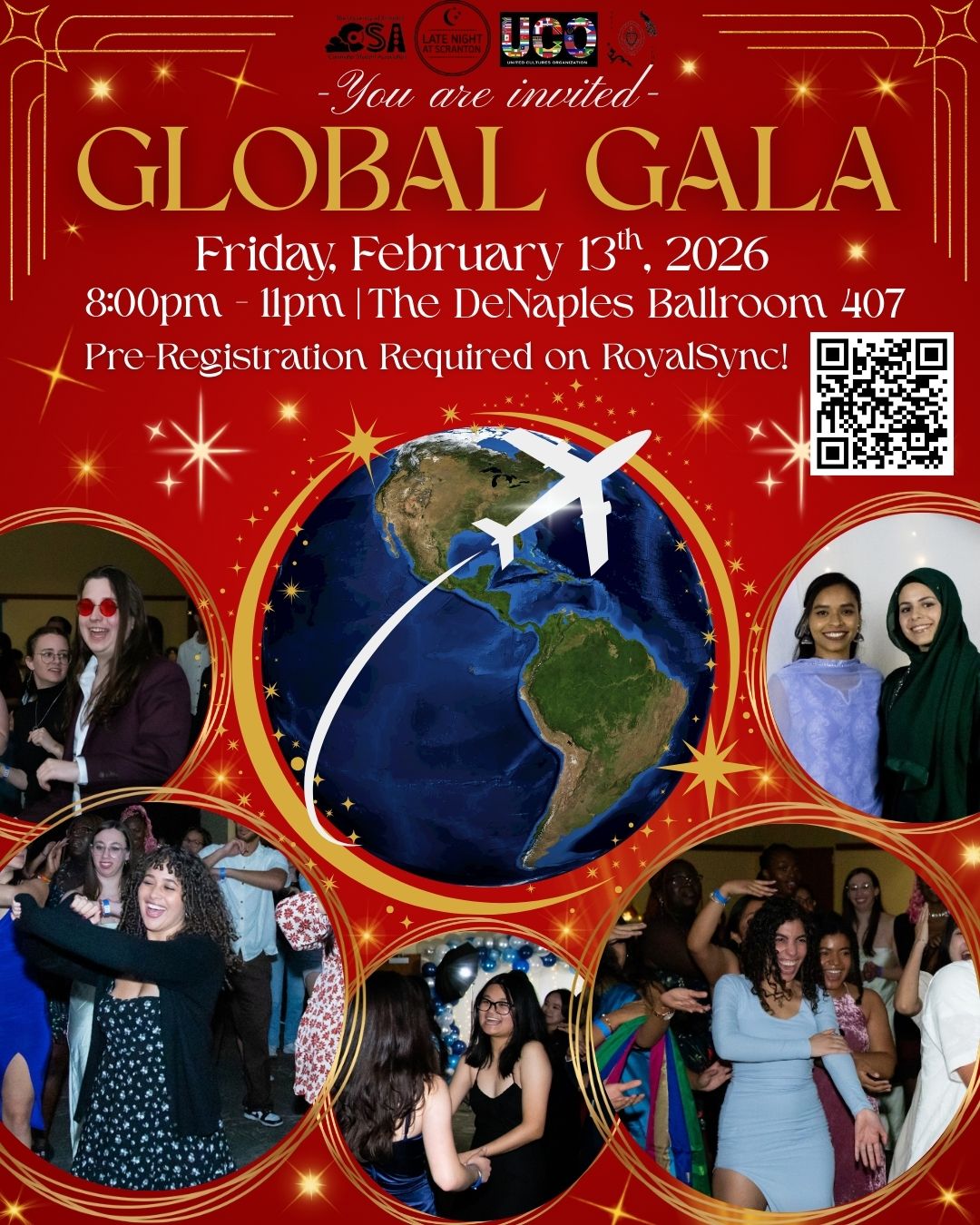
Register for the Feb. 13 Global Gala
We’d love to hear from YOU! We’re inviting Scranton students, alumni, staff and faculty to take a brief survey to help guide how the University shares its story with prospective students and families. Your unique Scranton experience offers valuable insight and ensures our enrollment and marketing efforts are authentic, meaningful and reflective of what makes a Scranton education distinctive.
The survey takes less than 10 minutes, and all responses are anonymous. You can take the survey here.
Thank you for taking a few minutes to help shape the future of Scranton. We truly appreciate your perspective.
Your Insights Matter. Please Complete the Scranton Brand Survey
“El Salvador is a country full of history, poets, celebrations, and festivals. No matter where you come from, you are welcomed as if you belong. Beyond the headlines, there are countless Salvadorans who have made meaningful contributions to art, culture, science, and community, driven by pride in their roots and love for their people. That is the El Salvador I hope others get to know..” - Jaime Serrano '27
Global Insights travels the world this semester with delicious, fun and educational programming! Jaime Serrano '27, software engineering major, will present the first spring Global Insights event on Tuesday, Feb. 10, beginning at 11:30 a.m. in the Rose Room, Brennan Hall 509.
All students, staff, and faculty are invited to the free lunch-and-learn program. Cultural cuisine will be provided. Registration is required.
Global Insights interviewed Serrano about his upcoming presentation.
What interesting fact about El Salvador would you like the audience to learn more about during your presentation?
One fascinating and lesser-known aspect of El Salvador is how the Izalco Volcano, once known as the “Lighthouse of the Pacific,” remained active for over 200 years and literally guided ships along the Pacific coast at night due to its constant eruptions.
Another remarkable story is Joya de Cerén, often called the “Pompeii of the Americas,” a pre-Hispanic village preserved under volcanic ash that offers an incredibly intimate look into everyday life over 1,400 years ago.
What is your favorite activity in El Salvador that you will share in the presentation?
One of my favorite activities in El Salvador is hiking and exploring mountains and small towns throughout the country. I especially enjoy combining this with discovering local food, since each region has its own traditional dishes and flavors. El Salvador is incredibly rich in both gastronomy and natural trails.
What do you miss most about being in El Salvador?
Without hesitation, what I enjoy and miss the most about El Salvador is the food. The country is full of incredible dishes, from fresh seafood to grilled meats and traditional desserts. What I miss the most are the seafood dishes and panes con gallina guisada, which are deeply tied to family gatherings and celebrations.
 Where is your favorite place to visit?
I have two places I never get tired of visiting. One is the Port of La Libertad (shown on bottom), because of its vibrant atmosphere and incredible seafood. The other is the mountainous region, especially places like El Boquerón Volcano (shown here), and the Ruta de las Flores, a collection of colorful towns full of life, festivals, music, and amazing food both day and night.
Briefly describe the people and culture. What values or traditions help to shape both?
If I had to describe Salvadorans in one phrase, I would say we are people with “hardworking hands and open-door hearts.” We are a small country in size, but with a resilience and warmth that cannot be measured on any map. Hospitality without discrimination, a strong sense of family, humor in both good and difficult times, and a deep respect for work are values that strongly shape our culture.
“We are small in territory, but immense in resilience, warmth, and heart,” said Serrano.
Register for El Salvador Feb. 10
This program is sponsored by The Office of Global Education and co-hosted with the Office of Institutional Compliance and Title IX, the Cultural Centers and Office of Residence Life.
For more information, please contact international@scranton.edu or 570-941-4841.
Jaime Serrano '27 Presents 'El Salvador' Feb. 10
The University will hold a Royal Meet-up in Clearwater, Florida, at Baycare Ballpark March 5 as the Philadelphia Phillies take on the Boston Red Sox in what's sure to be a spectacular spring training game.
A $65 ticket to the event includes game seating in the Palm Pavilion Patio, a pre-game buffet, beer and soft drinks. The buffet will begin at noon, and the first pitch will be thrown out at 1:05 p.m. Register here for the event.
Royals To Meet at Spring Training Game in Clearwater March 5
The Garden of Cedar will be planting Valentine hearts bearing personalized messages on the lawn of the Everhart Museum at Nay Aug Park until Feb. 14, and the leaders of both nonprofit organizations hope their fellow Scranton grads will help them reach their goal of collecting 2,000 inscribed hearts during this snow-dusted season of love.
“I’d like to issue a challenge to the University community to assist the Garden and Everhart in obtaining 2,000 Valentine participations, including every U.S. state, and as many countries as possible,” said Frank Dubas ’75, a former University trustee and the president of the Garden of Cedar, a nonprofit urban community garden/park and children’s discovery area that serves the Scranton community from its home base on the 700 block of Cedar Avenue. “Claim your personally inscribed heart and tell the world what you’d like to say to your loved ones.”
Dubas has already placed more than 700 hearts on the lawn to date as part of the Garden’s fourth annual Valentine’s Day event, and the hearts will remain on display at the Everhart until the first week of March.
“We’re a couple of U of S alums teaming up to do something really cool for the community,” said Tim Holmes ’88, CEO of the Everhart Museum, which has been enlightening Northeastern Pennsylvania through natural history, science and art since 1908.
To claim your free personalized heart, visit this link.
“Keep the requests coming,” said Dubas. “Our scribes are not deterred by snow!”Garden of Cedar, Everhart Museum Seek Messages of Love from Scranton Alumni
The University will hold a reception in Naples, Florida, with Rev. Joseph G. Marina, S.J., University president, March 4.
The reception, which will be hosted by Patrick '83 and Mary '85 Haveron, will take place at the Twin Eagles Club, 11725 Twin Eagles Blvd., Naples, Florida, from 5:30-7:30 p.m. Register today to reconnect with your fellow alumni, parents and friends in the greater Naples area.
University To Hold Presidential Reception in Naples March 4
Make plans to join fellow Royals and friends in the spring as we unite in service to implement the values of a Jesuit education and make a meaningful impact in our communities.
Service sites have been set up in California, New York, Pennsylvania and Washington, D.C., on Saturday, April 25. Visit https://bit.ly/DayofService26 for the full list of confirmed sites and dates.
If you’re interested in coordinating a Day of Service site in your region or have ideas for volunteer opportunities near you, please reach out to Marge Gleason, P'14, '17 at margery.gleason@scranton.edu.
Reminder: Register Today for the 2026 Day of Service
All alumni are invited to the Royals 2 Royals Networking Reception with current students on Friday, Feb. 20. The event will take place from 6 to 7:30 p.m. in the Rose Room of Brennan Hall, located on the fifth floor of 320 Madison Avenue in Scranton.
This engaging networking opportunity offers a platform for casual conversations between alumni and students. Our students are eager to learn from alumni about their post-Scranton careers and experiences. Refreshments will be served, creating a relaxed atmosphere conducive to meaningful interactions.
Following the reception, alumni are encouraged to join us at Backyard Ale House from 8 to 9 p.m. for additional socializing over drinks and appetizers. Register here to reserve your spot today.
University to Host 'Royals 2 Royals' Networking Event Feb. 20
What's new with you? To submit a Class Note, visit the Class Notes Submission Page.
Mark Chopko '74, Falls Church, Virginia, was appointed the Lieutenant of the Middle Atlantic Lieutenancy of the Equestrian Order of the Holy Sepulchre of Jerusalem. The appointment was made in October by Cardinal Fernando Filoni, who heads the order in Rome. The order is a pontifical institution dedicated to supporting the Church's works and mission and strengthening the Christian presence in the Holy Land through works of faith, service and charity. The Middle Atlantic Lieutenancy includes 13 dioceses in six states and the District of Columbia.
Colin O'Boyle '04, Plymouth Meeting, was elected president of the Montgomery Bar Association for the 2026 Bar Year. O'Boyle is a Shareholder at Elliott Greenleaf, P.C., where his practice includes trial and appellate litigation, focusing on commercial disputes, health law and employment discrimination. He is based in the firm's Blue Bell office.
Holli Bott Archer '13, Philadelphia, was promoted to Shareholder of Marshall Dennehey’s Healthcare Department.
Samuel J. Richards G'15, Bentleyville, is among the contributing authors for "Authoritarian Rule since 1750," part of Pearson’s new series of textbooks designed to support the International Baccalaureate’s revised history course being unveiled in February 2026. Richards has taught and developed curricula for schools in Brazil, China, Kenya, Switzerland and the United States. He is currently head of social sciences at the International School of Kenya in Nairobi.
MARRIAGES
Mia Notarianni '16 to Nicholas Swift '16
Katie Zefran, D.D.S.'16 to TJ Murray
Kaitlyn Davis ’17 to Matthew Andres ’17
Marissa Joyce ’20 to Jack McCaffrey ’20
Bridget Pynn '21, G’22 to Daniel Shuck '21, G’22
BIRTHS
Sean and Maribeth Castaldi Baress '14 welcomed a son, Michael Ryan.
DEATHS
Milton A. Rosenbloom '53, Bloomfield, Connecticut
C. Martin Kelly Jr. '59, Moosic
William T. Kwolek ’62, Peckville
John M. Wastak Jr. '62, Old Forge
Caesar Augustus DeLeo, M.D. '65, Lake Bluff, Illinois
Gary C. Boam '67, Roaring Brook Township
Harold P. Perkins '67, Etters
James L. Walsh '69, Camp Hill
Gerald J. Paparella G'70, Peckville
Brian R. Flynn G'71, Wolcott, Connecticut
James C. Daily G'72, Westfield, Connecticut
Thomas J. Hughes '73, G'87, Scranton
Robert A. Gerrity '76, Clarks Summit
James M. McLaine '79, Scott Township
Cindy L. Noll '80, Dalton
Ronald V. Petrilla, Ph.D. G'80, Hazleton
Gerard McGraw '85, Havertown
Denise L. Doty Cabezas '89, Wall Township, New Jersey
Lisa Gervasio Alfano '90, Verona, New Jersey
James P. Burton '96, Scranton
Deno S. Gualtieri, D.O. '03, Coopersburg
FRIENDS/FAMILY DEATHS
Diann Sauer, wife of Joseph Sauer '64
Tara Canally, wife of James Canally '95, Wyndmoor
Alumni Class Notes, Feb. 2026
Amateur radio has a long history of public service.
When emergencies and natural disasters cause conventional systems to fail, amateur radio, with its high-frequency radio waves, is used to provide reliable, long-distance communications.
Those high-frequency radio waves, however, are not guaranteed. They, too, require ongoing research.
The University of Scranton is on the front line of that research and received a three-year, $600,000 grant (subject to annual appropriations) from the Office of Naval Research. The project — officially titled, “Crowdsourced Observations for Ionospheric Model Validation and a Diagnostic Approach for Forecasting Equatorial Spread F” — is led by principal investigator Kornyanat “Kukkai” Hozumi, Ph.D., research scientist, with co-investigator Nathaniel Frissell, Ph.D., associate professor of physics and engineering.
“I’m very happy not only because, ‘Oh, we get an award, we get money.’ It’s not just that,” said Dr. Hozumi. “It’s a project that has impact on the real society and can help people to have safe and secure communication in the future. It can also help fulfill the HamSCI volunteers who contribute a lot to our HamSCI projects. Being that helpful to so many people at the same time — I feel very happy.”
HamSCI refers to the Ham Radio Science Citizen Investigation community, which was developed by Dr. Frissell and is supported by multiple six- and seven-figure grants from the National Science Foundation, NASA and other organizations. It is a worldwide group of licensed ham radio operators who gather and submit data to measure the effects of weather in the ionosphere.
“I didn’t know anything about HamSCI, at all, before I came to the United States,” said Dr. Hozumi, who was born in Thailand and educated in Japan. “Just before I started my position in 2023 with NASA CCMC (Community Coordinated Modeling Center) as a postdoc, my supervisor told me that my duty was to work on radio propagation and to use HamSCI data.”
From there, Dr. Hozumi was introduced to the world of HamSCI and to Dr. Frissell and was ultimately hired at the University in 2024. She works remotely in Utah.
This project will combine HamSCI community-contributed observations with physics-based modeling to serve multiple purposes, including creating a repeatable way to test and improve ionospheric forecasts and providing framework to evaluate performance and track improvements over time. Strengthening the reliability of systems used for communication, navigation and situational awareness is a boost for national resilience and public safety.
In a second, equally important effort, the team will also try to identify early warning signs of Equatorial Plasma Bubbles (EPBs). EPBs can interfere with critical signals, including GPS and long-distance radio, most often after sunset and sometimes into the early morning in equatorial and low-latitude regions. This interference can make it more difficult for phones, planes, ships and emergency responders to know if they are connected. On an ionogram, a chart that shows how radio waves travel through the ionosphere, EPBs may appear as Equatorial Spread F (ESF) — a spread-out pattern that can cause long-distance high-frequency radio signals to fade, distort or disconnect.
“My job is to use HamSCI data to make sure that the ionospheric model is precise,” Dr. Hozumi said. “And, if not, why?”
For more information about HamSCI, whose next workshop will be held March 14-15 at Central Connecticut State University, please visit its website.
University Receives ONR Grant: ‘A Project That Has Impact’ on Society
Members of the Classes of 2022-2026 will celebrate the 16th annual Shamrockin' Eve in the Byron Recreation Complex March 13.
Visit the Shamrockin' Eve Alumni Registration Page to register today, or visit scranton.edu/shamrockin to learn more about this year's festivities.
Register Today for Shamrockin' Eve
The University of Scranton is pleased to partner with Orbridge to offer alumni exceptional travel opportunities. Each trip combines unique itineraries, deluxe properties or ships, knowledgeable expedition leaders and the fellowship of other Royals. With special features and unparalleled access to distinguished locations, you’ll discover unforgettable places, people and cultures while enriching your understanding of our diverse and wonderful world.
Whether close to home or far away, on land or by sea, your next adventure is waiting. Join us and our partner Orbridge and make your reservation today!
Discover the World With Scranton Alumni Travel
Join us on Thursday, Feb. 12, from 6:30–8:30 p.m. in the McIlhenny Ballroom on the 4th floor of the DeNaples Center at The University of Scranton for a Craft Night hosted by Creative Sisters. The $55 registration fee includes all materials needed to create your choice of a 22-inch St. Patrick’s Day door hanger or a 22-inch Hello Spring door hanger.
Guests will also enjoy wine, beer, soda and snacks while they craft and unwind. Space is limited, so be sure to register early to save your spot.
University to Hold Craft Night with Creative Sisters Feb. 12
Join fellow Royals on Thursday, Feb. 26, from 6–8 p.m. at Hudson Golf, located at 16 Hudson Place, Hoboken, for a casual night out. The $35 per person registration fee includes golf, appetizers and one drink ticket, making it the perfect way to unwind and reconnect.
Spots are limited, so be sure to register today to secure your place.
Tee Up a Night Out at Hudson Golf
The Office of Global Education, the Cultural Centers, Residence Life and the Office of Institutional Compliance and Title IX announce Global Insights events for the spring semester. All students, faculty and staff are invited to join the Global Insights monthly programs that feature presentations by students and scholars. Seating is limited. Registration is required.
Global Insights continues to offer the University community educational programs on countries and cultures around the world, presented by international students, faculty, and staff with service experience. Three lunch-and-learn adventures are featured each semester. Cultural cuisine is offered at the luncheons free of charge to the University community.
On Tuesday, Feb. 10, Jaime Serrano '27, master of science in software engineering major, will present on El Salvador.
Next, on Thursday, March 12, Chih Yi "Arena" Wu, Fulbright Language Teaching Assistant in Mandarin, will present Taiwan.
On Wednesday, April 15, Eva Katharina Grohs, Fulbright Language Teaching Assistant in German, will present Bavaria.
All programs will take place from 11:30 a.m. to 12:50 p.m. in the Rose Room, Brennan Hall, room 509. Registration is required for each program.
Register for El Salvador.
Register for Taiwan.
Register for Bavaria.
Global Insights is hosted by the Office of Global Education, the Cultural Centers, Residence Life and the Office of Institutional Compliance and Title IX. For more information, please contact international@scranton.edu or 570-941-4841.
Global Insights Announces Spring Programs
Through March 13 Art Exhibit: “The Anthracite Coal Industry of Northeastern Pennsylvania Selected Prints, Drawings, and Watercolors from The Stanislaus Collection: 1933-1946.” Hope Horn Gallery, Hyland Hall. Free during gallery hours. Call 570-941-4214 or email darlene.miller-lanning@scranton.edu.
Feb. 6 5 p.m. Art Gallery Panel Discussion: “Depictions of the Anthracite Coal Industry in Prints of the 1930s.” Pearn Auditorium, Brennan Hall. Free. Reception to follow at the Hope Horn Gallery. Call 570-941-4214 or email darlene.miller-lanning@scranton.edu.
Feb. 9 through April 23 Art Exhibit: “Early 20th Century Celebrity Portraits by P. W. Costello.” Charles Kratz Scranton Heritage Room, Weinberg Memorial Library. Free during library hours. Call 570-941-6341 or email michael.knies@scranton.edu.
Feb. 9 through April 23 Art Exhibit: “Banknotables: Commemorative Currency Art.” Charles Kratz Scranton Heritage Room, Weinberg Memorial Library. Free during library hours. Call 570-941-6341 or email michael.knies@scranton.edu.
Feb. 9 11 a.m. to 2 p.m. Black History Month Table Sit and Play: awareness and quiz game about the 2026 theme: “A Century of Black History Commemorations,” sponsored by the Multicultural Center. First Floor DeNaples Center. Free. Call 570-941-5904 or email multicultural@scranton.edu.
Feb. 12 7:30 p.m. Performance Music: “In Concert” featuring Lucky Chops!, shown below, and The University of Scranton Jazz Ensemble. Houlihan-McLean Center. Free. Call 570-941-7624 or email music@scranton.edu.
Feb. 16 6:30 p.m. "Trivia Night: Contributions of Black Northeast Pennsylvanians Across the Eras - From the Underground Railroad to Black Scranton," featuring Glynis Johns, founder and CEO of the Black Scranton Project, and E.J. Murphy, Program Manager of The Destination Freedom Underground Railroad Walking Tour. This event will feature opening comments by the two speakers, trivia questions and prizes, and Q&A and discussion! Free to the public. Rose Room, Brennan Hall. Registration required at https://www.surveymonkey.com/r/Feb-Trivia-Night. Email community@scranton.edu with any questions.
Feb. 19 5:30 p.m. Ethics Across the Curriculum Lecture: “Loving Strangers” presented by Meghan Sullivan, Ph.D., Wilsey Family Collegiate Professor of Philosophy, University of Notre Dame; director of Notre Dame's Ethics Initiative and founding director of Notre Dame’s Institute for Ethics and the Common Good. PNC Auditorium, Loyola Science Center. Free. Call 570-941-4700 or email sarah.kenehan@scranton.edu.
Feb. 19 6:30 p.m. Asian New Year Festival and Workshop. Rose Room, Brennan Hall. Free. Registration required at https://tinyurl.com/2026AsianNewYearRSVP. Email asianstudies@scranton.edu for questions.
Feb. 21 12:30 p.m. 25th Annual Northeast PA Brain Bee sponsored by the Neuroscience Program at The University of Scranton. Snow date Feb. 28. PNC Auditorium, Loyola Science Center. Free. Pre-registration required. Call 570-941-4324 or email robert.waldeck@scranton.edu.
Feb. 25 5 p.m. The Slattery Center and The Jesuit Center Lecture: “The Bible, Gender, and Sexuality: Historical Insights and Contemporary Relevance” presented by Amy-Jill Levine, Ph.D., Rabbi Stanley M. Kessler Distinguished Professor of New Testament and Jewish Studies, Hartford International University for Religion and Peace and professor of New Testament and Jewish Studies Emerita, Vanderbilt University. Pearn Auditorium, Brennan Hall. Free. Call 570-941-4700 or email sarah.kenehan@scranton.edu.
Feb. 26 6 p.m. Humanities Forum sponsored by The Slattery Center Lecture: “The Religion of Thinness: How Faith, Culture, and Body Ideals Shape Our Relationship with Ourselves and Each Other” presented by Michelle Lelwica, Ph.D., professor of religion at Concordia College and author of Shameful Bodies and The Religion of Thinness. Rose Room, Brennan Hall. Free. Call 570-941-4700 or email sarah.kenehan@scranton.edu.
Feb. 27 11:30 a.m. Schemel Forum’s World Affairs Luncheon Seminar: “Advancing Decision Sciences with Artificial Intelligence: Swarm Intelligence, Predictive Analytics, and Executive AI Leadership” presented by Anasse Bari, Ph.D., professor of computing science, Courant Institute School for Mathematics, Computing, and Data Science, New York University; director, NYU’s Predictive Analytics and AI Research Lab. Rose Room, Brennan Hall. Registration required. Fees vary. Call 570-941-4740 or email schemelforum@scranton.edu.
Feb. 27, 28, March 1, 6-8 8 p.m. Friday and Saturday; 2 p.m. Sunday. Performance: “The Spitfire Grill” (musical) presented by The University of Scranton Players. Royal Theatre, McDade Center for Literary and Performing Arts. Ticket prices vary. Call 570-941-4318 (voice mail reservations) or email players@scranton.edu.
Feb. 28 9 a.m. Regional National History Day Competition for junior and senior high school students. The DeNaples Center. Pre-registration required. Call 570-941-4549 or email nhdparegion2@gmail.com.
Feb. 28 7:30 p.m. Performance Music: “In Recital” featuring Sidney Outlaw, baritone voice and Christopher Johnson, organ/piano/harpsichord. Houlihan-McLean Center. Free. Call 570-941-7624 or email music@scranton.edu.
March 4 5 p.m. The Slattery Center, The Jesuit Center and the Ellacuría Initiative Collaborative Lecture: “The Catholic Church and Matters LGBT: How Did We Get Here, and Where Are We Going?” presented by Fr. James Alison, Catholic priest and theologian. Pearn Auditorium, Brennan Hall. Free. Call 570-941-4700 or email sarah.kenehan@scranton.edu.
March 4 6 p.m. Community-Based Learning Talk: "Community Solutions: Affordable Housing in NEPA." This CBL talk will focus on affordable housing issues in NEPA. Speakers will include leaders from the Scranton Housing Authority, United Neighborhood Centers of NEPA, and Lackawanna County. PNC Auditorium, Loyola Science Center. Registration required at https://www.surveymonkey.com/r/Healthcare-CBL-Talk. Email daysi.carreto@scranton.edu with any questions.
March 4 7:30 p.m. Performance Music: “General Recital” featuring The University of Scranton Performance Music student musicians in solo, duo, trio and small ensemble performances. Houlihan-McLean Center. Free. Call 570-941-7624 or email music@scranton.edu.
March 5 8:30 a.m. 3rd Annual World Languages Day: “MAKE YOURSELF MORE (interesting than) AI.” Refreshments, interactive exhibits, and lightning-round beginner lessons in multiple languages with a chance to meet world languages and cultures instructors from Argentina, Egypt, Germany, Italy, Japan, Russia and Taiwan. Local high school students/teachers in World Language/ESL programs must receive registration confirmation in advance. The Kane Forum, Leahy Hall. Call 570-941-4711 or email amy.kuiken@scranton.edu.
March 6 11:30 a.m. Schemel Forum’s World Affairs Luncheon Seminar: “Commemorating and Interpreting the American Revolution 250 Years Later” presented by James McKane, living history interpreter and artisan; advisor for Ken Burns’ The American Revolution; and design patent examiner, U.S. Patent and Trademark Office. Rose Room, Brennan Hall. Registration required. Fees vary. Call 570-941-4740 or email schemelforum@scranton.edu.
March 11 5 p.m. Lecture: “Karl Marx in America,” presented by Andrew Hartman, Ph.D., Distinguished Professor of History at Illinois State University, co-sponsored by The University of Scranton History Department, The Slattery Center, the English and Theatre Department and the Pre-Law Program. Charles Kratz Scranton Heritage Room, Weinberg Memorial Library. Free. Call 570-941-4700 or email sarah.kenehan@scranton.edu.
March 25 7 p.m. No Other Land: Campus Screening and Discussion. Palestinian activist Basel Adra documents the destruction of his community in Masafer Yatta under Israeli occupation. He forms an unlikely alliance with Israeli journalist Yuval. For years, they have fought against mass expulsion—forging a complex bond haunted by the extreme inequality between them. The Oscar-winning documentary film will be accompanied by comments from and Q&A discussion with Fr. Michael Azar, Theology and Religious Studies Department, and Julie Schumacher Cohen, Community Engagement. DeNaples Center, Room 405. Registration required at https://www.surveymonkey.com/r/No-Other-Land. Email community@scranton.edu with any questions.
March 26 11:30 a.m. Schemel Forum’s World Affairs Luncheon Seminar: “The Federal Government Today: Institutional Pressures and the Way Forward” presented by The Honorable Bob Casey, Jr., Leahy Distinguished Fellow in Public Service, The University of Scranton; former United States Senator from Pennsylvania. McIlhenny Ballroom, DeNaples Center. Registration required. Fees vary. Call 570-941-4740 or email schemelforum@scranton.edu.
March 26 5 p.m. 29th Annual ACHE Healthcare Symposium: “From Collaboration to Care: The Power of High-Performing Healthcare Teams.” McIlhenny Ballroom, DeNaples Center. Registration required. Includes dinner, presentation and panel discussion. Fees vary. Call 570-941-4527 or email william.miller2@scranton.edu.
March 26 5:30 p.m. The Slattery Center and The Jesuit Center Lecture: “Gay and Catholic: A Long and Winding Road to Faith and Flourishing” presented by Michelle Loris, Ph.D., associate dean in the College of Arts and Sciences, founder of the Department of Catholic Studies, director of the Center for Catholic Studies, and professor of English at Sacred Heart University. Pearn Auditorium, Brennan Hall. Free. Call 570-941-4700 or email sarah.kenehan@scranton.edu.
March 28 9 a.m. Accepted Students Day for students and their families of The University of Scranton’s class of 2030. Meet representatives from academic departments, student activities/services, financial aid, athletics and tour campus. Various locations on campus. Call 570-941-7540 or email admissions@scranton.edu.
March 28 7:30 p.m. Performance Music: “In Concert” featuring The University of Scranton Singers and Symphonic Band. Houlihan-McLean Center. Free. Call 570-941-7624 or email music@scranton.edu.
April 7 through May 8 Art Exhibit: “Art Educators Make Art: Pennsylvania Art Educators Association Northeast Juried Exhibition.” Hope Horn Gallery, Hyland Hall. Free during gallery hours. Call 570-941-4214 or email darlene.miller-lanning@scranton.edu.
April 9 4 p.m. Humanities Forum event sponsored by The Slattery Center Lecture: “America, Viet Nam, and the ‘White Space’ of History” presented by Jonathan Nashel, Ph.D., professor of history at the University of Indiana South Bend. PNC Auditorium, Loyola Science Center. Free. Call 570-941-4700 or email sarah.kenehan@scranton.edu.
April 9 6 p.m. Performance, lecture and reception: “George Gershwin: Music and Healing,” by Richard Kogan, M.D., professor of psychiatry, Weill Cornell Medical College, and artistic director, Weill Cornell Music and Medicine Program, shown below, presented by the Schemel Forum and the Geisinger Commonwealth School of Medicine Collaborative Program. Geisinger Commonwealth School of Medicine Auditorium. Registration required. Fee $40. Call 570-941-4740 or email schemelforum@scranton.edu. 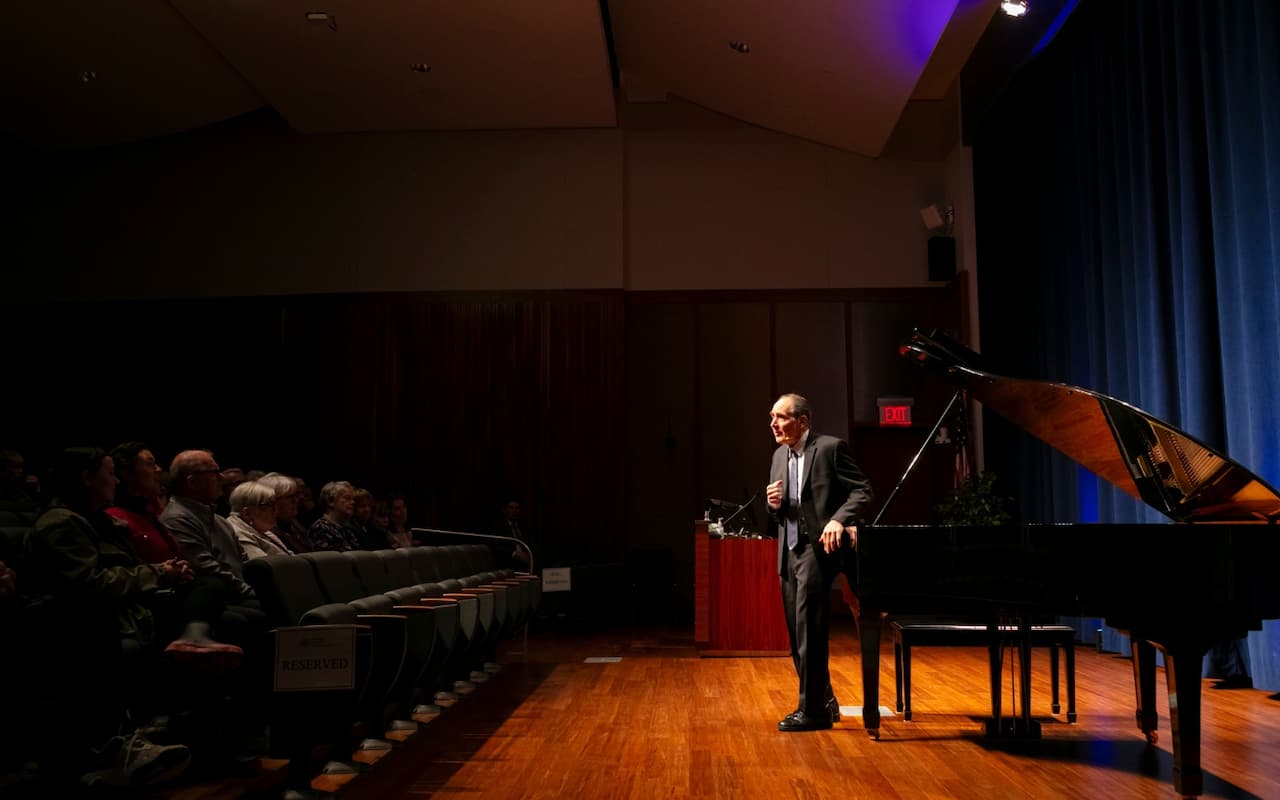
April 10 5 p.m. Art Gallery Panel Discussion: “Pennsylvania Art Educators Association Northeast Juried Exhibition.” Pearn Auditorium, Brennan Hall. Free. Reception to follow at the Hope Horn Gallery. Call 570-941-4214 or email darlene.miller-lanning@scranton.edu.
April 11 9 a.m. Accepted Students Day for students and their families of The University of Scranton’s class of 2030. Meet representatives from academic departments, student activities/services, financial aid, athletics and tour campus. Various locations on campus. Call 570-941-7540 or email admissions@scranton.edu.
April 13-22 Environmental Art Show: “Nature Reimagined.” Charles Kratz Scranton Heritage Room, Weinberg Memorial Library. Free during library hours. Call 570-941-4740 or email marleen.cloutier@scranton.edu.
April 15 4 p.m. Spring Henry George Seminar “How We Got to Now (The Henry George Edition)” presented by Philip E. Auerswald, Ph.D., professor of public policy, George Mason University, Schar School of Policy and Government. McIlhenny Ballroom, DeNaples Center. Free. Call 570-941-4048 or email pamela.turbessi@scranton.edu. Shown below is a 2025 Henry George Seminar event.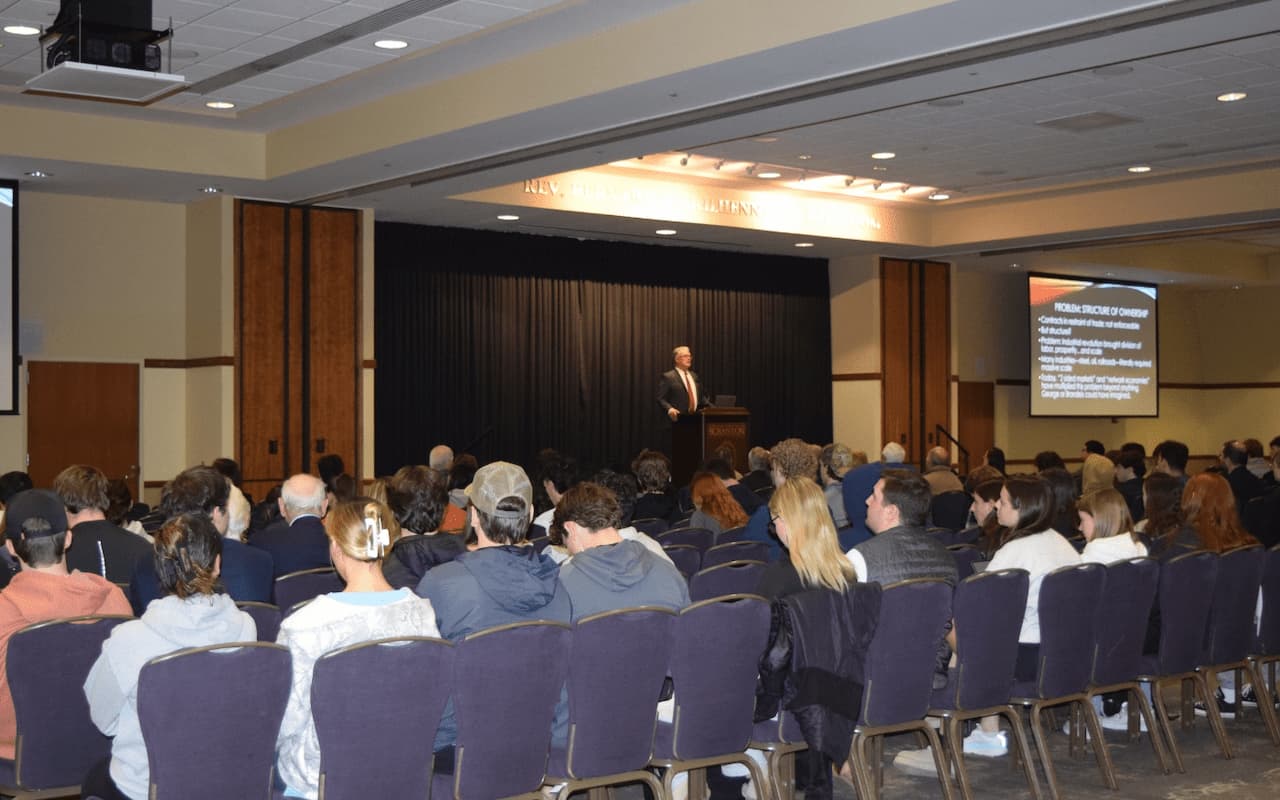
April 16 8:30 a.m. Hayes Family Competition in physics and engineering for high school students. Byron Complex. Registration required. Call 570-941-7509 or email salisa.brown@scranton.edu.
April 16-18 8 p.m. Thursday and Friday; 2 p.m. and 8 p.m. Saturday. Performance: “Oklahoma!” presented by The University of Scranton Liva Arts Company. McDade Center for Literary and Performing Arts. Ticket prices vary. Visit https://livaartscompany.ludus.com for tickets or email livartscompany@gmail.com
April 18 7:30 p.m. Performance Music: “In Concert” featuring The University of Scranton Jazz Ensemble and guest soloist Jennifer Krupa, trombone. Houlihan-McLean Center. Free. Call 570-941-7624 or email music@scranton.edu.
April 22 5:30 p.m. Graduate Open House. DeNaples Center, 4th floor. Registration required. Free. Call 888-SCRANTON or email gradadmissions@scranton.edu.
April 22 6 p.m. Humanities Forum Lecture sponsored by The Slattery Center: “Shame must change sides: How Gisèle Pelicot, Trauma Studies and Survivor-centered Storytelling Can Inform a New Paradigm on Gender-based Violence” presented by Alexis Paige, author of two award-winning memoirs: Work Hard, Not Smart: How to Make a Messy Literary Life and Not a Place on Any Map. Pearn Auditorium, Brennan Hall. Free. Call 570-941-4700 or email sarah.kenehan@scranton.edu.
April 23 5 p.m. Campus Take Back the Night. Dionne Green. Free. Call 570-941-6194 or email brandice.ricciardi@scranton.edu.
April 23 5:30 p.m. Myers Fellow Lecture sponsored by the Sondra H’87 and Morey Myers H’12 Distinguished Visiting Fellowship in the Humanities and Civic Engagement housed in The Slattery Center: “Shattered Dreams, Infinite Hope” presented by Brandon Terry, Ph.D., John L. Loeb Associate Professor of the Social Sciences at Harvard University and the co-director of the Institute on Policing, Incarceration, and Public Safety at the Hutchins Center for African and African American Research. Pearn Auditorium, Brennan Hall. Free. Call 570-941-4700 or email sarah.kenehan@scranton.edu.
April 23 6 p.m. Community-Based Learning Talk: "Making NEPA Home: Screening and Panel Discussion." This event will include a screening of the WVIA documentary Making NEPA Home, which shares stories related to immigration in NEPA from refugee and immigrant individuals and agencies that work with these communities. After the film, a panel discussion will include speakers: Kara Washington, WVIA; Fikile Ryder, Catholic Social Services; Ushu Mukelo, Congolese Community of Scranton; Terilynn Brechtel and Audrey Golosky, United Neighborhood Centers of NEPA; Julie Schumacher Cohen, University of Scranton. PNC Auditorium, Loyola Science Center. Registration required at https://www.surveymonkey.com/r/Making-NEPA-Home-CBL-Talk. Email community@scranton.edu with any questions.
April 25-26 8 a.m. National History Day State Competition for qualifying students from Pennsylvania. Pre-registration required. Call 570-941-4549 or email nhdparegion2@gmail.com.
April 25-26 9 a.m. Saturday; Noon Sunday. Friends of the Library Book Sale. Charles Kratz Scranton Heritage Room, Weinberg Memorial Library. Call 570-941-6195 or e-mail melisa.gallo@scranton.edu.
April 25 9 a.m. Junior Open House. DeNaples Center, 4th floor. Registration required. Free. Call 888-SCRANTON or email admissions@scranton.edu.
April 29, 30, May 1-3 8 p.m. Wednesday, Thursday, Friday and Saturday; 2 p.m. Sunday. Performance: “The Apiary” presented by The University of Scranton Players. Studio Theatre, McDade Center for Literary and Performing Arts. Ticket prices vary. Call 570-941-4318 or email players@scranton.edu.
April 30 5:30 p.m. Lecture, exhibit and light refreshments for Schemel Forum with the Friends of the Weinberg Memorial Library and Hope Horn Art Gallery Collaborative Program: “Unveiling Niccolò Betti’s Madonna and Child with the Young St. John the Baptist” presented by John Powell, art restorer, co-owner, Chelsea Restoration Associates and Robert Simon, Ph.D., president, Robert Simon Fine Art. Charles Kratz Scranton Heritage Room, Weinberg Memorial Library. Registration required. Free. Call 570-941-4740 or email schemelforum@scranton.edu.
April 30, May 1 9 a.m. Applied Ethics in an Era of Globalization: Perspectives from East and West. PNC Auditorium, Loyola Science Center on April 30 and Pearn Auditorium, Brennan Hall on May 1. Free. Conference Program https://tinyurl.com/GlobalEthics2026Scranton. Email asianstudies@scranton.edu for questions.
May Online Hope Horn Gallery Art Exhibit: “The University of Scranton Student Show Online.” Visit https://www.scranton.edu/academics/hope-horn-gallery/index.shtml or email darlene.miller-lanning@scranton.edu.
May 2 9:30 a.m. NOYCE Science Camp. Sponsored by The University of Scranton NSF Noyce Program. Registration is free. Kane Forum, Leahy Hall. Call 570-941-7491 or email jason.graham@scranton.edu.
Shown below are attendees at the 2025 NOYCE Science Camp.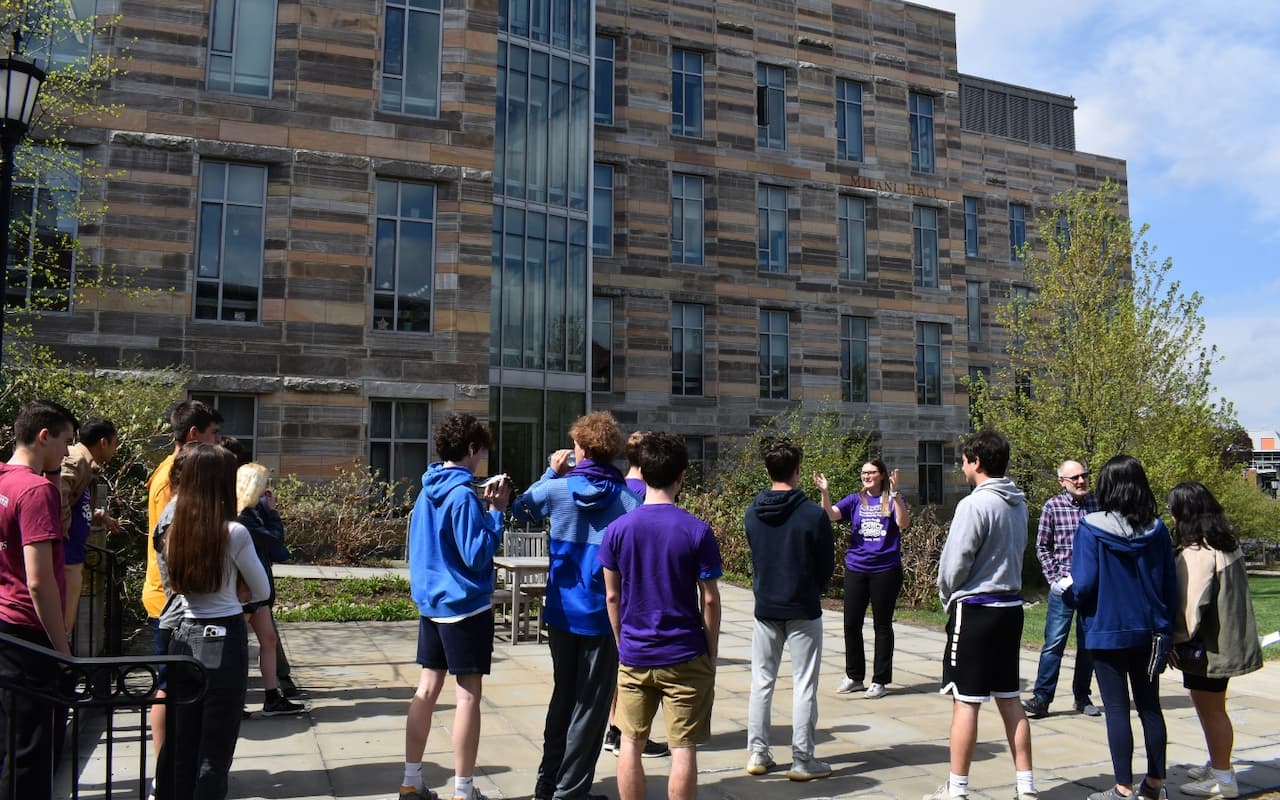
May 2 7:30 p.m. Performance Music: “43rd Annual World Premiere Composition Series Concert” featuring The University of Scranton Concert Band and Concert Choir performance of two new works by guest composer/conductor Ahmed Alom. Houlihan-McLean Center. Free. Call 570-941-7624 or email music@scranton.edu.
May 5 11:30 a.m. Schemel Forum’s World Affairs Luncheon Seminar: “Wise Words: Ancient Egypt’s Wisdom Tradition” presented by Jennifer Houser Wegner, Ph.D., curator, Egyptian section, Penn Museum and adjunct associate professor in the Department of Middle Eastern Languages and Cultures at the University of Pennsylvania. Rose Room, Brennan Hall. Registration required. Fees vary. Call 570-941-4740 or email schemelforum@scranton.edu.
May 6 noon. Celebration of Student Scholars. Displays and presentations of undergraduate and graduate student research and scholarly projects. Loyola Science Center. Free. Call 570-941-7653 or email brooke.leonard@scranton.edu.
May 8 7:30 p.m. Performance Music: “In Concert” featuring The University of Scranton String Orchestra. Houlihan-McLean Center. Free. Call 570-941-7624 or email music@scranton.edu.
May 12 7:30 p.m. Judaic Studies Institute Lecture: “The Pope and the Rabbi: My Story of Friendship and Dialogue with Pope Francis” by Abraham (Armando) Skorka, Ph.D., author and Senior Research Fellow for Jewish Studies and Jewish-Catholic Relations, Georgetown University. Pearn Auditorium, Brennan Hall. Free. 570-941-7956 or marc.shapiro@scranton.edu.
May 16 7:30 p.m. Performance Music: “In Recital” featuring John Wilson, piano. Houlihan-McLean Center. Free. Call 570-941-7624 or email music@scranton.edu.
May 23 4 p.m. Commencement Baccalaureate Mass. Byron Recreation Complex. Call 570-941-7401 or email info@scranton.edu.
May 24 11 a.m. Undergraduate Commencement. Mohegan Sun Arena at Casey Plaza. Wilkes-Barre. Call 570-941-7401 or email info@scranton.edu. Shown below is the 2025 Commencement ceremony.
May 24 4:30 p.m. Graduate Commencement. Mohegan Sun Arena at Casey Plaza. Wilkes-Barre. Call 570-941-7401 or email info@scranton.edu.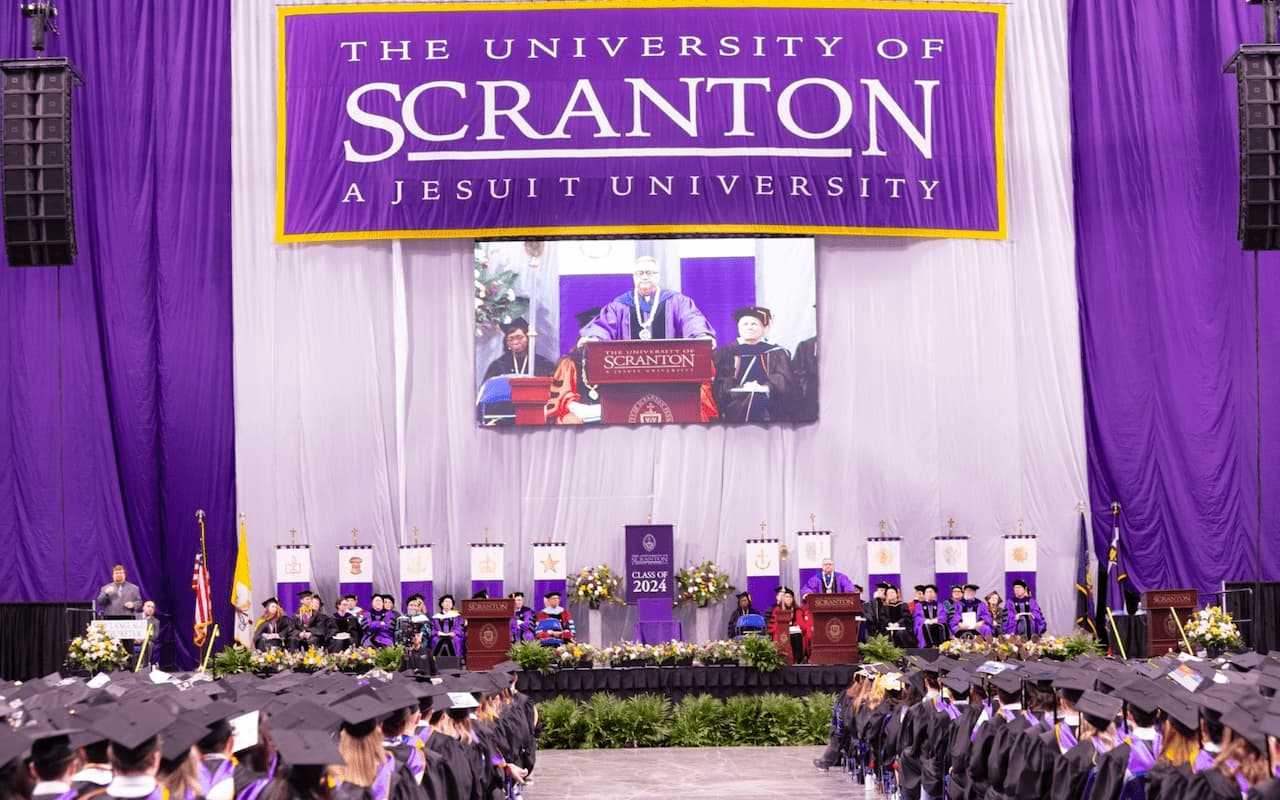
May 29 5:30 p.m. Schemel Forum Collaborative Program: “Vin et Vues: Loire Valley and its Wines” presented by David Falchek, CAE, IOM, CMP, wine writer and critic, including for Wine and Spirits Magazine and The Scranton Times-Tribune, and former executive director of the American Wine Society. Wine tasting, hors d’oeuvres, lecture, and discussion. Charles Kratz Scranton Heritage Room, Weinberg Memorial Library. Registration required. Fee $60. Call 570-941-4740 or email schemelforum@scranton.edu.
Schemel Forum Courses
Mondays: Feb. 2, 9, 16, 23, March 2, 9 6 p.m. Schemel Forum Evening Course: “Food, Climate Change, and Justice” presented by Sarah Kenehan, Ph.D., executive director of the Gail and Francis Slattery Center for the Ignatian Humanities, The University of Scranton. Weinberg Memorial Library. Registration required. Fees vary. Call 570-941-4740 or email schemelforum@scranton.edu.
Wednesdays: March 25, April 1, 8, 15, 22, 29 6 p.m. Schemel Forum Evening Course: “Appreciating Art Through the Ages” presented by Darlene Miller-Lanning, Ph.D., director of the Hope Horn Art Gallery, The University of Scranton. Weinberg Memorial Library. Registration required. Fees vary. Call 570-941-4740 or email schemelforum@scranton.edu.
Spring Semester Events Planned at University
The Office of Institutional Compliance and Title IX (OIC) will host informational and training programs for staff and faculty.
Two sessions will be offered to provide overviews of the Non-discrimination and Anti-harassment (Title VI-VII) Policy, and the Sexual Harassment and Sexual Misconduct (Title IX) Policy, and policies related to employee accommodations requests for disabilities, pregnancy or religious reasons. Become acquainted with University policy and handling of matters related to reports of harassment and discrimination based upon the protected classes, and learn what constitutes sexual harassment/misconduct and how to report incidents to the University.
-
Wednesday, Feb.18, 3:30 p.m., in-person, Brennan 228, Pearn Auditorium
Scheduled to accommodate both day and evening employees. -
Friday, Feb. 20, 10 a.m. virtual, via Zoom
Please register here for a Zoom link for University Policy Virtual Session.
Also, consider volunteering to support students, faculty, and staff participating in the Title IX process by learning more about the policies and procedures related to reports of sexual harassment and misconduct.
- Title IX-Sexual Harassment and Sexual Misconduct Grievance/Hearing Process Training for Volunteers
OIC offers online training for faculty and staff interested in learning more about the Title IX adjudication process. This important training is for individuals willing to serve the University community in Title IX (sexual harassment and sexual misconduct)-related matters, supporting students, faculty and staff. Title IX process roles may include party advisors, hearing panelists and informal process facilitators. This video may be completed at your convenience.
Register here to receive the link for Title IX Process Volunteer Training.
Please contact the OIC at compliance@scranton.edu or 570-941-6645 with any questions related to trainings, topics and reporting options.
Employee Policy Information and Volunteer Opportunities
Recognized as one of the most important and original thinkers in Jewish history, Rav Kook’s writings have been studied for generations.
“In this area of scholarship, everyone is usually studying the same writings within the canon,” said Marc B. Shapiro, Ph.D., professor and chair of theology and religious studies at The University of Scranton. “That’s what people did (with Kook) for many years.”
However, volumes of additional texts written but never publicly released by Kook, who died in 1935, have been uncovered in recent years.
The recently discovered texts have allowed historians and researchers to further examine Kook, as Dr. Shapiro did in his book, “Renewing the Old, Sanctifying the New: The Unique Vision of Rav Kook.”
Released in 2025, Dr. Shapiro’s ninth and newest book was honored as a finalist for the prestigious Rabbi Sacks Book Prize from Yeshiva University.
“We have new writings, which is causing us to rewrite his history and rewrite his thoughts,” Dr. Shapiro said. “That is very exciting scholarship.”
Dr. Shapiro described Kook as “an effervescent personality” who was constantly thinking and coming up with new — often unconventional — ideas. Kook had strong opinions on science and religion, as well as morality.
In addition to this book’s consideration for the Rabbi Sacks Book Prize, two of Dr. Shapiro’s previous books were finalists for the National Jewish Book Award.
Dr. Shapiro, who has worked at The University of Scranton since 1996, is a graduate of Brandeis University. He earned his Ph.D. from Harvard University, where he is scheduled to speak Feb. 20-21 at the Harvard Hillel.
Dr. Marc Shapiro’s 9th Book a Sacks Prize Finalist
January
View January Listing Page
The ninth presentation in the Jay Nathan, Ph.D., Visiting Scholar Lecture Series featured remarks by a career diplomat and additional programming that celebrated her native country.
Leena-Kaisa Mikkola, Ambassador of Finland to the U.S., participated in the program, titled, “Finland: History. Culture. Economy,” on Thursday, Jan. 15, at the PNC Auditorium inside The University of Scranton’s Loyola Science Center.
Mikkola, who previously served as Ambassador to China (2021-2024) and Israel (2011-2016) and as Director General for Africa and the Middle East (2017-2021), has been in her current role since September 2024. She spoke alongside Petri Koikkalainen, senior specialist for science and higher education.
In addition to the lecture, the evening’s events included live performances by Finnish singer Josefin Silén and Finnish classical pianist Markus Kaitila, as well as a reception.
Previous Nathan lecturers have included representatives from Denmark, Iceland, Lithuania, Romania, India, Thailand, Mongolia, Kazakhstan and Central Asia.
For more information, please see the series’ webpage on The University of Scranton’s website.
$content.getChild('content').textValueFinland’s Ambassador to the U.S. Speaks at Scranton (Photos + Video)
The University of Scranton will host the 25th annual Northeastern Pennsylvania Brain Bee, an event that offers high school students a chance to test their neuroscience knowledge in an academic competition.
There is no cost to enter the Brain Bee, which will begin at 12:30 p.m. Saturday, Feb. 21, at room 133 inside the Loyola Science Center. Registration is currently open and will close after Feb. 20. The registration form can be found on the event’s website. The event is open to high school students currently enrolled in Grades 9-12 and between the ages of 13-19.
Sponsored by the University’s neuroscience program in the Department of Biology, the Brain Bee covers topics including emotions, intelligence, memory, sleep and stress.
The winner of this regional bee — dedicated to the memory of J. Timothy Cannon, Ph.D., founder of the University’s neuroscience program and a longtime Brain Bee coordinator and judge — receives a $400 prize, a $1,000 scholarship to The University of Scranton and also advances to the National Brain Bee, held Saturday, April 25, at the University of California, Irvine.
Three University of Scranton biology professors will serve as NEPA Brain Bee Judges: Gary Kwiecinski, Ph.D.; Marc Seid, Ph.D.; and Robert F. Waldeck, Ph.D., director of the neuroscience program and NEPA Brain Bee coordinator.
Previous top-three finishers have attended local schools such as Wyoming Area, Wallenpaupack, Abington Heights and Scranton Prep, as well as schools from other parts of Pennsylvania and other East Coast states.
For more information or to register online, visit the NEPA Brain Bee’s website or contact Dr. Waldeck at 570-941-4324 or email robert.waldeck@scranton.edu.
Registration Open to H.S. Students for Feb. 21 Brain Bee
January 28 marks the resumption of the regular liturgical schedule on The University of Scranton campus, according to Dan Cosacchi, Ph.D., vice president for Mission and Ministry. All are welcome at these worship services:
Sunday: 11 a.m., 4:30 p.m., 7 p.m. - Mass in Madonna della Strada Chapel, shown
Monday through Thursday: 12:05 p.m. - Mass in the Chapel of the Sacred Heart
Friday: 12:05 p.m. - Communion Service in the Chapel of the Sacred Heart
Thursday: 10:15 a.m.- Byzantine Catholic Divine Liturgy in Ciszek Hall
Every other Friday (starting Jan. 30): 5:30 p.m. - Orthodox Vespers in Ciszek Hall
Additionally, on Fridays at 1 p.m., there is a Jum’ah Service at the campus Mosque.
Mission and Ministry Announces Spring Liturgy Schedule
By Elizabeth Vander Neut '26, student correspondent
Eight University of Scranton occupational therapy students traveled to Kauai, Hawaii, from Jan. 8 to 18, 2026, for a fieldwork and service-learning experience that blended cultural immersion, clinical education and community engagement. Accompanied by faculty members Dr. Lisa Kozden and Dr. Courtney Lancia, the students explored Hawaiian values through fieldwork placements and service opportunities across the island. Meredith Lee '24, OTD'26 and Caitlin Mannion '26 reflect on their experience.
Please share some location and program highlights from your time in Kauai, Hawaii. How long did the trip run, and what did your schedule look like on a daily basis?
Meredith Lee '24, OTD '26: This trip was structured to balance cultural immersion, community service and clinical exposure. Eight students participated in this experience, representing a diverse cohort that included four seniors, two fifth-year graduate students, and two sixth-year graduate students. Two occupational therapy professors accompanied the students on this trip. This diverse cohort made the trip especially unique, as it fostered peer mentorship, collaboration, and shared learning across different stages of professional development.
Daily schedules varied depending on individual roles and placements, but generally included morning cultural immersion activities, community service or fieldwork activities completed by the senior students. In the afternoons and evenings, everyone participated in additional cultural exploration, reflection and group discussions about the activities completed during the day. Community service involved engaging with local organizations supporting individuals with limited access to food and shelter, helping provide access to hot meals, clothing, household items and toiletries. These experiences reinforced the importance of addressing both immediate needs and broader social determinants of health.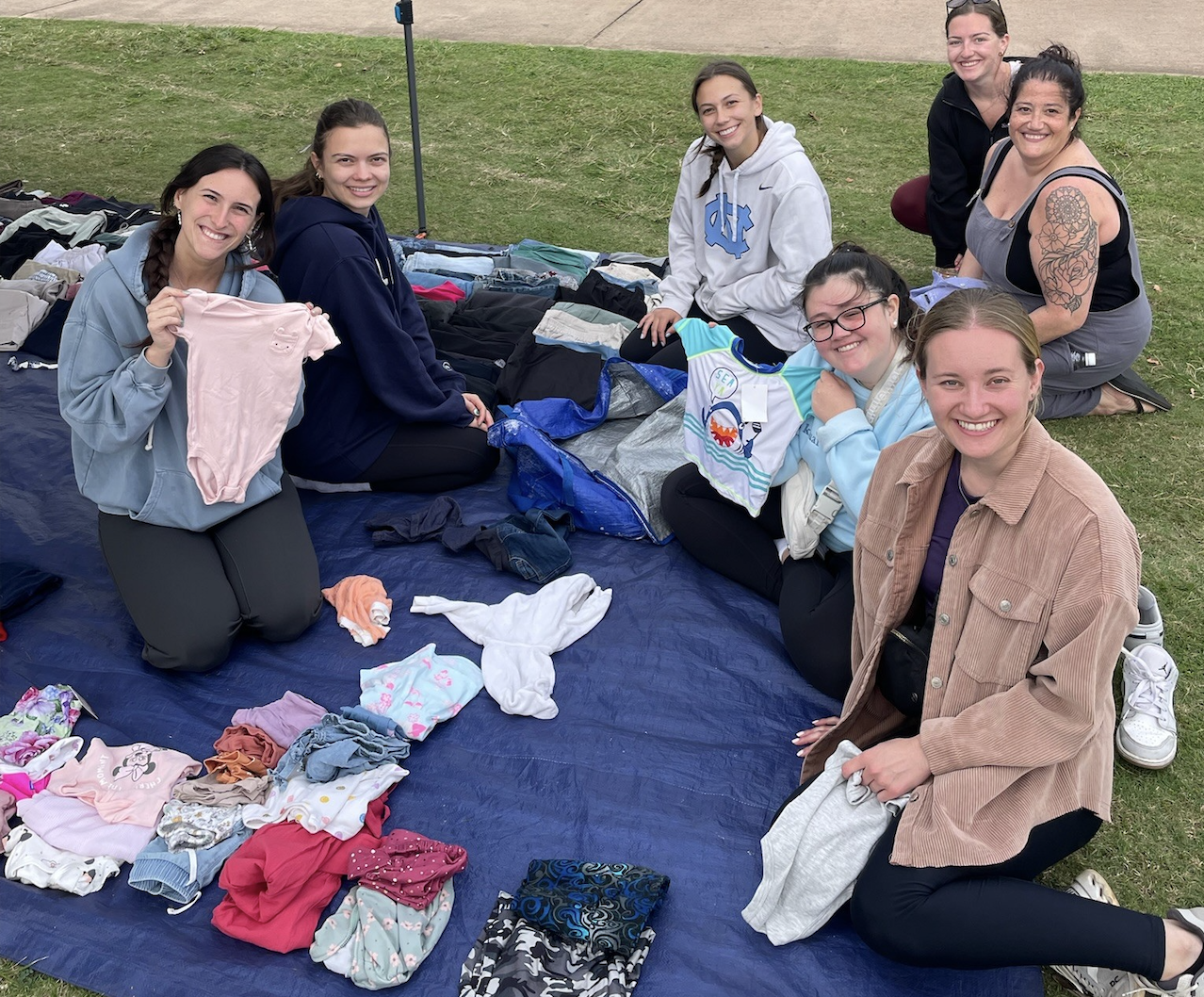
Additional experiences throughout the trip included visiting Waimea Canyon State Park, seeing Hawaiian sea turtles at Poipu Beach, attending a traditional luau with music and hula dancing and sampling traditional foods such as fresh fish and fruit. Overall, the structure of this trip and the richness of the Kauai setting created an experience that was both professionally and personally transformative.
Caitlin Mannion '26: Our 10-day trip allowed us to explore and learn more about the island’s history, culture, and environment. Each day was different as our goal was to embrace the island and whatever came our way. The first few days there we walked around Princeville, where we stayed, finding beautiful paths and trying different food spots. We experienced a luau in Lihue, where we were given a traditional feast and they performed a traditional Hawaiian love story.
During the week, I conducted fieldwork by shadowing various occupational therapists at Wilcox Hospital. We spent our days going from room to room, trying to get patients moving in any way we could and learning more about them. Toward the end of the trip, we helped Hope Collective Church distribute clothes, food, household items and other necessities to those in need. We also explored places like Hanalei, Wailua River State Park and Waimea Canyon, and experienced activities such as ziplining and tubing down an old sugar plantation irrigation system.
How has learning about Hawaiian culture and values connected to your Jesuit education? Did this experience enrich or change your perspective?
CM: Learning about Hawaiian culture connected to my Jesuit education through themes like cura personalis, respect for human dignity, and justice rooted in community. Hawaiian values such as “live aloha” and respect for the land emphasize building relationships, caring for others, and protecting the island. These ideas closely reflect Jesuit ideas about selflessness and community.
There was a saying in one town, “slow yourself down.” Many on the island take this idea to heart. They speak highly of the land and the people around them, and they take time to get to know their community. This experience enriched my perspective by helping me see how faith, culture and ethics are lived beyond my own community. It reinforced the idea that education should involve becoming more aware, compassionate, and socially responsible.
ML: Learning about Hawaiian culture and values deepened my understanding of how my Jesuit education encourages me to engage with respect, humility and authentic care for the whole person. Core Hawaiian values such as aloha, meaning love, compassion and peace; kuleana, meaning responsibility to one another and the community; and mālama, meaning to care for and protect, closely align with the Jesuit principle of cura personalis. Experiencing these values as practices within the community emphasized care for the whole person, including mind, body, and spirit.
Approaching community service through the lens of cura personalis encouraged me to be attentive to everyone’s circumstances and offer support with empathy and respect. This service opportunity strengthened my commitment to justice-oriented service and affirmed that caring for the whole person requires presence, compassion, and a willingness to learn from those we serve.
How has learning in a different cultural and healthcare environment influenced your understanding of service and/or your future goals in occupational therapy?
ML: Learning in a different cultural and healthcare environment significantly expanded my understanding of service and reshaped how I view my future role as an occupational therapist. Being immersed in Hawaiian culture emphasized the importance of cultural humility, respect and relationship building alongside clinical intervention.
After working with individuals with limited access to housing and resources, I saw how occupational therapy can serve as a vital intervention to advocate and collaborate in addressing basic needs as a foundation for engagement in meaningful occupations. This experience strengthened my desire to work in settings that prioritize community engagement and holistic, meaningful care.
CM: When performing service, every aspect of a person should be considered: culture, values and beliefs. Each individual should be viewed with respect, kindness, and empathy.
I have also seen how effective occupational therapy goes beyond clinical skills and requires genuine listening and partnership with clients and communities. This experience has influenced my future goals, as I will strive to provide care that honors clients’ cultural identities, daily occupations, and lived experiences.
Can you describe a meaningful moment from the trip and the role you played as a student volunteer?
CM: The most meaningful moment on the trip for me was providing some OT services to a man during our service event. He had suffered a stroke and was experiencing muscle weakness and spasticity on his left side. With one of the OT graduate students, we tried to figure out ways to help him. We taught him stretches he can use to help with his spastic left hand and educated him on the importance of moving around and stretching his muscles.
We even rolled up a children’s sock from the donations to place in his hand to provide a stretch throughout the day. He was willing to learn and grateful for the help we were able to give. That experience showed me how meaningful even small interventions can be.
ML: A meaningful moment from the trip was the nightly group discussions we held at the end of each day. These debriefing sessions brought together all of the students and professors to reflect on the experiences, challenges and observations from the day’s fieldwork.
As a sixth-year graduate student who has already completed all fieldwork rotations, I provided mentorship during these discussions. I offered suggestions, professional insight and practical strategies, particularly to undergraduate students navigating Level I fieldwork. These moments reinforced the importance of collaboration, mentorship, and shared reflection in occupational therapy education.
Kauai Trip Connects OT Students to Culture and Care
The University of Scranton’s Schemel Forum will offer two evening courses this spring, each furthering the program’s mission of sharing ideas and lessons that illuminate culture, ethics and the human experience. Both courses will be taught inside room 305 at the Weinberg Memorial Library.
The first course, titled, “Food, Climate Change and Justice,” is instructed by Sarah Kenehan ’02, Ph.D., executive director of the University’s Gail and Francis Slattery Center for the Ignatian Humanities. Meeting from 6 to 7:15 p.m. on Mondays — Feb. 2, 9, 16, 23 and March 2 and 9 — the course examines how global food systems intersects with climate change. Participants will explore scientific data and philosophical literature to better understand how justice intersects with food systems and individual food choices in the context of a warming world.
Dr. Kenehan earned a bachelor’s degree in biology and philosophy from The University of Scranton, where she was also a member of the women’s cross country team. She earned her master’s degree from the University of Tennessee and her Ph.D. from the University of Graz in Australia. Dr. Kenehan, who previously worked at Marywood University, began working in her current position in 2022.
The second course, titled “Appreciating Art Through the Ages,” is instructed by Darlene Miller-Lanning, Ph.D., director of the Hope Horn Gallery at The University of Scranton. Dr. Miller-Lanning’s course will meet from 6 to 7:15 p.m. on Wednesdays — March 25 and April 1, 8, 15, 22, 29 — and covers major art developments and significant artworks from the Ancient, Classic, Medieval, Renaissance, Modern and Contemporary eras, as described in Helen Gardner’s century-old text.
Dr. Miller Lanning earned a bachelor’s degree from Wilkes University, a master’s from Marywood University and a Ph.D. from Binghamton University. She has worked at the University since 1991.
Registration starts at $100 per course for non-members of the Schemel Forum.
To register for the evening courses or to request more information, please call 570-941-4740 or email schemelforum@scranton.edu.
For more information about upcoming events, visit the Schemel Forum’s website. The Schemel Forum’s spring brochure is now available.
Schemel Forum Spring Courses Explore Climate Justice and Art Across the Ages
The University of Scranton, fueled by elite finishes in two of its signature MBA specializations, remains one of the best colleges and universities for an online graduate education, according to the U.S. News and World Report’s 2026 “Best Online Graduate Programs” rankings.
Scranton earned a rare dual achievement with two top-20 finishes in the MBA Finance (tied, 14th) and MBA Business Analytics (tied, 16th) categories. Additionally, the University tied for 76th in Best Online Master’s in Business Programs and tied for 152nd in Best Online MBA Programs.
Hundreds of qualifying schools were eligible for the U.S. News rankings, which were released Tuesday, Jan. 27. U.S. News considers criteria including student engagement, student excellence, faculty credentials and training and student services and technology.
Scranton performed particularly well in the student engagement and student excellence categories. Student engagement examines factors like graduation rates, class size, one-year retention rates;and best practices such as accreditation by AACSB International, while student excellence weighs acceptance rates, work experience and students’ undergraduate GPAs, among other things. In the Best Online Master’s in Business Programs category, Scranton ranked No. 7 in student excellence and No. 47 in student engagement.
According to the most recent Roche Family Center for Career Development’s First Destination Survey, graduate degree recipients in The University of Scranton’s Class of 2024 reported a 100% success rate. Survey participants reported a mean annual salary of $82,932 — a 15.4% increase from just three years earlier — with 95% of them employed full-time.
Scranton offers online graduate degrees in accounting and finance, business, business analytics, health administration, health informatics, health sciences, human resources, operations and management, social sciences and STEM, as well as graduate certificates in various fields.
The University of Scranton also achieved high marks in the U.S. News 2026 “Best Colleges” report, released in the fall, which ranked Scranton as a top 10 college in its region with six undergraduate programs ranked nationally. The most recent U.S. News “Best Graduate Schools” report also placed five University of Scranton programs in the top 50 in the nation and several more in the top 150.
U.S. News Ranks University of Scranton Among ‘Best Online’
Lackawanna and Wayne County residents, whose households earned $67,000 or less in 2025, can receive free assistance in completing and filing their federal, state and local tax returns from University of Scranton accounting students through the Volunteer Income Tax Assistance (VITA) program.
University students have assisted residents with low and moderate incomes who need help with their basic tax returns for more than 30 years.
Walk-in service at Brennan Hall on the University’s campus begins Monday, Feb. 4, and will end on Wednesday, April 8. The VITA service is offered on a first-come, first-served basis during scheduled hours. Appointments are not available at the University.
Residents can schedule appointments at other locations by contacting the United Way of Lackawanna and Wayne Counties by visiting its website or calling 570-602-3133 or 1-866-662-8887.
Residents who qualify for the free VITA service are asked to bring the following items: a valid photo ID; Social Security cards for all taxpayers and dependents; all W2 forms; last year’s tax returns; all 1099 forms (interest, dividends, pensions); unemployment paperwork; Form 8332 for non-custodial parents; information related to income and expenses (business, rental properties, sale of stocks); a personal banking account check if direct deposit is desired; documentation related to health insurance for themselves and anyone on the tax return, such as Form 1095-A, -B or –C; and real estate tax receipts if you qualify for the rent/tax rebate.
Walk-in VITA service without an appointment is available in Room 111 of Brennan Hall, Madison Avenue, on the University’s campus on Mondays, from 9 a.m. to 3 p.m.; Tuesdays, noon to 5 p.m.; Wednesdays, 9 a.m. to 3 p.m.; and Fridays, 9 a.m. to 1 p.m.
Service begins on Monday, Feb. 4, and continues to Wednesday, April 8, except for the week of March 16-20, when the University is closed for Spring Break.
The VITA office may also close due to inclement weather.
The University reserves the right to cap the number of walk-in residents they can serve within a single day. Residents with questions may call the University at 570-941-4045.
Scranton Students to Offer Free Income Tax Assistance
A group of seventh-grade students from Wyoming Seminary visited The University of Scranton on Thursday, Jan. 22, for a hands-on field trip focused on creativity, problem-solving and entrepreneurship.
Much of the day’s programming occurred inside the IDEA Center at Robert S. ’68 and Marilyn A. Weiss Hall, where Sem students participated in interactive activities that challenged them to think like entrepreneurs and designers. Working in small teams, the students developed business ideas, identified real-world problems and pitched solutions in areas such as gaming, entertainment, sustainability and school improvements. The students also engaged with the IDEA Center’s laser engravers and 3-D printers to create advertisement products and investigate protoyping.
“Students embraced this experience completely,” said Tom Bryan, director of the IDEA Center, who was featured earlier this month in a video walkthrough of the new facility. “They collaborated, solved problems and gained real insight into entrepreneurship and design. They stepped into the role of University students for the day, rose to the occasion and had a lot of fun in the process.”
$content.getChild('content').textValueWorking alongside Bryan as volunteers were University of Scranton students Allison Kipp, a business analytics major from Pittston; Cameron Moczulski, a journalism/electronic media and advertising/public relations major from Carbondale; Damien Bryla, an accounting major from Canadensis; Daniel Juchnicki, a mechanical engineering major from Tobyhanna; and Vincenzo Angeloni, a journalism/electronic media major from Jessup.
The goal of the IDEA Center, which opened at the beginning of the 2025-2026 academic year, is to empower students, faculty and community partners to turn concepts into reality with cutting-edge resources and instructors.
For additional coverage, please see the following links from WNEP-TV and the Scranton Times-Tribune.
$content.getChild('content').textValueWyoming Seminary, University of Scranton Students Explore Innovation
On Saturday, Jan. 31, Performance Music at The University of Scranton will host the Anderson Twins Sextet performing their acclaimed program, “The Fabulous Dorseys,” to open Performance Music’s spring 2026 season. The performance begins at 7:30 p.m. in the Houlihan-McLean Center, Mulberry Street and Jefferson Avenue, downtown Scranton. Admission is free and the concert is open to the public. Seating is on a first-come, first-seated basis.
“Will and Pete are no strangers to Scranton, and on every occasion they visit, their approachable virtuosity draws in our students," said Performance Music Executive Director Janelle Decker.
“The twins first performed here with Loren Schoenberg and the National Jazz Museum in Harlem All-Stars in 2008 and have returned to the University as guest artists and clinicians so many times that they feel like sons of Scranton," added Cheryl Y. Boga, Artistic Director of Performance Music.
The Anderson brothers’ program brings the remarkable story of the Dorsey brothers, Jimmy and Tommy, to life. Performed by a sextet of New York’s finest musicians, the show traces the Dorseys’ journey from their start in the coal regions of Northeastern Pennsylvania as teenage professionals on trombone and saxophone through their rise as national stars with the Dorsey Brothers Band, to the dramatic 1935 sibling split that sent them on separate paths, followed by their long-awaited reunion a decade later.
Identical twins Peter and Will Anderson are two of the most extraordinary jazz woodwind players today. Hailed by The New York Times as “virtuosos on clarinet and saxophone," they were born and raised in Washington, D.C., and moved to New York City to attend The Juilliard School. They’ve performed with the Jazz at Lincoln Center Orchestra, Vanguard Jazz Orchestra, Wycliffe Gordon, Cecile McLorin Salvant, Paquito D’Rivera, Wynton Marsalis, and can be heard on the 2014 Grammy-winning soundtrack of HBO’s "Boardwalk Empire" with Vince Giordano’s Nighthawks. They’ve headlined at Carnegie Hall, The Blue Note, Jazz at Lincoln Center, Kennedy Center, New Orleans Jazz Festival, Feinstein’s 54 Below, Blues Alley, Birdland and performed live on Garrison Keillor’s Prairie "Home Companion" Radio Program. The Andersons have performed in over 40 U.S. states, throughout Brazil, Japan, the U.K., and six times in New York City's famed "Highlights in Jazz" series, alongside Lou Donaldson, Jimmy Heath, Ken Peplowski, Steve Turre, Warren Vache, Frank Vignola and Jimmy Cobb.
The Andersons' film credits include "Revolutionary Road," "Killers of the Flower Moon," "Boardwalk Empire" and "The Marvelous Mrs. Maisel." They performed with the Jazz at Lincoln Center All-Stars in "After Midnight," which ran on Broadway from 2013-2014, and featured Vanessa Williams, k.d. lang, Fantasia Barrino and Patti LaBelle. In 2017, the Andersons directed “The Fabulous Dorsey Brothers” in Jazz at Lincoln Center’s Appel Room, narrated by "The Wire" and "Treme" actor Clarke Peters.
The legendary Dorsey Brothers began their professional careers performing with the popular local band, the Scranton Sirens, at venues such as Scranton’s historic Hotel Casey in the early 1920s before relocating to New York and rising to fame as big band leaders. A mural of the brothers, completed in 2024 to honor their connection to the area, can be seen at 217 Wyoming Ave. in Scranton.
For further information on the performance, call 570-941-7624, email music@scranton.edu or visit scranton.edu/music. For more info on the Andersons, visit peterandwillanderson.com.
If You Go:
What: “The Fabulous Dorseys” with the Anderson Twins Sextet, presented by Performance Music at The University of Scranton
When: 7:30 p.m., Saturday, Jan. 31
Where: Houlihan-McLean Center, Mulberry Street and Jefferson Avenue, downtown Scranton
Admission: FREE
Anderson Twins' Acclaimed Concert Coming Jan. 31 to Scranton
When decluttering for the new year, consider donating gently used items to local organizations, the Center for Service and Social Justice (CSSJ) at The University of Scranton recommends. A chart listing organizations and the donations they accept is shown below. Donations include clothing, toys, linens, household items, furniture and food. Organizations include Goodwill, Salvation Army, United Neighborhood Center - Angels Attic, Friends of the Poor, Catherine McAuley Center, Griffin Pond Animal Shelter, Dress for Success, Clothesline for Men, St. Francis Commons Food Pantry, University of Scranton Royal Restore Food Pantry, St. Joseph's Center, Providence Pregnancy Center, Catholic Social Services, Luzerne County SPCA and St. Cat's and Dogs of Nay Aug Zoo.
Additionally, the Center for Service and Social Justice will accept Christmas holiday decor for an annual Holiday Flea Market held on campus in November that supports students who volunteer on service trips domestically and internationally. Drop off Christmas decorations at Ciszek Hall, 1120 Mulberry Street Scranton, Monday through Thursday 10 a.m.- 2 p.m. For more information, call the CSSJ office 570-941-7429.
Tip: Contact each organization directly about their current needs, which often change. Most do not have unlimited storage. Find them on their websites or on Facebook and message them. 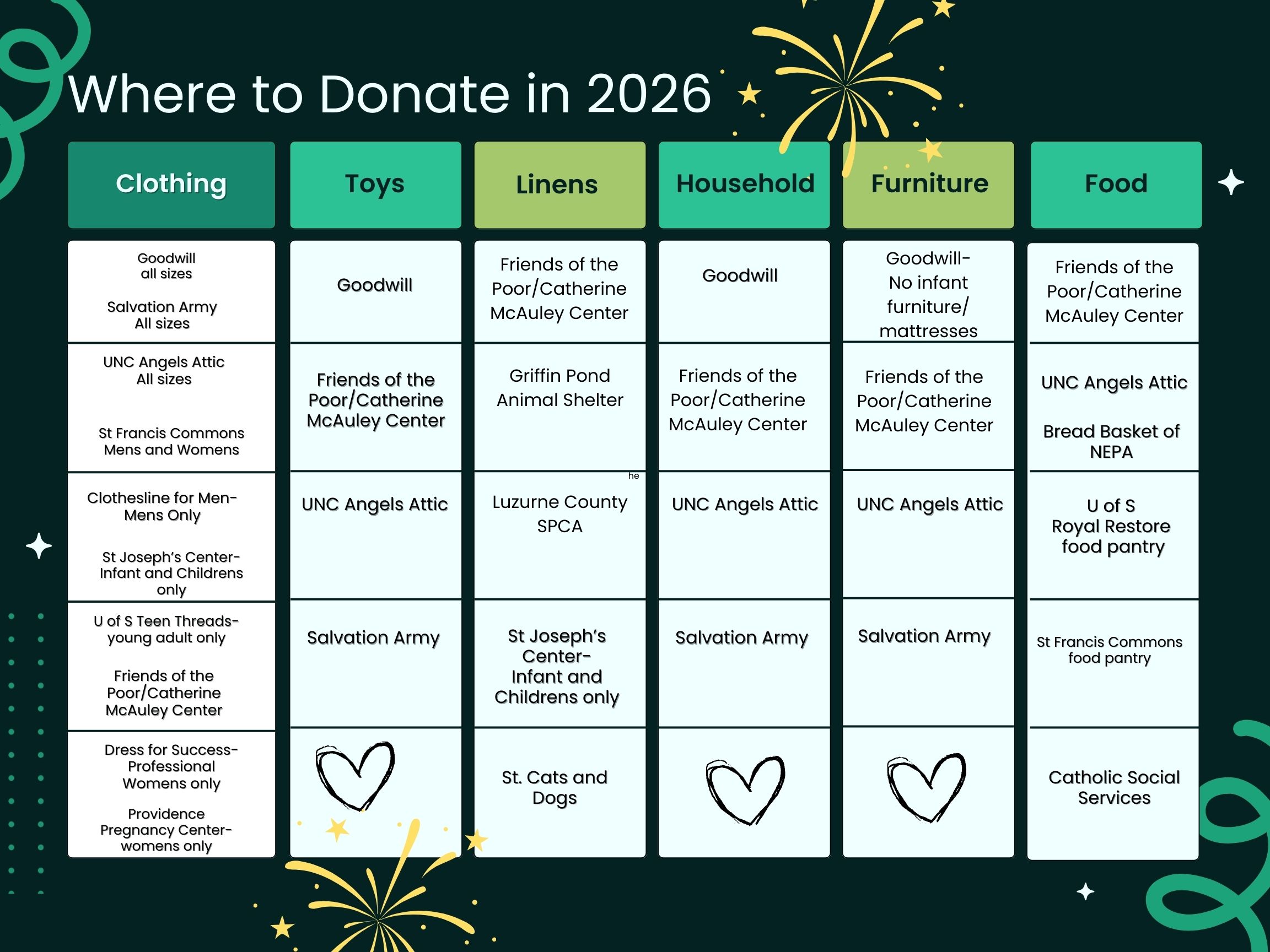
Where to Donate in 2026
Two extraordinary jazz woodwind players, identical twins Peter and Will Anderson, will present “The Fabulous Dorseys” at The University of Scranton on Saturday, Jan. 31, at 7:30 p.m.
The free concert performed by a sextet of New York’s finest musicians will begin with a pre-concert talk at 6:40 p.m. in The Houlihan-McLean Center (Mulberry Street at Jefferson Avenue.) Its focus: the late Tommy and Jimmy Dorsey, and the brothers' journey from Northeastern Pennsylvania to their rise as national stars.
Identical twins Peter and Will Anderson are two of the most extraordinary jazz woodwind players today, hailed as “virtuosos on clarinet and saxophone,” according to The New York Times. The Andersons have performed with jazz greats throughout the U.S. and abroad - over 40 U.S. states, throughout Brazil, Japan, and the U.K. Their program, "The Fabulous Dorseys," brings the remarkable story of Tommy and Jimmy Dorsey to life.
Performed by a sextet of New York’s finest musicians, the show traces the Dorsey brothers’ journey from their start in the coal regions of Northeastern Pennsylvania as teenage professionals on trombone and saxophone through their rise as national stars with the Dorsey Brothers Band, to the dramatic 1935 sibling split that sent them on separate paths, followed by their long-awaited reunion a decade later.
All events will take place in The Houlihan-McLean Center (Mulberry Street at Jefferson Avenue) and are free of admission charge, unless otherwise noted.
'The Fabulous Dorseys' Jan. 31
The University of Scranton has been nationally recognized for its dedication and distinction in community engagement in a newly released report that serves as the premier framework for assessing and honoring institutions committed to this work.
The 2026 Carnegie Community Engagement Classification, an elective designation awarded by the American Council on Education and the Carnegie Foundation for the Advancement of Teaching, listed Scranton as one of 237 honorees nationwide. The cohort includes 157 public and 80 private institutions, including 19 others in Pennsylvania. The University is the only 2026 cohort recipient of the honor in the Scranton/Wilkes-Barre area.
The classification, which is valid until 2032, is awarded to colleges and universities that submitted a self-study that revealed an institutional integration of mission, culture, leadership and resources used to advance meaningful and impactful community engagement. The Carnegie Foundation describes community engagement as “the mutually beneficial exchange of knowledge and resources in a context of partnership and reciprocity” that contributes to the public good.
Answering the Call To 'Love Your Neighbor'
“Students, faculty, staff and alumni engage with the Scranton community in a range of ways — direct service, academic projects and research, and joint initiatives — that help improve the community we all call home. They address community-defined needs and priorities in such areas as poverty, food insecurity, youth programming, health care, older adult needs, immigrant and refugee support, prison education and civic engagement,” said Julie Schumacher Cohen, assistant vice president of community engagement and government affairs. “These community-based activities and partnerships are where some of our best learning takes place and one of the important ways that we respond to the call to ‘love your neighbor,’ grounded in our Jesuit and Catholic mission."
As a Catholic, Jesuit institution, The University of Scranton’s identity is closely tied to serving others in the community. Spearheading the University’s efforts are the Center for Service and Social Justice, the Office of Community Relations in External Affairs, the Office of Community-Based Learning, the Leahy Community Health and Family Center and the Small Business Development Center. Collectively, these offices and others organize service opportunities, host educational and cultural events, provide health and wellness services, offer expert consulting solutions and create hands-on learning experiences that connect students and employees with local and regional partners. Altogether, through these and other offices and programs, the University invested $1,077,557 in its 2023-2024 annual budget to support institutional engagement in the community.
These campus offices work directly with a range of community organizations; the application highlights several key partnerships including Children’s Advocacy Center of Northeastern Pennsylvania, United Neighborhoods Center of NEPA, Scranton Jewish Community Center, Geisinger Commonwealth School of Medicine, Scranton Tomorrow, The Gino Merli Center, Catherine McAuley Center and Friends of the Poor, Bhutanese Cultural Foundation Association of Scranton, Congolese Community of Scranton, Saint Joseph's Center, Neighborworks of NEPA, Marywood STARS after-school program, McNichols Plaza Elementary School and more.
“Since arriving at the University in 2021, I have found the relationship between The University of Scranton and the City of Scranton and the broader community of Northeastern Pennsylvania to be a source of pride, mutual learning, and collaboration in pursuit of the common good. The University cannot be successful if Scranton is not flourishing and vice versa,” Rev. Joseph G. Marina, S.J., University of Scranton president, said in a letter submitted with the Carnegie application. “The University’s Jesuit and Catholic mission characterizes how we seek to engage with our community — in solidarity, in a spirit of mutuality and encounter, and in service of justice and positive change.”
The application provides information and analysis of the University’s community engagement efforts, reflecting on areas of growth and improvement as well as long-standing programs and commitments. It details local co-curricular service such as students preparing 1,700 meals in 2023-2024 for low-income neighbors through innovative projects such as “We Care;" supporting and mentoring youth in after-school programs; conducting item drives; volunteering with numerous local non-profit organizations; and participating in domestic and international service trips.
Through community-based learning, faculty and students engage locally in ways tied to their academic course or program. They have helped improve the health and wellbeing of neighbors with special needs and older adults, archived the stories of veterans, addressed period poverty, created arts activities for elementary students, provided health fairs for newly arrived refugees, and promoted awareness and advocacy on such issues as child abuse, among other projects. In 2023-2024, a total of 88 community-based learning courses were taught at the University, including an estimated 1,200 students performing 31,673 academic service hours during that year.
Community engagement is embedded in still further ways — through student government’s biannual Street Sweep that beautifies streetscapes and parks, through the many faculty and staff (80%) who engage in local community volunteer activities, and through the University's alumni’s annual day of service. The application also highlights civic engagement programs — such as non-partisan voter engagement activities and a political dialogue across differences project run since 2017 — which help students reflect on their values and use their voice within campus and in the public square.
The data and projects detailed in the Carnegie application built on the information shared through the University’s 2024 Community and Economic Impact Report, produced by the University’s Office of Community Relations. The University produced an overall economic impact of more than $277 million and awarded over $100 million in institutional student aid. The newest building on campus, Robert S. ’68 and Marilyn A. Weiss Hall, is a hub for several of the University’s community-focused programs and has state-of-the-art equipment that is meant to be shared with local partners.
Community Collaborator: University Awarded Prestigious Carnegie Classification
By Elizabeth Vander Neut '26, student correspondent
University of Scranton occupational therapy students traveled beyond the classroom this winter, participating in a service-learning trip that combined hands-on healthcare delivery, cultural immersion and community service in the rural Dominican Republic.
Led by faculty chaperone Dr. Chandra Nealon, MS/LPT, DPT, the trip provided students with a non-traditional fieldwork experience in San Juan de la Maguana, where they worked alongside local healthcare providers and community organizations to address unmet occupational therapy needs.
Students delivered services through daily pop-up clinics in rural neighborhoods along with in a more structured rehabilitation setting at the Asociación Dominicana de Rehabilitación Filial San Juan. The experience allowed students to compare healthcare delivery models across settings and cultures while responding to a wide range of patient needs.
OT needs in the area varied from healthcare screenings including vital signs, range of motion, strength, balance and functional mobility to more focused assessments and treatments. Students worked with children with diagnoses like cerebral palsy, developmental delay and autism, as well as adults with diabetes, osteoarthritis, strokes, amputations and injuries related to motor vehicle accidents.
Senior occupational therapy major Camryn Hoffman of Rockville Centre, New York, said the clinics emphasized adaptability and cultural awareness. Working with older adults and children, students conducted assessments, took vitals and implemented resource-conscious interventions.
“Limited access to equipment and time, as well as navigating a language barrier, required me to be more creative, flexible and client-centered," Hoffman said. "This reinforced that effective occupational therapy does not depend on high-tech tools, but on meaningful connection and functional relevance."
Jamie Alderfer, a senior occupational therapy major from Souderton, operated pop-up clinics with her fellow students near their worksite, treating community members who lack access to healthcare.
“It was a fun challenge to work with our classmates and trip leaders to decide how to best help our clients while working with a large language barrier. We discussed feeling our confidence grow throughout the week, as we got more comfortable using Spanish terms and got into the groove of our therapeutic process," Alderfer said.
Students also spent time observing occupational and physical therapy services at a local rehabilitation facility, where they learned how economic barriers affect access to care.
“Getting to work with people who have much less, but are so appreciative and generous was very humbling," Alderfer said. "I have always had an interest in service, but getting to fully immerse myself in a service trip in another culture was so unique and inspiring."
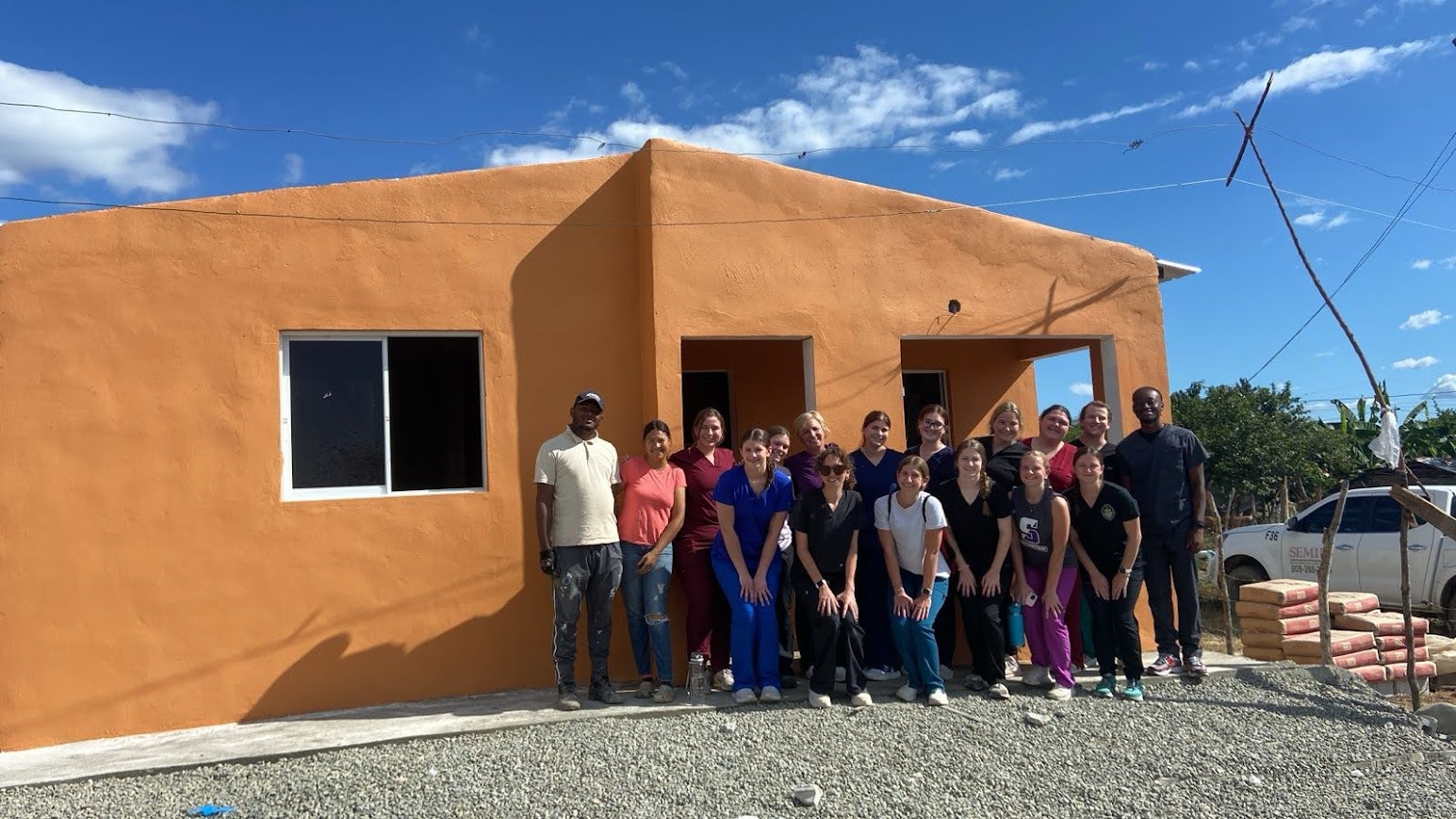
In addition to clinical work, students participated in a five-day house build through the Cambiando Vidas organization, applying principles of body mechanics, accessibility and universal design while contributing to a family’s future home.
Hoffman noted one of the most meaning moments of the experience, on the last day of the house build. “I noticed the couple who were moving in step back and watch the entire process unfold, visibly excited and grateful as they realized this house would be their future," Hoffman said. "Witnessing that moment felt full circle, as it connected our physical labor, teamwork, and service directly to the impact it would have on the family’s life."
The couple receiving the finished house had even participated in the very first build of the Cambiando Vidas organization. Alderfer noted the significance of this moment and their commitment to the community.
"It was very inspiring to me to see all the hard work that they put into their own house and all the other houses, as housing has been something that I have somewhat taken for granted throughout my life," Alderfer said.
Nealon emphasized that experiences like these extend beyond technical skill development and align with the University of Scranton's Jesuit mission.
“Service trips such as this connect both the course objectives and the University’s Jesuit values in a fully immersive experience,” Nealon said. “Students are challenged to reflect upon their own lives and understand the meaning of ‘being for and with others.’”
For many students, the trip reshaped their understanding of service and their future roles as healthcare professionals.
"After this experience, I definitely feel more inclined to look into opportunities with populations in more need of help or in places unknown to me," Alderfer said. "I am learning that the unknown just means there is more to learn!"
Nealon hopes the impact of the trip resonates with both the students and the Dominican communities served.
“This trip serves as a powerful affirmation of human dignity, providing to the people of San Juan de la Maguana, DR, that they are truly seen and valued,” Nealon said. “Our group traveled such a distance to help and learn from families, community members, patients and healthcare providers they had never met. This mutual exchange of knowledge and emotion leaves both groups forever changed."
As the students returned to campus, they brought with them expanded clinical experience and a renewed commitment to service, empathy and culturally responsive care.
Occupational Therapy Students Learn and Serve in Dominican Republic
The University of Scranton’s life-changing, four-year, pre-college program was recently awarded a grant that will help it continue to provide encouragement and academic, cultural and social enrichment to local teenagers who aspire to enroll in colleges and universities.
The University of Success program at The University of Scranton received a $15,000 grant from the Robert H. Spitz Foundation. It was awarded as part of the 2025 spring grant cycle for the Robert H. Spitz Foundation, administered by the Scranton Area Community Foundation. The funds will support promising high school students who can contribute to the community and achieve success with access to post-secondary education.
Created in 1996 and with its first full graduating class in 2001, the University of Success is supported by gifts and grants. The program, which is offered free of charge to selected local students beginning in Grade 9 and continuing through Grade 12, offers mentorship, seminars, test prep and developmental enrichment courses covering a wide range of topics. The University of Success staff closely works with students to keep them on track as they develop skills and confidence and ultimately gain admission to their chosen institutions of higher learning. The 17 University of Success graduates in the Class of 2025 matriculated to 11 colleges and universities, including five at The University of Scranton. Two graduates joined the military to further pursue their education.
The Robert H. Spitz Foundation has awarded more than $6 million in funding to initiatives and programs that serve the people of Lackawanna County and Northeastern Pennsylvania. It was founded in 2015, shortly after the death of Spitz, who was born in Scranton in 1955, graduated from Scranton Central High School and the University of Miami, Florida, and had been employed by the U.S. Department of Labor and owned several local Arby’s restaurants.
Spitz Foundation Awards Grant to University of Success
One of The University of Scranton’s most historic and highest-achieving programs has been awarded a nearly $1 million federal grant.
The University of Scranton’s clinical rehabilitation counseling program will receive a five-year grant, totaling nearly $1 million, from the U.S. Department of Education’s Rehabilitation Services Administration (RSA). The grant, which will provide scholarships to graduate students at Scranton and will also broaden program accessibility through online and hybrid learning formats, was announced Monday, Jan. 12, in partnership with U.S. Representative Rob Bresnahan ’12 through an official press release.
“The University of Scranton plays an important role in preparing students for careers that meet real needs in our communities,” said Rep. Bresnahan in the press release. “That’s why I’m proud to have helped secure this critical funding to expand access to training and help address workforce shortages in rehabilitation and counseling services. I will always fight to bring tax dollars back to Northeastern Pennsylvania to strengthen programs our communities rely on.”
The rehabilitation counseling profession itself was significantly shaped — and in many ways created — by the federal government. It emerged in the early 20th century as a result of injured veterans returning from war and desiring a sense of normalcy. As the demand for these services grew, so, too, did the need for qualified professionals. Because of service demand and concomitant federal commitment to rehabilitation programmatic success, a handful of programs were started at well-established, graduate degree-granting colleges and universities.
Clinical rehabilitation counseling practitioners are charged with helping individuals overcome developmental, emotional, mental and physical disabilities while also encouraging autonomy and removing the social and attitudinal barriers that restrict full participation for people with disabilities.
“As a Catholic, Jesuit institution, The University of Scranton teaches our students and graduates to be ‘for and with others.’ We must not only serve others but stand in solidarity with them,” said Rev. Joseph G. Marina, S.J., University of Scranton president. “The clinical rehabilitation counseling field is a shining example of this Jesuit ideal. Our students are trained to treat — but even more importantly, accompany — individuals as they face emotional, physical and psychological challenges. They work with the underserved and overlooked, treating them with the humanity and dignity they deserve and that ultimately helps them flourish.”
The grant will fund tuition scholarships and increase the pool of highly qualified, master’s-level rehabilitation counselors, thus addressing regional personnel shortages. The degree was previously offered only on-campus, but will now also be offered entirely online or as an on-campus/online hybrid, making it accessible to more students.
Scranton’s nationally recognized rehabilitation counseling program, which offers a Master of Science degree, was established in 1965. It is the second-oldest such program at a Catholic college or university in the U.S.
Since its inception, Scranton’s rehabilitation counseling program has prepared 976 graduates who have gone on to serve people with disabilities in both public and private settings. Data shows rehabilitation counselors are likely to serve 1,500 to 2,500 individual clients in a career, meaning Scranton’s graduates are estimated to have served about 1.5 million clients with disabilities.
In addition to the teaching rooted in Jesuit values and instruction coming from world-class educators, Scranton’s innovative program features state-of-the-art video technology at the David W. Hall Counselor Training Center, which enables students to record counseling sessions with hands-on supervision.
“We are very honored to have received this grant award, as it is a significant validation of the commitment to excellence of those who have built and sustained this program for over 60 years,” said Samantha Herrick, Ph.D., associate professor of counseling and human services and director of the University’s Clinical Rehabilitation Counseling Program. “This grant will allow us to carry forward our mission into the future by increasing capacity and expanding access for qualified applicants with a passion for empowering others to reach their full potential.”
The clinical rehabilitation field offers strong employment rates and salaries, as well as opportunities to engage in meaningful, life-changing work. Additionally, Scranton alumni remain connected to the program long after graduation, evidenced by the 60-year anniversary celebration and reunion held this fall.
The grant will award the University’s program with five payments over a five-year period, totaling $999,909.16.
U.S. News & World Report recently ranked Scranton’s rehabilitation counseling program as No. 2 in Pennsylvania and in the top 50 in the U.S., reflecting its strong reputation across the nation.
Nearly $1 Million Grant Awarded to University of Scranton’s Clinical Rehabilitation Counseling Program
Being the editor of a publication is hard work.
Beyond mapping out the content, proofreading it and laying it out on the page, there are countless editorial decisions and editor-to-writer interactions that determine what is ultimately presented to readers.
It’s a full-time job — in most instances.
However, in the case of academic journals, which engage scholarly subject matter authorities from around the world and serve small but deeply influential audiences, the herculean tasks at the top are often carried out by faculty who already have a full-time gig.
Such is the case for Hank Willenbrink, Ph.D., professor of English and theatre at The University of Scranton, who recently put the finishing touches on his first issue as editor-in-chief of “Ecumenica: Performance and Religion.”
“The major thing I feel is — well, it’s a few things,” Dr. Willenbrink said. “One, I feel immense gratitude to the people who gave up their time to contribute to it, everyone from the editors to the contributors and the peer reviewers. There’s a lot of work that doesn’t get seen and I really feel gratitude to everyone, including David Mason, who was the editor before me and kind of held my hand through so much of this.
“The second thing I feel is: it’s just damn good scholarship. People are really bringing out their A-game. There are a lot of things in it that I find so fascinating. The different pieces speak to each other without knowing it.”
The 122-page special edition, filled with book and performance reviews, essays and roundtable conversations, didn’t come together overnight.
In some ways, it began in 2021, when Dr. Willenbrink’s first contribution was published in “Ecumenica.”
“‘Ecumenica’ was kind enough to work with me on that and it’s really from there that we began a deeper connection,” he said. “About a year ago, they wrote to me and asked if I would be interested in taking on the editor-in-chief role. I said, ‘Yeah. Absolutely.’”
Contributors in the new issue are currently employed at colleges on the West Coast, in the Ivy League and even across the border in Canada.
“The runway for issues like this can be up to two years,” Dr. Willenbrink said. “In this particular case, it was a bit more condensed, partially because of the editorial transition. We were really grinding on this about a year or less than a year.”
Dr. Willenbrink describes “Ecumenica” as existing to probe the intersection between all kinds of performance and religion, two broad categories that open numerous possibilities he hopes to explore further in future issues.
“We’re always accepting people to pitch ideas for contributions or academic essays,” he said. “You know what they say about Motel 6: ‘We’ll leave the light on for you.’ We’ve always got the light on for folks that are interested in writing.”
For more information and to purchase the latest issue of “Ecumenica,” please visit the Scholarly Publishing Collective.
Scranton English and Theatre Professor, Dr. Willenbrink, Edits Magazine
Teaching is a calling.
That’s how Juan Serna, Ph.D., chair of physics and engineering at The University of Scranton, sees it. Dr. Serna earned an undergraduate degree in his native Colombia and master’s and doctoral degrees from the University of Arkansas before arriving at Scranton in 2015 and preparing a new generation of learners and doers.
“I believe, for example, a person who’s a scientist has some kind of obligation to transmit that knowledge to the next generation,” Dr. Serna said. “When you start teaching a class and you notice that the students are responding and you catch their attention, it is amazing. You feel that you are doing something good and really rewarding.”
Dr. Serna then shifts his attention from the interviewer to the two students in his office.
“I believe you’re going to feel the same thing when you are teaching students,” he tells them.
Those two students — James Kane, of White Plains, New York, and Alessandra Bellino, of Schwenksville — are set to become Scranton’s 10th and 11th graduates of the National Science Foundation’s Robert Noyce Teacher Scholarship Program. Since launching at Scranton in 2022, the program has produced highly qualified STEM (science, technology, engineering, mathematics) teachers who participate in workshops, mentorship sessions and other benefits from the program to receive the proper training to work in high-need school districts.
While Kane and Bellino are similar in that they are in the Noyce program and are double majors in secondary education and mathematics, they took different routes to this destination.
“Freshman year, I came in undecided and really had no idea what I wanted to do,” Kane recalled. “I was taking a couple business classes but I couldn’t wrap my head around the idea of working in a 9-to-5. So, I kind of ruled that out.”
Kane then set his sights on teaching. His father is an art teacher in a high-need school in the Bronx, New York, where Kane has participated for years as a youth baseball instructor.
“My dad said, ‘You’re qualified to lead people in some capacity,’” Kane said. “I have an interest in math, too, so he said, ‘That’s probably a good route to go.’ It’s a lot of fun to work with kids and being able to see someone become better at something — it’s just a rewarding feeling.”
Meanwhile, Bellino said she has always wanted to be a teacher.
Working in a high-need school, however, was something that entered her radar through Scranton and the Noyce program. It was an eye-opening possibility for someone who attended Catholic school with a small cohort of classmates.
The Noyce scholarship, which is a nationwide program, supports efforts to recruit, prepare and retain excellent teachers in STEM fields from kindergarten through 12th grade. It provides scholarships, stipends and advanced support resources while funding research on what helps STEM teachers succeed and stay in high-need schools.
As the Noyce program at Scranton enters its final funded year, with a possible extension through 2027, its purpose of inspiring and teaching the next generation of STEM students is clear as ever. And its soon-to-be graduates are prepared to make a difference where it matters most.
“I feel like we really focus on the whole person,” Bellino said, reflecting on the Jesuit values learned at The University of Scranton. “Caring about the person and bringing that into the classroom: not necessarily just being there to teach the student, but being there to take care of the student, as well, if they need something.”
Noyce Scholars Serve Critical Need in STEM Education
Innovation. Design. Education. Application. The IDEA Center at The University of Scranton promotes creativity among students and fosters connections with the community.
In this video, IDEA Center Director Tom Bryan explains some of the possibilities the center offers, including 3D printing, laser engraving, graphic design, and manufacturing equipment, as well as a podcast media studio.
You do not need to be an engineer to create in the space at the IDEA Center, which is located at the University's Robert S '68 and Marilyn A. Weiss Hall. The team there provides instruction, safety training and guidance prior to the use of the equipment or machinery.
Learn more about how the IDEA Center can help bring creative ideas to life. Visit the website to reserve the podcast studio, complete a form to request training or schedule a visit or field trip.
Walk through the IDEA Center in this video interview with Tom Bryan. Then, get all the details at The Scranton Journal website: https://journal.scranton.edu/issues/2025/fall
Need a Workspace for Your Creativity? Visit The University of Scranton IDEA Center at Weiss Hall
The ninth presentation in the Jay Nathan, Ph.D., Visiting Scholar Lecture Series, Jan. 15 at the Loyola Science Center, PNC Auditorium, will welcome the distinguished Ambassador from Finland to The University of Scranton. This special evening will offer the campus and broader community an enriching exploration of Finland's fascinating history, vibrant culture and dynamic economy through the ambassador's presentation.
Following the 5 p.m. lecture, attendees will be treated to an authentic cultural performance showcasing the rich artistic traditions of the Nordic nation. The program will conclude with a reception, providing an opportunity for informal conversation and cultural exchange between the ambassador, performers, students, faculty and community members.
This engaging event continues the lecture series' mission of bringing international perspectives to Scranton while fostering cross-cultural understanding and appreciation for Finland's unique contributions to world history, art, and global commerce.
The performance, lecture and reception are complementary and open to the community, courtesy of the Jay Nathan, Ph.D., Visiting Scholar Endowment.
Jan. 15 Lecture Features Distinguished Ambassador From Finland
Preparing students for the realities of small business internships, The University of Scranton Small Business Development Center (SBDC) recently hosted Small Business Ready, an interactive Internship Readiness Training program for an interdisciplinary cohort of students. The program provided practical exposure to small business operations and guidance from experienced business consultants on the skills needed to succeed in real-world internship settings.
 Funded by a grant from the Appalachian Regional Commission through its Partnerships for Opportunity and Workforce and Economic Revitalization (POWER) Initiative, the program was developed by the SBDC in consultation with small business owners and career development staff. The curriculum introduces students to both foundational small business knowledge and essential professional skills required in internship roles.
Held in the University’s newly opened Robert S. '68 and Marilyn A Weiss Hall, a space designed to foster innovation, entrepreneurship, and experiential learning, the program reinforced the SBDC’s commitment to connecting classroom learning with real-world business application.
During the program, students strengthened their interpersonal communication, problem-solving and professional writing skills while developing an entrepreneurial mindset focused on creativity, confidence and adaptability. Informational sessions covered small business fundamentals, including marketing, accounting and finance, and cybersecurity basics, with learning reinforced through case studies and interactive group activities.
The inaugural cohort of nine students represented a range of academic disciplines, including finance and education, and demonstrated a strong interest in professional growth and community engagement. Upon completion of the final case study, participants will have the opportunity to add a Small Business Ready certificate to their resumes and attend a networking reception with local small business owners.
The Small Business Ready program expands on the SBDC’s successful Small Business Internship Initiative, which connects small businesses with students to provide meaningful experiential learning while supporting day-to-day business operations. The SBDC looks forward to continuing the program to help bridge the gap between student skill sets and the practical needs of small business owners.
SBDC Prepares Students for Small Business Internships
In 2025, The University of Scranton’s student tutor training program, housed in the Office of Student Support and Success, received certification from the internationally recognized College Reading and Learning Association (CRLA), meeting the CRLA rigorous standards and successfully completing its International Tutor Training Program Certification (ITTPC) peer review process.
As part of this work, OSSS created a 10-hour Tutor Training Program tailored to CRLA guidelines. The program is proud to meet CRLA’s high standards for student tutor selection, training, direct service and evaluation
After a tutor completes a 10-hour training program and provides 25 hours of tutoring, they are internationally certified. In spring 2025, the University's Office of Student Support and Success certified 66 tutors and 13 Writing Center consultants, according to Matthew Smith, manager of the Office of Student Support and Success and a Certified Learning Center professional.
Student Tutor Training Program Receives Certification
On Sunday, Jan.18, The University of Scranton will once again host the Greater Scranton MLK Commission’s annual dinner. This event strives to give voice to and emphasize the importance of positive community and racial relations in all aspects of life through education, programming, and special events. It is an opportunity to celebrate the life, legacy and work of Rev. Dr. Martin Luther King, Jr.
The annual celebration and awards dinner will take place on Sunday, beginning at 2:30 p.m. in the University’s DeNaples Center McIllhenny Ballroom.
This year’s program theme is “Where Do We Go from Here: Chaos or Community?” and will feature keynote speakers, U. Melissa Anyiwo, Ph.D., associate professor of history and director of Black Studies at The University of Scranton and Dr. Yerodin Lucas, Ph.D., assistant professor in the School of Social Work at Marywood University. University President Rev. Joseph Marina, S.J., will provide an opening welcome.
The University will sponsor a table; members of the University community interested in attending are directed to contact Julie Schumacher Cohen in Community Relations at julie.cohen@scranton.edu
For more information, visit the event registration page: MLK Commission Annual Dinner details.
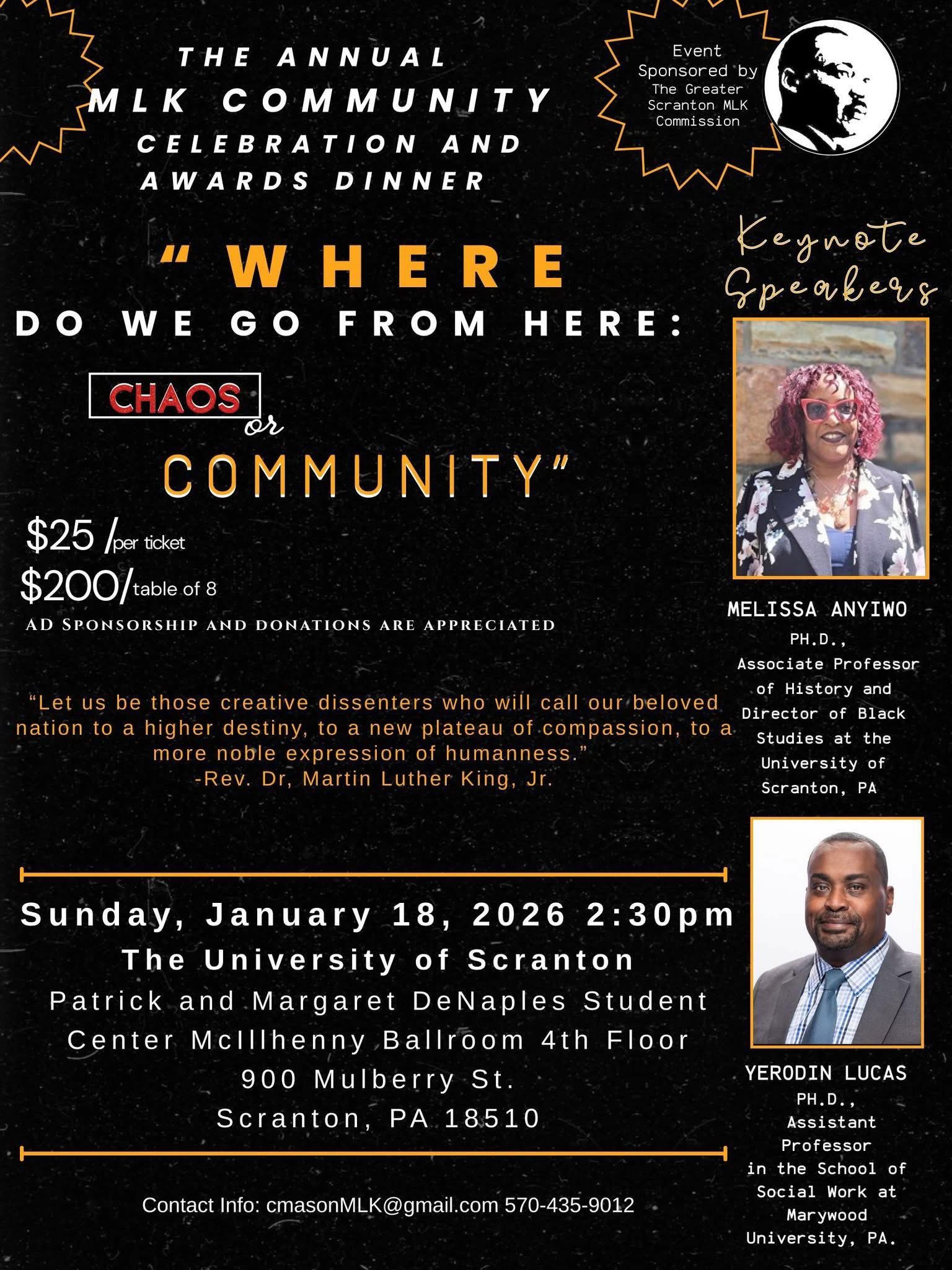
University To Host Greater Scranton MLK Commission Annual Dinner Jan. 18
Julius Marchuska, a senior at The University of Scranton, was awarded the 2025 Immaculata Award through the Diocese of Syracuse. The Immaculata Award, established by Bishop Robert Cunningham in 2011, annually honors dedicated parish volunteers for their selfless service.
Recipients are presented with the Immaculata Medallion during a special Advent ceremony at the Cathedral of the Immaculate Conception. These "unsung heroes" are nominated by their pastors for their exemplary commitment to their church communities, embodying faith through action and inspiring others. Marchuska has served at his parish since 2020, holding roles that include Sacristan, Eucharistic Minister and Usher.
University Senior Receives 2025 Immaculata Award Through the Diocese of Syracuse
In December, alumni, parents and friends of the University in New York, Philadelphia, the Lehigh Valley, Scranton and Washington, D.C., celebrated the holiday season at regional Christmas receptions. See photos from the events below:
University Holds Regional Christmas Receptions
The University of Scranton will hold the 2026 Day of Service on Saturday, April 25. Once again, alumni, parents and friends of the University will gather to serve their communities in a manner that demonstrates the life-changing and enduring power of a Jesuit education.
If you are interested in coordinating a Day of Service site in your region or know of somewhere in your area Royals can volunteer, email Marge Gleason P'14, '17, director of Alumni Engagement, at margery.gleason@scranton.edu by Friday, Feb. 7. For more information, visit scranton.edu/dayofservice.
Save the Date for the Day of Service April 25
The University is planning to hold many exciting alumni events in 2026, and we're asking our alumni who have recently changed their address, email address, phone number or employer to update their contact information so they can continue to connect with their Royal Family. Visit this link today to receive your invitation to our next event.
In With the New: Update Your Contact Information Today To Receive Your 2026 Invitations
The University of Scranton will celebrate Reunion Weekend 2026 from June 5-7. Alumni from class years ending in "1" and "6" will be celebrating their milestone years. Add your name to the "Planning to Attend List" today to let your friends and classmates know you'll be joining the festivities, and check future editions of Royal News for registration information. Visit scranton.edu/reunion for more information.
Save the Date for Reunion 2026 June 5-7
Alumni and friends of The University of Scranton are invited to join a Topgolf outing on Saturday, Jan. 31, from 1–3 p.m. at Topgolf King of Prussia.
The $55 per person registration fee includes Topgolf game play, a live leaderboard, food and soft drinks. No golf experience is required, making the event a fun and relaxed way to connect with fellow Royals.
University To Host Alumni Topgolf Outing in King of Prussia Jan. 31
The University of Scranton invites alumni, parents and friends to a Day of Prayer and Reflection on Saturday, Jan. 24, from 9 a.m. to 4 p.m. at The Retreat Center at Chapman Lake, 287 Chapman Lake Road, Jermyn.
This annual tradition offers participants a chance to pause, reflect and reconnect with their faith and with one another in a serene lakeside setting.
Register Today for a Day of Prayer and Reflection Jan. 24
The University of Scranton Women’s Basketball team will face Susquehanna University on Sunday, January 11, at 2:30 p.m. as part of a full day of Landmark Conference men’s and women’s basketball action at the Palestra in Philadelphia.
Alumni and friends are invited to attend a pre-game reception beginning at noon at Smokey Joe’s, located at 210 South 40th Street in Philadelphia. The $25 reception fee includes an open bar and appetizers. Game tickets are not included with reception registration.
Following the reception, attendees can head to the Palestra to cheer on the Lady Royals in one of college basketball’s most historic venues.
University to Host Lady Royals Pre-Game Reception in Philadelphia Jan. 11
The University will host a reception with Rev. Joseph G. Marina, S.J., University President, on Jan. 21 from 6-8 p.m. at Basking Ridge Country Club, 185 Madisonville Road, Basking Ridge, New Jersey. Register here for the event.
University to Hold Presidential Reception in New Jersey Jan. 21
What's new with you? To submit a Class Note, visit the Class Notes Submission Page.
Maureen Sullivan Gonzales '90, Narberth, earned her Ph.D. in nursing from Widener University.
Ruth Parry G’91, Clarks Summit, had her short story, “Love,” accepted for publication in A Daily Gift of Friendship by Teresa Velardi, marking the first story she submitted for publication.
Jeanne Duggan-Jones '91, Debra Robertson Halpin '92, Tracy Altebrando Young '92, Janine Pierlott-Lacava '92, Colleen Nolan '92, Jennifer DeRobertis Menziuso '92, Mary Katherine Holland McNeill '92, Denise Boudreau '92, Kara Dugan '92, VJ Iannone '92, Jessica Perry Egner '92, Sue Paige Leahy '91, Andrea Miele Killian '92 and Angela DePetris Lewis '92 celebrated their "Double Nickels" birthday together in July 2025 with a long weekend on the Chesapeake Bay. Since graduation, the same group has celebrated past milestone birthdays together in Cape May, New Jersey, and with a weekend cruise to the Bahamas.
Deborah L. Nealon ’13, G’15, Columbia, Maryland, owner of The MBa Group, announced the successful spin-off of the Medical Business Advisory Division of BlueStone Services Solutions, LLC into a new independent firm: The Medical Business Advisory Group, LLC, DBA The MBa Group. The MBa Group is proudly owned by Nealon and headquartered in Columbia, Maryland. Continuing its legacy of trusted expertise, The MBa Group specializes in guiding independent physician practices, hospitals, hospital-based physician groups, Ambulatory Surgical Centers (ASCs), laboratories, and a wide range of other healthcare organizations through today’s complex operational and financial landscape. Please join us in celebrating this exciting new chapter and in welcoming The MBa Group as a continued dedicated partner to the healthcare community.
Vincent Solomeno '07, Red Bank, New Jersey, was appointed by Governor Mikie Sherrill to be the New Jersey Commissioner of Veterans Affairs.
MARRIAGES
Karen Mennella '16 to Michael Klein on November 7th, 2025.
BIRTHS
Stephen '14 and Marissa Schiling Barbuto '14, G'15 welcomed a daughter, Michaela Ruby, in April 2025.
DEATHS
Ronald L. Terranella, Ph.D. '55, South Abington Township
Arthur P. Poli '60, Winchester, Virginia
James J. Grace '61, Springfield, Virginia
Paul J. Angelis, Ph.D.'62, Mequon, Wisconsin
Robert P. Theis '63, Scranton
Richard J. Davidson '68, Dunmore
Dennis T. Harkins '70, Plymouth Meeting
Frederick Bender, Ph.D. '73, Lafayette, New Jersey
Frank B. Kresge G'76, Wind Gap
Patrick P. Mulhern G'76, Tunkhannock
Keith E. Tucker '76, Roaring Brook Township
Jeffrey McDonough '78, Scranton
Valerio J. Ungarini '80, Bristol
Catharine F. Grow G'87, Mount Pleasant
William F. Gil '92, Lewisberry
FRIENDS/FAMILY DEATHS
Peggy Diver, mother of Maureen Diver '90
Alumni Class Notes, Jan. 2026
By Marcus Smith '27, Student Correspondent
Freshman, sophomore and junior students with the highest grade-point averages of their class, each representing one of The University of Scranton’s three colleges, recently received awards for academic excellence.
Recipients of the Frank O’Hara Awards, named in honor of the late administrator who served 53 years at The University of Scranton, were honored at a ceremony held Dec. 3 at the Weinberg Memorial Library. Awards were based on grades from the 2024-25 academic year.
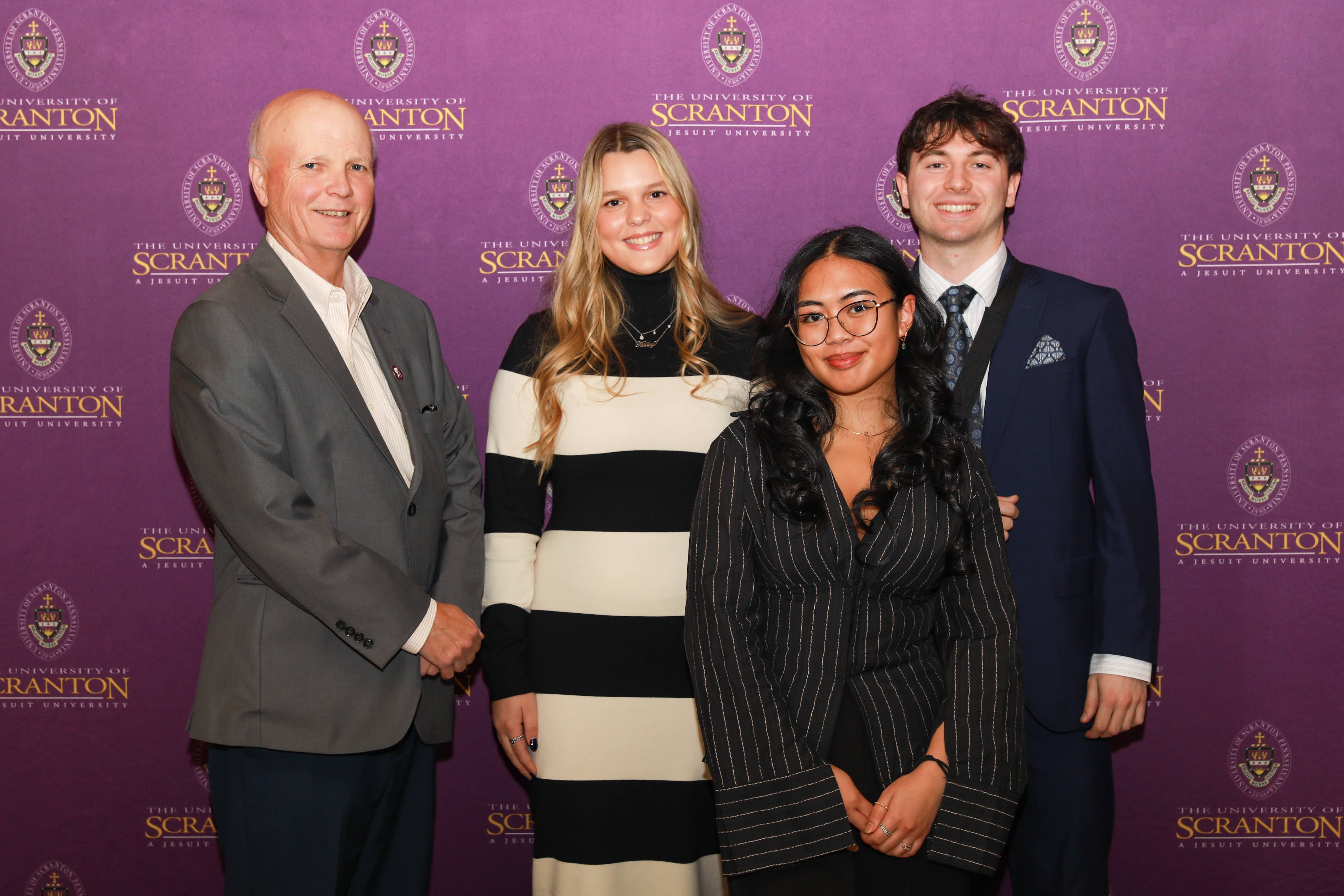
Kania School of Management
Hailey Poskonka, of Dover, New Jersey, received the O’Hara Award for academic achievement for her freshman year in the Kania School of Management. A member of the Frank P. Corcione Business Honors Program, she is currently in her sophomore year at Scranton, where she is pursuing a double major in accounting and business analytics. A dean’s list student, she is a student-athlete on Scranton’s softball team. She is a member of several campus organizations, including business club, Society of Accounting Students, Omega Sigma Beta, Kania Women in Business, the NCAA Student-Athlete Advisory Committee and Kindness for Chemo.
Jessieca Aguasin, of Honesdale, received the O’Hara Award for academic achievement for her sophomore year in the Kania School of Management. A member of both the Frank P. Corcione Business Honors Program and the Robert L. McKeage Business Leadership Program, she is a junior at Scranton, where she is an accounting major. She is a recipient of the University’s full-tuition Presidential Scholarship. She is a member of Kania Women in Business and the Commuter Students Association.
Dean Finan, of Malvern, received the O’Hara Award for academic achievement for his junior year in the Kania School of Management. A member of the Frank P. Corcione Business Honors Program and Robert L. McKeage Business Leadership Honors Program, he is in his senior year at Scranton and is pursuing a double major in finance and business analytics. He is a recipient of the University’s full-tuition Presidential Scholarship. He is a member of the University’s men’s soccer team and its leadership council. He serves as the sector head for Consumer Staples and Industrials at PRISM, the University’s investment club, and as president of the Kania Student Advisory Board.
College of Arts and Sciences
Molly Grove, of Mountain Top, received the O’Hara Award for academic achievement for her freshman year in the College of Arts and Sciences. She is a member of the University’s Special Jesuit Liberal Arts Program and the undergraduate University Honors Program. She is in her sophomore year at Scranton and is pursuing a triple major in history, political science and philosophy. She is a dean’s list student and a recipient of the University’s Dean’s Scholarship and the 2025-26 Sabatino Scholarship for sophomores studying history. She also volunteers with animal shelters and is a contributor and editor for the University’s Esprit literary magazine.
Alexandra Beltre, of Bloomfield, New Jersey, received the O’Hara Award for academic achievement for her sophomore year in the College of Arts and Sciences. A dean’s list student, she is in her sophomore year at Scranton and is pursuing an environmental science: ecology major on the pre-veterinary track. She is the events coordinator for the University’s gaming club, a member of the pre-vet club and a tutor for the Office of Student Support and Success.
Sheila Miller, of Milford, New Jersey, received the O’Hara Award for academic achievement for her junior year in the College of Arts and Sciences. A dean’s list student, she is in her senior year at Scranton, where she is pursuing a double major in journalism and electronic media. She is the secretary of Rho Tau Elta, the Communication and Media Department’s honor society; the vice president of Mulberry Media; and a staff writer for The Aquinas newspaper. She is also a member of Scranton’s HerCampus chapter and a member of the Royal Harmony A Capella group.
Leahy College of Health Sciences
Nicole Schulingkamp, of Harleysville, received the O’Hara Award for academic achievement for her freshman year in the Leahy College of Health Sciences. She is in her sophomore year at Scranton, where she is pursuing an occupational therapy major. She is a member of the University’s women’s soccer team and a member of the Student Athletic Advisory Committee. She is also a member of the Student Occupational Therapy Association and an anatomy tutor.
Olivia Gallione, of Hewitt, New Jersey, received the O’Hara Award for academic achievement for her sophomore year in the Leahy College of Health Sciences. A recipient of the Dean’s Scholarship and Ignatian Award, she is in her junior year at Scranton, where she is pursuing an occupational therapy major. She is a member of the Student Occupational Therapy Association and both the American Occupational Therapy Association and the Pennsylvania Occupational Therapy Association. She is also a teaching assistant and a tutor and volunteers with the Center for Service and Social Justice.
Claudia Campisciano, of Broomall, received the O’Hara Award for academic achievement for her junior year in the Leahy College of Health Sciences. She is in her senior year at Scranton and is pursuing a major in kinesiology with a guaranteed seat in the Doctor of Physical Therapy program. She is a peer health educator for the Center for Health Education and Wellness and is involved with HerCampus.
Marcus Smith '27, Schuylkill Haven, is an English and theatre double major at Scranton.
Students Receive O’Hara Awards for Academic Excellence
University of Scranton accounting chair and professor Douglas M. Boyle, DBA’88, was recently re-elected to serve as chair of the Allied Services Foundation Board of Directors. Allied Services Integrated Health System, which has offices and centers throughout Northeastern Pennsylvania, is a nationwide leader in rehabilitation and elderly care services.
Dr. Boyle has been a member of the board since 2010. He was named chair in 2016.
“We are privileged to have Dr. Boyle reappointed as board chairman for Allied Services Foundation," said Bill Conaboy, Esq., president and CEO, Allied Services Integrated Health System. "Doug’s past professional expertise leading a healthcare company, coupled with his academic credentials and research accolades, make him an invaluable asset as a volunteer leader of our board of directors.
"Our 2,700 employees making a difference in a dozen post-acute, long-term care, human services and home care programs across 55 locations and in countless homes across Northeast Pennsylvania, truly appreciate board members like Doug who understand the critical importance of each program, while balancing the fiscal responsibility and needs of thousands in our region who rely on Allied Services every day.”
An award-winning educator and researcher who’s worked 30-plus years in industry in startup, middle market and Fortune 500 companies, where he has held the positions of board chair, president, Chief Executive Officer, Chief Operations Officer and Chief Financial Officer. He is professor and chair of Scranton’s Department of Accounting and director of its Ph.D. program. He recently ranked No. 2 worldwide for accounting education publication volume in the past six years, according to the Brigham Young University Accounting Research Rankings, which also placed the University No. 1 worldwide for research published by Ph.D. students. He is also ranked No. 1 internationally for research published in leading refereed accounting practitioner journals, according to “The Intersection of Academia and Practice: Publishing in Leading U.S. Accounting Organizations’ Journals,” Issues in Accounting Education (2020). He was honored as the Distinguished Scholar of the Institute of Management Accountants Research Foundation in 2022.
Under Dr. Boyle’s leadership, The University of Scranton’s accounting program in the Kania School of Management was selected as one of the nation’s Best Business Schools by the Princeton Review. U.S. News and World Report recently ranked Scranton’s accounting program top 40 in the nation.